WarBrief Live | November 3, 2026 | Country Profile
France is the European Union’s only nuclear-armed state and, alongside the United Kingdom, co-leader of the multinational force being prepared to support Ukraine after a ceasefire. That combination — an independent nuclear deterrent, a carrier strike group and a deployable expeditionary army — is why Paris is shaping Europe’s post-war security planning for Ukraine. This profile explains what the French armed forces can do, where their limits lie, and what to watch in November 2026.
Key Takeaways
- France co-leads the Multinational Force — Ukraine, supplying 1,100 troops for its first exercise in Poland on November 9–22, 2026.
- Its defence budget is programmed at about €57 billion for 2026, rising to €64 billion in 2027.
- Its nuclear deterrent rests on about 290 warheads, four ballistic-missile submarines and Rafale aircraft, with the new M51.3 missile entering service.
- Euronaval 2026, opening in Paris on November 3, showcases the future carrier France Libre, planned to replace Charles de Gaulle in 2038.
- France’s strength is breadth under national command — but its force is relatively small for its global commitments.
Overview: a complete but compact military
France’s armed forces are all-volunteer, organised into the Army, the Navy, and the Air and Space Force, with the National Gendarmerie as a separate military force largely under the Interior Ministry. Counts vary with whether the Gendarmerie is included: International Institute for Strategic Studies-based counts put active armed forces at roughly 200,000 personnel, with about 43,000 reservists, while totals including the Gendarmerie run higher. France is a founding NATO member and a permanent member of the United Nations Security Council, yet it kept an independent nuclear deterrent and a national capacity to command operations alone or as a coalition leader — the sovereignty of decision that defines its posture.
What are France’s military capabilities?
The Army fields armoured brigades, artillery including the truck-mounted CAESAR howitzer, and airmobile and special-forces elements, with the Foreign Legion as a distinctive long-service component. The Air and Space Force flies the Dassault Rafale as its backbone fighter, with transport, tanker and surveillance support, and operates the air leg of the nuclear deterrent. The Navy operates the nuclear-powered carrier Charles de Gaulle, amphibious ships, FREMM and newer FDI frigates, Barracuda-class attack submarines, and four Triomphant-class ballistic-missile submarines.
Domestic industry is central: Dassault, Naval Group, Thales, Safran, MBDA and KNDS France supply most major systems, giving Paris export leverage — Rafale sales to India, Egypt, Qatar, Greece, Croatia, the United Arab Emirates and Indonesia are the best-known example — but also exposing programmes to delays, as the Franco-German future combat air and ground combat systems have shown.
| Metric | Figure | Note |
|---|---|---|
| Defence budget, 2026 | About €57 billion | Up from €50.5 billion in 2025; €64 billion planned for 2027 |
| Military spending, 2025 (SIPRI) | $68 billion, about 2.0% of GDP | Different methodology from the national budget figure |
| Active personnel | Roughly 200,000 | IISS-based counts; totals including the Gendarmerie are higher |
| Nuclear stockpile | About 290 warheads | Reported estimate; France publishes no exact deployed count |
| Ballistic-missile submarines | 4 Triomphant-class, 16 tubes each | At least one boat is at sea at all times |
| Ukraine exercise contingent | 1,100 troops of about 2,800 | Exercise Koalicja, Poland, November 9–22, 2026 |
Figures above are confirmed by at least two sources listed below; where counting methods differ, the table says so rather than presenting a disputed number as exact.
Alliances and posture: NATO member, national commander
France’s posture is dual-track. Inside NATO it contributes to collective defence, including forces on the eastern flank and air policing, while preserving the freedom to act outside NATO command — most visibly through the Multinational Force — Ukraine, explicitly not a NATO operation with little United States participation. Inside the EU, Paris presses for greater strategic autonomy, a position that has gained traction since Russia’s full-scale invasion of Ukraine. Its deterrent, described as strictly defensive, has no formal extension to allies: it is a national deterrent with alliance effects, not a shared NATO asset.
Current developments: the Ukraine support force takes shape
Exercise Koalicja, the first major exercise of the Multinational Force — Ukraine, runs from November 9 to 22, 2026, in south-east Poland near Nowa Deba, about 100 kilometres west of the Ukrainian border. France and the United Kingdom jointly lead the force, set up in 2025 with an operational headquarters in Paris. About 2,800 troops take part — France 1,100, the United Kingdom 300, with Belgium, Estonia, Germany, Lithuania, the Netherlands, Poland, Spain and Sweden, and Türkiye leading a maritime tabletop element. The exercise tests movement, protection and supply using light equipment such as drones; no tanks or heavy weaponry will deploy, the force has no offensive mission, and it would deploy only after a ceasefire and at Ukraine’s request, without a peacekeeping or ceasefire-monitoring role. Its credibility will be judged on logistics and command, not firepower.
France’s wider Ukraine support runs in parallel: SCALP cruise missiles, CAESAR howitzers and other systems since 2022, and Mirage 2000 fighters in Ukrainian service. In February 2026 the two countries signed a letter of intent on joint arms production, and Ukrainian pilots are due to begin Rafale training in November 2026 under a July 2026 roadmap covering an initial 16 Rafale aircraft, with a November 2025 letter of intent sketching up to 100 over a decade. Those aircraft are not expected in Ukrainian service until 2028 or 2029, so the near-term effect lies in air defence, missiles and training; the wider package’s financing remains partly unresolved.
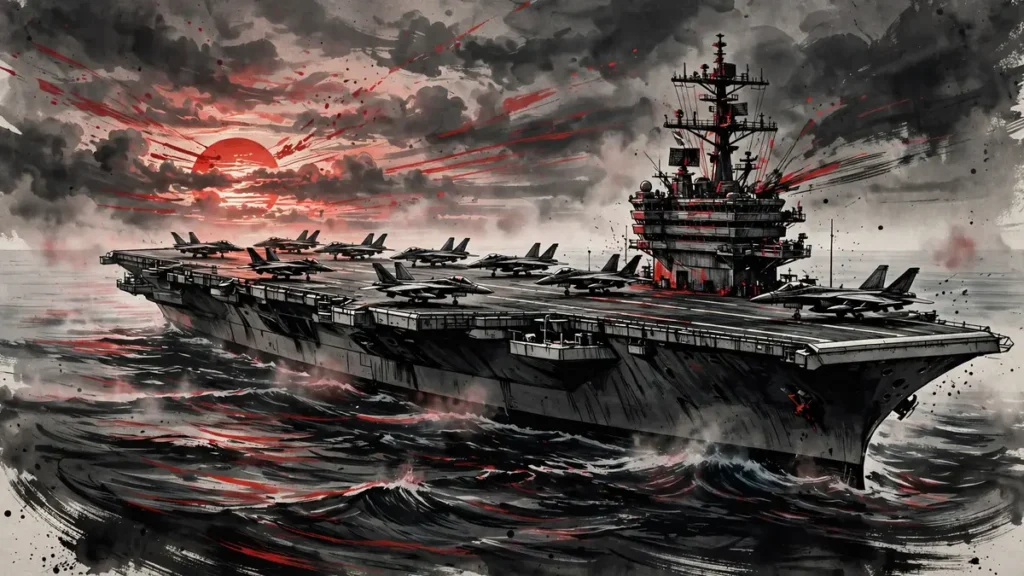
At home, Euronaval 2026 runs from November 3 to 6 at Paris Nord Villepinte, where the Ministry of the Armed Forces presents the future nuclear-powered carrier France Libre, successor to Charles de Gaulle and planned to enter service in 2038, with four missions: nuclear deterrence, large-scale sea control, airborne deep strike, and command of a naval task force. It is a design programme, not a completed ship. On the deterrent, the submarine Le Vigilant fired the new M51.3 missile for the first time from a submarine on October 6, 2026, after a major overhaul. The M51.3, commissioned in October 2025 with the new TNO-2 warhead, is gradually replacing earlier M51 versions, while a successor class, SNLE 3G, is planned for the 2030s.
What to watch next
Three tests follow: whether Koalicja shows the coalition can move and sustain itself; whether the path to €64 billion in 2027 survives France’s wider fiscal pressures; and whether Rafale training and signed contracts turn the July 2026 roadmap into a programme. For US, UK and EU readers, the point is straightforward: France is the ally most likely to lead a European-only mission for Ukraine, but not at scale without partners.
For related profiles, see the Country Profiles hub, the previous France military power profile, and the United Kingdom military power profile.
Frequently asked questions
How large is France’s military?
About 200,000 active personnel on IISS-based counts, plus about 43,000 reservists. Totals including the Gendarmerie are higher.
Is France a nuclear power?
Yes — the EU’s only nuclear-armed state, with about 290 warheads delivered by submarines and Rafale aircraft under national command.
Will French troops deploy to Ukraine?
Not under the current plan unless fighting stops and Ukraine requests it. The force has no offensive, peacekeeping or ceasefire-monitoring role.
What is Exercise Koalicja?
The first major exercise of the Multinational Force — Ukraine, in Poland from November 9 to 22, 2026, testing how about 2,800 troops could support a post-ceasefire force.
When will France’s new carrier enter service?
France Libre is planned for 2038, replacing Charles de Gaulle. It was presented at Euronaval 2026 as a design programme, not a completed ship.
Sources
- Free Malaysia Today: Multinational Ukraine force to hold first exercise in Poland
- Joint Forces: France and UK to lead MNF-U Exercise Koalicja
- Defense News: France updates submarine-launched nuclear missile amid arms race
- Defence Blog: France fires its newest nuclear missile from a submarine
- European Parliament Think Tank: EU Member States’ defence budgets
- MilitarySpend: France Military Spending 2025
- Framatome: Defence expertise at Euronaval 2026
- Army Recognition: France to present future carrier France Libre at Euronaval
- Defense News: France to give Ukraine more cruise missiles, plans security pact
- Zona Militar: France to begin training Ukrainian pilots on Rafale fighters next month