
WarBrief Live | October 23, 2026 | Global Security
A shadow fleet is a network of oil tankers that moves sanctioned crude outside the rules of normal maritime trade — hiding ownership, switching flags, silencing tracking signals, and swapping cargoes at sea so the oil’s origin disappears before it reaches a buyer. Iran’s ghost tankers, which have kept Tehran’s oil revenue flowing for decades, are the oldest and most developed example — and after the October 2026 tanker attacks in the Strait of Hormuz, they are suddenly central to global energy security.
What is confirmed: the fleet exists, it is large (over a thousand tankers by independent broker estimates), it relies on a documented toolkit of evasion methods, and the US Treasury has sanctioned more than 100 Iran-linked shadow-fleet vessels in 2026 alone. What remains unverified or estimated: the exact size of the fleet (no official registry exists, so every figure is an analyst estimate) and the precise volume of Iranian oil currently moving, since much of the trade is deliberately invisible. This explainer separates the confirmed mechanics from the attributed estimates.
Key Takeaways
- A shadow fleet is not a navy — it is a parallel commercial shipping industry of aging, often uninsured tankers that move sanctioned oil for Iran, Russia, Venezuela, and North Korea.
- Its methods are well documented: AIS transponders switched off (“going dark”) or spoofed, ship-to-ship transfers in international waters, flag-hopping between lax registries, shell-company ownership, and falsified cargo documents.
- Independent estimates put the global shadow oil-tanker fleet at roughly 1,140 vessels (broker BRS, August 2025) — more than 18 percent of the world’s oil tankers — though figures vary widely because the trade is deliberately opaque.
- Enforcement is escalating: on October 8, 2026, the US Treasury sanctioned 17 more vessels and 18 firms under “Operation Economic Outcast,” saying the move “effectively neutralizes the vast majority” of Iran’s remaining shadow fleet.
What is a shadow fleet?
The term describes commercial vessels that operate outside the conventional regulatory framework of global maritime traffic, moving sanctioned cargoes — overwhelmingly crude oil and petroleum products — while concealing who owns them, who insures them, and where they actually sail. Analysts also call them the dark fleet, the ghost fleet, or the parallel fleet.
There is no single official definition. In December 2023, the International Maritime Organization agreed on a working definition: ships “engaged in illegal operations for the purposes of circumventing sanctions, evading compliance with safety or environmental regulations, avoiding insurance costs, or engaging in other illegal activities.” The Atlantic Council, whose researchers have tracked the fleet closely, describes vessels that are disproportionately old, typically carry sanctioned cargo, feature opaque ownership, lack insurance from the International Group of P&I Clubs (the protection-and-indemnity associations that cover legitimate shipping), and frequently conceal their movements.
The fleet is not new. The Atlantic Council notes that South Africa used shadow vessels during the apartheid era, and Iran, Venezuela, and North Korea have relied on them for years — Iran for decades. What changed is scale: when Western governments imposed a $60-per-barrel price cap on Russian oil in December 2022, Russia bought hundreds of aging tankers on the secondhand market and the shadow fleet exploded from a few hundred vessels into a parallel industry. Russia has since spent an estimated $14 billion amassing more than 500 tankers, according to maritime intelligence firm Windward’s analysis cited by Trade Finance Global.
How do ghost tankers hide their movements?
The core deception targets the Automatic Identification System (AIS) — the transponder every commercial vessel is required to carry, broadcasting its identity, position, speed, and heading. Ghost tankers manipulate this system in two ways. The simplest is “going dark”: the crew switches the transponder off, creating a suspicious gap in the data that analysts now flag immediately. The more sophisticated method is AIS spoofing — actively falsifying the broadcast so the ship appears somewhere it is not.
Maritime analysts describe several spoofing signatures. One is “circle spoofing,” where the broadcast shows the vessel sailing a perfect geometric holding pattern — generated by software to look busy in safe waters while the ship conducts illicit transfers elsewhere. Another is GNSS manipulation, feeding false satellite-navigation coordinates into the transponder so a tanker can appear docked at a legitimate port while physically loading crude at a sanctioned terminal. Analysts have documented the “Oman Anchor” ruse: a tanker loading crude at Iran’s Kharg Island broadcasts coordinates placing it at anchorage off Fujairah in the UAE, thousands of miles from its true position.
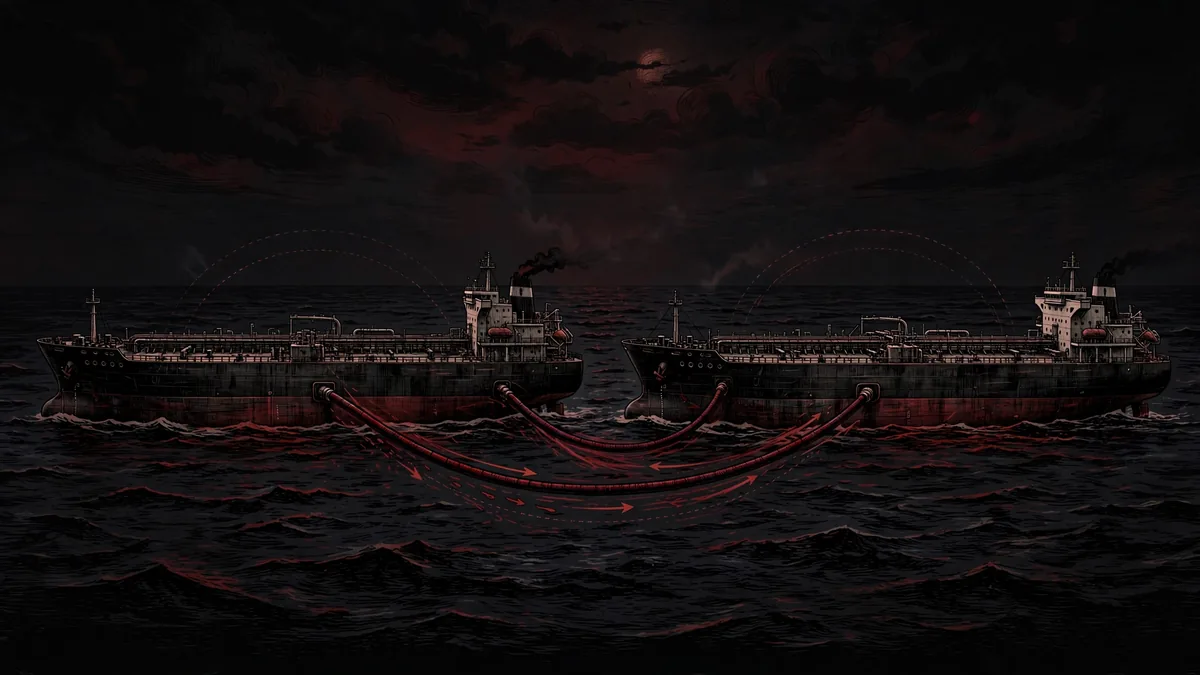
The second pillar is the ship-to-ship (STS) transfer. Instead of delivering oil directly to a port — where customs and inspectors wait — a sanctioned tanker meets a second vessel in international waters, often at night, and pumps the crude across. The cargo may pass through multiple hulls, each transfer mixing or relabeling it, until its origin is effectively unprovable. United Against Nuclear Iran (UANI), an advocacy group that tracks Iranian shipping with satellite imagery, reported at least 39 such transfers in February 2026 alone near the Eastern Outer Port Limit anchorage off Malaysia — attributing about 58.5 million barrels, worth roughly $3.5 billion, to them. Treat that as an attributed estimate, not audited fact: as Homeland Security Today noted in its analysis of the data, successive transfers can involve the same oil, so barrel counts can be overstated.
The ghost tanker’s toolkit: flags, shells and false paperwork
Beyond electronic deception, the fleet launders its identity on paper. Flag-hopping is the simplest layer: a vessel re-registers between flag states with minimal oversight — Panama, Cameroon, Palau, Comoros, Gabon, the Gambia, Sierra Leone, Vanuatu — sometimes multiple times in a single year. Each reflagging creates a new paper identity and outruns regulatory blacklists. The US Treasury’s October 2026 designations listed sanctioned tankers flagged in the Bahamas, Panama, Hong Kong, Mongolia, Zanzibar, Cameroon, Comoros, Gambia, Palau, San Marino, Sierra Leone, and Vanuatu.
Ownership is buried under shell companies in permissive jurisdictions — the Marshall Islands, Hong Kong, Dubai, the Seychelles, the British Virgin Islands. Treasury identified the designated vessels’ owners and managers as spread across more than a dozen jurisdictions, including mainland China, Hong Kong, the United Kingdom, and the Marshall Islands. The false-flag problem is measurable: in a February 2026 assessment, maritime intelligence firm Windward identified roughly 430 tankers engaged in Iranian trade, describing about 62 percent as falsely flagged and 87 percent as already sanctioned. Analysts also document vessels physically renaming themselves, reflagging mid-voyage, and in some cases adopting the identity of scrapped ships — programming a dead vessel’s maritime identity number into an active tanker so it sails as a ghost of a ghost.
Then come the false documents: falsified bills of lading that misstate the cargo’s origin, forged insurance certificates, and manipulated port-clearance papers. As the Treasury’s Office of Foreign Assets Control (OFAC) describes it, successive transfers, falsified cargo documents, and manipulated AIS data work together to separate the ship that presents the cargo at its destination from the ship that actually loaded it in Iran — so checking only the final carrier leaves the earlier chain unresolved.
The economics make the system self-sustaining. The vessels are old and cheap — some 60 percent of large oil tankers engaged in sanctions evasion are over 20 years old, according to Windward data — bought from European owners eager to offload aging hulls. They sail without proper P&I insurance, which makes them ticking environmental risks: old hulls, no credible insurer, transponders off, and no one clearly liable if they break up or spill. Sweden’s Coast Guard boarded and seized the tanker Kiwala in the Baltic Sea on February 14, 2026 — its AIS off for stretches of the voyage, its cargo’s origin undisclosed, its insurance certificate fake — in what analysts described as the first seizure of a shadow-fleet tanker by a European nation.
By the numbers: the shadow fleet
No official registry of shadow vessels exists, so every size figure is an analyst estimate — and they vary widely. Here is what the major sources report, labeled as confirmed or attributed.
| Metric | Figure | Source |
|---|---|---|
| Shadow oil tankers worldwide | 1,140 (over 18% of the global oil tanker fleet) | Broker BRS estimate, August 2025, via Atlantic Council (CONFIRMED attribution) |
| Tankers in the “opaque market” since Jan 2021 | More than 1,600 | Atlantic Council report, December 2024 (CONFIRMED attribution) |
| Vessels loading Iranian crude in 2025 | 251 | Tanker-tracking data via Times Now (REPORTED) |
| Vessels carrying Russian oil in 2025 | 510 | Tanker-tracking data via Times Now (REPORTED) |
| Iran’s crude exports, trailing 12 months to Mar 2026 | ~1.61 million barrels per day, 94% via Kharg Island | Kpler, via Homeland Security Today (CONFIRMED attribution) |
| STS transfers off Malaysia, Feb 2026 | 39, attributed ~58.5 million barrels (~$3.5 billion) | UANI via Homeland Security Today (REPORTED — attributed estimates, not audited) |
| Iran-linked shadow-fleet vessel sanctions in 2026 | More than 100 | US Treasury, via Homeland Security Today (CONFIRMED) |
| Vessels + firms designated Oct 8, 2026 | 17 vessels, 18 firms | US Treasury press release (CONFIRMED) |
| Share of large evasion tankers over 20 years old | 60% | Windward data, via Trade Finance Global (REPORTED) |
Caveat: fleet-size figures are analyst estimates, not counts from any official registry — different methodologies produce different totals (analyst estimates for the broader dark fleet range from several hundred to over 3,000 vessels). Treat REPORTED figures as attributed claims from the named source, not independently verified facts.
Why shadow fleets matter for fuel prices
The shadow fleet cuts both ways for energy markets. On one side, it keeps sanctioned crude flowing to buyers — mainly China’s independent “teapot” refiners, and historically India — at steep discounts. One consultancy estimated Iran was shipping 1.65 to 1.80 million barrels per day in early 2026, nearly all to Chinese buyers, at discounts to Brent that had widened to roughly $14–$17 per barrel. That discounted trade acts as a pressure valve: it keeps barrels in the market that sanctions were designed to remove.
On the other side, the fleet’s methods raise costs and risks for everyone else. Aging, uninsured tankers sailing dark through congested waters like the Strait of Hormuz push up war-risk insurance premiums for legitimate shipping — costs that ultimately land in freight rates and pump prices. And when the invisible trade becomes visible — through seizures, sanctions waves, or attacks like the October 2026 Hormuz tanker incidents covered in WarBrief’s breaking analysis — markets price in the disruption instantly. Brent crude surged past $103 a barrel earlier in October 2026 on Hormuz escalation fears.
The deeper dynamic: enforcement is now squeezing the valve shut. Treasury Secretary Scott Bessent said Iran loaded effectively zero new crude onto tankers in September 2026, linking the collapse to “Operation Economic Outcast” — and tanker-tracking data showed no new Iranian loadings since mid-August. Every barrel removed from the shadow trade is a barrel the legal market must replace — at market price, not the sanctions discount. That is the mechanism by which a sanctions campaign against ghost tankers can end up at your gas station.
What shadow fleets mean for US/UK/EU readers
First, your fuel bill. The United States, the UK, and the EU are net consumers of refined products priced off Brent. When enforcement or conflict disrupts shadow-fleet flows — or when attacks in Hormuz spook the whole shipping market — the price signal reaches the pump within weeks, and with winter approaching in the Northern Hemisphere, heating costs follow. The sanctions discount never reached Western consumers; the price spikes do.
Second, your coastline. Shadow tankers sail European waters constantly — Russia’s fleet moves through the Baltic, the North Sea, and the English Channel. These are old, poorly maintained, often uninsured vessels running without transponders in some of the world’s busiest sea lanes. A breakup or collision would leave European taxpayers and coastal states, not the shell-company owners in the Marshall Islands, holding the cleanup bill.
Third, your security. The fleet is the financial engine of sanctioned states: it funds Iran’s regional operations, Russia’s war in Ukraine, and North Korea’s weapons programs. Treasury’s stated goal for Operation Economic Outcast — announced August 24, 2026, and dubbed “Economic D-Day” — is to starve Tehran of what Bessent called “the money it uses to wage war in the region.” Whether you view that campaign as effective pressure or market distortion, the shadow fleet is where sanctions policy meets real-world geopolitics. The WarBrief sanctions desk tracks every designation wave as it lands.
What to watch next in the tanker cat-and-mouse game
Four developments will shape the shadow fleet’s future, roughly in order of immediacy. 1. The blockade effect. With Iran loading zero new crude in September and roughly 67 million barrels of floating storage accumulated by mid-August, watch whether Tehran can rebuild its tanker network or whether the export halt holds — that is the live test of Operation Economic Outcast. 2. Enforcement technology. Analysts are shifting from AIS-only tracking to “visual intelligence” — satellites, radar, and AI spotting hulls that have gone dark — which could erode the fleet’s main advantage. 3. The IMO crackdown. The IMO’s 2023 definition gave regulators common language; watch for flag-state registries (Panama, Cameroon, Palau) facing real pressure to delist ghost vessels, as Sweden’s seizures suggest enforcement appetite is growing. 4. The spill risk. The longer the fleet runs on 20-plus-year-old uninsured hulls, the more likely a major incident becomes — and a single large spill could trigger the kind of port-state crackdown that reshapes the trade overnight. For the sanctions-policy backdrop, see our evergreen guide How Do Oil Sanctions Work? and our analysis of naval blockades vs sanctions.
Frequently asked questions
What is a shadow fleet?
A shadow fleet — also called a dark fleet, ghost fleet, or parallel fleet — is a network of commercial oil tankers that moves sanctioned cargo outside normal maritime rules. The vessels use opaque ownership, flags of convenience, disabled or spoofed tracking signals, and ship-to-ship transfers at sea to hide the origin of their cargo. The largest such fleets serve Iran, Russia, Venezuela, and North Korea.
How do ghost tankers hide their movements?
They switch off their AIS transponders (“going dark”), spoof AIS signals to appear in false locations, conduct ship-to-ship transfers in international waters so the cargo changes hulls before reaching port, hop between lax flag registries, bury ownership in shell companies, and falsify cargo documents. The combination makes the oil’s origin nearly unprovable by the time it reaches a refinery.
How big is the shadow fleet?
Estimates vary because no official registry exists. Broker BRS estimated 1,140 shadow oil tankers in August 2025 — more than 18 percent of the global oil tanker fleet. The Atlantic Council reported over 1,600 oil and product tankers had operated in the “opaque market” since January 2021. Some analyst estimates run higher; treat every figure as an estimate from the named source.
Who buys oil from the shadow fleet?
Overwhelmingly China — particularly independent “teapot” refineries in Shandong Province — and, for Russian crude, India at various points. The oil sells at steep discounts to global benchmarks (Iranian crude at roughly $14–$17 below Brent in 2026, per consultancy estimates), which is the economic incentive that keeps the trade alive despite sanctions risk.
Is it illegal to sail with AIS switched off?
Switching off AIS violates international maritime safety rules (SOLAS requires it for most commercial vessels), and doing so to evade sanctions can trigger designation by the US Treasury’s OFAC — as happened to more than 100 Iran-linked vessels in 2026. On October 8, 2026, Treasury sanctioned 17 more vessels and 18 firms under Operation Economic Outcast, warning that “no enabler of Iranian sanctions evasion is safe.”
Sources
- US Treasury: Operation Economic Outcast Neutralizes Iranian Regime’s Remaining Shadow Fleet Network (Oct 8, 2026)
- Atlantic Council: The shadow fleet is undermining the maritime order more brazenly than ever
- Homeland Security Today: Why maritime enforcement must look beyond Iran’s shadow fleet and sanctioned tankers (Oct 9, 2026)
- Business Standard: How sanctioned oil travels the world through shadow fleets and fake flags
Discussion 0
Share analysis, corrections, or context. Be civil — comments are moderated.