
WarBrief Live | October 15, 2026 | Conflict Zones
Yemen’s Houthi rebels fired missiles at the Maashiq presidential palace complex in Aden on Thursday, October 15, 2026, in a rare direct strike on the seat of the country’s internationally recognized government. Two security guards were killed, officials told The Associated Press and Reuters, while the prime minister and cabinet members present inside the complex escaped unharmed. The Houthis quickly claimed responsibility, saying they had targeted a Saudi military operations headquarters on the palace grounds — a claim news agencies said they could not independently verify. This explainer breaks down what happened in the Aden palace strike, what is confirmed so far, and why the attack marks a dangerous escalation in Yemen’s reignited war.
Key Takeaways
- Missiles struck the Maashiq presidential palace complex in Aden on October 15, 2026 — a rare direct Houthi attack on the seat of Yemen’s internationally recognized government.
- Two security guards were killed and six wounded, according to officials cited by the AP and Reuters; the prime minister and cabinet were unharmed.
- The Houthis claim they hit a Saudi military operations headquarters and weapons depots inside the complex; Reuters and the AP could not independently verify the target claim.
- The strike widens a campaign that has already hit Saudi airports and oil infrastructure this month, and the Houthis warn more attacks are coming.
What happened in the Aden palace missile strike?
On Thursday morning, residents of Aden heard at least six loud explosions near the Maashiq Palace, according to witnesses cited by the AP. A security official said at least two blasts landed on the hill near the palace itself and two more near the security gate. Smoke rose over the complex, and residents in nearby neighborhoods fled their homes and shops in panic, witnesses said.
Yemen’s government said the Houthis attacked with missiles and drones, the Aden-based SABA news agency reported. Information Minister Moammar al-Eryani said five missiles were fired at the complex, where the prime minister and cabinet members were present. Three witnesses had earlier told Reuters they heard loud booms in the vicinity of the palace.
The Houthis wasted no time claiming the attack. The Houthi-run Saba news agency, citing a military official, said the group had targeted a military operations headquarters run by Saudi officers at the complex, along with weapons depots. The group’s military spokesperson, Yahya Saree, framed the strike as part of a declared policy:
“Targeting Saudi military build-ups wherever they are.” — Houthi military spokesperson Yahya Saree, via Reuters
Reuters said it could not independently verify the Houthi claims about what was hit. That verification gap matters: the Yemeni government describes the target as its presidential palace and seat of government, while the Houthis describe it as a Saudi military facility. Both descriptions can contain a grain of truth — the palace complex houses the government and, in wartime Aden, a heavy security and military presence.
By the numbers: what is confirmed so far
| Metric | Figure | Source |
|---|---|---|
| People killed | 2 (CONFIRMED) | Reuters (two government officials); AP (one official) |
| People wounded | 6 (REPORTED) | AP (one official, anonymous) |
| Missiles fired | 5 (REPORTED) | Information Minister Moammar al-Eryani, via Reuters |
| Explosions heard | At least 6 (REPORTED) | Witnesses, via AP |
| Alternate casualty toll | 4 killed, 10 wounded (REPORTED — conflicts with above) | Government military sources, via regional outlets |
Caveat: casualty figures in the first hours of an attack often shift as officials verify them. The two-killed figure is the only one confirmed by two separate wire services; treat the rest as provisional.
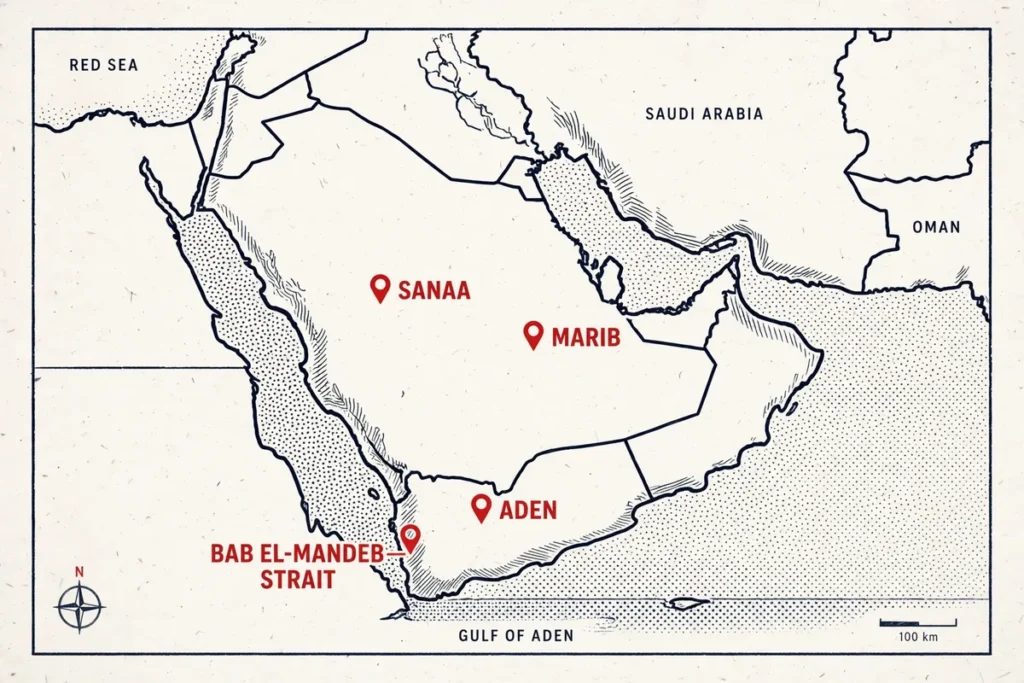
What is Maashiq Palace, and why does Aden matter?
Maashiq Palace is the presidential palace complex in Aden’s Crater district, set on a hilltop above one of the region’s great natural harbors. Since the Houthis seized the capital Sanaa, the palace has served as the seat of Yemen’s internationally recognized government — the interim capital from which the prime minister and cabinet attempt to run a country largely controlled by their enemies. Many of Yemen’s government leaders live in exile, the AP noted, making the officials who do work from Aden both symbolically and practically important.
Aden itself is one of the most strategic ports in the Middle East. It sits just east of the Bab el-Mandeb strait, the narrow chokepoint through which Red Sea shipping passes into the Gulf of Aden — a lane the Houthis have repeatedly threatened during the wider regional war. A strike on the government’s seat in Aden is therefore an attack on two things at once: the political legitimacy of Yemen’s recognized government, and the security of a port city the world depends on for trade. See our country profiles and conflict zones hubs for the broader picture.
Timeline: how the Yemen war reignited in 2026
- July 2026: Yemen’s years-long truce collapses and the civil war flares back to life, according to regional reporting. The Houthis launch a lightning offensive, seizing swathes of strategic territory along the Red Sea coast.
- Early October 2026: The Houthis launch repeated missile and drone attacks on targets inside Saudi Arabia, including airports — see our coverage of the Houthi airport attacks in Saudi Arabia and the Riyadh airport attack.
- October 4, 2026: Yemen’s government launches a major offensive against the Houthis.
- October 10, 2026: The Saudi-led coalition strikes 136 Houthi targets in retaliation.
- October 13, 2026: The Saudi-led coalition warns civilians to evacuate the Yemeni Oil Company’s Al-Sabahah Central Station in Sanaa ahead of a planned military operation, regional outlets report.
- October 14, 2026: Houthi spokesperson Yahya Saree claims strikes on Saudi Aramco facilities and Riyadh’s King Khalid International Airport using ballistic and cruise missiles and drones. These are Houthi claims and have not been independently verified.
- October 15, 2026: Yemeni government forces say on social media that the Houthis fired “several ballistic missiles” at the central city of Marib, in an oil-rich region — an unverified claim. Hours later, the Maashiq Palace strike hits Aden.

Why the Aden palace strike changes the war’s calculus
Until Thursday, the Houthi campaign of October 2026 had mostly struck outward — at Saudi airports, oil infrastructure, and airspace. The Maashiq Palace attack turns the guns inward, onto the seat of Yemen’s own internationally recognized government. The AP called it a rare attack on the palace area, and rarity is the point: striking the compound where the prime minister and cabinet were sitting is a decapitation-risk message, not just another frontline exchange.
For the Yemeni government, the symbolism cuts deep. Minister of Youth Nayef Saleh al-Bakri told Al Arabiya that all cabinet ministers in Aden were unharmed and insisted the government would not leave the city — a statement that only makes sense if staying was suddenly in question. For the Houthis, the strike demonstrates reach: if they can put missiles onto the government’s headquarters in Aden, few fixed sites in the south are safe.
The attack also complicates efforts to end the wider regional war. As the AP noted, the escalation comes as diplomacy around the broader Iran war is already fragile, and it further rattles markets watching a region where Saudi Arabia — one of the world’s top oil exporters — faces repeated attacks on its infrastructure and now, by extension, on its Yemeni ally’s seat of power.
What the Aden attack means for US/UK/EU readers
Travel: The Houthis have renewed warnings to international airlines that Saudi airspace and airports are unsafe. The AP reports thousands of flights across the kingdom have already been disrupted by the escalation. If you are flying to, from, or over Saudi Arabia or Yemen, check your airline’s latest advisories and expect possible rerouting or delays.
Energy and shipping: The fighting sits astride two of the world’s critical energy corridors — the Red Sea/Bab el-Mandeb lane off Yemen’s coast and the Gulf routes the wider Iran war has already disrupted. Escalation near Aden adds risk to Red Sea shipping, which can feed through to fuel and freight costs over time. This is context, not financial advice: markets price in disruption risk, and this strike adds to it.
Security: The strike shows the regional war’s habit of jumping categories — from cross-border missile exchanges to an attack on a seat of government. For Western readers, the practical takeaway is to treat official travel advisories for Yemen and the wider region as live documents, not background reading.
Different claims: how each side frames the strike
The Yemeni government frames it as an attack on the presidency itself: missiles fired at the Maashiq Palace complex, the headquarters of the internationally recognized government, killing guards and endangering the cabinet. Its message, via ministers al-Eryani and al-Bakri, is defiance — the government stays in Aden.
The Houthis frame it as a legitimate military operation: a strike on a Saudi-run military operations headquarters and weapons depots, part of a declared policy of hitting Saudi military deployments wherever they are. Saree has paired the claim with warnings that airports and oil installations remain targets and that operations against Saudi territory will continue — all Houthi statements, none independently verified.
The fog of war: casualty figures already conflict (2 killed per Reuters/AP versus 4 killed per some regional outlets citing military sources), and the true nature of the target — palace, military HQ, or both — cannot be confirmed from outside. Treat every number and every target claim from Thursday as provisional until independently verified.
What to watch next in Yemen and the Red Sea
- Retaliation: the Saudi-led coalition warned earlier this week of a planned operation around Sanaa’s Al-Sabahah station; the palace strike gives Riyadh every incentive to answer forcefully.
- Houthi follow-through: Saree has warned that strikes on Saudi airports and oil installations will continue in the coming days — watch Riyadh’s King Khalid airport and Aramco sites.
- The government’s footing in Aden: ministers say they will not leave, but a second strike on the palace compound would test that promise.
- Aviation: whether airlines expand reroutes around Saudi airspace as the Houthi warnings harden.
- Marib: the reported ballistic-missile fire at the oil-rich central city — if confirmed, it signals a multi-front Houthi offensive, not a one-off strike.
Frequently asked questions
What is Maashiq Palace?
Maashiq Palace is the presidential palace complex in Aden’s Crater district, set on a hilltop above the harbor. Since the Houthis seized Sanaa, it has served as the seat of Yemen’s internationally recognized government and the country’s interim presidential headquarters.
Who was killed in the Aden palace strike?
Two security guards were killed, according to officials cited by both Reuters and the AP, and six people were wounded according to the AP. Some regional outlets citing government military sources reported four killed and ten wounded — a conflicting figure that has not been confirmed by the wire services. The prime minister and cabinet members were unharmed.
Why did the Houthis attack the Aden palace?
The Houthis say they targeted a Saudi military operations headquarters and weapons depots inside the complex, as part of their declared policy of striking Saudi military deployments wherever they are. The Yemeni government describes the same event as an attack on its presidential palace and seat of government. The exact nature of the target has not been independently verified.
Did the Houthis attack anywhere else on Thursday?
Yemeni government forces said on social media that the Houthis also fired several ballistic missiles at Marib, a strategic oil-rich city in central Yemen. That claim has not been independently verified.
How does the Aden strike affect flights and travel?
The Houthis have warned international airlines that Saudi airspace and airports are unsafe, and the AP reports thousands of flights across Saudi Arabia have already been disrupted by the escalation. Travelers should check airline advisories and official travel guidance before flying to or over the region.
Sources
- Associated Press: 2 killed in explosions near palace used by Yemen’s government in latest Houthi attack
- Reuters via Haaretz: Houthis attack Yemen’s presidential palace, government officials say
- Reuters via Jerusalem Post: Houthis target Yemen’s presidential palace in Aden with missiles, PM unharmed
- The Tribune (ANI/Al Arabiya): Houthi forces attack Yemen’s Al-Maashiq presidential palace in Aden
- Khaleej Times: Houthi attack on presidential palace in Yemen’s Aden kills 4, govt sources say



Discussion 0
Share analysis, corrections, or context. Be civil — comments are moderated.