
WarBrief Live | October 24, 2026 | Analysis
Last updated: October 24, 2026. We update this guide when major AI-military developments break.
AI and nuclear weapons is one of the most consequential intersections of technology and security. As artificial intelligence enters military decision-making — from early-warning interpretation to intelligence analysis — experts are split on the most basic question: will AI make nuclear war less likely or more likely? Both outcomes are plausible, and this guide lays out the strongest arguments on each side, the policies governments are adopting, and what the evidence supports.
One framing note: this article is about today’s machine-learning AI, not artificial general intelligence or superintelligence — neither of which is a confirmed capability. All speculative scenarios are labeled as such. For the scenario-focused analysis of how AI could trigger escalation, see our companion deep-dive, Could AI Trigger a Nuclear War?
Key Takeaways
- In December 2025, the UN General Assembly adopted its first resolution on AI risks in nuclear command and control (A/RES/80/23), calling for human control and oversight over all such systems.
- The case that AI could reduce risk: better information and decision tools in crises, fewer human errors, and new possibilities for arms-control monitoring and verification.
- The case that AI could increase risk: compressed decision time, automation bias, misinterpretation, and feedback loops between adversaries’ machine-speed systems.
- The US Senate’s FY2026 defense bill would ban AI from launching nuclear weapons or using lethal force without a human deciding — but no comparable international treaty exists.
What is nuclear command and control, and where does AI fit in?
Nuclear command, control, and communications — abbreviated NC3 — is the system of people, procedures, and technology through which a nuclear-armed state detects threats, decides whether to respond, and communicates orders. It includes early-warning satellites and radars, secure communications, and the decision processes at the top of the chain. No nuclear-armed state publicly admits to letting AI make launch decisions, and all major powers say a human must remain involved.
AI enters NC3 around the edges rather than at the launch button: interpreting satellite imagery and radar returns, fusing intelligence from many sources, assessing force readiness, forecasting escalation, and protecting communications from cyberattacks. The policy analysis outlet iStrategies argues this is where the real debate should focus — not on an algorithm authorizing a launch (a red line everyone publicly maintains), but on the AI that never touches the launch button yet shapes everything around it: early-warning interpretation, adversary-intent analysis, and recommendations presented to leaders under crushing time pressure.
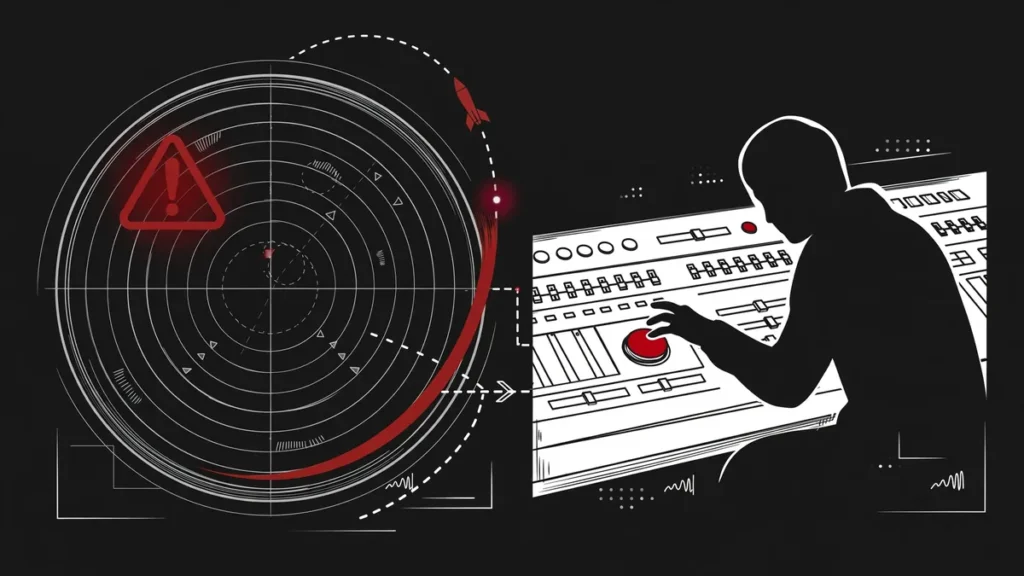
The danger of false alarms is not theoretical. In 1983, Soviet early-warning systems wrongly reported a US nuclear attack; only human judgment — the famous decision by duty officer Stanislav Petrov — prevented a potential escalation. That incident predates modern AI by decades, and it is exactly why analysts worry about adding faster, more confident automated systems into the same decision chain.
Could AI reduce the risk of nuclear war?
The optimistic case has serious backing. The United Nations University notes that machine learning could give nuclear-armed states better information and decision-making tools in time-critical situations, reducing miscalculation and accidental escalation. If leaders receive more accurate, less ambiguous information — and have more time to consider it — the odds of a catastrophic mistake could fall.
Human error is the other pillar. Automation could reduce the nuclear close calls caused by human mistakes, cognitive bias, and fatigue, according to the Bulletin of the Atomic Scientists. Senior US officials — including former Strategic Command chief General John Hyten — have emphasized AI’s potential role in improving early warning, predicting adversary behavior, and protecting NC3 communications from cyberattacks.
Perhaps the strongest risk-reducing application is verification. The Bulletin’s December 2025 analysis outlines constructive, low-stakes uses of AI: flagging unusual patterns in open-source data on missile tests and exercises, improving the consistency of information used in diplomatic exchanges, and supporting shared analysis of past crises to clarify escalation pathways. For arms control, AI could help process monitoring data, improve nuclear material accounting, and strengthen verification regimes — tools that become more valuable as traditional treaties erode. Our companion piece on AI battlefield intelligence examines the same sensing revolution at the tactical level.
Could AI increase the risk of nuclear war?
The pessimistic case is equally well grounded — and it is the side governments are acting on most urgently. The UN General Assembly’s December 2025 resolution warned that AI-driven decision-making in NC3 “could reduce human control and oversight, increasing the possibility of induced distortions in decision-making environments and shortened action and response windows, particularly when related to the most sensitive and critical stages such as decision to launch.”
Speed is the core mechanism. Nuclear decision timelines are already measured in minutes; AI that compresses the analysis cycle could give leaders less time to think, not more — pressuring them to launch in response to false or manipulated information. The resolution specifically cited AI’s technical limitations — the potential for malfunction, exploitation or intrusion, automation bias in training data, and “hallucinations and flawed, inaccurate or misleading outputs” — warning these could produce “serious and catastrophic outcomes such as the accidental, unintended or unauthorized use of nuclear weapons.”
Analysts add subtler dangers. Automation bias — the tendency to defer to a machine’s confident recommendation under time pressure — could hollow out the “human in the loop” every policy document promises. AI systems on both sides could create feedback loops, where each side reacts to increasingly machine-generated representations of what the adversary is doing. ICAN, the Nobel-winning disarmament campaign, assesses that the risks of unintended escalation and reduced human control currently outweigh perceived benefits — an advocacy position, but one reflecting genuine expert concern.
What are governments doing about AI and nuclear weapons?
Diplomacy is moving, though unevenly. The UN General Assembly’s December 2025 resolution — the first of its kind — demands that, pending the total elimination of nuclear weapons, human control and oversight be maintained over NC3 systems, including those integrating AI. In November 2024, the United States and China affirmed the need to maintain human control over decisions to use nuclear weapons, a notable bilateral commitment between the two leading AI powers.
In Washington, legislators are writing guardrails into law. The Senate-passed version of the FY2026 National Defense Authorization Act would prohibit AI systems capable of initiating nuclear warfare or lethal force without explicit human approval — via Senator Elissa Slotkin’s AI Guardrails Act (S.4113) and Senator Kirsten Gillibrand’s Secure and Accountable Military AI Act. These build on the 2023 Block Nuclear Launch by Autonomous AI Act and the Pentagon’s Directive 3000.09, which requires appropriate human judgment over the use of force.
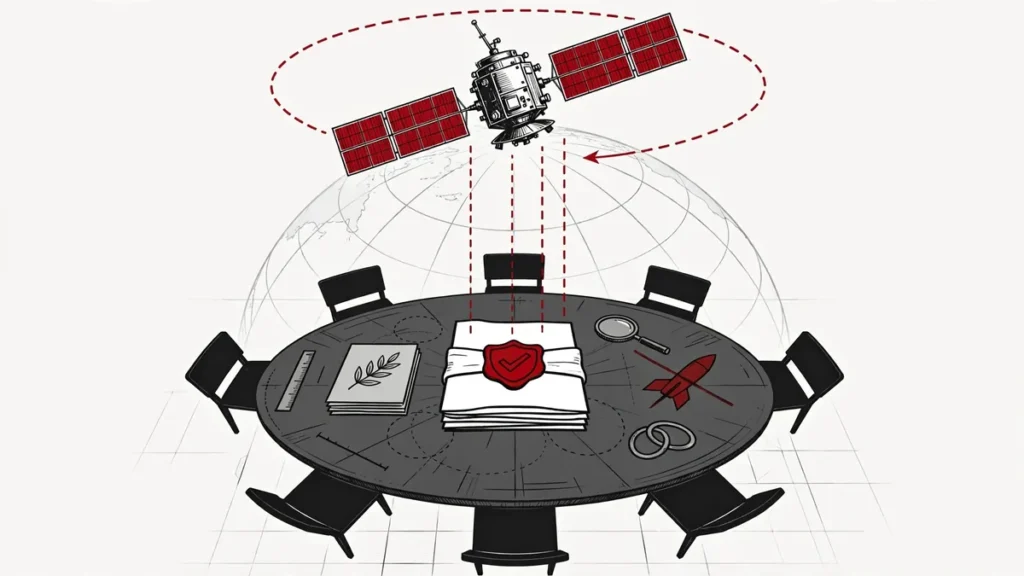
But governance gaps remain glaring. At the 2026 Nuclear Non-Proliferation Treaty Review Conference, specific language on AI-related nuclear risks was removed from the final draft outcome document. A Global Assembly of Nobel Laureates, convened by the International Physicians for the Prevention of Nuclear War at the Vatican in July 2026, warned that AI integration with nuclear weapons systems “is already well underway” and “compounds and heightens” the risk. There is no binding international treaty governing AI in NC3 — a question examined further in our analysis of superintelligence and national security. For the strategic-stability implications of advanced AI, see also superintelligence and the balance of power.
By the numbers: AI and nuclear weapons
| Metric | Figure | Source |
|---|---|---|
| UNGA resolution on AI in NC3 adopted | December 2025 (A/RES/80/23) | UN General Assembly via Bulletin of the Atomic Scientists — CONFIRMED |
| US–China affirmation of human control over nuclear use decisions | November 2024 | iStrategies — CONFIRMED |
| Global Nobel Laureates Assembly on AI and nuclear war | July 16, 2026, Vatican/Castel Gandolfo | IPPNW — CONFIRMED |
| Share of world nuclear weapons held by US and Russia | ~90% | IPPNW (Dr. James Muller) — CONFIRMED (attributed statement) |
| Senate FY2026 NDAA ban on AI nuclear launch without human oversight | Passed Senate version | NDAA reporting — REPORTED (final enacted status unconfirmed) |
| Soviet false-alarm incident | 1983 (Petrov) | UN University — CONFIRMED (historical) |
Caveat: CONFIRMED items are documented in official texts or reputable outlets. REPORTED items rely on secondary reporting of legislative status, which may change.
Why this matters beyond the battlefield
Nuclear risk is not abstract for anyone. The difference between the optimistic and pessimistic AI scenarios is measured in decision time — minutes — and in whether leaders in a crisis receive accurate, well-contextualized information or confident-sounding, machine-generated misreadings. For readers in the US, UK, and EU, the practical stakes include the stability of deterrence that has prevented great-power war for eight decades, and the credibility of the arms-control architecture that is visibly fraying.
There is also a less discussed dimension: the same AI capabilities that could destabilize NC3 — better sensing, better analysis, better verification — could also be what rebuilds trust between nuclear-armed states. Whether AI becomes a force for nuclear stability or instability will depend less on the technology itself than on the governance choices being made now: human-control commitments, transparency, dialogue tracks, and whether the AI-risk language stripped from the 2026 NPT outcome finds its way into future agreements.
Frequently asked questions
Does AI control nuclear weapons?
No. No nuclear-armed state publicly admits to letting AI make launch decisions, and the US, China, France, the UK, and Pakistan have all endorsed human control over nuclear use decisions in various forums. The debate concerns AI’s growing role in the systems around the decision — warning, intelligence, and analysis — not an AI launch button.
Could AI cause an accidental nuclear war?
Experts consider it a real risk: AI could misinterpret data, compress decision time, or be manipulated, and human operators may over-trust confident machine outputs. The December 2025 UN resolution warned of exactly this scenario. But it is a risk of miscalculation and misperception, not of AI “deciding” to start a war.
Could AI make nuclear weapons safer?
Possibly. Proponents argue AI could reduce human errors in warning systems, give leaders better information and more time in crises, and improve arms-control verification through better monitoring. The United Nations University and the Bulletin of the Atomic Scientists both outline plausible risk-reducing applications.
What laws govern AI and nuclear weapons?
As of 2026, governance is mostly national and voluntary: the US Senate’s FY2026 defense bill would ban AI-initiated nuclear launches without human oversight, and the Pentagon’s Directive 3000.09 requires human judgment over force. Internationally, the December 2025 UN resolution calls for human control but is not a binding treaty.
What was the 1983 Petrov incident?
In September 1983, Soviet early-warning satellites wrongly reported incoming US nuclear missiles. Duty officer Stanislav Petrov judged the warning a false alarm and did not report it up the chain, preventing a possible retaliatory response. It is the canonical example of how automated warning systems can fail — and why human judgment matters.
Sources
- Bulletin of the Atomic Scientists: AI is changing biological and nuclear risks
- Bulletin of the Atomic Scientists: Lessons from the UN’s first resolution on AI in nuclear command and control
- United Nations University: AI and Nuclear Weapons — Promise and Perils
- iStrategies: Preserving Strategic Stability as AI Enters Nuclear Decision Making
- IPPNW: Global Nobel Laureates call for abolition, noting AI integration risks
- ICAN: Will AI increase the risk of nuclear war?
- NDAA reporting: Senate bans AI from launching nuclear weapons without human oversight
- Bulletin of the Atomic Scientists: Keeping humans in the loop is not enough
Discussion 0
Share analysis, corrections, or context. Be civil — comments are moderated.