WarBrief Live | October 7, 2026 | AI & Future Warfare
The AI Russia-Ukraine war has turned Europe’s largest conflict since 1945 into the world’s most important military experiment. Both sides now deploy AI at scale: FPV drones that navigate on their own when jamming kills their radio link, machine-vision systems that pick their own targets, automated gun turrets defending a capital city, and a Russian strike — documented by The New York Times in August 2026 — in which a drone appears to have selected and killed civilians with no human making the final decision. Analysts now call Ukraine the AI laboratory of modern warfare.
Key Takeaways
- A July 6, 2026 Russian drone strike in Zaporizhzhia is the first documented case of an AI-selected target killing civilians — the drone carried an Nvidia Jetson Orin module and no antenna, per The New York Times’ August 24 investigation.
- Ukraine deployed AI-guided counter-drone turrets in Kyiv, with first claimed Geran-5 intercepts on October 5, 2026.
- A CSIS assessment from April 2026 describes Russia reaching “functional independence at the tactical edge” — narrow AI functions in platforms, without comprehensive autonomous warfare.
- Germany committed roughly €1 billion in military aid plus multi-billion-euro joint drone and radar programs during Chancellor Merz’s October 4, 2026 Kyiv visit.
- Northrop Grumman’s YFQ-48A Talon Blue flew fully autonomously for the first time on October 3, 2026.
How did the Russia-Ukraine war become an AI laboratory?
Two forces converged in Ukraine. First, cheap consumer hardware: a first-person-view drone costing a few hundred dollars can destroy a tank costing millions, and commercial AI chips small enough to ride inside can navigate and recognize targets on board. Second, an electronic-warfare environment so dense that remote pilots are often jammed — pushing both sides to put the decision-making inside the drone. The result: autonomous and semi-autonomous functions are now ordinary, from terminal guidance on onboard cameras to target recognition and GPS-jamming-resistant navigation. Military drones have evolved from surveillance tools into the war’s central strike weapon, and AI is the accelerant.
Definitions matter. An AI-assisted weapon uses algorithms to help a human decide; a semi-autonomous system executes a human’s target choice; a fully autonomous weapon selects and engages targets with no human in the loop. Ukraine is the laboratory because the war pushed weapons across those boundaries in public, with wreckage open to forensic analysis.
What happened in Zaporizhzhia?
On July 6, 2026, a Russian drone struck a gas station in Zaporizhzhia, killing three civilians: Tetiana Bubynets, a 19-year-old accounting student, Oleksiy Svirin, 41, and Roman Karpiy, 48. Ukrainian investigators found a Russian Molniya fixed-wing attack drone equipped with an Nvidia Jetson Orin minicomputer — and no communications antenna. According to The New York Times’ investigation, published August 24, 2026, the drone flew without radio control: operators programmed it toward a general area, and its onboard AI then searched for an object matching a target profile — most likely propane tanks — and selected the exact point of impact itself. The drone clipped an apartment building and detonated near people sheltering nearby.
Analysis of the unencrypted chip reportedly found stored terrain imagery and signs of pre-training for specific facility types. Nvidia confirmed the recovered module was a Jetson Orin — a consumer product not sold directly to Russia but widely available through resellers. Ukrainian intelligence has also found the same module in other Russian weapons, including the V2U drone and the S-71M Monochrome cruise missile. Experts describe this as the first documented case of a Russian self-targeting drone causing civilian deaths — the moment autonomous weapons stopped being theoretical. Russia has not commented.
An April 2026 CSIS assessment, summarized by Strategy International, argues Russia is moving toward “functional independence at the tactical edge”: narrow AI functions — reconnaissance, target recognition, navigation in jammed environments, drone interception — embedded directly into battlefield platforms. CSIS’s key distinction: Russia does not need American-style frontier AI to get military value. A cheap drone that recognizes a propane tank and keeps navigating when jammed is already a useful weapon. The ethical questions have been debated for a decade; Ukraine is where they became operational.
(see our explainer on autonomous warfare)
How are drones and AI fighting each other?
Ukraine’s answer to Russia’s drone campaign has itself become automated. Ukrainian electronic warfare — radio-frequency jammers that overwhelm the signals drones use to navigate — was the dominant short-range defense from 2022 through 2024. Russia’s response was to remove the radio link: fiber-optic-guided attack drones unspool a thin glass cable as they fly, carrying control signals as light pulses. No electromagnetic frequency to flood means no jamming — the immunity is physics.
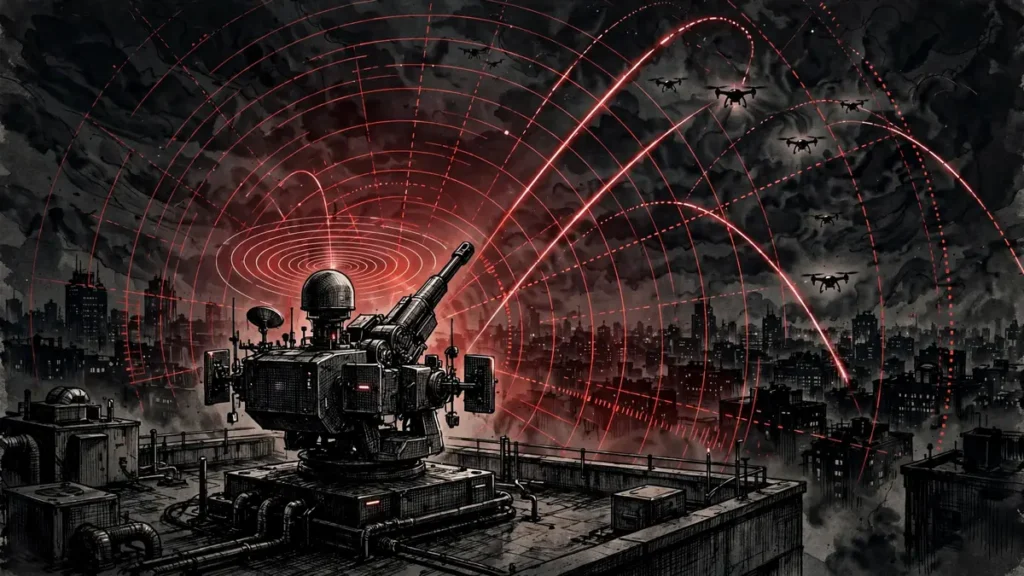
So Ukraine changed the game again. On October 5, 2026, Ukrainian manufacturer UFORCE deployed AI-guided autonomous gun turrets across Kyiv — the first deployment of autonomous kinetic anti-drone turrets at scale inside a capital city, according to Tech Times — and Ukraine’s Air Force recorded its first claimed intercepts of Russia’s faster jet-powered Geran-5 drones the same day. Treat the “first capital-city” framing as manufacturer-adjacent reporting rather than independently verified doctrine, but the direction is unmistakable: machines now intercept machines.
What is the West doing about military AI?
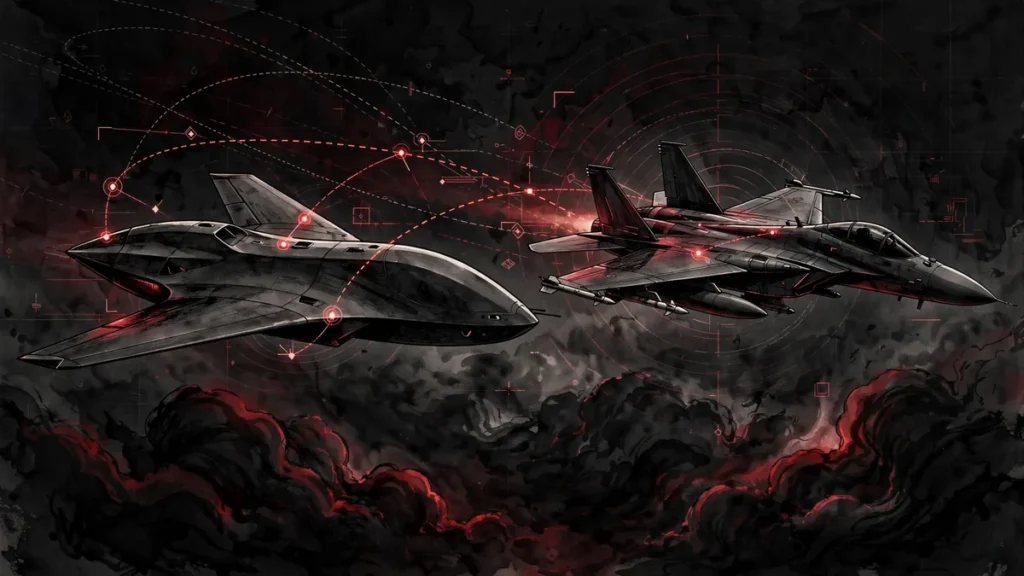
The US is accelerating its own autonomy. On October 3, 2026, Northrop Grumman’s YFQ-48A Talon Blue — an unmanned “loyal wingman” combat aircraft — completed its first fully autonomous flight at the Mojave Air and Space Port in California, with taxi, takeoff, maneuvers and landing all flown with no pilot. The company-funded aircraft is positioning for the Air Force program’s second increment, while Anduril’s FQ-44A “Fury” and General Atomics’ FQ-42A “Vengeance” already hold first-increment production contracts. Air Force leadership wants at least 500 collaborative combat aircraft in service by 2032.
Europe is industrializing its response. During his surprise October 4, 2026 visit to Kyiv, German Chancellor Friedrich Merz announced roughly €1 billion in military aid — including turbojet-powered drone interceptors, standoff weapons and space-based technology — alongside defense agreements worth roughly €6.6 billion per German officials (President Zelenskyy put the total above €8.5 billion across 15 agreements, a discrepancy worth noting). The packages center on the AI-era kit: interceptor drones, counter-drone radars, and joint production of Ukrainian drone technology in Germany. The industrial logic is the real story: the war is now won by whoever redesigns and mass-produces fastest.
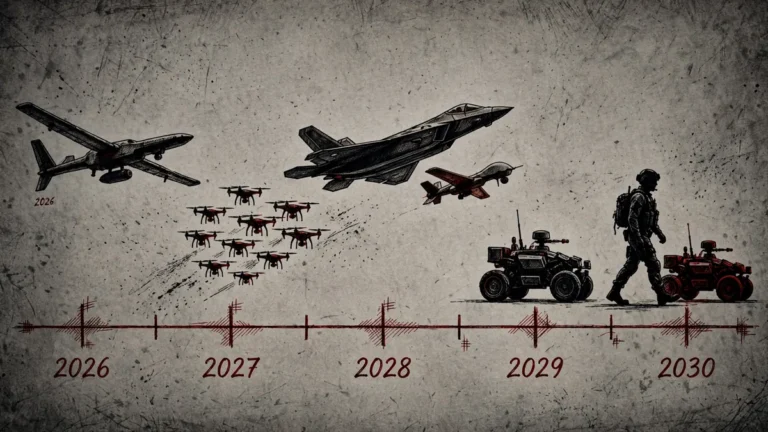
Read next: the future of war — what warfare in 2030 could look like.
What are the lessons for NATO?
Five lessons are emerging for NATO. First, autonomy is driven by jamming: the denser the electromagnetic environment, the more decisions migrate onto the weapon itself. Second, commercial supply chains are now weapon supply chains: consumer AI chips inside Russian strike drones make export controls a counter-proliferation tool. Third, counter-drone is now an AI problem: cheap interceptors and autonomous turrets are displacing missiles costing a hundred times more. Fourth, the human-in-the-loop debate is no longer academic. Fifth, industrial speed beats peak performance: a drone obsolete in six months still wins if fielded in two.
The cyber dimension of the Russia-Ukraine war — intelligence theft, grid attacks, information operations — is covered in WarBrief’s analysis of cyber warfare lessons from the conflict, which this article complements rather than repeats.
(see also our analysis of Trump’s AI war strategy)
AI in the Russia-Ukraine war: by the numbers
| Metric | Figure | Source | Status |
|---|---|---|---|
| Civilians killed, Zaporizhzhia gas station strike | 3 (July 6, 2026) | The New York Times, Aug 24, 2026 | CONFIRMED |
| Autonomous US combat aircraft planned | 500+ by 2032 | USAF via Air & Space Forces | CONFIRMED |
| German military aid package to Ukraine | ~€1 billion (Oct 4, 2026) | Breaking Defense | CONFIRMED |
| German-Ukrainian defense agreements | ~€6.6B (German officials) / >€8.5B (Zelenskyy) | Guardian via Breaking Defense; Zelenskyy | CONFIRMED (figures differ) |
| Interceptor drones planned by Quantum WIY | “Tens of thousands” | Quantum Systems statement | REPORTED |
| Kyiv AI turret Geran-5 intercepts | First claimed Oct 5, 2026 | Tech Times / UFORCE | REPORTED |
Caveat: CONFIRMED = two or more independent sources; REPORTED = a single source chain, treat with caution.
What this means for US/UK/EU readers
The AI laboratory in Ukraine is a rehearsal for the wars NATO might fight. The Zaporizhzhia precedent means the first fully autonomous civilian killings have already happened — in Europe, near NATO territory — and the diplomatic response will shape the rules under which Western forces operate. For American taxpayers, the Talon Blue flight and the 500-aircraft plan mean the Pentagon is converting Ukrainian lessons into procurement now. For European readers, Germany’s Kyiv package shows the continent shifting from donating stockpiles to co-producing AI-era weapons.
What to watch next
Whether the October 2026 interceptor programs blunt Russia’s Geran campaign this winter — and how the UN’s lethal-autonomous-weapons experts respond to the Zaporizhzhia evidence as their mandate window closes.
Frequently asked questions
How is AI being used in the Russia-Ukraine war?
Both sides use AI for drone navigation and target recognition, machine-vision terminal guidance, and increasingly for autonomous target selection when jamming severs radio links. Ukraine deploys AI-guided counter-drone turrets; Russia fields drones with onboard AI modules such as the Nvidia Jetson Orin. It is the most intensive real-world test of military AI to date.
Has an autonomous weapon killed civilians in Ukraine?
According to a New York Times investigation published August 24, 2026, a Russian Molniya drone that struck a Zaporizhzhia gas station on July 6, 2026 — killing three civilians — carried an Nvidia Jetson Orin module and no communications antenna, and appears to have selected its own target. Ukrainian investigators conducted the forensic analysis; Russia has not commented. Experts describe it as the first documented case of its kind.
What is the difference between AI-assisted and autonomous weapons?
AI-assisted weapons use algorithms to help a human decide. Semi-autonomous systems execute a human’s targeting choice without a human flying the weapon. Fully autonomous weapons select and engage targets with no human in the loop. The Zaporizhzhia drone crossed into the third category, according to investigators.
Can Russia’s fiber-optic drones really not be jammed?
Not by radio-frequency jammers: they carry control signals as light pulses through a glass cable, so there is no electromagnetic frequency to attack. They can still be shot down, which is why Ukraine moved to automated gun turrets and interceptor drones.
What is NATO learning from the AI laboratory?
That dense jamming pushes autonomy onto the weapon; that commercial AI chips are now a proliferation concern; that cheap AI interceptors are displacing expensive missiles; and that industrial speed matters more than peak performance.
Sources
- SOFX: Autonomous Russian drone equipped with Nvidia chip kills 3 civilians (reporting The New York Times investigation, Aug 24, 2026)
- Breaking Defense: Germany pledges $1.1B military aid package to Ukraine (Oct 5, 2026)
- Air & Space Forces Magazine: Northrop’s Talon Blue CCA makes first flight (Oct 5, 2026)
- Strategy International: The current state of Russian military AI (summarizing CSIS, Sept 2026)
- Tech Times: Ukraine AI turrets shoot down Geran-5 (Oct 6, 2026)
- WarBrief Live: Cyber warfare in the Russia-Ukraine conflict