WarBrief Live | October 5, 2026 | Breaking Analysis
The latest Caribbean boat strike has pushed one of the most controversial US military campaigns of the decade past a grim milestone. On October 4, 2026, US Southern Command announced it had destroyed a suspected drug-smuggling vessel in the Caribbean Sea, killing all four people on board — the 71st such strike since the campaign began in September 2025, according to independent tallies.
Key Takeaways
- US Southern Command said Joint Task Force Western Hemisphere carried out a “lethal, kinetic strike” on a go-fast vessel in the Caribbean on October 4, killing four people it described as “narco-terrorists.”
- The military cited “confirmed intelligence” of drug trafficking but released no evidence, names, or details of what the vessel was allegedly carrying.
- Independent tallies put the campaign at 70–71 strikes and 235–238 people killed since September 2025, with no public evidence presented for any individual strike.
- Human rights groups and UN experts call the strikes unlawful extrajudicial killings; a US federal judge ordered the administration to hand over its secret legal memo for court review on September 30.
Related: US military operations intelligence · active conflict zones · country-by-country security profiles
What happened in the October 4 Caribbean boat strike?
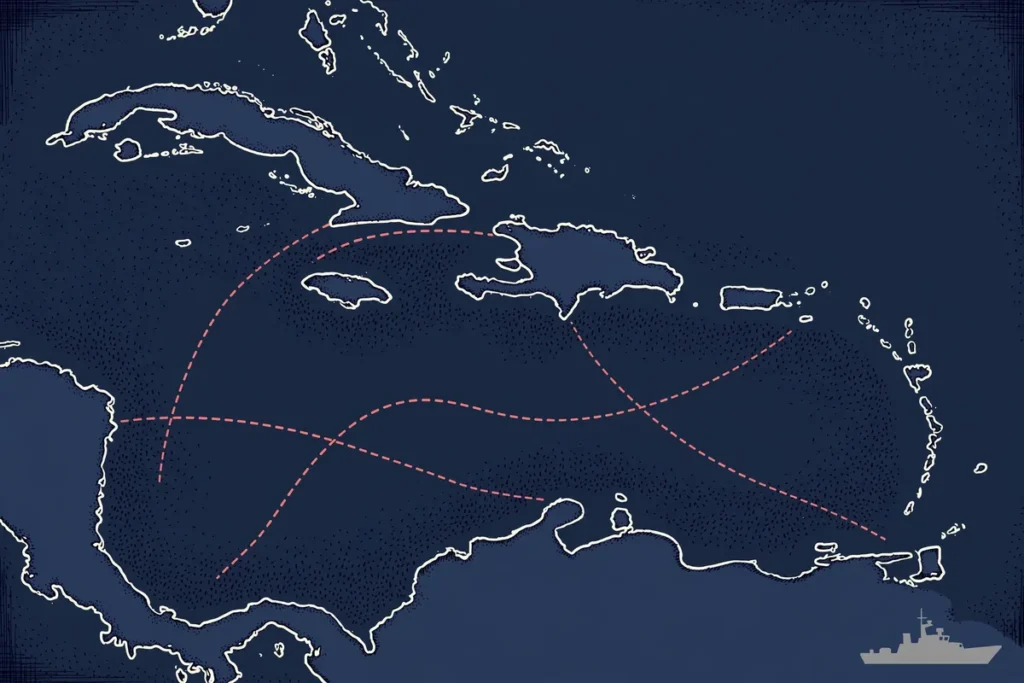
On October 5, 2026, US Southern Command (SOUTHCOM) announced on X that, a day earlier, “under the direction of US Southern Command, Joint Task Force Western Hemisphere executed a lethal, kinetic strike on a go-fast vessel operating along established narco-trafficking routes in the Caribbean.” The statement said “confirmed intelligence revealed the vessel’s active involvement in narco-trafficking” and that “the operation killed four narco-terrorists.”
The military also released video footage that appeared to show an explosion destroying the moving boat. As with previous strikes, SOUTHCOM did not identify the four people killed, did not say what drugs — if any — were aboard, and did not publish the intelligence it cited. Reuters reported the strike on October 4, noting it was the latest in a series of attacks Washington says target “narco-terrorists” but which human rights experts condemn as extrajudicial killings.
The Trump administration has maintained since September 2025 that the vessels it strikes were transporting narcotics toward the United States, arguing that drug cartels pose a direct threat to American lives and that the US is engaged in an armed conflict with “narco-terrorists.” The Pentagon has consistently refused to release the identities of those killed or to provide evidence of drugs on board any of the targeted vessels.
How many boat strikes has the US carried out since 2025?
The campaign’s scale is documented by three independent tallies, which differ slightly in methodology. All three agree the death toll is in the hundreds:
| Metric | Figure | Source |
|---|---|---|
| Total strikes since September 2025 | 71 (CONFIRMED by timeline; AP tally counts “at least 70”) | Just Security / AP |
| Total killed | 238, including 23 missing/presumed dead (Just Security); 235+ (AP tally); 220+ (Reuters) | Just Security / AP / Reuters |
| Killed in the October 4 strike | 4 (CONFIRMED by SOUTHCOM) | US Southern Command |
| Known survivors across the campaign | 3 | Just Security |
| Evidence of drugs published for any strike | None disclosed publicly | Reuters / NY Post |
| Identities of the dead released | None | NY Post |
Figures marked CONFIRMED are stated by the source cited; tallies differ because some counts include missing/presumed-dead cases. All figures reflect reporting through October 4, 2026.
Are the US boat strikes legal?
This is the central unanswered question of the campaign. The administration’s legal justification rests on a secret Office of Legal Counsel (OLC) memorandum that purports to authorize lethal strikes on civilians in boats the government asserts are carrying drugs. On September 30, 2026, a federal judge in the Southern District of New York ordered the administration to provide that memo for in camera (private, judge-only) review and to identify every person who has had access to it — a significant escalation in judicial scrutiny, according to Just Security’s timeline of the strikes.
The critics are blunt. Human Rights Watch, Amnesty International, and independent UN experts have called the strikes unlawful extrajudicial killings. Ben Saul, the UN special rapporteur on human rights and counterterrorism, has said there are “reasonable grounds to believe” the attacks “constituted crimes against humanity of murder under customary international law,” Reuters reported. The American Civil Liberties Union has described the administration’s assertions about its targets as “unsubstantiated, fear-mongering claims.”
Domestic political scrutiny has also grown. Democrats — and some Republicans, including Senator Rand Paul of Kentucky — have raised concerns about killing people without due process and the risk of killing innocent people. The administration, for its part, shows no sign of slowing: it has instead pushed for broader cooperation with Latin American countries to take the fight against organized crime onto land.
Different perspectives
The administration frames the campaign as wartime self-defense: cartels are designated terrorist organizations, their boats are legitimate military targets, and interdiction at sea saves American lives from fentanyl and cocaine. Supporters argue that traditional Coast Guard interdiction has failed to stem the flow of drugs and that only military-grade deterrence works.
Legal scholars and rights advocates counter that drug smuggling, however serious, is a law-enforcement problem, not an armed conflict — and that the US is killing unidentified people on the basis of secret intelligence with no judicial review, no public evidence, and no accountability for errors. They note that the government has never demonstrated, in any single case, what a destroyed vessel was carrying.
Regional governments in Latin America and the Caribbean have been largely quiet in public, but the campaign’s expansion onto land — which Washington is now seeking — would test that silence, raising sovereignty questions across the hemisphere.
What this means for US/UK/EU readers
For US readers, the stakes are constitutional as much as strategic: a federal court is now privately reviewing the secret legal memo behind a campaign that has killed more than 230 people without trial. Whatever the court decides could define the limits of presidential war powers for a generation. Congressional pressure is building on both sides of the aisle, and the midterm elections on November 3 give voters a direct say.
For UK and EU readers, the campaign matters because it is rewriting the rules of maritime interdiction that European navies also practice — in the Mediterranean, the Red Sea, and the English Channel. If lethal strikes on suspected smugglers become accepted state practice, European governments will face pressure, and legal challenges, to follow or to condemn. The UN special rapporteur’s “crimes against humanity” language also raises the prospect of international legal proceedings that could eventually touch allied intelligence-sharing arrangements.
For travelers and shippers, the immediate practical effect is a growing US military footprint across the Caribbean and Eastern Pacific, with expanded patrols, temporary maritime security zones, and the possibility of the campaign moving onto land in partner countries.
What to watch next
- The OLC memo: what the federal judge does after reviewing the administration’s secret legal justification in private — and whether any of it becomes public.
- The land expansion: whether Latin American governments agree to host or support US operations against cartels on their soil.
- The death toll: whether the pace of strikes accelerates or slows as midterm-election scrutiny intensifies.
- International law: whether UN bodies or the International Criminal Court take further steps following the special rapporteur’s findings.
Frequently asked questions
What is a go-fast vessel?
A go-fast vessel is a small, high-speed boat — typically with multiple outboard engines — commonly used by drug traffickers to move cocaine and other narcotics across the Caribbean and Eastern Pacific. The US Coast Guard has interdicted such boats for decades; what is new is destroying them with military strikes rather than intercepting them.
How many people has the US boat strike campaign killed?
Three independent tallies through October 4, 2026, put the toll between 220 and 238 dead across 70–71 strikes since September 2025. Reuters reports “more than 220” killed; an Associated Press tally counts at least 235 killed in at least 70 strikes; Just Security’s timeline records 71 strikes and 238 killed, including 23 missing and presumed dead.
Has the US shown evidence the boats were carrying drugs?
No. The Pentagon has refused to release the identities of those killed and has not publicly provided evidence of drugs aboard any targeted vessel. SOUTHCOM cites “confirmed intelligence” in its statements but publishes no details.
Are the boat strikes legal under international law?
This is disputed. The administration relies on a secret Justice Department memo authorizing the strikes. Human Rights Watch, Amnesty International, and UN experts call them unlawful extrajudicial killings, and a UN special rapporteur has said there are reasonable grounds to believe they constitute crimes against humanity. A US federal judge ordered the legal memo handed over for private court review on September 30, 2026.
What is Joint Task Force Western Hemisphere?
It is the US military task force under Southern Command responsible for operations in the Caribbean and surrounding waters. SOUTHCOM credited it with executing the October 4 strike.
Sources
- Reuters: US military says it struck vessel in Caribbean, killing four
- New York Post: Dramatic footage shows alleged narco boat erupt in fireball during US military strike
- Just Security: Timeline of Boat Strikes and Related Actions
- PopSmoke Media: U.S. Military Blows Up Another Suspected Drug Boat, Killing Four (citing AP tally)