
WarBrief Live | November 10, 2026 | Defense Technology
Secure military communications systems — the encrypted radios, protected satellite links, and hardened networks that carry orders, intelligence, and targeting data — have become one of the most contested technology races of the decade. The war in Ukraine showed what happens when armies depend on commercial satellite broadband they do not control; Europe’s answer, crystallized in 2026, is to build its own. On October 1, 2026, Finland’s ICEYE and Nokia announced a partnership to develop sovereign broadband satellite communications for governments and defense customers, with the first satellites expected in 2028. Two months earlier, the European Commission expanded its IRIS² constellation to 348 satellites. This guide explains how military communications encryption works, what the sovereign-comms trend means, and who is building the Starlink alternatives.
Key Takeaways
- Secure military communications combine NSA-certified encryption (Type 1 for classified traffic), anti-jam waveforms, and protected or sovereign satellite capacity to keep command links alive under attack.
- The sovereign-comms trend is Europe’s strategic bet: ICEYE and Nokia’s October 2026 partnership and the EU’s expanded IRIS² constellation (348 satellites, first launches 2029) both aim to end dependence on foreign commercial operators.
- Starlink remains the dominant commercial provider with more than 10,000 active satellites — the alternatives are years from matching its scale, but sovereignty, not scale, is the buyers’ argument.
- Tactical radios stay secure through frequency hopping, spread-spectrum waveforms, and layered encryption — techniques designed for a battlefield where jamming is constant.
What Are Secure Military Communications Systems?
Secure military communications systems are the integrated set of technologies that let armed forces exchange voice, data, and video with confidentiality, integrity, and availability under combat conditions. The stack has four layers. Tactical radios connect units on the battlefield — software-defined radios that hop frequencies and use anti-jam waveforms. Satellite communications (SATCOM) carry beyond-line-of-sight traffic: protected military satellites for the most sensitive links, commercial capacity for volume. Network encryption — devices like HAIPE (High Assurance Internet Protocol Encryptor) encryptors — secures IP traffic between enclaves. Command-and-control networks tie it together, increasingly converging on the same IP standards as civilian networks, which is why encryption discipline matters more than ever.
The defining requirement is operation in a contested electromagnetic environment. Civilian networks assume a cooperative spectrum; military systems assume an adversary actively jamming, intercepting, and spoofing. That assumption drives every design choice, from the encryption certification to the satellite architecture — and it is why the Ukraine war’s communications lessons have reshaped procurement thinking across NATO. As satellite technology has transformed battlefield awareness, keeping the links that carry that awareness has become a mission in itself.
How Is Military Communications Encryption Different?
Military communications encryption differs from commercial encryption in certification, key management, and operational control. The U.S. standard for classified traffic is NSA Type 1 encryption: algorithms and devices certified by the National Security Agency for securing classified information up to the Top Secret level, subject to rigorous testing for cryptographic strength, side-channel resistance, and real-world functionality. Type 1 products are restricted to U.S. government agencies, military personnel, and cleared contractors. In 2003, the NSA approved two published algorithms — Skipjack and AES — for Type 1 use in approved systems, a notable moment when a public cipher entered the classified world.
What actually distinguishes military crypto in practice is everything around the algorithm. Key management — getting cryptographic keys securely to thousands of devices in the field — is widely considered the hardest part of the system. Devices must meet military specifications for ruggedness, electromagnetic-pulse hardening, and tamper resistance; captured equipment must not yield its keys. Tactical data links add another layer: systems like Link 22, used by the U.S. military and allies, carry their own NSA-certified encryptors (the LLC 7M device received Type 1 certification for the Link 22 environment). Commercial “military-grade encryption” marketing usually means AES-256 — genuinely strong, but a single algorithm is not a military communications system.
” alt=”Editorial illustration of rugged tactical military radios with encrypted key symbols” width=”1200″ height=”675″ loading=”lazy”>
What Is the Sovereign Communications Trend?
Sovereign communications is the principle that a nation should own and control the satellites, ground infrastructure, and terminals its forces depend on — not rent capacity subject to a foreign operator’s terms of service. The concept sharpened dramatically during the Ukraine war, where commercial satellite broadband became part of military and civil communications, and governments discovered the leverage that gives a private provider over wartime connectivity.
The ICEYE–Nokia partnership announced on October 1, 2026 is the clearest commercial expression of the trend. The two Finnish companies will develop secure, sovereign broadband low Earth orbit (LEO) systems for governments and defense customers, integrating satellites, ground infrastructure, and ruggedized user terminals. The first communications satellites are expected to launch in 2028, serving defense, border security, emergency services, and disaster response. Built on European technology, the systems are designed so that nations own and control the full stack — the satellites, the ground segment, and the terminals — and are explicitly intended to complement, not replace, existing military and commercial networks by adding reach, resilience, and capacity where terrestrial networks are disrupted or compromised.
“Nations must be able to fully own and control their communications, without dependency on a foreign commercial operator’s terms of service.” — Rafal Modrzewski, CEO and co-founder of ICEYE, October 2026
ICEYE brings a track record in sovereign space missions — the company says it delivered Poland its own radar satellite system in under a year — and operates what it describes as the world’s largest commercial synthetic aperture radar (SAR) satellite constellation. Nokia contributes secure networking technology and a growing defense portfolio. The partnership is a statement that sovereign satcom is now a product category, not just a policy aspiration.
Starlink Alternatives: Who Is Building Them?
Elon Musk’s Starlink dominates the field with more than 10,000 active satellites in orbit and a proven wartime role in Ukraine’s defense — which is precisely why governments want alternatives. The field of builders divides into sovereign programs, allied commercial constellations, and rival megaconstellations.
IRIS² is Europe’s flagship sovereign answer. The EU adopted the program in 2023 and signed a twelve-year concession with the SpaceRISE consortium (satellite operators SES, Eutelsat, and Hispasat) in December 2024. On August 7, 2026, the European Commission and SpaceRISE agreed to accelerate and reinforce the program: the constellation now totals 348 satellites — 330 in low Earth orbit and 18 in medium Earth orbit — including an additional 66-satellite advanced defense set. First launches are targeted for 2029, earlier than originally planned. The program is explicitly designed for governments, defense and security forces, and emergency services rather than consumer broadband, and the Commission says governments will get 60% more secure capacity over EU territory than under the earlier plan. At the International Space Summit in Paris on September 10, 2026, President Emmanuel Macron and Commission President Ursula von der Leyen both publicly backed the program, with von der Leyen saying that in a crisis Europe must have connectivity “on our own terms.”
On the commercial side, Eutelsat’s OneWeb — around 600 satellites in service — functions as the bridge to IRIS², serving government and enterprise customers including the French military. Amazon’s Leo (formerly Kuiper), with a planned 3,236-satellite constellation, is the closest commercial-scale rival, though its dedicated government-services arm remains early. China is building the most ambitious response of all: three parallel megaconstellations planning roughly 38,000 satellites combined, with the state-backed Guowang system carrying explicit dual-use capabilities that U.S. defense officials are watching closely. None of the Western alternatives will match Starlink’s scale this decade — but for the governments buying them, sovereignty is the specification, not satellite count.
” alt=”Editorial illustration of a sovereign satellite constellation over a world map for secure military communications” width=”1200″ height=”675″ loading=”lazy”>
How Do Tactical Radios Stay Secure?
Below the satellite layer, the tactical fight is won and lost on radios. Modern military radios are software-defined: the waveform — the signal pattern that carries the data — is software, which means new encryption and anti-jam techniques can be loaded without replacing hardware. Security comes from three techniques working together. Frequency hopping jumps the signal across frequencies hundreds of times per second following a pattern only the network knows, making interception and jamming far harder. Spread-spectrum transmission spreads the signal across a wide band at low power, hiding it below the noise floor. Layered encryption — Type 1 for classified nets, strong commercial crypto for the rest — protects the content even if the signal is captured.
The electronic-warfare reality is that these defenses are tested constantly. Russian forces have made GPS and communications jamming a standard feature of the Ukrainian battlefield, and the cat-and-mouse cycle — jammer deployed, waveform updated, jammer adapted — is continuous. Open-source tracking of military movements has additionally shown how much operational information leaks through unsecured emissions, reinforcing why emission control and encrypted links are treated as force protection. For procurement teams, the lesson is that a radio is never “secure” as a product — it is secure as a maintained system of waveforms, keys, and updates.
What Does This Mean for US, European and Allied Readers?
For U.S. readers, the sovereign-comms wave is both validation and competition: the Pentagon’s own protected SATCOM architecture remains the gold standard, but allies building independent capacity changes the alliance’s communications geography — more resilient overall, more complex to integrate. For European readers, IRIS² and the ICEYE–Nokia venture are the concrete form of “strategic autonomy” in space: by 2029–2030, EU governments should have sovereign options that do not exist today, which reshapes every defense communications procurement now being planned. For allied militaries elsewhere — and for the defense contractors who sell to them — the trend means sovereign control is becoming a scored requirement, not a nice-to-have, in satcom tenders.
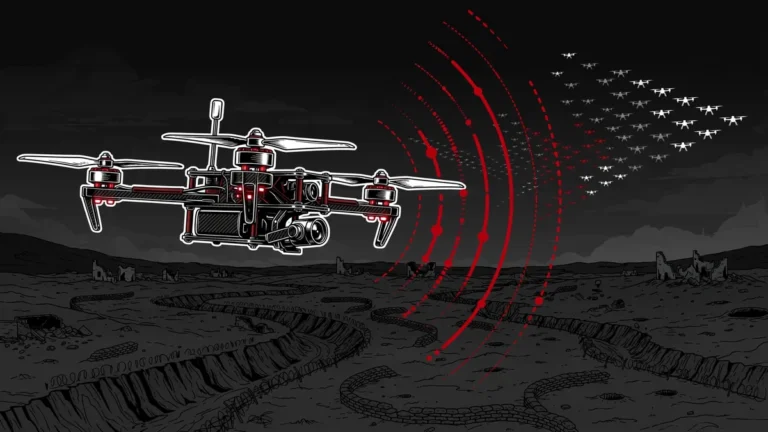
The civilian spillover matters too. The same LEO constellations built for defense carry emergency-services and disaster-response missions — the ICEYE–Nokia announcement explicitly names both — and the resilience argument (connectivity that survives terrestrial network disruption) applies to critical infrastructure as much as to armies. The drone-heavy battlefields of 2026 run on the same links: unmanned systems are only as connected as their communications.
What to Watch Next
The ICEYE–Nokia venture’s 2028 first-launch target is the nearest milestone — watch for spectrum filings, anchor government customers, and terminal demonstrations in 2027. IRIS²’s reinforced schedule puts first launches in 2029; the Paris summit commitments suggest political risk has fallen, but manufacturing 348 satellites on schedule is the industrial test. On the threat side, watch how Russia and China adapt their jamming and counterspace tooling to LEO broadband constellations — the jamming of Starlink terminals in Ukraine was the opening round, not the last. And watch the U.S. Space Force’s own protected-SATCOM and commercial-integration decisions: how the Pentagon buys commercial capacity will set the template every ally follows.
| Metric | Figure | Source |
|---|---|---|
| IRIS² total constellation | 348 satellites (330 LEO + 18 MEO) | European Commission, Aug 7, 2026 (via Reuters) |
| IRIS² first launches | 2029 | European Commission (reported) |
| IRIS² program funding | ~€6B EU + €4B+ private + ~€550M ESA (12-yr concession) | Commission/SpaceRISE reporting (reported) |
| ICEYE–Nokia first satellites | 2028 | Joint company announcement, Oct 1, 2026 |
| Starlink active satellites | More than 10,000 | Le Monde, Sept 2026 (reported) |
| Amazon Leo planned constellation | 3,236 satellites | Industry reporting (reported) |
Caveat: constellation sizes and launch dates are CONFIRMED from company/government announcements via reputable outlets. Funding totals and competitor satellite counts are REPORTED from trade and industry press and should be treated as approximate.
Frequently asked questions
What are secure military communications systems?
The integrated technologies — tactical radios, satellite links, network encryptors, and command networks — that let armed forces communicate confidentially and reliably under combat conditions, including active jamming and interception attempts.
What is the ICEYE–Nokia partnership?
Announced October 1, 2026, it is a Finnish partnership to develop sovereign broadband LEO satellite communications for governments and defense customers, with first satellites expected in 2028. Nations using the systems would own and control the satellites, ground segment, and terminals.
What is IRIS²?
The EU’s sovereign multi-orbit satellite communications program, built through the SpaceRISE consortium (SES, Eutelsat, Hispasat). After the August 2026 reinforcement, it totals 348 satellites with first launches targeted for 2029, designed for government, defense, and emergency-service connectivity.
How is military encryption different from commercial encryption?
Classified U.S. military traffic uses NSA Type 1 certified encryption, restricted to government and cleared contractors, with rigorous key management, tamper resistance, and ruggedization requirements that commercial products do not carry.
Can anything replace Starlink for military use today?
Not at Starlink’s scale — no alternative approaches 10,000+ active satellites. The alternatives compete on sovereignty and security guarantees rather than scale, and the credible sovereign options (IRIS², ICEYE–Nokia) reach service around 2028–2029.
Secure military communications are becoming the infrastructure on which every other capability depends — drones, intelligence, and command all ride the same links. The sovereign-comms investments of 2026 will not pay off until 2028–2029, which means the decisions being made now, in procurement offices across Europe and allied capitals, will define who can actually communicate in the next crisis.
Related reading
- Defense Startups to Watch in 2026
- Military SATCOM Explained: How Armies Stay Connected
- Electronic Warfare Companies: 2026 Market Guide
Sources
- GlobeNewswire (via TradingView): ICEYE and Nokia Partner to Launch Secure and Sovereign Satellite Communications
- Mobile World Live: Nokia, ICEYE Dock for Defence Satcom Mission
- Reuters: EU Commission Signs Contract to Expand IRIS2 Satellite Constellation
- Le Monde: At Space Summit, France and EU Rescue European Satellite Constellation Iris²
- Adria Defense: How Starlink Is Reshaping the Global Defense Tech Industry
- Mercury Systems: NSA Type-1 Encryption FAQ


Discussion 0
Share analysis, corrections, or context. Be civil — comments are moderated.