
WarBrief Live | October 29, 2026 | Explainer
800,000
troops Germany may have to move through its territory in a crisis, within six months
45 days
notice one EU state required for cross-border military movement, against a 5-working-day standard
10,000
troops from 13 countries in NATO’s Steadfast Dart 2026 reinforcement exercise
€17.65bn
proposed EU military mobility budget for 2028–2034, up from €1.69 billion in 2021–2027
Military mobility is the ability to move troops, weapons and supplies across borders fast enough to matter in a crisis. In Europe, that depends as much on permits, bridges and railways as on armies.
The issue returned to the top of the NATO-EU agenda on October 28, 2026, when NATO Secretary General Mark Rutte welcomed European Commissioner for Defence and Space Andrius Kubilius to NATO Headquarters in Brussels. According to NATO, the two discussed readiness, defence production and support for Ukraine, with military mobility singled out as an area where cooperation is particularly crucial — because moving equipment and personnel into and across Europe is, in NATO’s words, critical for deterrence and defence. What is confirmed in this article: that meeting, the eight-country mobility area agreed in November 2025, and the auditors’ 45-day finding. What remains proposal, not yet law: the fast-track emergency system and the larger 2028–2034 budget.
Key Takeaways
- A unit that is ready to leave its base within 10 days is not automatically combat power on NATO’s eastern flank within the same period — clearance, transport, host-nation support and route resilience all take time.
- One EU member state required 45 days’ notice for cross-border military movement, according to the European Court of Auditors — against a 5-working-day standard agreed in 2018.
- Eight European countries signed the Central Northern European Military Mobility Area in November 2025, aiming for a “Military Schengen” of standardised border procedures.
- Germany’s crisis plan reckons with moving up to 800,000 allied troops and 200,000 vehicles through its territory within six months — a task that would also mobilise civilian transport, energy and medical systems.
What is military mobility, and why does it decide wars?
Military mobility means the capacity of armed forces to move troops, equipment and supplies quickly from one place to another. The European Commission’s definition covers both military-owned transport and civilian companies contracted by the military — and that second half is the point. Only part of the system sits inside armed forces. The rest depends on roads, railways, airports, ports, customs procedures, border crossings, commercial transport, accommodation, energy and communications.
That is why a technical-sounding subject carries strategic weight. Deterrence is not only about how many brigades an alliance owns; it is about what an adversary believes the alliance can actually bring into theatre, sustain and employ. A reinforcement plan that works on paper but stalls at a border crossing, a weak bridge or a congested rail yard does not deter. Conversely, a system that demonstrably moves heavy forces across a continent at speed tells a potential attacker that a quick, localised fait accompli is unlikely to succeed.
Europe’s geography sharpens the problem. Most NATO forces sit in the west of the continent; the most likely flashpoints sit in the east. Reinforcements must therefore cross several sovereign states, each with its own transport rules, customs procedures and approval processes, on infrastructure built overwhelmingly for civilian peacetime use. Bridges, tunnels and rail lines were designed for commercial loads, not for columns of 70-tonne tanks. Rail gauges differ at the EU’s eastern edge. Ports and airports that would receive transatlantic reinforcements are also civilian economic hubs that must keep functioning.
Why can a ready unit still arrive too late?
Since 2022, NATO has reorganised how quickly it can respond. Under the NATO Force Model, allied forces sit in readiness tiers: Tier 1 forces should be ready within 0–10 days, Tier 2 within 10–30 days, and Tier 3 within 30–180 days, with the Allied Reaction Force adding another high-readiness element. Those figures describe when a unit should be ready to move. They say much less about when it can actually arrive where it is needed and fight.
Once a force leaves its base, a second clock starts. An analysis by the UISC think tank describes the chain as force readiness, then movement clearance, then transport capacity, then host-nation support, then route resilience, and only then combat power in theatre. One weak link slows the whole process. Political and legal clearance to cross borders must be granted in time. Heavy equipment needs rail, road, sea or air transport. Fuel, repairs, medical support and host-nation support have to follow. Civilian infrastructure must keep working while the system itself is under pressure.
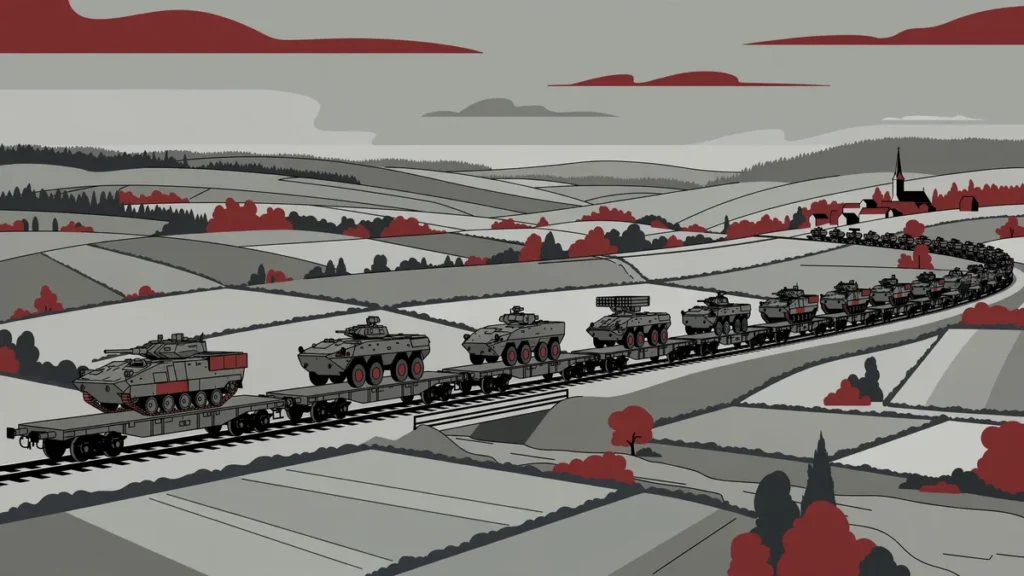
The exercise record shows both the progress and the scale of the gap. Steadfast Dart 2026 practised rapid multinational reinforcement with around 10,000 troops from 13 allied countries, roughly 1,500 military vehicles, 17 ships and more than 20 aircraft, testing the Allied Reaction Force across land, sea, air and cyber domains. For an exercise, that is a serious deployment. The scale of a real reinforcement operation in a major European war would be much larger — which is where Germany’s planning figures come in. According to a Bundeswehr officer who contributed to the first version of the plan, speaking to DW, around 800,000 soldiers and 200,000 vehicles would have to move through Germany within six months in a crisis, with accommodation, food, security and routing arranged along the way.
Background and timeline
Military mobility was a niche logistics concern for most of the post-Cold War period. Russia’s full-scale invasion of Ukraine in 2022 turned it into a first-order defence issue, and the fixes since then have come in layers: rules, money, corridors and commands.
- 2018: EU Council members commit to a 5-working-day standard for cross-border military movement permissions.
- 2021: NATO’s Joint Support and Enabling Command (JSEC) in Ulm, Germany, becomes fully operational to coordinate the movement of troops and equipment across Europe.
- 2022: Russia’s full-scale invasion of Ukraine exposes how slowly heavy forces can move across a continent built for peacetime commerce; Germany commissions its Operationsplan Deutschland.
- 2024: The Netherlands, Germany and Poland pioneer a model military mobility corridor; Albania, Italy, Bulgaria and North Macedonia agree a Corridor VIII mobility arrangement at the NATO Washington summit.
- June 2025: NATO leaders at The Hague commit to spending 5% of GDP on defence by 2035, including up to 1.5% of GDP on defence-related investment such as critical infrastructure.
- November 2025: Eight countries sign the Central Northern European Military Mobility Area, expanding the Dutch-German-Polish corridor east and west.
- 2026: NATO runs Steadfast Dart 2026, its large-scale Allied Reaction Force reinforcement exercise.
- June 2026: The EU Council agrees its negotiating position on new military mobility rules, including harmonised procedures, digitalised permits and a Military Mobility Solidarity Pool.
- October 28, 2026: NATO Secretary General Mark Rutte and EU Defence Commissioner Andrius Kubilius meet in Brussels and put military mobility at the centre of NATO-EU cooperation.
What is the “Military Schengen”?
The nickname refers to the ambition of moving troops across Europe almost as freely as civilians move inside the Schengen passport-free zone. The most concrete step so far is the Central Northern European Military Mobility Area, agreed in November 2025 by Belgium, the Czech Republic, Germany, Luxembourg, the Netherlands, Poland, Slovakia and Lithuania. According to Defence Today, the eight countries will coordinate infrastructure development, joint monitoring, movement coordination and information-sharing, with the stated goal of removing the bottlenecks and bureaucratic obstacles that delay military convoys.
The area builds on the earlier Netherlands-Germany-Poland corridor and extends it westward through Belgium and Luxembourg and eastward through Lithuania, the Czech Republic and Slovakia. Lithuania’s defence ministry has described coordinated military mobility as a national priority, and the corridor work connects directly to the Suwałki corridor and the Baltic states’ reinforcement routes. Other corridors are forming in parallel: a Nordic letter of intent in November 2024, a Bulgaria-Greece-Romania corridor giving southern access via Alexandroupolis, and the Corridor VIII arrangement linking the Adriatic to the Black Sea.
None of this removes national sovereignty over troop movements. What the mobility areas change is the plumbing underneath: standardised border-crossing procedures, joint control and coordination of movements, shared information, and synchronised investment in dual-use roads, railways, bridges, airports and seaports rated for the weight, dimensions and scale of military transport. NATO’s JSEC in Ulm sits at the centre of that coordination for the alliance as a whole, while the EU funds much of the infrastructure through its Connecting Europe Facility.
By the numbers
Confirmed figures (official statements or two or more independent sources):
| Metric | Figure | Source |
|---|---|---|
| Allied troops Germany may have to move in a crisis | Up to 800,000 within six months | Bundeswehr officer via DW; UISC analysis |
| Vehicles in the same German transit task | Up to 200,000 within six months | Bundeswehr officer via DW; UISC analysis |
| Longest cross-border movement notice found by EU auditors | 45 days in one member state | European Court of Auditors, via UISC and press reporting |
| Agreed standard for cross-border movement permissions | 5 working days (Council commitment, 2018) | European Court of Auditors reporting |
| Countries in the Central Northern European Military Mobility Area | 8 (Belgium, Czech Republic, Germany, Luxembourg, Netherlands, Poland, Slovakia, Lithuania) | Defence Today; Lithuanian Defence Ministry via Caliber |
| EU military mobility funding, 2021–2027 | €1.69 billion, funding 95 dual-use projects, fully committed by end-2023 | UISC; EU Institute for Security Studies |
Reported figures (single or secondary source, attributed as such):
| Metric | Figure | Source |
|---|---|---|
| Steadfast Dart 2026 exercise scale | Around 10,000 troops, 13 countries, 1,500 vehicles, 17 ships, 20+ aircraft | UISC analysis |
| Proposed EU military mobility budget, 2028–2034 | €17.65 billion | European Commission proposal, via UISC |
| NATO defence spending commitment, Hague 2025 | 5% of GDP by 2035, including up to 1.5% for defence-related infrastructure | Foundation for Defense of Democracies analysis |
Figures in the first table are confirmed by an official statement or by two or more independent sources; figures in the second table rest on a single source and should be read as reported, not confirmed.
What NATO military mobility means for US, UK and EU readers
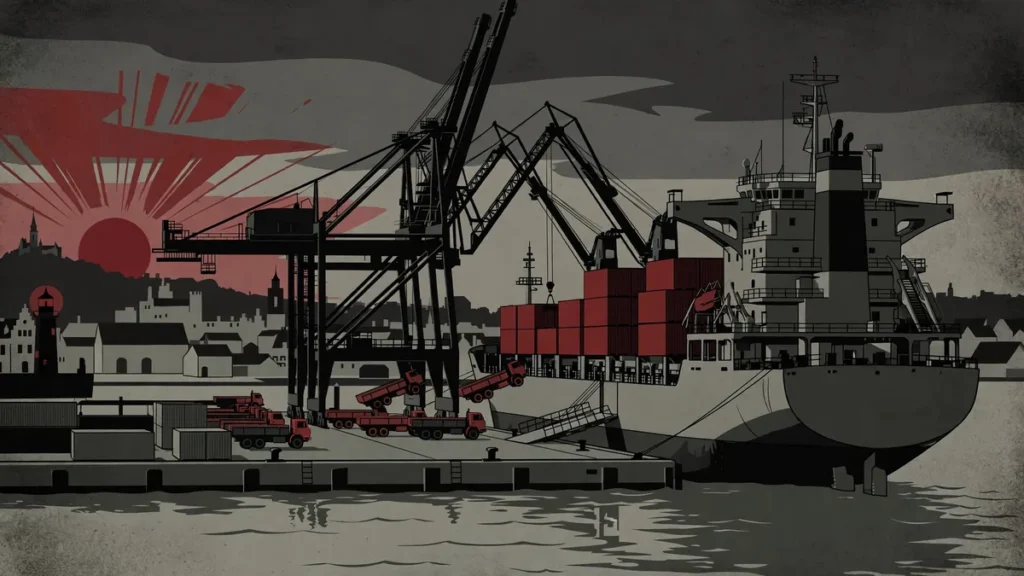
For US readers, the stakes are about reinforcement. A former NATO deputy assistant secretary general, Jamie Shea, has put the current US troop presence in Europe at around 80,000 — a fifth of the Cold War figure. In a crisis, the bulk of US reinforcements would arrive by sea and air and then have to transit Europe by road and rail. Every day lost to permits, weak bridges or congested rail yards is a day in which those forces are not where they are needed, and the credibility of the US commitment is measured in that gap, not only in the forces themselves.
For UK readers, the same corridors carry British forces committed to NATO’s eastern flank. The UK’s ability to reinforce allies quickly depends on the same border procedures, rail capacity and port infrastructure as every other ally’s. A system that works smoothly in peacetime exercises is the only evidence available that it would work under pressure — which is why exercises like Steadfast Dart, and the audit findings about 45-day notices, matter beyond military circles.
For EU readers, the effects are closer to home and to the household budget. Dual-use infrastructure — bridges strengthened for tanks, rail lines upgraded for heavy freight, ports adapted for military cargo — is paid for from EU and national budgets, and the proposed jump to €17.65 billion for 2028–2034 is a significant spending decision. In a crisis, civilian transport would also feel the effects: military trains and convoys would get priority on some routes, and the emergency fast-track system now under negotiation is designed precisely to give military transport priority access to infrastructure when it is activated.
Different perspectives
NATO and EU officials present military mobility as a deterrence investment: the faster the alliance can reinforce, the less likely an attack becomes. Commissioner Kubilius has made it a centrepiece of his defence portfolio, and Secretary General Rutte has welcomed the progress while noting that further work is required to ensure readiness.
Auditors and analysts are more sceptical about delivery. The European Court of Auditors found fragmented management, funding gaps and insufficient use of military priorities when dual-use projects were selected — some were funded as individual transport improvements rather than as parts of a single strategic plan built around the worst bottlenecks. The Foundation for Defense of Democracies has added a different warning: Chinese state-linked firms hold stakes in at least 14 of 29 European ports near NATO naval facilities or supporting NATO logistics, raising questions about intelligence access and coercive leverage over the very infrastructure reinforcement depends on.
Moscow, for its part, portrays NATO’s movement and build-up as a threat to Russia, and Kyiv has warned that Russia may use peace negotiations to push for a wider redrawing of Europe’s security map. President Volodymyr Zelensky said at a Kyiv briefing on October 27, 2026, that Moscow could seek a separate agreement rolling NATO’s military footprint back toward its 1997 lines — a demand Russia tabled in draft treaties in December 2021 and which NATO rejected in January 2022. That dispute is itself a reason the mobility debate matters: the corridors exist because the alliance does not accept that its eastern members should be a second-tier security zone.
What to watch next in European military mobility
Three decisions will shape whether the current momentum turns into faster movement. First, the EU’s military mobility package trilogue: negotiators are still divided over permit deadlines — the Commission proposed three working days for ad-hoc transit permits, Parliament two, and the Council five calendar days — and over whether the single digital permit platform should be operational by 2028 or 2030. Second, the 2028–2034 EU budget negotiation will decide whether the proposed €17.65 billion for military mobility survives, and whether the roughly 500 hotspot projects identified along priority corridors get funded as a system rather than one by one. Third, the emergency fast-track mechanism, the European Military Mobility Enhanced Response System, still needs agreed activation rules: it is intended to be triggerable within 48 hours of a proposal and to give military transport priority access, but its exact scope is not yet settled.
Watch also for the next large-scale movement exercise and for whether the eight-country mobility area publishes common procedures that other allies adopt. The test that matters is not a press release but a convoy: how many days, in practice, between a political decision and heavy forces arriving, supplied and ready, on the eastern flank.
Frequently asked questions
What is military mobility?
It is the ability to move troops, military equipment and supplies quickly across borders and over long distances. It covers military transport and civilian infrastructure alike — roads, railways, ports, airports, customs and border procedures — because modern reinforcements travel on civilian networks.
What is the “Military Schengen”?
It is a nickname for the goal of moving troops across Europe almost as freely as civilians travel inside the Schengen passport-free zone. The most concrete step is the Central Northern European Military Mobility Area, signed in November 2025 by eight countries, which standardises border-crossing procedures and coordinates infrastructure investment.
Why does moving troops across Europe take so long?
Because each border crossing has historically needed separate diplomatic permits, customs arrangements and transport bookings, and because civilian infrastructure was not built for 70-tonne vehicles. EU auditors found one member state requiring 45 days’ notice, against a 5-working-day standard agreed in 2018.
How many troops would Germany have to move in a crisis?
Germany’s Operationsplan Deutschland reckons with up to 800,000 allied troops and 200,000 vehicles moving through German territory within six months, including accommodation, food, fuel, repairs, medical support and security along the routes.
Does military mobility affect ordinary civilians?
Yes. Dual-use infrastructure is funded from public budgets, civilian transport could face priority rules for military movements in a crisis, and the same bridges, rail lines and ports carry both military and civilian traffic every day.
Read next: Conflict Zones hub · Lithuania Permanent US Base: Why Vilnius Wants One · The Evolution of NATO: Adapting to New Security Challenges · EU’s Emergency Security Protocol: Answering Hybrid Attacks
Sources
- NATO: Secretary General highlights strong NATO-EU cooperation during visit of Commissioner Kubilius
- UISC: European Military Mobility and NATO Reinforcement
- Defence Today: Eight European countries sign agreement to establish NATO mobility corridor
- EU Institute for Security Studies: The road to readiness — How the EU can strengthen military mobility
- Radio Free Europe / GlobalSecurity: Is the EU edging closer to a ‘Military Schengen’?
- DW via ABP Live: Inside Germany’s push to strengthen NATO’s defence readiness

Discussion 0
Share analysis, corrections, or context. Be civil — comments are moderated.