
WarBrief Live | October 16, 2026 | Global Conflicts
Satellite images analyzed by Reuters show Russia has nearly finished building a major new launch base for its Geran-4 and Geran-5 jet drones in just six weeks — turning an empty field in the Rostov region into one of Moscow’s largest drone-attack complexes. The site, roughly the size of 126 soccer pitches, sits about 3.5 km from the Millerovo air base and could be operational within weeks, according to defense analysts who reviewed the imagery. This is the Geran-4 and Geran-5 jet drone story explained with verified figures only: what the imagery confirmed, what experts estimate, and what remains unverified.
Key Takeaways
- A Reuters analysis of commercial satellite imagery (Planet Labs and Airbus) found an empty Rostov-region field on August 31 had become a ~0.9 km² facility with eight launch platforms by October 14, 2026 — a six-week build.
- DroneSec CEO Mike Monnik and RUSI programme director Rob Jordan assess the site is designed to launch Russia’s newest jet-powered Geran-4 and Geran-5 drones. Russia’s defense ministry did not respond to Reuters’ request for comment.
- Russia’s jet-drone use rose roughly six-fold over three months this summer (Ukrainian military data), and interception rates for jet models have fallen to around 55–57%, from over 90% for propeller-driven Shaheds (Ukrainian reporting).
- The base would add to a network of at least 11 existing fixed launch sites ahead of an expected winter campaign against Ukraine’s energy infrastructure. The oft-cited figure of 100+ launches per day is an expert estimate, not a confirmed capacity.
What happened at Russia’s new drone base in Rostov?
On October 15, 2026, Reuters published a satellite-imagery investigation documenting one of the fastest military construction projects of the war. Overhead imagery of the site — in Russia’s southwestern Rostov region, near the Ukrainian border — showed a few vehicles in an empty field on August 31, with construction beginning the following morning. By October 14, the field had become a sprawling complex the size of around 126 soccer pitches.
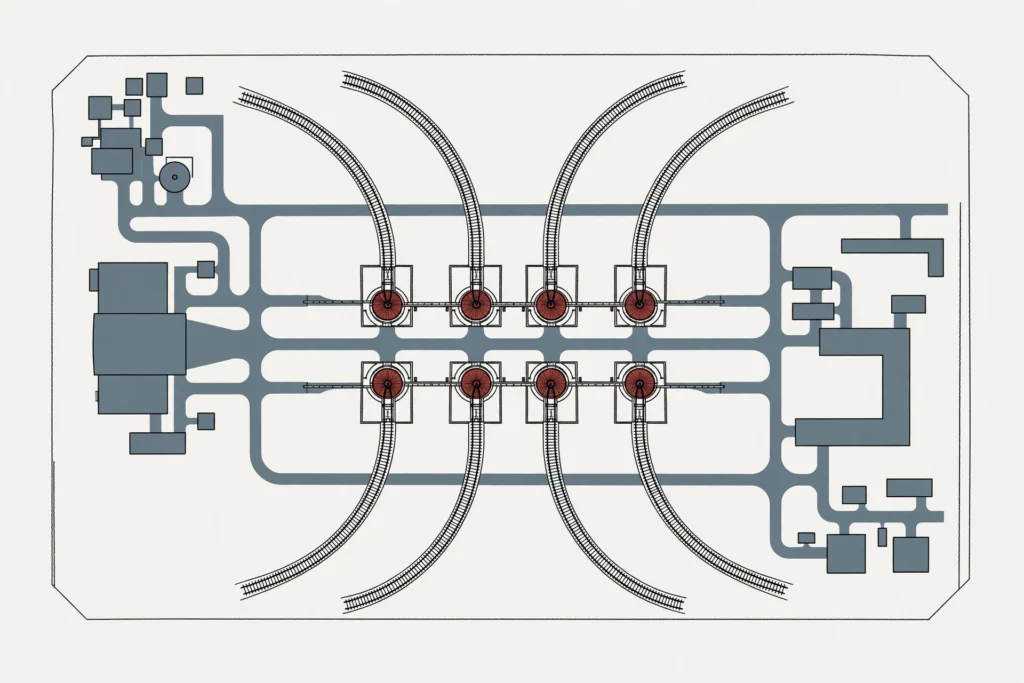
The most significant features are on the facility’s western edge: eight platforms built to carry launch rails for jet-powered drones, according to Mike Monnik, founder and CEO of the private intelligence firm DroneSec. A Reuters analysis of the imagery found rails already installed on two of the pads, with rails under construction on two more, and other work visible from space over three days that week.
The location is deliberate. The site lies about 3.5 km from Russia’s Millerovo air base, home to the 31st Guards Fighter Aviation Regiment — placing the new launch complex inside the air-defense “bubble” of the base’s systems, which would complicate any Ukrainian attempt to strike it, DroneSec assessed. Monnik said the facility looked very close to completion and would likely be fully operational within weeks, if not sooner.
Rob Jordan, programme director at the London-based RUSI think-tank, told Reuters the concrete pads and possible takeoff rails in the imagery looked consistent with launch tracks for Russian Geran drones, calling the pace of construction impressive and a sign of the faith Moscow is placing in its deep-strike capability — possibly at the expense of its conventional land forces. A second outlet reviewing the same imagery reported the same eight-launcher layout and the weeks-away operational timeline.
What are Geran-4 and Geran-5 jet drones?
The Geran-4 and Geran-5 are Russia’s newest jet-powered one-way attack drones — the fast successors to the propeller-driven Shahed-136/Geran-2 that defined the early drone campaign. The Geran-4 keeps the familiar Shahed delta shape at roughly 3.5 metres long but swaps the piston engine for a Chinese-made turbojet, giving it a reported top speed of more than 300 mph — about three times the Shahed-136. The larger Geran-5, at around six metres, looks more like a cruise missile and is reported to be roughly 100 mph faster than the Geran-4, with a repositioned jet engine for higher speed.
A rare Radio Free Europe/Radio Liberty teardown of a recovered Geran-4, detailed by United24 Media, found the drone is far more than a faster Shahed. It carries day-and-night cameras, Chinese mesh-networking modems and cellular communications hardware, plus a 16-element anti-jamming satellite-navigation antenna — systems that may let operators receive images and steer the drone mid-flight. Ukrainian intelligence identified components from firms in the United States, Germany, Japan, Switzerland and China inside recovered airframes; only the airframe and warhead are largely Russian-made. Reported figures — a ~500 km range, a 50 kg warhead in high-explosive, thermobaric or incendiary versions — come from Ukrainian and Western assessments and should be treated as estimates, not confirmed specifications.
Production scale is also estimated, not confirmed. Ukraine’s military intelligence agency (HUR) told the Militarnyi outlet in August that Russia builds about 3,000 Geran-4 and Geran-5 airframes a month — a figure from an interested party that other reporting has questioned. What is confirmed is the trend: Reuters, citing Ukrainian military data, reported jet-drone use rose roughly six-fold over three months this summer, with Kyiv and its region targeted most heavily.
By the numbers: the Rostov base in verified figures
| Metric | Figure | Source |
|---|---|---|
| Construction time (empty field to near-complete complex) | ~6 weeks (Aug 31 – Oct 14, 2026) — CONFIRMED | Reuters satellite analysis (Planet Labs/Airbus) |
| Facility footprint | ~0.9 km² (≈126 soccer pitches) — CONFIRMED | Reuters satellite analysis |
| Launch platforms | 8 on the western edge; rails on 2, building on 2 more — CONFIRMED | Reuters / DroneSec |
| Distance to Millerovo air base | ~3.5 km — CONFIRMED | Reuters |
| Existing Russian fixed drone-launch sites | At least 11 — CONFIRMED (analyst assessment) | DroneSec via Reuters |
| Jet-drone usage surge | Roughly six-fold over 3 summer months — CONFIRMED (Ukrainian military data) | Reuters |
| Potential launch rate | 100+ jet drones per 24 hours — REPORTED (expert estimate) | DroneSec’s Mike Monnik via Reuters |
| Monthly Geran-4/5 production | ~3,000 airframes — REPORTED (interested party) | Ukraine’s HUR via Militarnyi (Aug 2026) |
| Jet-drone interception rate | ~55–57% vs 90%+ for propeller Shaheds — REPORTED | Ukrainian reporting via United24 Media |
Caveat: figures marked CONFIRMED rest on satellite imagery or two or more independent sources; figures marked REPORTED come from a single or interested-party source and should be treated as estimates.
Why jet drones are harder for Ukraine to shoot down

Speed is the core problem. A propeller-driven Shahed-136 cruises at roughly 180–200 km/h — slow enough for Ukraine’s cheap interceptor drones, mobile machine-gun teams and Soviet-era air-defense guns to catch it, which is how interception rates topped 90%. A Geran-4 or Geran-5 arriving at 500–600 km/h, possibly at higher altitude, compresses the entire detect-track-engage sequence into seconds. United24 Media reports Ukrainian units are now neutralizing only about 55–57% of the jet-powered systems — and at closing speeds of 700–900 km/h, a human pilot may have one or two seconds for the final intercept correction.
Ukraine is adapting on several tracks. President Volodymyr Zelenskyy said on September 19 that a new interceptor drone developed for the Security Service had already been successfully deployed against jet-powered Shaheds; operators have since published footage of upgraded interceptors destroying a Geran-5. The Defense Ministry announced in August that the Alexa Spatium — described as Ukraine’s first interceptor built primarily to engage jet-powered Shaheds — had reached frontline units. Ukrainian Air Force deputy commander Yurii Cherevashenko says at least 20 manufacturers are working on jet-powered interceptors, with AI-assisted terminal guidance seen as the key to beating human reaction-time limits. Stopgaps already in use include AI-assisted gun turrets, Soviet-era Kub launchers paired with American RIM-7 interceptors, and fighter jets firing expensive air-to-air missiles — an unfavorable cost exchange against mass-produced drones. For background on the wider technology race, see our AI warfare explainer.
What the base signals for Ukraine’s winter campaign
Kyiv expects Russia to further escalate jet-drone and missile attacks this winter, and the new base fits that warning precisely. The Institute for the Study of War assessed on October 8 that jet-powered Gerans penetrate Ukrainian air defenses deeper and more reliably than propeller models — which partly lets Russia concentrate scarce cruise and ballistic missiles on priority targets without firing many more of them. ISW expects the same pattern applied to a likely brutal winter campaign against energy infrastructure, aimed at making city life untenable.
The pattern is already visible. Overnight on October 7, Russia launched 48 Kh-101, Iskander-K and Kalibr cruise missiles alongside ballistic missiles and 130 strike and decoy drones — 46 of them jet-powered, according to Ukraine’s Air Force. The strike killed 22 people in Pryluky, Ukraine’s emergency service said. Our coverage of the shattered Russia-Ukraine energy truce and Ukraine’s Ryazan refinery strike tracks how both sides are now hitting energy targets — the new Rostov base would give Russia a dedicated high-tempo launch node for its side of that exchange. Browse the conflict zones hub for the full picture.
What the jet-drone build-up means for US, UK and EU readers
For Western readers, the Rostov base matters in four concrete ways. Energy costs: a winter campaign against Ukrainian energy infrastructure — following the collapse of the energy truce — keeps European gas and diesel markets exposed to supply shocks, with knock-on effects on heating bills and fuel prices. Airspace security: the base’s construction coincides with worsening Russia-NATO tensions; European governments accuse Moscow of stepping up drone incursions, sabotage and cyberattacks, and NATO planners now treat cheap long-range drones as a standing airspace threat, not a Ukraine-only problem. Defense spending: Monnik warned that the combination of industrial jet-drone production and thin counter-drone defenses across many NATO countries is a strategic vulnerability — closing it will cost taxpayers, from interceptor programs to radar coverage. Sanctions policy: the Geran-4 teardown shows how heavily the program leans on imported components, including Western-made electronics acquired through sanctions circumvention — a reminder that export-control enforcement is now a frontline defense issue. This is educational context, not financial advice.
Different perspectives
Ukraine’s view: a race against time — scale jet-capable interceptors before the winter campaign peaks, while keeping the cost exchange from collapsing the air-defense budget. Russia’s view (inferred from its investments): deep-strike capability is now a core, industrialized weapon system worth building at wartime speed, even at the possible expense of conventional land forces, per RUSI’s assessment. Western analysts’ view: the base demonstrates how quickly Russia can field large-scale unmanned strike capacity — a capability NATO countries are poorly postured against, and one whose components flow through global supply chains that sanctions have not sealed. Civilians’ view: between August 27 and September 27, Kyiv endured more than 235 air-raid alerts totaling 261 hours, with 29 people killed and about 228 injured in the capital, Ukrainian officials reported — the human ledger the new base is built to extend. Today’s Starshield speed-limit story shows the parallel fight over the satellite links Ukraine’s defenses depend on.
What to watch next on the jet-drone front
- Operational status: analysts put the base weeks from going live — watch for the first confirmed launches from the Rostov site.
- Winter tempo: whether jet-drone waves concentrate on Ukraine’s energy grid as ISW expects, and at what daily rate.
- The interceptor race: whether Ukraine’s jet-powered interceptors (Alexa Spatium, SBU systems, SkyFall’s JetKiller) scale to mass production before current stocks are exhausted.
- Component crackdown: any new export-control or sanctions enforcement actions targeting the turbojet and electronics supply chains feeding Geran production.
- NATO posture: whether European capitals accelerate counter-drone procurement after the Rostov build demonstrated the threat’s industrial speed.
Frequently asked questions
What are the Geran-4 and Geran-5 drones?
They are Russia’s newest jet-powered one-way attack drones, successors to the propeller-driven Shahed-136/Geran-2. The Geran-4 is roughly 3.5 metres long with a reported top speed above 300 mph; the larger, six-metre Geran-5 resembles a cruise missile and is reported to be about 100 mph faster. Both carry advanced cameras and communications suites, according to a teardown of a recovered Geran-4.
Where is Russia’s new jet drone base?
In Russia’s southwestern Rostov region, about 3.5 km from the Millerovo air base (home to the 31st Guards Fighter Aviation Regiment), according to a Reuters satellite-imagery analysis published October 15, 2026. DroneSec assesses the site sits inside the air base’s air-defense coverage, complicating Ukrainian counterstrikes.
How fast are Russia’s jet-powered drones?
Reported top speeds are around 500 km/h for the Geran-4 and 600 km/h for the Geran-5 — roughly double to triple the ~180–200 km/h of propeller-driven Shaheds. These figures come from Ukrainian and Western assessments and are reported estimates, not officially confirmed specifications.
Why is Ukraine struggling to shoot down jet drones?
Speed and altitude compress the engagement window to seconds, defeating interceptor drones and mobile gun teams built for slower targets. Ukrainian units neutralize only about 55–57% of jet-powered drones versus over 90% of propeller models, per Ukrainian reporting. Ukraine is rushing jet-powered interceptors and AI-assisted targeting into service to close the gap.
What does the new drone base mean for winter 2026?
Kyiv expects Russia to escalate jet-drone and missile attacks this winter, and the Institute for the Study of War assesses the jet Gerans will let Moscow concentrate missiles on priority targets — likely energy infrastructure — while drones saturate defenses. The base, weeks from operational, would add a dedicated high-tempo launch node for that campaign.
Sources
- Reuters: Russia builds major new drone attack base in six weeks, satellite images show (October 15, 2026)
- Euromaidan Press: Fewer targets, more waves — jet-powered Gerans partly free Russia to concentrate missiles, ISW says (October 8, 2026)
- United24 Media: Russia’s jet-powered Geran drones are changing the war over Ukraine (October 15, 2026)
- Zamin.uz: Russia nearly finishes construction of massive jet drone base near Ukrainian border (October 15, 2026)



Discussion 0
Share analysis, corrections, or context. Be civil — comments are moderated.