
WarBrief Live | October 15, 2026 | Shipping & Logistics
On Wednesday, Oman announced it had opened a temporary shipping corridor through the Strait of Hormuz in coordination with the International Maritime Organization (IMO), open to all vessels and free of transit tolls. The announcement gave a formal name and structure to what has quietly become the world’s most important maritime workaround: the Omani corridor, the US-backed southern shipping lane through Omani waters that keeps Gulf oil and gas moving despite the US-Iran war. This explainer covers what the Omani corridor is, how ships use it, why Iran calls it unauthorized, and what it means for energy prices.
Key Takeaways
- The Omani corridor is the US-supported southern shipping lane through the Strait of Hormuz, running along Oman’s Musandam Peninsula, where American and allied naval forces provide escorts and surveillance for commercial traffic.
- Oman said on October 14 that the new temporary corridor is coordinated with the IMO, open to all vessels, and carries no tolls or fees — a direct answer to speculation that Iran might charge for passage.
- Iran rejects the corridor as unauthorized and insists vessels should transit through waters it oversees; the IRGC Navy described the route taken by the sunken GFS Pride as an “illegal and dangerous route.”
- The US claims more than 1,000 commercial vessels have used the southern corridor in three months, while reporting puts current throughput at roughly half pre-war levels — oil prices and insurance remain elevated.
What is the Omani corridor?
The Omani corridor is the southern transit lane through the Strait of Hormuz that runs through Omani territorial waters along the Musandam Peninsula, rather than through the waters near Iran’s northern coast. Since the US-Iran conflict escalated this year, the United States has encouraged commercial ships to use this southern route, where American and allied naval forces provide escorts and surveillance, according to Gulf News.
The Strait of Hormuz is only about 33 kilometres (21 miles) wide at its narrowest point, with internationally recognised Traffic Separation Schemes (TSS) acting as maritime lanes: two-mile-wide shipping lanes separated by a two-mile buffer zone, as Anadolu Agency explains. Before the war, commercial traffic moved through these lanes under the right of transit passage in international law. The fighting shattered that arrangement — and the Omani corridor is the American-led substitute.
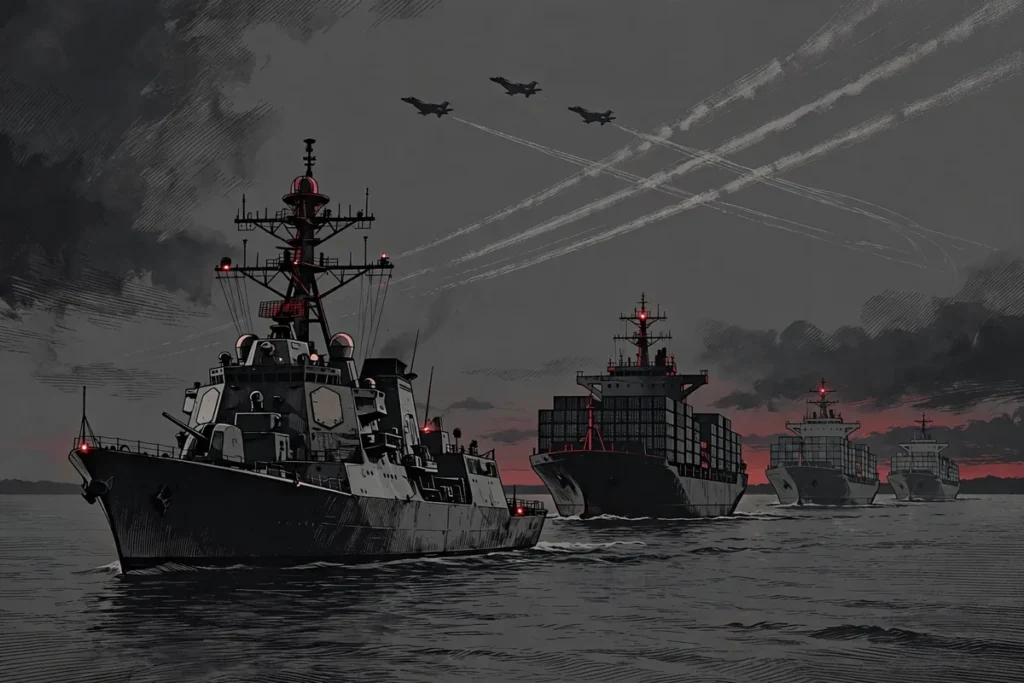
The corridor is not an informal arrangement. US forces organise vessels into scheduled inbound and outbound groups, assign reporting checkpoints, and fly fighter jets overhead to detect potential missile and drone attacks, Axios reported via Daily Sabah. Washington describes the operation as protecting freedom of navigation in an international waterway that no single country can control.
How do ships use the Omani corridor?
Before entering the strait, vessels coordinate with the US Navy’s Naval Cooperation and Guidance for Shipping programme, which provides updated security information and recommended sailing routes, Moneycontrol reports. Ships transit in organised groups, report their movements at checkpoints, and receive air cover for much of the passage. US officials told Axios that 15 to 20 tankers pass through the strait each night via the southern channel — though that figure is a reported claim, not an independently verified count.
Security for crews has become a central question. Moneycontrol reports that shipping companies ask crews whether they are willing to make the journey, and sailors who agree are reportedly paid double or even triple their normal wages. At the height of the crisis, ships were instructed to switch off tracking systems and cover windows to reduce the chances of being targeted.
Oman’s announcement on October 14 added a formal layer. According to the announcement, carried by Ship & Bunker, vessels wishing to use the temporary corridor must coordinate with the IMO and follow coordinates issued by the IMO and the relevant Omani authorities. Oman said the initiative reflects its responsibility towards the strait and its importance to the global economy, as well as its commitment to international law and the law of the sea.
By the numbers: the Hormuz shipping crisis
| Metric | Figure | Source |
|---|---|---|
| GFS Pride crew rescued | 21 crew, all evacuated (CONFIRMED) | Maritime and Port Authority of Singapore |
| GFS Pride capacity | 2,824 TEU (CONFIRMED) | Reuters |
| Vessels sunk since war began, Feb 28 | 3: Safeen Prestige, GFS Pride, Cape Dao (CONFIRMED via casualty data) | International Maritime Organization |
| Vessels transited via southern corridor in 3 months | 1,000+ (US CLAIM, reported) | Gulf News, citing US officials |
| Oil throughput via southern channel | ~10M barrels/day, ~half pre-war (REPORTED, Aug 2026) | Axios via Daily Sabah |
| Tankers transiting per night | 15–20 (REPORTED, US officials) | Axios via Daily Sabah |
| War-risk insurance at crisis peak | 7–8% of vessel value (REPORTED) | Moneycontrol |
| Brent crude, Oct 14 close | $106.06 (CONFIRMED) | Al Jazeera live blog |
CONFIRMED figures are backed by two or more sources or an official statement; REPORTED figures rely on a single source or an attributed claim and should be treated with caution.
Why does Iran call the Omani corridor “unauthorized”?
Tehran’s objection is fundamentally about who controls the strait. Iran argues that because much of the Strait of Hormuz passes through or alongside Iranian territorial waters, it has an essential security role in regulating traffic, particularly during wartime. Iran wants vessels to transit closer to its northern coastline through waters it manages, coordinate with Iranian maritime authorities, and pay transit fees that Tehran says cover navigation and security services.
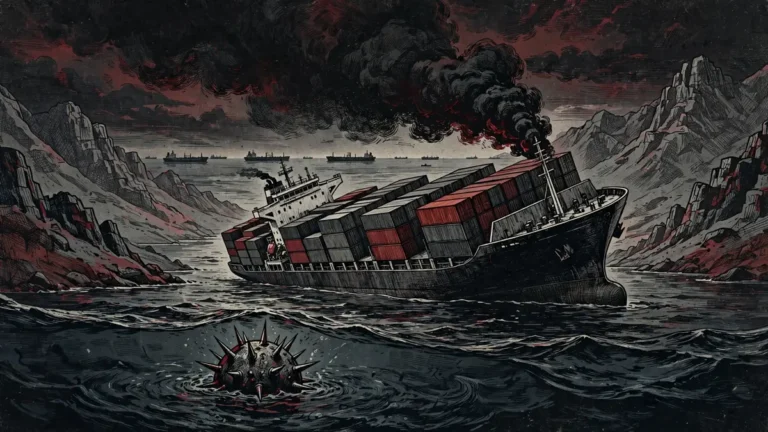
The IRGC Navy made the dispute concrete after the sinking of the GFS Pride on October 14. In a statement carried by Iran’s state TV and reported by the Times of Israel, the Guards said the vessel hit a naval mine while travelling what they called an illegal and dangerous route — language Tehran applies to the US-backed southern corridor. Independent maritime security analysts have cast doubt on the mine claim, and the exact cause of the sinking remains disputed.
The legal battle goes back months. Under the June ceasefire memorandum’s fifth point, Iran committed to use its best efforts for the safe passage of commercial vessels with no charge for 60 days, FutureUAE reports — an arrangement that has since collapsed. On October 13, Secretary of State Marco Rubio said that “no country is permitted to charge tolls or fees on an international waterway.” Washington’s position is that the strait is an international waterway subject to transit passage under the UN Convention on the Law of the Sea, and Iran cannot impose its own navigation system. Oman has played mediator: Muscat proposed a regional management mechanism inspired by the Strait of Malacca, and talks have explored splitting oversight, with Iran handling inbound traffic and Oman handling outbound movements.
What does the Omani corridor mean for US/UK/EU readers?
The corridor is the reason oil is still flowing out of the Gulf at all — and the reason prices are high anyway. Brent crude settled at $106.06 a barrel and WTI at $95.09 on October 14, Al Jazeera reported, as the ship sinkings, Houthi attacks in Saudi Arabia, and continued tension over the strait kept markets on edge. The International Energy Agency has warned that global diesel shortages could persist well into 2027, with record prices fuelling inflation.
For households in the US, UK, and EU, the effects travel through fuel prices, airfares, and shipping costs. October’s shipping bill through Hormuz shows how insurers price in the risk: war-risk premiums reportedly hit 7–8% of a vessel’s value at the peak of the crisis, and underwriters now shorten coverage validity because conditions can change within hours.
WarBrief’s shipping and markets coverage is educational analysis only, not financial advice. Energy prices and insurance rates change rapidly during conflicts.
What happens next in the Strait of Hormuz?
The most immediate deadline is the 60-day US-Iran framework to reach a deal to end the conflict. It remains unclear what shipping arrangements will apply once it expires, and media reports have speculated that Iran may seek to impose fees on vessels using the waterway afterwards — the exact move Rubio warned against. For context on how the sinkings began, see our Strait of Hormuz coverage hub.
Three scenarios are competing. The first is that Oman’s temporary IMO-coordinated corridor becomes the durable channel — effectively institutionalising the southern route. The second is the Iran-Oman “intermediate” corridor, with inbound traffic under Iranian oversight and outbound under Oman’s, possibly with shared service fees. The third is breakdown: another attack — whether by mine, drone, or projectile, as in the drone strikes on tankers this month — freezes transits entirely.
Watch for three signals: whether insurers lengthen coverage validity (a sign they believe the corridor is stabilising), whether Iran repeats or escalates its “unauthorized route” warnings after the GFS Pride sinking, and whether the 60-day framework produces any written agreement on shipping before it lapses. Until then, the strait remains contested but partially transited — the most watched maritime flashpoint in the world.
Frequently asked questions
What is the Omani corridor?
The southern shipping lane through the Strait of Hormuz, running through Omani waters along the Musandam Peninsula. Since the US-Iran war began, the US has backed it as the protected route for commercial shipping, with American and allied naval forces providing escorts and surveillance. On October 14, 2026, Oman formally announced a temporary version coordinated with the IMO, open to all vessels with no tolls.
Why are there two routes through the Strait of Hormuz?
The strait has an internationally recognised Traffic Separation Scheme with lanes for inbound and outbound traffic. Since the conflict escalated, two competing security arrangements have emerged: a US-backed southern corridor through Omani waters, and an Iranian-preferred northern route through waters Tehran oversees. Iran has warned vessels using the southern route.
Is the Omani corridor safe for ships?
Safer than the alternatives, but not safe. The corridor has US naval escorts, organised transit groups, and air cover, and the US claims more than 1,000 vessels have transited it in three months. But Iranian weapons have still hit ships: the GFS Pride sank on the route on October 14, and the MT Petro Dolphin was hit by a drone attack earlier in October. Insurers still price in a war premium.
Is the Strait of Hormuz open to shipping now?
Partially. The waterway is contested but not fully closed: roughly 10 million barrels of oil per day were moving through the southern channel as of August reporting — about half of pre-war levels. Traffic is escorted, scheduled, and insured at war-risk rates, but two cargo ships sank in a single day on October 14, showing how fragile the passage remains.
Can Iran charge tolls on ships passing through Hormuz?
Iran has proposed transit or “service fees,” but the US flatly rejects the idea — Secretary of State Marco Rubio stated on October 13 that no country may charge tolls on an international waterway. Oman’s October 14 corridor announcement carries no transit fees, though the 60-day US-Iran framework leaves the longer-term arrangement unresolved.
Sources
- Ship & Bunker: Oman Opens Temporary Shipping Corridor Without Tolls in Strait of Hormuz
- Gulf News: Strait of Hormuz — Why Are There Two ‘Routes’?
- Daily Sabah: US Operates Clandestine Shipping Corridor Through Strait of Hormuz
- Free Press Journal: Strait of Hormuz Mine Explosion Sinks Cargo Ship, Iran’s Revolutionary Guards Say
- Anadolu Agency: In 5 Questions — How the Strait of Hormuz Is Managed and What Could Change
- Moneycontrol: Why the Strait of Hormuz Has Become the World’s Most Dangerous Shipping Route
- Times of Israel: Iran Guards Say Cargo Ship Sank in Hormuz After Hitting Mine
- Al Jazeera: Iran War Updates — Cargo Ships Sunk in Hormuz (Oct 14 live blog)


Discussion 0
Share analysis, corrections, or context. Be civil — comments are moderated.