
WarBrief Live | November 17, 2026 | Energy & Oil
Brent close, Mon 16 Nov — down $3.40 (3.6%)
Brent, 04:30 GMT Tue 17 Nov
IEA Q4 2026 supply above demand
Iran forecast winter gas deficit
Brent crude settled at $92.44 a barrel on Monday 16 November, down $3.40, even as tankers burned in the Strait of Hormuz. The Brent oil price in November 2026 is falling for a reason that has little to do with the shooting: the International Energy Agency now expects the world to produce more oil than it uses, and that surplus forecast is outweighing the war premium.
Key Takeaways
- Brent fell 3.6% on Monday to $92.44 and traded at $91.66 on Tuesday morning, despite new attacks on Gulf shipping.
- The IEA said on 13 November that the global oil market will return to surplus in the final quarter of 2026, with supply 1.7 million barrels a day above demand.
- Hormuz flows remain roughly half of pre-war levels, but overall Middle East exports excluding Iran have recovered to more than 90% via the strait and bypass routes.
- Iran faces its own energy crisis: a forecast winter gas deficit of about 430 million cubic metres a day.
Why did Brent oil fall on 16 November?
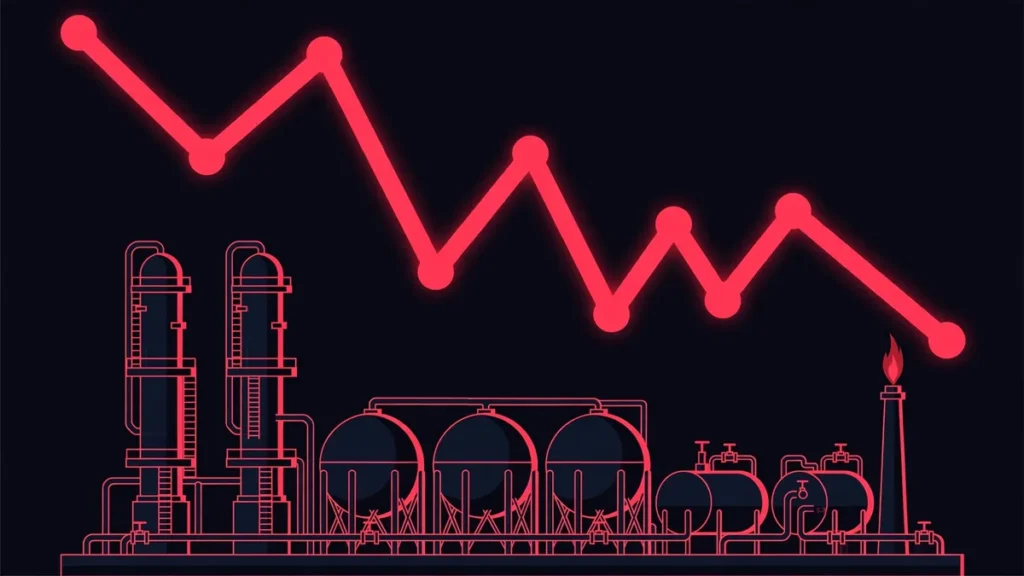
Brent crude futures fell $3.40 a barrel, or 3.6%, to settle at $92.44 on Monday, Reuters reported. US West Texas Intermediate fell $2.84, or 3.2%, to $85.72. Brent slid through the session, down $1.67 at $94.17 by early afternoon in London, before closing at its low.
The fall capped a second consecutive weekly decline. Brent had settled at $95.84 on Friday 13 November, and Monday’s drop extended the slide into a third week. By 04:30 GMT on Tuesday, Brent traded at $91.66, down a further 0.8%, according to Reuters. Brent has shed roughly a fifth of its value since the start of November.
Three forces drove the move: recovering Hormuz flows reinforced surplus expectations; the IEA’s Friday forecast flipped the market’s view; and Goldman Sachs expects Brent to average $88 in 2027 and ease to $78 by year-end.
What did the IEA say about the oil surplus?
The International Energy Agency said on Friday 13 November that the global oil market will return to a surplus in Q4 2026, as Middle East exports recover faster than demand despite continued attacks on shipping. The agency expects oil supply to average 105 million barrels a day in the final quarter, 1.7 million barrels a day higher than forecast demand. It had previously forecast a deficit for the quarter.
The agency’s November report added that global supply exceeded demand in October for the first time since the outbreak of the war, with observed inventories rising 52 million barrels that month. The IEA also said 71 million barrels from the record release of emergency oil reserves its members pledged in March would be made available by the end of February, including 15 million barrels of diesel.
About 15 million barrels a day of crude moved through the Strait of Hormuz in 2025, according to IEA data. The US Energy Information Administration’s November outlook underlined the split between crude and products: it cut its 2027 Brent forecast to $86 a barrel from $97, while raising its US retail diesel forecast to $5.03 a gallon from $4.49.
How can oil fall while tankers are being attacked in Hormuz?
The paradox has a simple explanation: futures price the oil that will actually be delivered, and that oil is still flowing. Our guide to how war moves oil prices sets out the mechanism: a war premium only holds while traders believe supply is at risk, and the market now believes it is not. That is the same logic behind why oil first fell below $90 on 10 November.
Monday’s attacks were real enough. The United Kingdom Maritime Trade Operations agency reported that a tanker was attacked about seven nautical miles north of Khasab, Oman, as it left the strait; an unknown projectile struck the vessel, disabling it and starting an engine-room fire. Maritime security firm Vanguard identified the ship as the Panama-flagged ON PHOENIX. Iran’s Revolutionary Guards said two tankers struck mines on a route Tehran considers unauthorised, and Iran’s navy said a third tanker was immobilised by a mine east of the strait. Those claims could not be independently verified, and Iranian authorities did not name the vessels.
The physical picture explains the market’s calm. Flows through the strait itself remain roughly half of pre-war levels, but overall Middle East exports excluding Iran have recovered to more than 90% of pre-war levels via the strait and bypass routes, according to Bloomberg. Bypass pipelines and rerouting have kept the oil moving even as the strait itself stays dangerous — the costs are the subject of our analysis of what the tanker war costs. Bloomberg’s Javier Blas argues the market is “stuck in limbo”: traders are pricing in no immediate third round of fighting, not peace — and if a deal were reached, oil would trade significantly cheaper than its current value.
By the numbers
| Metric | Figure | Source | Status |
|---|---|---|---|
| Brent, Mon 16 Nov | $92.44 (down $3.40, 3.6%) | Reuters | CONFIRMED |
| Brent, Tue 17 Nov, 04:30 GMT | $91.66 (down 0.8%) | Reuters / CNBC | CONFIRMED |
| WTI, Mon 16 Nov | $85.72 (down $2.84, 3.2%) | Reuters | CONFIRMED |
| Brent, Fri 13 Nov | $95.84 (second weekly fall) | Reuters | CONFIRMED |
| IEA Q4 2026 supply/demand | 105m bpd vs 103.3m bpd (surplus 1.7m bpd) | IEA | CONFIRMED |
| Goldman 2027 Brent view | $88 average; $78 by December 2027 | Goldman Sachs | CONFIRMED (forecast) |
| Crude through Hormuz, 2025 | ~15m bpd | IEA | CONFIRMED |
| Hormuz transit now | Roughly half of pre-war levels | ANZ / industry estimates | REPORTED (estimate) |
| Iran winter gas deficit | ~430m cubic metres a day | Iranian government via Reuters | CONFIRMED (as a forecast) |
| Tankers claimed hit by mines | Two claimed; vessels unnamed | IRGC via Iranian media | REPORTED (unverified) |
Figures marked REPORTED come from a single or unverified source and may change.
What the Brent slide means for US, UK and EU drivers and heating bills
For petrol, the relief is real but slow. Wholesale crude falls usually feed through to pump prices over weeks, not days, so drivers should expect gradual relief rather than an overnight drop.
Diesel is the exception, and it matters more in Europe than in the United States. The EIA raised its 2027 US retail diesel forecast to $5.03 a gallon from $4.49 even as it cut its Brent forecast, because the bottleneck is refining capacity, not crude supply. Ukrainian drone strikes since late October have cut Russian refining capacity by about 30%, roughly 2.2 million barrels a day, according to two industry sources cited by Reuters. In the UK and the EU, where diesel powers much of the freight fleet and many cars, haulage and heating-oil costs will stay elevated while petrol eases.
Heating is the third exposure: winter demand is rising just as Iran’s gas crisis deepens. A cold snap, a new Hormuz incident, or a decision by OPEC+ to restrain output at its ministerial meeting on 29 November would reverse the slide quickly.
This article is educational and is not financial advice.
Why is Iran facing a gas shortage in the middle of an oil war?
Iran holds the world’s second-largest proven natural gas reserves, behind only Russia, according to Al Jazeera — yet its government last week forecast a peak-demand deficit of about 430 million cubic metres a day this winter, up from about 300 million last year.
The cause is war damage. Strikes on gas-processing plants in March — 26 projectiles struck six refineries on 18 March — knocked out 28% of Iran’s gas production capacity in the immediate aftermath, according to the National Iranian Gas Company. About 100 million cubic metres a day has since been restored, but fully bringing back the remaining 130 million could extend into 2028.
Gas accounts for 73% of Iran’s energy mix, the gas company said last week, and household consumption has reached 480 million cubic metres a day and is expected to rise sharply as the cold season approaches. The company identifies 11 of Iran’s 31 provinces as considerably vulnerable to shortages this winter, particularly Mazandaran, Golestan and North Khorasan in the north. Government spokesperson Fatemeh Mohajerani warned gas might be cut off across the country, including Tehran, and shortages could cause blackouts at gas-fed power plants. A senior Iranian source told Reuters that Iran is in talks to import gas from Russia.
Different perspectives
The surplus camp — the IEA and Goldman Sachs — argues fundamentals point down and the war premium is a wasting asset. The risk camp — Commerzbank and Bloomberg’s Javier Blas — argues the premium is compressed, not gone: one successful attack on Gulf output or Hormuz traffic would send prices back up.
What to watch next in the oil market
- Wednesday 18 November: the EIA weekly petroleum status report and the Federal Reserve’s October minutes.
- 29 November: the OPEC+ ministerial meeting — any signal of restraint would put a floor under Brent.
- Project Freedom: the US mission to guide stranded vessels through the Strait of Hormuz, and Iran’s response. Read our report on Iran’s claim that a US warship was hit for what is confirmed and what is not.
- Shipping: whether attacks on tankers escalate again. The aircraft carrier USS Theodore Roosevelt arrived in the region on 15 November.
- Iran’s winter: the gas balance through December and any Russian import deal.
- The hubs: follow the wider picture on our conflict zones hub.
Frequently asked questions
Why is Brent oil falling despite the war with Iran?
Because supply is growing faster than demand. The IEA said on 13 November that the market will return to surplus in Q4 2026, with supply 1.7 million barrels a day above demand. Middle East exports outside Iran have also recovered to more than 90% of pre-war levels through the strait and bypass routes.
What is the IEA’s oil surplus forecast?
The International Energy Agency said on 13 November 2026 that global oil supply will average 105 million barrels a day in the fourth quarter of 2026, about 1.7 million barrels a day more than the world is expected to use. The agency also said 71 million barrels from emergency reserves would be available by the end of February, including 15 million barrels of diesel.
Will petrol and diesel prices fall in the UK?
Petrol usually follows Brent lower with a lag of weeks, so some relief is likely if crude stays near $92. Diesel is different: refining capacity is tight, and the US Energy Information Administration raised its 2027 retail diesel forecast even as it cut its Brent forecast. UK and EU drivers should expect diesel to stay expensive relative to petrol.
Latest: Russia earned an average of €754 million a day from fossil fuel exports in October 2026, the highest since December 2022, according to CREA data published November 12. Read our full breakdown: Russia Earned EUR 754 Million a Day From Fossil Fuels in October — Despite the Sanctions Net.
Sources
- Reuters (via Business Recorder): Oil falls as recovering ME exports bolster surplus outlook
- Reuters (via Dawn): Oil prices fall
- Al Jazeera: Iran braces for natural gas shortages during winter energy imbalance
- Reuters (via The Jerusalem Post): Iran faces winter gas crisis after US war damages energy plants
- Reuters (via Moneycontrol): From oil shortage to surplus? Crude prices fall as IEA signals major supply shift
- FinanceFeeds: Brent Crude Oil Price: $91.66 Tuesday as Goldman Warns of a Glut
- AInvest: Brent Shrugged Off Bahrain. The Diesel Barrel Hasn’t.



Discussion 0
Share analysis, corrections, or context. Be civil — comments are moderated.