
WarBrief Live | November 18, 2026 | Breaking Analysis
| 227 m Road arch that collapsed into the Kerch Strait | 19 km Total length of the Crimean Bridge | ~6,000 tonnes Estimated weight of the fallen arch section* | 1+ years Estimated rebuild time, per military experts* |
*Expert estimates, not official figures. See the By the numbers table below.
Ukraine collapsed a section of the Crimean Bridge on the night of November 16-17, 2026, dropping its 227-metre road arch into the Kerch Strait and cutting the road link between Russia and occupied Crimea. Rail traffic resumed on one track by noon on November 17, but the roadway is out of action.
What investigators have confirmed so far: a two-night operation tilted the arch on November 16 and brought it down on November 17; the attack was the seventh stage of a weeks-long operation by Ukraine’s Security Service (SBU) and General Staff; and Russia has promised to rebuild the crossing. What remains unverified: the full extent of the damage to the railway section, the exact repair timeline, and the casualty claims from both sides.
Key Takeaways
- Ukrainian forces struck the Crimean Bridge on two consecutive nights. The November 16 drone attack tilted the 227-metre road arch by about 15 degrees; the November 17 combined missile and drone strike collapsed the arch and a road span into the water.
- President Volodymyr Zelenskyy said the strike was the seventh phase of an operation that ran for several weeks, in which Ukrainian forces first destroyed Russian air defences, radars and electronic warfare systems around the bridge.
- The road section is out of service and no vehicle can cross it. The railway section is still standing but damaged, with traffic restored on one track by noon on November 17.
- The fallen arch now sits in the navigable channel of the Kerch Strait, which experts say could block shipping for weeks or months and raises the cost of supplying Russian forces in southern Ukraine and Crimea.
- Russia answered within hours, hitting Kyiv’s Northern and Southern bridges with ballistic missiles. Two people were killed in Kyiv, and NATO Secretary General Mark Rutte publicly defended Ukraine’s right to strike Russian logistical targets.
What happened to the Crimean Bridge on November 16-17?
The operation unfolded over two nights. On the night of November 16, Ukrainian drones struck the bridge and visibly shifted the 227-metre arch supporting the roadway sideways by approximately 15 degrees, damaging the road surface in two places, RBC-Ukraine reported. The Russian-installed head of Crimea, Sergey Aksyonov, confirmed the strike and said road traffic had been shut from 2:22 a.m. Moscow time.
On the night of November 17, Ukraine’s Defence Forces launched a second, combined attack using drones and missiles. The arch that had been tilted the previous day and a section of the roadway could no longer withstand the damage and collapsed into the water, RBC-Ukraine reported. Ukraine’s General Staff said plainly: “The arch and a span of the bridge’s road section have collapsed. The roadway is out of action: no vehicle can cross it. The railway section is still standing, but now with a damaged arch.”
Russia’s Transport Ministry confirmed the attack and announced a temporary suspension of traffic on both the road and railway sections. By noon on November 17, railway traffic had been restored on one track, while the road remained closed. Video of the collapsed arch, published by President Zelenskyy and verified by Reuters, showed a gap in the roadway with debris visible in the strait below.
The strike came two days before Russian President Vladimir Putin was scheduled to meet US President Donald Trump and Chinese President Xi Jinping in Shenzhen, China, on the sidelines of the APEC summit. The timing was not lost on observers: the bridge is both a supply artery and, as the Atlantic Council noted, a personal prestige project for Putin, built to cement the 2014 annexation of Crimea.
What weapons did Ukraine use against the Crimean Bridge?
Zelenskyy named the weapons himself on November 17, describing a combined strike by a long list of Ukrainian-built systems. “Today – at a critical stage of the operation – the Palianytsia drones performed exemplarily, striking the vehicular section of the bridge, while Neptune missiles, along with Ruta and FP-5 drones, struck the railway section,” he said. “Using the Flamingo system, our forces executed a precision [strike], with the communication link functioning perfectly right up to the final seconds.”
The full list Zelenskyy gave for the operation included Dovbush, Vendetta, Da Vinci, Sichen, MICH 2000, Ruta, Palianytsia, An-197, FP-1, FP-5 Flamingo and R-360 Neptune, The War Zone reported. The SBU said its Alfa special forces fired the Palianytsia drones at the road section before it collapsed, and that the operation lasted about a month and ran in seven stages.
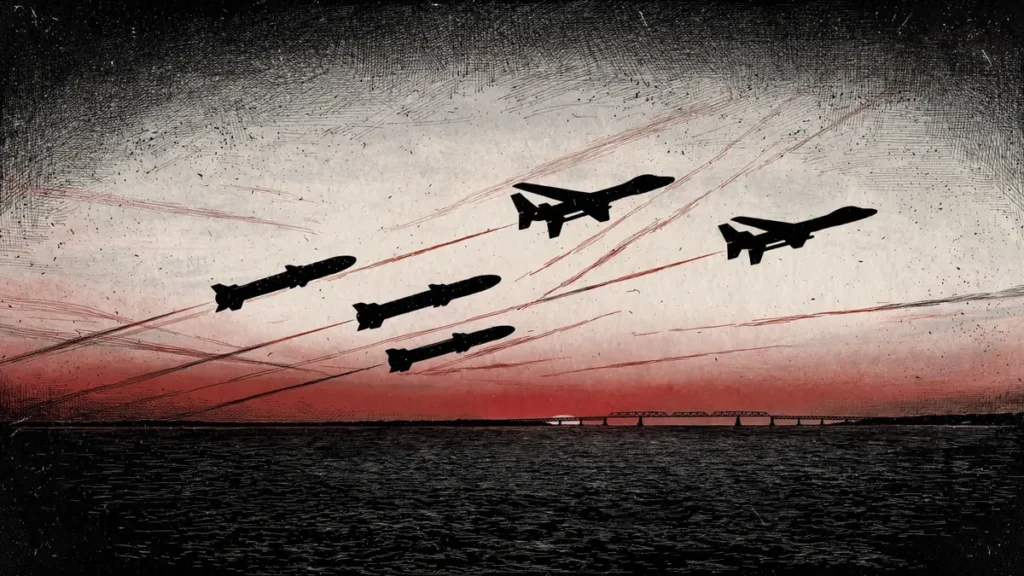
European arms maker Destinus, which builds the Ruta cruise missile, said its weapons struck the bridge on both nights. “Last night’s strikes damaged the bridge’s upper load-bearing structure. Today, seven RUTA missiles hit the bridge, causing one span to collapse,” the company said on LinkedIn. The FP-5 Flamingo, which carries a 2,500-pound warhead, drew particular attention: video published by Ukrainian forces appeared to show a Flamingo making its attack run with what The War Zone described as apparent man-in-the-loop control.
Just as important as the weapons was the preparation. Zelenskyy said Ukrainian forces “gradually destroyed air defense systems, radars, electronic warfare equipment, and other designated targets on the way to the final objective.” The SBU said the same: the early stages systematically suppressed Russian air defences, and only then did direct strikes on the bridge begin. A US Air Force RC-135U electronic intelligence aircraft, supported by a NATO E-3A Sentry, was reported monitoring airspace around Crimea less than a day before the follow-up attack, according to the Kyiv Post.
Background: the bridge’s history as a target
The 19-kilometre Crimean Bridge, also known as the Kerch Bridge, links Russia’s Krasnodar Krai with the Crimean Peninsula across the Kerch Strait. Built after Russia’s 2014 occupation of Crimea, the road section opened in 2018 and passenger rail services began in 2019. The project cost about $4 billion and was designed as a political statement as much as a transport link.
Ukraine has targeted it repeatedly since the full-scale invasion began. The SBU said the November 2026 operation was the fourth time it had damaged the bridge: a truck bomb in October 2022, Sea Baby kamikaze drone boats against support pylons in July 2023, and underwater explosives placed on pylons in June 2025. None of those attacks took the bridge out of commission for long. This one did.
The Kerch strike also fits a wider campaign. Ukraine’s General Staff said the bridges at Chonhar and Henichesk, on Crimea’s northern edge, were destroyed this autumn, shrinking the land routes available to Russian forces in Crimea. WarBrief’s coverage of Ukraine’s deep-strike campaign has tracked how Kyiv has extended its reach against refineries, airbases and logistics deep inside Russia – a campaign that depends on the same long-range drones and cruise missiles used at Kerch. The bridge attack is the most visible result of that campaign so far.
By the numbers: what is confirmed and what is reported
| Metric | Figure | Source |
|---|---|---|
| Road arch length | 227 metres | CONFIRMED – RBC-Ukraine; Guardian photographs |
| Arch tilt after November 16 strike | ~15 degrees | CONFIRMED – RBC-Ukraine |
| Bridge total length | 19 km (12 miles) | CONFIRMED – Kyiv Independent |
| Fallen arch section weight | ~6,000 tonnes | REPORTED – expert estimate (Andrii Kharuk, via Kyiv Independent) |
| Estimated rebuild time | More than a year | REPORTED – expert estimates (Andriy Ryzhenko, RBC-Ukraine; Kharuk, Kyiv Independent) |
| Ukrainian drones Russia says it downed on November 17 | 2,256 | REPORTED – Russian Defence Ministry claim, via Times Now and Izvestia |
| Ballistic missiles at Kyiv’s bridges | 4 at Southern Bridge, 3 at Northern Bridge | REPORTED – President Zelenskyy, via Times Now |
| People killed in Kyiv overnight November 17 | 2 | CONFIRMED – Kyiv City Military Administration and State Emergency Service, via UNN |
| People killed in Crimea’s Lenin district | 2 | REPORTED – Sergey Aksyonov, via The War Zone (not independently verified) |
Caveat: figures marked REPORTED rest on a single source or a party’s own claim and may change as more evidence emerges. The Russian drone figure is disputed in its own terms: Channel News Asia reported 1,441 drones downed in the overnight barrage alone, while the Defence Ministry’s full-day figure was 2,256.
Why the Kerch Strait shipping blockage matters for the Black Sea
The military effect of the strike is only half the story. The other half is in the water. Retired Ukrainian Navy Captain Andriy Ryzhenko told RBC-Ukraine that the main strategic impact lies in the blockade of shipping: the 6,000-tonne arch fell into the navigable channel, and clearing it will most likely take at least weeks, possibly months.
That matters because the Kerch Strait is the only sea passage between the Black Sea and the Sea of Azov, and the bridge has always been the chokepoint over it. WarBrief’s Black Sea shipping war coverage has documented months of drone attacks on vessels, port infrastructure and grain corridors; the bridge collapse adds a physical obstruction to a waterway that was already contested. Ferries now carry passengers between Crimea and the Russian mainland, but ferries have themselves been targeted by Ukrainian attacks in the past, and they cannot replace the volume a road-and-rail bridge carried.
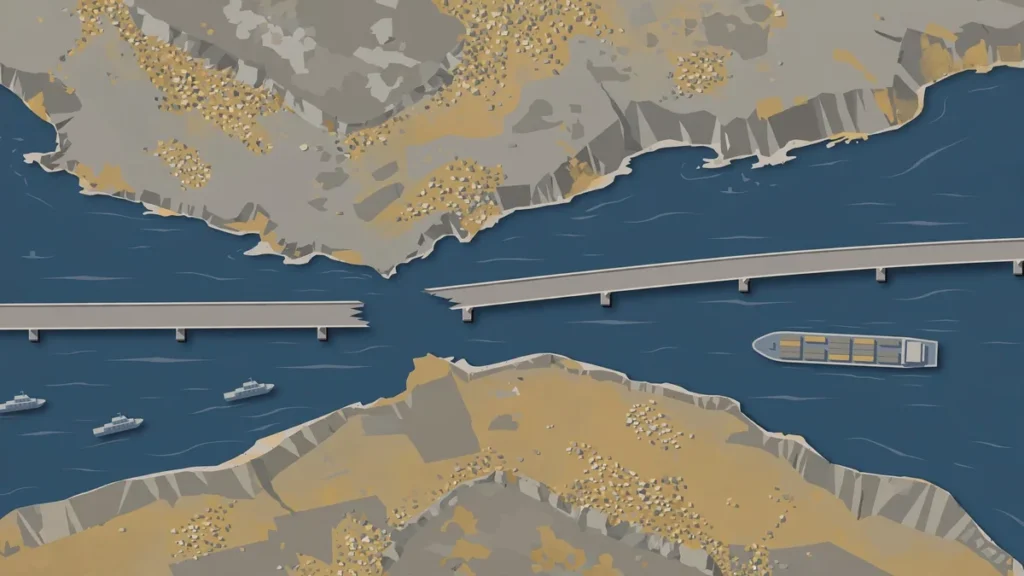
There is a counter-argument, and Moscow is making it. Mikhail Razvozhayev, the Russian-installed governor of Sevastopol, said the bridge “was practically not used for delivering cargo” and that all supply chains for the city were preserved. If that is accurate, the immediate logistical damage is smaller than Kyiv claims – though it sits awkwardly with the General Staff’s description of the bridge as “the main artery carrying fuel, ammunition, equipment and personnel to the peninsula and on into southern Ukraine.” The truth is probably between the two: the bridge mattered most for road freight and civilian traffic, while much military cargo already moved by rail and sea. Even so, every hour the road stays closed narrows Russia’s options, and the land alternatives at Chonhar and Henichesk are already gone.
The shipping blockage also reaches beyond the war. Insurers price war risk on the Black Sea by the incident, and a collapsed arch in the Kerch channel is the kind of event that pushes premiums and reroutes traffic – the same dynamic WarBrief has tracked in the Bab el-Mandeb and Strait of Hormuz chokepoints, where mines and missile threats have already reshaped tanker routes this month.
How Russia responded – and what the world said
Moscow’s public response combined defiance with damage control. Kremlin spokesman Dmitry Peskov said there was “no doubt that the bridge will be restored” and that it “will be even better than before.” A government commission on the consequences of the attack, led by Deputy Prime Minister Marat Khusnullin, was convened, and Peskov said Khusnullin had briefed President Putin. Russia’s Investigative Committee opened a criminal case into what it called a terrorist act.
The military response came the same night. Russian forces struck Kyiv’s Northern and Southern bridges over the Dnipro River with ballistic missiles – four at the Southern Bridge and three at the Northern, according to Zelenskyy. Two people were killed in Kyiv’s Obolonskyi district, and the strikes damaged heating and water supplies, suspended Green Line metro services and closed both bridges to traffic while engineers assessed the damage. Traffic has since partially resumed on the Southern Bridge.
International reaction split along familiar lines. NATO Secretary General Mark Rutte defended Ukraine’s right to strike Russian logistical infrastructure. Poland’s Foreign Minister Radoslaw Sikorski posted: “Two refineries, an airbase and half the Kerch bridge in a couple of days. Looks like Ukraine has cards.” In Washington, the reaction was cooler: US Defense Undersecretary Elbridge Colby criticised the attack as disruptive to American efforts to end the war, saying Ukrainian strikes “have not been effective in driving an end to the war” – a reminder that Kyiv’s escalation carries diplomatic costs even when it succeeds militarily.
Ukraine’s Presidential Sanctions Commissioner, Vladyslav Vlasiuk, added a pointed coda on social media: “Crimean Bridge. Sanctioned.” The bridge has been under Western sanctions since its construction, but the remark captured Kyiv’s message – that a symbol of annexation, however sanctioned, could still be struck.
What this means for US/UK/EU readers
For readers in the US, UK and EU, the direct effects are limited but real. Black Sea shipping disruption feeds into grain and energy freight rates, and war-risk insurance premiums for vessels in the region will be repriced after an event of this scale – costs that eventually reach food and fuel prices. The strike also lands two days before the Putin-Trump-Xi meeting in Shenzhen, which means the bridge will be in the room, literally or not, when the three leaders discuss Ukraine. For European governments, the attack tests the line Rutte drew: strikes on Russian logistics are legitimate, but they invite retaliation against Ukrainian cities, as Kyiv’s bridges showed within hours. And for defence planners, the operation is a case study in what Ukrainian industry can now do – a domestically built cruise missile, the FP-5 Flamingo, with a 2,500-pound warhead and apparent man-in-the-loop guidance, hitting a defended target 19 kilometres long. That capability, built under fire, is the story that will outlast this bridge.
What to watch next in the Black Sea
Five things will show whether this strike changes the war or becomes another repaired span. First, whether the railway section holds: it is standing but damaged, and Ukrainian experts warn it will need load restrictions and prolonged technical inspections after the shock to its supports. Second, whether Russia can keep Crimea supplied by ferry and by the damaged rail line while the road is out – and whether Ukraine strikes the ferries next. Third, whether the arch can be cleared from the navigable channel in weeks, as optimists hope, or months, as Ryzhenko expects. Fourth, whether Zelenskyy’s warning holds – he said new waves of strikes on the bridge could still be coming, and the SBU has now damaged it four times. And fifth, what happens at Shenzhen on November 19, where the bridge’s collapse gives Putin a fresh grievance and Trump a fresh complication in the same meeting. WarBrief will update this story as the damage assessment, the repair plan and the shipping picture become clear. For the wider picture, see our Conflict Zones hub and our reporting on North Korea’s missile pipeline to Russia, which supplies the weapons Moscow fires back.
Frequently asked questions
What happened to the Crimean Bridge in November 2026?
Ukrainian forces struck the bridge on two consecutive nights. On November 16, drones tilted the 227-metre road arch by about 15 degrees. On November 17, a combined drone and missile strike collapsed the arch and a road span into the Kerch Strait. The road is out of action; rail traffic resumed on one track by noon on November 17.
Is the Crimean Bridge destroyed or still standing?
Partly both. One metal arch and the road span beneath it were completely destroyed, according to the SBU, and the roadway cannot be used. The railway section is still standing but was damaged, and trains are running on one track while engineers assess it.
What weapons did Ukraine use to hit the Crimean Bridge?
President Zelenskyy said Palianytsia drones struck the road section, while Neptune missiles, Ruta drones and FP-5 Flamingo cruise missiles struck the railway section. The operation also used Dovbush, Vendetta, Da Vinci, Sichen, MICH 2000, An-197 and FP-1 systems, mostly to destroy Russian air defences, radars and electronic warfare equipment first.
How long will it take to repair the Crimean Bridge?
More than a year, according to military experts cited by RBC-Ukraine and the Kyiv Independent. The fallen arch weighs around 6,000 tonnes, was assembled onshore over months before being installed, and cannot be rebuilt over open water. Russia says the bridge will be restored, but has not published a timeline.
Why is the Crimean Bridge important to Russia?
It is the main road and rail link between Russia and occupied Crimea, carrying fuel, ammunition, equipment and personnel into the peninsula and on into southern Ukraine. It is also a symbol: a $4 billion project built after the 2014 annexation to cement Crimea’s connection to Russia. Its collapse is both a logistical blow and a political humiliation for the Kremlin.
Sources
- RBC-Ukraine: Ukraine strikes Crimean Bridge twice in two days, collapsing arch and blocking shipping
- Kyiv Independent: Entire section of Crimean Bridge collapses after ‘seven-phase operation,’ Zelensky reveals
- The War Zone: What We Know About Ukraine’s Strikes That Cut Russia’s Kerch Bridge
- Military.com: Ukraine Strikes Section of Russia’s Crimean Bridge Two Days Before Putin Meets Trump, Xi
- Atlantic Council: Ukraine’s Crimean Bridge attack is a very personal humiliation for Putin
- Times Now: Ukraine Blows Up Putin’s ‘Pet Project’ Bridge Linking Russia to Crimea
- Channel News Asia: Russia, Ukraine exchange strikes on bridges ahead of Xi-Trump-Putin summit


Discussion 0
Share analysis, corrections, or context. Be civil — comments are moderated.