
WarBrief Live | November 14, 2026 | Event Preview
€70bn
Ukraine’s estimated funding gap for 2027
€45bn
The share the EU is expected to cover
€90bn
Existing EU loan for Ukraine, 2026–27
Nov 26–27
Special European Council, Brussels
On November 26–27, European Union leaders meet in Brussels for a Special European Council with two items on the agenda: the EU’s 2028–2034 long-term budget and how to cover Ukraine’s estimated €70 billion funding shortfall in 2027. The special european council november 2026 ukraine funding what to expect question is, in short, whether 27 governments that cannot agree on who pays can still agree on a plan before the money runs out.
Key Takeaways
- European Council President António Costa has set aside the November 26–27 Special European Council for two items only: the 2028–2034 Multiannual Financial Framework and Ukraine’s financing needs for 2027.
- Ukraine faces an estimated €70 billion shortfall in 2027, with the EU expected to cover about €45 billion — roughly two-thirds — according to European Commissioner Valdis Dombrovskis.
- German Chancellor Friedrich Merz has tied Germany’s support for the next seven-year EU budget to a commitment from all 27 member states to fund Ukraine, turning the budget negotiation into a leverage point.
- The European Commission is expected to present a concrete financing proposal before the summit, and EU foreign ministers are expected to adopt new Russia sanctions listings on November 16.
- No decision is guaranteed: the long-term budget requires unanimity, and several governments have already signalled they will not join a new Ukraine loan.
What is on the agenda in Brussels on November 26–27?
The meeting is a Special European Council, which means it was called for a specific purpose rather than as part of the regular calendar of summits. According to a letter from Costa to Merz seen by the Kyiv Independent on November 10, the agenda will have exactly two items: “the EU’s next multiannual financial framework and Ukraine’s financial needs for 2027.” Costa wrote: “We will address this issue in the Special European Council on 26–27 November,” and added that the Commission would submit its proposal on Ukraine’s financing before the meeting.
The Council itself confirmed the plan after the informal meeting of EU leaders in Dublin on November 13. In its published results, the Council said leaders would address “how best to respond to Ukraine’s financing needs for 2027 and beyond, building on the forthcoming proposals from the European Commission” at the November 26–27 meeting. That framing matters: the summit is not being sold as a routine budget discussion, but as the moment the financing question must be answered.
The two items are linked by design. The Multiannual Financial Framework — the MFF — is the EU’s seven-year spending plan, and the Commission proposed a near €2 trillion framework for 2028–2034 in July 2025, equal to about 1.26% of the EU’s gross national income. Governments have been negotiating it ever since, and they face pressure to reach agreement before the end of 2026 so legislation can be adopted in 2027 ahead of the framework taking effect in 2028. Ukraine’s 2027 needs sit outside that framework’s window, but the politics of the two are now fused: the country that wants the budget settled is using it to force a decision on Ukraine, and the countries resisting new Ukraine spending hold a veto over the budget itself.
How did the €70 billion gap become the summit’s hardest problem?
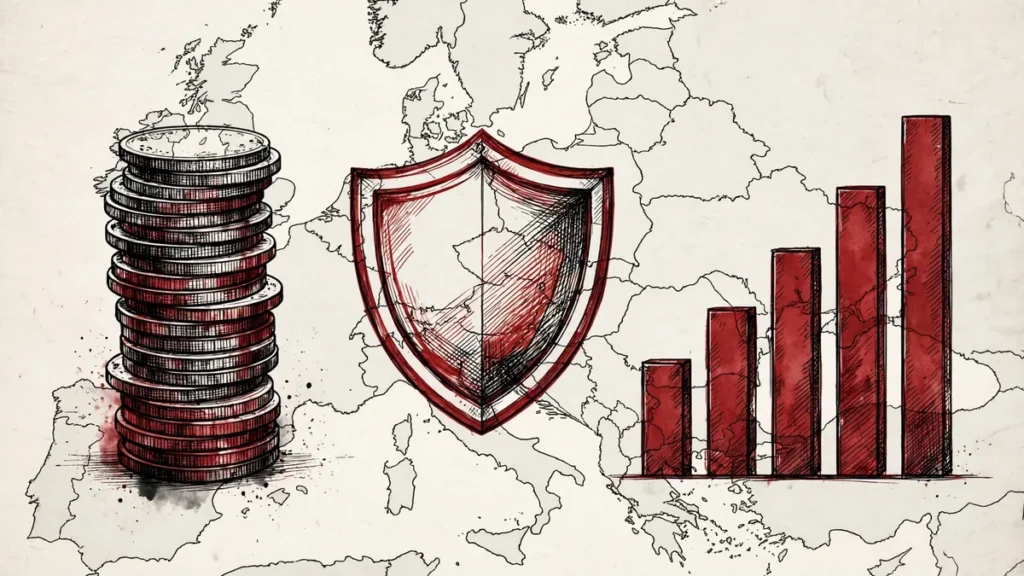
The figure at the centre of the summit is €70 billion. That is the estimated additional amount Ukraine needs in 2027, after the money already committed, according to the European Commission. President Ursula von der Leyen first put the figure to leaders in October, and Dombrovskis, the Commissioner for Economy, told reporters on November 9 that the EU intended to cover about two-thirds of it — roughly €45 billion — with the rest expected from other partners. “These are additional €70 billion, of which the EU would aim to cover approximately two thirds,” Dombrovskis said, according to reporting of his remarks.
The gap exists because the money already agreed does not stretch far enough. In December 2025 the EU agreed a €90 billion loan for Ukraine covering 2026 and 2027, split at €45 billion a year, with about two-thirds earmarked for defence and one-third for budget support. Council figures reported on November 11 show about €24.1 billion of that loan has been disbursed so far, including €16.4 billion for defence-related procurement. Ukraine’s needs have grown faster than the envelope: Russian strikes on energy and other critical infrastructure have raised the cost of keeping the state running, and Kyiv has said it will need substantially more in 2027. President Volodymyr Zelenskyy asked leaders on October 16 for at least €70 billion in additional defence and weapons assistance in 2027 alone, according to the New Voice of Ukraine.
Non-EU partners were expected to help. Reuters reported in October that Norway, Switzerland, Canada, Japan and the United Kingdom were expected to contribute €45 billion between them over 2026 and 2027, but that not all of that money had materialised. The result is a gap that is simultaneously a budget problem, a defence problem and a political problem: without new financing, Ukraine’s ability to pay soldiers, keep services running and buy weapons in 2027 is in doubt, and the EU is the lender of last resort.
By the numbers: the funding gap, the loan and the budget
The figures below separate what is confirmed by official statements or multiple reputable outlets from what is still only reported. Where two published figures differ, the article uses the most recent official figure and says so.
| Metric | Figure | Source |
|---|---|---|
| Ukraine’s estimated additional funding need, 2027 | €70 billion (CONFIRMED) | European Commission, via Dombrovskis, November 9 |
| EU share under discussion | About €45 billion, roughly two-thirds (CONFIRMED as under consideration) | Dombrovskis, November 9 |
| Existing EU loan for Ukraine, 2026–27 | €90 billion, €45 billion per year (CONFIRMED) | EU agreement, December 2025 |
| Disbursed from the €90 billion loan so far | €24.1 billion, including €16.4 billion for defence (REPORTED, Council figures) | Council figures reported November 11 |
| Proposed EU long-term budget, 2028–2034 | Nearly €2 trillion, 1.26% of EU GNI (CONFIRMED) | European Commission, July 16, 2025 |
| Russian shadow-fleet vessels already listed by the EU | More than 690 (CONFIRMED) | Commissioner Maria Luís Albuquerque, November 12 |
| New sanctions listings expected November 16 | 145 individuals and entities, plus 50 banks (REPORTED, preliminary agreement) | Coreper agreement November 11; French Europe Minister Benjamin Haddad |
Caveat: figures marked REPORTED rest on preliminary agreements or single ministerial statements and have not yet been confirmed by a final Council decision; the disbursement figure is the latest reported Council total and may have moved since November 11.
What are the options for closing the gap?
The Commission has not yet published its proposal, so the options below are the ones publicly under discussion — not a leaked draft. The most likely route, judging by the Commission’s own language, is another loan raised through joint EU borrowing, on the model of the €90 billion package. Dombrovskis said the Commission was still analysing formulas and would pass concrete proposals to member states for negotiation, and Costa’s letter says the proposal will arrive before the summit. A second loan would need the same ingredients as the first: agreement on the size, on who guarantees it, and on whether participation is universal or voluntary.
A second option, repeatedly raised and repeatedly blocked, is using frozen Russian sovereign assets — about €210 billion held in Europe, much of it at the Brussels-based Euroclear — as the basis for a loan to Ukraine. Germany and others have revived the idea as a way to fund Kyiv while reducing pressure on the next EU budget, according to reporting in late October, but Belgium has cited legal and financial risks, and the plan remains politically blocked. It is best understood as the option leaders discuss when the straightforward ones stall, not as the expected outcome of November 26–27.
A third route is a voluntary coalition: the countries willing to pay fund Ukraine outside the EU budget framework, as happened with the €90 billion loan, from which Hungary, Czechia and Slovakia did not participate. Bulgaria’s prime minister said on November 10 that Bulgaria would not join a new loan either, according to reporting of his remarks. That route can work — the existing loan is proof — but it is exactly what Merz is trying to prevent, because it lets holdouts free-ride on the security spending of others while still benefiting from the stability it buys.
Why did Merz link the budget to Ukraine funding?
The summit’s sharpest edge is not the arithmetic but the ultimatum behind it. The Financial Times reported on November 9 that Merz had written to Costa making Germany’s support for the 2028–2034 budget conditional on all 27 member states committing to finance Ukraine in 2027 and beyond. Merz’s argument, as reported, is that supporting Ukraine must be a shared responsibility across Europe, and that a long-term budget agreed while some members refuse to fund Ukraine would lock in an unfair division of the burden. He also pressed, according to reporting of his letter, for a reliable multi-year framework for Ukraine financing from 2028 onwards, including the interest on outstanding Ukraine-related debt.
Costa’s reply, seen by the Kyiv Independent on November 10, did not accept the ultimatum’s timing. Merz had urged Costa to prioritise the funding question at the earlier Dublin meeting on November 13; Costa instead promised a broad discussion in Dublin and kept the substantive decision for November 26–27. That is a small but telling piece of choreography: Dublin was where Europe’s negotiating team for the Ukraine peace talks was named — the EU institutions plus the United Kingdom, France, Germany, Italy and Poland, the so-called E5 — and where von der Leyen said the Commission would soon propose a plan to close the financing gap. The money discussion was deliberately parked until the diplomacy had its moment, and the summit is where the two threads meet.
Merz’s leverage is real because the budget rule is unanimity. Under Article 312(2) of the Treaty on the Functioning of the European Union, the Council adopts the MFF regulation unanimously, after obtaining the consent of the European Parliament. One government can therefore block the seven-year budget — and several have shown they are willing to use that power. But the leverage cuts both ways: if Merz’s condition cannot be met, Germany itself would be the country blocking the budget it says it wants agreed this year, before election campaigns in France, Italy, Poland, Greece, Estonia, Finland and Slovakia politicise the issue in 2027.
Why does the November 16 sanctions meeting matter first?
Before the summit, EU foreign ministers meet on November 16, and that meeting sets the tone. Commissioner Maria Luís Albuquerque told the European Parliament on November 12 that ministers were expected to adopt further listings covering Russian oil refineries and the shadow-fleet ecosystem, according to reporting by the New Voice of Ukraine. Ambassadors had preliminarily agreed on November 11 to add 145 individuals and entities to the lists, and French Europe Minister Benjamin Haddad said the measures would cover 50 banks operating in Russia. The EU has already listed more than 690 shadow-fleet vessels, barring them from EU ports and services, according to Albuquerque.
The same officials confirmed that the European External Action Service and the Commission are finalising proposals for a 22nd package of sanctions against Russia, which European Pravda’s EU sources said would be ready by the end of November, with Bloomberg reporting that foreign ministers could consider it in December. The sanctions track and the funding track are two halves of the same strategy: pressure on Russia’s war revenues on one side, money for Ukraine’s defence on the other. A smooth November 16 adoption would signal that the Council can still act unanimously on Russia; a fight over the listings would warn that November 26–27 will be harder than the agenda suggests. WarBrief’s coverage of the sanctions track is in our report on the EU’s new Russia sanctions on 145 targets, including 50 banks.
What the November 26–27 decisions mean for US, UK and EU readers
For readers in the EU, the summit is the most direct test yet of whether the bloc can pay for its own security strategy. If leaders agree a financing mechanism, Ukraine’s 2027 budget and defence procurement gain a planning horizon, and the MFF negotiation can move forward on its own timetable. If they do not, the question does not disappear — it returns, larger, in December, when the next Foreign Affairs Council is expected to take up the 22nd sanctions package and when the budget deadline bites harder. Households will feel the difference indirectly at first: through energy prices if the war drags on without a funded Ukrainian defence, through defence spending debates in national budgets, and through the borrowing costs attached to any new joint EU debt.
For readers in the United Kingdom, the summit matters even though Britain is no longer an EU member. The UK is part of the E5 negotiating team named in Dublin, it was among the non-EU partners expected to contribute to Ukraine’s funding over 2026–27, and its defence and sanctions policy moves in step with the EU’s. A funded Ukraine reduces the pressure on London to fill gaps unilaterally; an unfunded one increases it. The same logic applies to the United States, where the 2026 midterm elections have already reshaped the politics of Ukraine aid: Washington’s envoys are running the peace-talk process, and the credibility of that process depends in part on whether Europe can show it will pay for Ukraine’s survival while talks continue. For all three audiences, the summit is best read not as a budget meeting but as a test of whether Europe’s stated strategy — that European security begins with Ukraine’s security, in Costa’s words in Dublin — survives contact with its own treasury.
What to watch next in Brussels
Four markers will tell readers whether the summit is heading for agreement or deadlock. First, the Commission’s financing proposal, expected in the days before November 26: its size, its instrument and whether it assumes universal or voluntary participation will set the negotiation. Second, the November 16 Foreign Affairs Council: a clean adoption of the refinery and shadow-fleet listings, and any signal on the 22nd package, will show whether unanimity on Russia still holds. Third, the public positions of Hungary, Slovakia, Czechia and Bulgaria in the run-up to the summit — whether they soften, hold firm, or seek side deals. And fourth, the language in the summit conclusions on November 27: a commitment to a specific figure and mechanism would be a decision; a commitment to “continue work” would be a postponement, and the gap would then fall to the December European Council. WarBrief will update this preview as the Commission’s proposal lands and as the November 16 meeting concludes; the Conflict Zones hub carries the latest reporting on the war itself, and our coverage of the EU energy ministers’ October meeting sets out the winter energy context the summit inherits.
Frequently asked questions
What is the Special European Council on November 26–27, 2026?
It is a special meeting of EU heads of state or government in Brussels, called with a two-item agenda: the EU’s next long-term budget for 2028–2034 and Ukraine’s financing needs for 2027. European Council President António Costa confirmed the agenda in a letter to German Chancellor Friedrich Merz, and the Council confirmed it again after the Dublin meeting on November 13.
How big is Ukraine’s funding gap for 2027?
Ukraine faces an estimated €70 billion shortfall in 2027, according to the European Commission. The EU is expected to cover about €45 billion of it — roughly two-thirds — with the remainder expected from other partners, according to Commissioner Valdis Dombrovskis on November 9. The figure is additional to the €90 billion EU loan already agreed for 2026–27.
Why is Germany linking the EU budget to Ukraine funding?
Chancellor Friedrich Merz has made Germany’s support for the 2028–2034 EU budget conditional on all 27 member states committing to fund Ukraine, according to the Financial Times’ reporting of his letter to Costa. His argument is that supporting Ukraine should be a shared responsibility with no exceptions. Because the long-term budget requires unanimity, his condition gives him leverage — but also means Germany could end up blocking the budget if the condition is not met.
What happens if leaders cannot agree on November 26–27?
Nothing is decided automatically: the financing gap would carry into December, when foreign ministers are expected to take up the 22nd Russia sanctions package and the budget negotiation would face its end-of-year deadline. Ukraine’s 2026 funding is covered, so the immediate effect would be political rather than a sudden cutoff — but the uncertainty would grow for Kyiv’s 2027 planning, and the cost of delay would fall on the December European Council.
What is the Multiannual Financial Framework?
The MFF is the EU’s seven-year spending plan. The Commission proposed a near €2 trillion framework for 2028–2034 in July 2025, equal to about 1.26% of the EU’s gross national income. It must be adopted unanimously by the Council, with the consent of the European Parliament, and governments aim to agree it before the end of 2026.
Sources
- Kyiv Independent: EU’s Costa keeps Ukraine funding talks on late-November agenda despite Merz appeal
- The New Voice of Ukraine: Costa sets separate EU summit on Ukraine’s 2027 funding after Merz’s ultimatum
- Council of the European Union: Informal meeting of heads of state or government, Dublin, November 13, 2026
- The New Voice of Ukraine: EU sanctions against Russia — oil refineries and shadow fleet are on the list; package 22 coming
- Reuters via Global Banking and Finance: EU leaders to discuss 2027 money for Ukraine, next EU budget
- European Pravda: EU announces new sanctions against Russian oil refining and ‘shadow fleet’


Discussion 0
Share analysis, corrections, or context. Be civil — comments are moderated.