
WarBrief Live | October 28, 2026 | Event Preview
At a glance
700+ leaders expected | 45+ nations represented | 80+ speakers listed | November 2–5, 2026, London
Global MilSatCom 2026 opens in London on November 2, 2026, bringing more than 700 military, government and industry satellite-communications leaders together for four days of talks on keeping allied forces connected in contested skies.
The conference, now in its 28th year, is organised by SAE Media Group and takes place at the Park Plaza Riverbank hotel on Albert Embankment in London. The opening day, November 2, is a dedicated SATCOM-on-the-move focus day, with the main conference running November 3–5 — a distinction worth noting, because some exhibitor listings show only the November 3–5 main-conference dates. The organiser’s own listing gives the full November 2–5 span, with 80-plus speakers and delegations from more than 45 nations.
Key Takeaways
- Global MilSatCom 2026 runs November 2–5, 2026, at the Park Plaza Riverbank in London, with a SATCOM-on-the-move focus day on November 2 and the main conference on November 3–5.
- The organiser lists 700-plus attendees from 45-plus nations and 80-plus speakers, including senior US, UK, German, French and Canadian space and defence officials.
- The agenda centres on hybrid multi-orbit networks, commercial satcom integration, spectrum, resilience in jammed environments, and satcom in the High North and Arctic.
- The timing matters: Ukraine’s October 2026 Starshield disruption showed how quickly a satellite link that troops depend on can become a point of leverage.
- For US, UK and EU readers, the decisions debated in London feed directly into allied procurement, interoperability and the resilience of the commercial networks civilians also rely on.
What is Global MilSatCom 2026?
Global MilSatCom is the annual gathering of the military satellite-communications world — the people who buy, build and operate the satellite links that carry orders, intelligence, drone video and ship-to-shore communications. The organiser describes it as the only global forum where allied militaries set the next year’s satcom direction together, and pitches it as the world’s largest gathering of active military satcom programme owners, with the SKYNET, Wideband Global SATCOM (WGS), EDRS and sovereign satcom programmes represented in one room.
That claim is marketing, but the speaker list gives it weight. The published line-up includes Air Commodore Darren Whiteley, Acting Commander of UK Space Command; Lieutenant General Dennis Bythewood, Commander of US Space Forces–Space and the Combined Joint Force Space Component; and Lieutenant General David N. Miller Jr., Deputy Chief of Space Operations for Strategy, Plans, Programs and Requirements in the US Space Force. Germany’s Major General Michael Traut, Commander of German Space Command, and France’s Rear Admiral Cedric Chetaille, Head of the Joint Digital Command, are also listed, alongside Brigadier General Ante Tolic of the European Union Military Staff and senior Canadian space officers.
Industry is there in force too, from Airbus Defence and Space, Telesat and Viasat to the UK’s Defence Digital team, which runs the SKYNET programme, and the European Space Agency and the EU Agency for the Space Programme (EUSPA). Active military and government personnel can attend free, subject to approval, while the commercial conference-plus-focus-day pass is listed at £3,397.
By the numbers: Global MilSatCom 2026
| Metric | Figure | Source |
|---|---|---|
| Dates | November 2–5, 2026 (focus day November 2; main conference November 3–5) | Organiser listing (ASDEvents) |
| Venue | Park Plaza Riverbank, 18 Albert Embankment, London | Organiser listing (ASDEvents) |
| Attendance (organiser figure) | 700+ senior military, government and industry leaders | Organiser listing (ASDEvents) |
| Nations represented (organiser figure) | 45+ | Organiser listing (ASDEvents) |
| Speakers listed | 80+ | Organiser listing (ASDEvents) |
| Edition | 28th year | Organiser listing (ASDEvents) |
| Commercial pass (conference + focus day) | £3,397 | Organiser listing (ASDEvents) |
| Military/government pass | Free, subject to approval | Organiser listing (ASDEvents) |
Caveat: attendance, nation and speaker figures are the organiser’s published figures, not independently audited counts. One exhibitor listing describes attendance as “over 1,000” leaders, a higher figure than the organiser’s 700-plus; this article uses the organiser’s figure throughout and does not treat the exhibitor figure as confirmed.

What happens on the SATCOM-on-the-move focus day?
November 2 is the focus day, and its theme is SATCOM-on-the-move: keeping a satellite link alive while the user is moving, under jamming, and under pressure. The organiser says the day brings perspectives from the UK Ministry of Defence and from Ukraine, with sessions on operating in contested, electronic-warfare-saturated environments, the evolving needs of the satcom warfighter, and how emerging technologies are being folded into deployed capabilities.
That theme is not abstract. In mid-October 2026, Ukrainian forces reported that terminals on fast-moving drones were dropping their Starshield connections, in what Ukrainian soldiers described to CBS News as “speed limits” imposed on the military-grade Starlink service. Ukraine’s defence ministry later said the service remained stable at speeds above 400 km/h, and US President Donald Trump said the service was restored after he asked SpaceX chief Elon Musk to lift the restriction — but the episode, reported in detail in the days that followed, showed allied planners exactly what is at stake when a moving platform loses its link mid-mission. A drone that loses its satellite connection can lose targeting data, video relay or control; an air-defence interceptor drone that goes dark is a gap in the shield, not just a lost feed.
What will the main conference debate?
The main conference agenda, as published by the organiser, covers spectrum governance, hybrid architectures, COMSATCOM integration, threat environments, international cooperation, resilience, and satcom in the High North and Arctic. Panel topics published ahead of the event include hybrid satcom architectures for multi-orbit, multi-domain connectivity; how emerging technologies are redefining global connectivity; and scaling Europe’s satcom future through a sovereign space architecture, with speakers from the European Defence Agency’s GOVSATCOM programme, EUSPA and Airbus Defence and Space.
UK-focused previews of the event highlight a UK keynote on strategic connectivity in a contested domain and a UK MoD panel on procurement agility, industry partnership and resilience. The same previews cite a £2.3 billion UK commitment to satellite communications, described as the “connectivity backbone” of the future force, with Defence Digital’s Barry Austin, the SKYNET programme manager, and UK Space Command’s Air Commodore Whiteley among the UK speakers. Readers should treat the £2.3 billion figure as reported in event previews rather than as a budget line confirmed in this article.
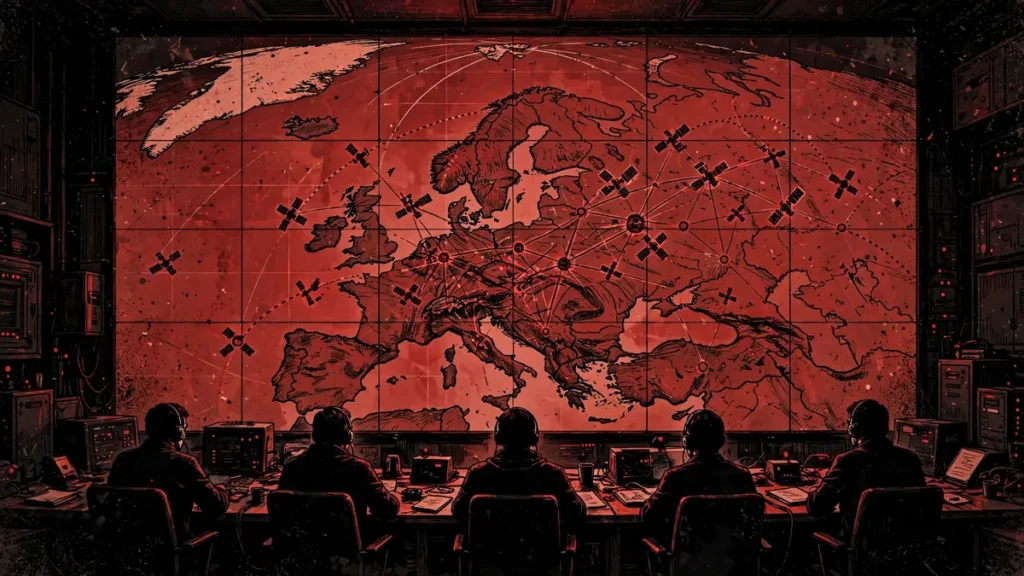
Two threads run through the whole programme. The first is hybrid networks: no single orbit does everything, so militaries are stitching together geostationary satellites for steady high-capacity links, medium-orbit systems, and low-orbit constellations for low latency, plus commercial capacity where it makes sense — and then trying to make that patchwork survive jamming, spoofing and cyber attack. The second is sovereignty: Europe’s push for its own secure satcom capacity, through GOVSATCOM and the EU’s IRIS² programme family, sits alongside the blunt lesson of the Starshield episode, which is that dependence on a single provider, however capable, is itself a vulnerability.
Why does military satcom matter right now?
Satellite communications are the nervous system of a modern force. Orders, sensor feeds, drone control and logistics all ride on links that have to work across oceans, in bad weather, and while an adversary is actively trying to break them. Russia’s electronic-warfare systems, including the Krasukha-4 and Tirada-2S complexes that analysts have long associated with satellite and radar disruption, are designed to do exactly that — inject noise into uplinks, spoof navigation signals and degrade the links an opponent depends on.
The wars in Ukraine and the Middle East have made that contest visible. Ukraine’s fight is fought through drones that depend on satellite links, and the October 2026 Starshield disruption — whatever its precise chain of command, which remains disputed between Kyiv, Washington and SpaceX — demonstrated that commercial satellite services are now treated as operational military infrastructure, to be throttled, contested or defended like any other. Meanwhile, the ongoing war with Iran, now in its sixth month, has kept Hormuz shipping blocked and put a premium on resilient command links across the Gulf, a theme WarBrief has covered in its reporting on the US warnings to Gulf states about possible renewed strikes after the midterms.
The Arctic thread matters for a different reason. As ice recedes and great-circle routes over the High North grow busier, coverage there is thin: geostationary satellites sit low on the horizon at polar latitudes, which is why low-orbit constellations and dedicated High North capacity are on the London agenda. For NATO’s northern flank, from Norway to Canada, that is a practical gap, not a theoretical one.
What Global MilSatCom 2026 means for US, UK and EU readers
For American readers, the conference is where the US Space Force’s direction meets its allies’ shopping lists. The US speakers in London — including the deputy chief of space operations for strategy and the commander of US space forces in Europe and Africa — are the officials shaping how American protected satcom, commercial augmentation and allied interoperability fit together, and what that means for the cost and pace of US programmes.
For British readers, the interest is closer to home. SKYNET is the UK’s own military satcom system, and the London agenda puts its managers on stage alongside UK Space Command and the UK Space Agency. Decisions debated here — on hybrid networks, on commercial integration, on resilience — feed into what the UK buys next and how quickly it can replace or augment capacity under pressure.
For EU readers, the stakes are sovereignty and spectrum. GOVSATCOM, EUSPA and the European Defence Agency are all represented, and the European panel on scaling a sovereign space architecture is the clearest sign of where Brussels wants to go: less dependence on non-European providers for secure government communications, shared capacity among member states, and rules for spectrum that keep allied systems from interfering with each other. None of that changes a household bill tomorrow. But the same commercial constellations that carry military traffic also carry civilian broadband, aviation and maritime data — so resilience decisions taken in London eventually touch the networks ordinary users depend on, especially in remote regions and at sea.
There is also a caution for readers following the event from the outside. Conference agendas are statements of intent, not outcomes. The test of Global MilSatCom 2026 will not be the panels but the procurement decisions, interoperability agreements and capability announcements that follow it — and WarBrief will track those as they emerge.
What to watch next in the run-up to London
Four things are worth watching before November 2. First, whether the organiser publishes a final agenda with confirmed keynote speakers, and whether any senior US or UK official uses the event to announce a procurement decision. Second, whether Ukraine’s delegation — including Colonel (Ret.) Vadym Slyusar of the Ukrainian armed forces’ armaments research institute, who is listed among the speakers — speaks publicly about the October Starshield disruption and what Kyiv wants changed. Third, whether European speakers give firmer dates or funding detail for sovereign satcom capacity, beyond the general direction already sketched. And fourth, whether the High North sessions produce anything concrete on Arctic coverage, where the gap between ambition and capacity is widest.
Readers who follow satellite communications closely may also want WarBrief’s earlier coverage of the Starshield dispute, Trump Says Starshield Is Back in Ukraine — Zelensky Disagrees (2026), and the explainer on how the Patriot battery Washington is moving to the Gulf works — a reminder that satellites are only one layer of the air-defence and communications picture. For the wider intelligence toolkit, see GEOINT Platforms Compared: 2026 Defense Buyer’s Guide, and for the regional picture, the Conflict Zones hub.
Frequently asked questions
When and where is Global MilSatCom 2026?
Global MilSatCom 2026 runs November 2–5, 2026, at the Park Plaza Riverbank hotel, 18 Albert Embankment, London. November 2 is the SATCOM-on-the-move focus day and November 3–5 is the main conference.
Who attends Global MilSatCom?
According to the organiser, more than 700 senior military, government and industry leaders from more than 45 nations attend, with 80-plus speakers including senior US, UK, German, French and Canadian space and defence officials, plus industry representatives from companies such as Airbus, Telesat and Viasat.
What is SATCOM-on-the-move?
SATCOM-on-the-move is satellite communication maintained while the user is moving — on a vehicle, ship or aircraft — rather than from a fixed ground station. It is hard because the antenna must track satellites while in motion and hold the link under jamming, which is why the November 2 focus day centres on operating in contested, electronic-warfare-saturated environments.
Can the public attend Global MilSatCom 2026?
Active military and government personnel can apply for a free pass, subject to approval. Commercial organisations pay for attendance; the organiser lists the conference-plus-focus-day commercial pass at £3,397.
Why does a satcom conference matter to ordinary readers?
The same satellite networks that carry military traffic increasingly carry civilian broadband, aviation and maritime data, and the procurement and resilience decisions debated in London shape how reliable those networks are under attack or disruption — particularly in remote regions, at sea and in the High North.
Sources
- ASDEvents: Global MilSatCom 2026 Conference
- Global Defense Insight: The UK Shares Insights into Its Plan for Shaping Satellite Communications at Global MilSatCom
- Global Defense Insight: Stay Ahead in Military Satellite Communications — Join Global MilSatCom 2026
- Marlink: Global MilSatCom
- BritEvents: Global MilSatCom 2026, London


Discussion 0
Share analysis, corrections, or context. Be civil — comments are moderated.