
WarBrief Live | October 23, 2026 | Geopolitics
On November 3, 2026 — eleven days from now — American voters will decide all 435 seats in the House of Representatives and 35 of the 100 seats in the Senate. That decision will reshape who controls Congress, and with it, the two most powerful levers Washington still holds over the war in Ukraine: the power to fund military aid, and the power to tighten or loosen sanctions on Russia. What follows is what is confirmed, what is only reported, and what remains unverified — separated throughout.
Key Takeaways
- All 435 House seats and 35 Senate seats are contested on November 3; Democrats need a net gain of four Senate seats to take the chamber, and pollsters project them to flip the House.
- A Democratic House would likely move new Ukraine aid within “nine days or nine weeks” of taking power, according to Rep. Jim Himes — but the White House could refuse to spend it, and has already used a $810M pocket rescission once.
- Congress wrote its toughest-ever Russia sanctions bill, the Graham Act — then President Trump waived its sanctions provisions on October 16, cutting a diesel deal with Moscow instead.
- The election result will land just as Russia-Ukraine-US talks are expected to resume in Abu Dhabi, making the midterms a de facto war-policy referendum.
What is at stake on November 3, 2026?
The arithmetic is straightforward. The Senate currently stands at 53 Republicans to 47 Democrats, with two independents caucusing with the Democrats, so Democrats need a net gain of four seats to take the chamber outright. Twenty-two of the 35 contested Senate seats are currently held by Republicans, which is why Democrats see a genuine opening. In the House, 218 seats make a majority.
The reported polling, which should be treated as reported rather than confirmed, points the same way. NBC News’ Decision Desk poll put Democrats about nine points ahead on the generic congressional ballot; the Cook Political Report’s October 9 assessment projected Democrats gaining between nine and 19 House seats — enough to flip the chamber — while Cook’s October 6 Senate outlook had Democrats gaining two to six seats across seven pure toss-ups, effectively a coin-flip. President Trump’s approval sits around 37 to 39 percent in the same polling window.
Will a Democratic Congress send Ukraine more aid?
This is the question Kyiv is asking most urgently. At the Warsaw Security Forum in mid-October, Rep. Jim Himes of Connecticut, the ranking Democrat on the House Intelligence Committee, promised that a Democratic Congress would move Ukraine aid packages “in nine days or nine weeks” rather than nine months, and would demand a “much more affirmative and consistent” Ukraine policy in budget negotiations with the president. That is a reported promise, not a passed bill — but it is the clearest on-the-record signal of what a Democratic House majority would attempt.
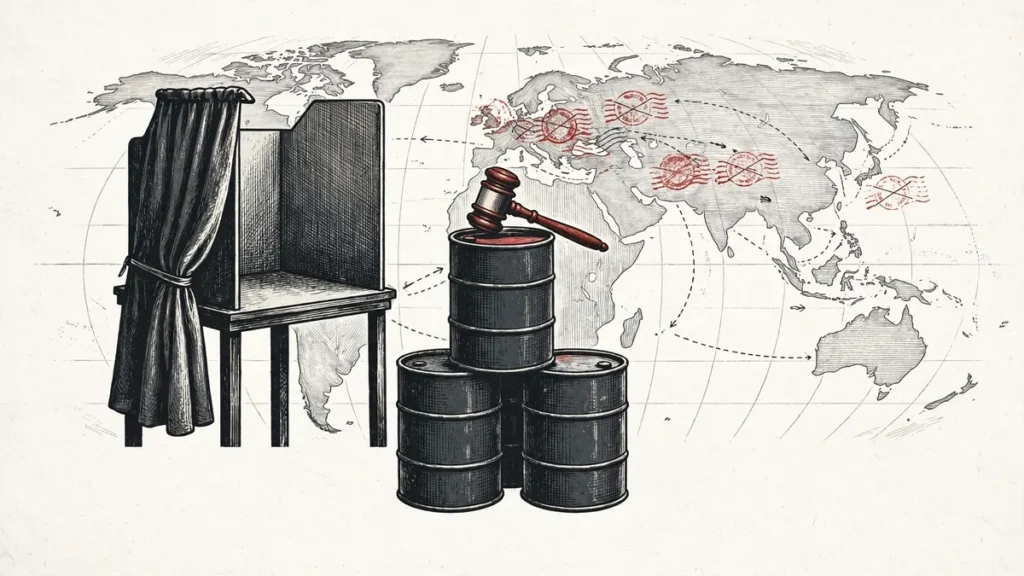
What is confirmed is the baseline a new Congress would inherit. Congress approved $400 million in Ukraine Security Assistance Initiative funding late last year; the Trump administration obligated $307 million and placed the remaining $93 million under contract before the money expired on September 30, 2026, according to Reuters — but no Patriot missiles were included despite Kyiv’s requests. Since then, Congress has authorized no major new assistance package. The 2026 defense authorization bill carries $400 million per year for Ukraine for fiscal 2026 and 2027, but it still needs separate passage and is described by defense analysts as a sharp cut from earlier war years.
Even a willing Congress faces a new constraint the founders did not design for. The White House announced an $810 million pocket rescission on September 25 — impounding appropriated money without congressional approval, which the Government Accountability Office has denounced as illegal. As the European Council on Foreign Relations warns, a Democratic Congress could write Ukraine aid into law and the president could simply decline to spend it: laws do not enforce themselves. Europe is quietly preparing for exactly that outcome. One reported lever already in play: the administration has threatened to stifle the NATO PURL procurement mechanism — the channel through which European money buys American weapons for Ukraine — to pressure Kyiv into halting deep strikes on Russian energy infrastructure.
The numbers behind the midterm war vote
| Metric | Figure | Source |
|---|---|---|
| House seats contested | 435 (218 for a majority) | Britannica — CONFIRMED |
| Senate seats contested | 35 (33 Class II + FL/OH specials) | Britannica — CONFIRMED |
| Net Senate gains Democrats need | 4 | Britannica — CONFIRMED |
| USAI funds obligated before Sept 30 | $307M of $400M ($93M contracted) | Reuters — CONFIRMED |
| Projected Dem House seat gains | 9–19 | Cook Political Report (Oct 9) — REPORTED |
| Dem generic-ballot lead | ~9 points | NBC Decision Desk — REPORTED |
| Graham Act secondary tariffs authorized | Up to 100% on Russian-oil buyers | Reuters — CONFIRMED |
| OFAC Oct 21 designations | Law firm + 5 people + 9 vessels | US Treasury — CONFIRMED |
Caveat: “CONFIRMED” figures are corroborated by two or more reputable sources; “REPORTED” figures come from polling or single-source reporting and should be read as estimates, not facts.
How Russia sanctions became a midterm battleground
The sanctions story is the clearest example of how the election and the war are now tangled. On September 17, Congress passed H.R. 5334 — the Lindsey O. Graham Sanctioning Russia and Iran Act — authorizing up to 500 percent tariffs on Russian goods and up to 100 percent secondary tariffs on the largest buyers of Russian oil and gas, with mandatory sanctions on key Russian economic sectors. President Trump signed it on September 19. Then, on October 16, he signed an executive order waiving the Act’s sanctions and duties provisions, certifying that the waiver was in the US “national interest” — and cut a diesel-supply arrangement with Moscow that had been paved by an OFAC general license on October 9 permitting Russian-origin diesel transactions. Twelve bipartisan senators and 22 House members had written urging him to implement the law fully, calling the diesel deal a “betrayal of the people of Ukraine.”
Read our breakdown of that decision — and why Brussels answered with its own escalation — in Trump Graham Act Waiver: Sanctions Pause Explained (2026). The EU’s response was swift: on October 21, the bloc’s foreign-policy arm proposed 117 new sanctions listings — 12 individuals and 105 entities — targeting Russian oil refining and export capacity, 52 banks and financial institutions, and two liquefied natural gas entities, with 31 listings aimed squarely at oil processing from St. Petersburg to Sakhalin. EU foreign policy chief Kaja Kallas framed it as a direct rebuke: “We see that we have to pressure the aggressor to stop the war, not the victim to surrender,” as reported by the Kyiv Independent.
Meanwhile, the sanctions war against Iran’s oil network continues on a separate track. On October 21, the US Treasury sanctioned the Panama- and Greece-based law firm Karnakis and Karnakis, five of its people, the Roxette Maritime shipping company and nine vessels tied to Iran’s shadow fleet — the largest “Operation Economic Outcast” designations to date. Treasury’s press release quotes Secretary Scott Bessent: “Whether you are conducting illegal oil transfers at sea or sitting in the corner office of a law firm, if you are supporting the Iranian regime, we will find you and sanction you.” FinCEN also issued its first-ever administrative subpoena under 31 U.S.C. § 5318(k), probing an unnamed Greek bank’s ties to Iran proxies. For the mechanics of the ghost-tanker trade these measures target, see What Is a Shadow Fleet?
What does this mean for US/UK/EU readers?
This section is educational context, not financial advice. For American voters, the most immediate war-adjacent issue is at the pump. US diesel prices remain elevated — our October analysis of why diesel still costs over $6 a gallon traced the crisis to refinery capacity, not just geopolitics — and the White House’s gamble is that Russian diesel imports will ease prices before November 3. Reuters reports that the midterms themselves may explain the president’s recent tilt toward Moscow: voters are angry about energy costs, and a negotiated settlement is being sold as the fastest route to cheaper fuel, even though analysts say consumers would feel no effect before election day.

For UK and EU readers, the stakes are strategic rather than electoral. If Washington scales back aid and leans on Kyiv to accept terms, the burden shifts to Europe — which is already financing weapons through the PURL mechanism the US has threatened to squeeze. The Intel hub tracks how that procurement pipeline holds up; the Sanctions hub follows the parallel economic pressure campaign. A Democratic Congress that writes new aid into law would steady European planning; a Republican hold, or a president who impounds the money anyway, would force Brussels to confront the cost of carrying Ukraine alone.
What the three camps in Washington want
Democrats want the election to be a referendum on a president they say abandoned Ukraine: more aid, enforced sanctions, and the Graham Act implemented in full. The Trump administration wants it to be a referendum on affordability: cheaper energy via Russian diesel, a negotiated end to the war, and — as the president said this week about the disputed Starshield satellite link, “the bottom line, he put it back” — disputes with Kyiv managed quietly rather than fought in public. Kyiv, for its part, is hedging both outcomes: President Zelensky contradicted Trump’s Starshield claim on October 23, insisting “the speed limits on Starlink and Starshield are still there, and the speed has not been restored,” even as he engages with the administration’s envoy Steve Witkoff on the planned Abu Dhabi talks. For the full account of that dispute, see Trump Says Starshield Is Back in Ukraine — Zelensky Disagrees (2026).
What to watch in the final eleven days
- The Senate toss-ups. Cook lists seven pure toss-ups; the Texas race, where Democrat James Talarico leads Republican Ken Paxton 51–49 in one CBS/YouGov poll (reported, not confirmed), could decide whether Democrats have any Senate path at all.
- Abu Dhabi talks. Kremlin spokesman Dmitry Peskov said Russia-Ukraine-US talks are planned for the first half of November — days after the vote — following Witkoff’s meetings with Putin on October 21 and with Zelensky and European leaders on October 20. Anything leaked before November 3 becomes campaign material.
- The diesel deal’s paper trail. Treasury waived Russian diesel sanctions until April 2027; congressional pressure to reverse course will intensify if Democrats post the expected House gains.
- The NDAA. The defense authorization bill’s $400 million annual Ukraine allocation still needs passage — a lame-duck Congress may punt it to the new one.
- Disinformation. Researchers have flagged AI-generated videos and influence activity targeting pro-Ukraine candidates — reported by advocacy outlets and worth watching, though the attribution picture is still developing.
Frequently asked questions
Can US midterm elections impact the Ukraine war?
Yes — substantially. Congress controls the two main US levers over the war: appropriations for military aid and sanctions law. A Democratic House has promised fast new aid packages and full implementation of the Graham Act sanctions law; a Republican hold keeps both levers with a president who has waived sanctions and declined to request new aid. The White House’s impoundment powers, however, mean a hostile Congress is not a guarantee of restored aid.
What are the implications of the US buying diesel from Russia for Ukraine and Europe?
The diesel arrangement eased US sanctions pressure on Moscow in exchange for supply, prompting bipartisan congressional condemnation and a counter-move from the EU — a proposed 117 new sanctions listings targeting Russian oil refining. For Ukraine, it signals that energy-price politics can override sanctions enforcement; for Europe, it raises the cost of sustaining the pressure campaign alone.
Can the US mid-terms unlock faster Ukraine aid?
According to Rep. Jim Himes, a Democratic Congress could move aid packages “in nine days or nine weeks.” That is a political promise, not a law — and the European Council on Foreign Relations cautions that a president can simply refuse to spend appropriated money, as the September 25 pocket rescission demonstrated. So: faster aid is possible, but not guaranteed.
Should Congress authorize additional funding to support Ukraine in the war with Russia?
That is the central policy question of the election. Supporters argue Kyiv needs sustained funding to hold the front and force a better settlement; opponents argue Europe should carry more of the burden and that the money is needed at home. The $400 million Ukraine Security Assistance Initiative appropriation was fully committed before its September 30 deadline, and the next defense bill proposes $400 million a year — the next Congress will decide whether that floor rises or falls.
Could the midterms change US policy on Iran too?
Possibly at the margins. The Treasury’s October 21 “Operation Economic Outcast” designations against Iran’s shadow-fleet network were an executive-branch action that does not depend on Congress. But a Congress hostile to the president could complicate any future deal with Tehran — much as it could with Russia sanctions — by locking sanctions into statute, as it attempted with the Graham Act.
Sources
- Britannica: 2026 US midterm elections
- Reuters: Trump administration to meet Ukraine assistance deadline (Sept 25, 2026)
- US Treasury: OFAC sanctions Karnakis & Karnakis and shadow-fleet vessels (Oct 21, 2026)
- Kyiv Independent: EU responds to Trump diesel deal with new Russia energy sanctions
- Breaking Defense: Why the midterms could matter for Ukraine aid
- Breaking Defense: Democratic midterm gains could speed US military aid, lawmaker says
- Ukrainska Pravda: Trump waives Russia sanctions under Graham Act (Oct 16, 2026)
- The Hindu: Trump claims Starshield is back in Ukraine (Oct 23, 2026)
- The Hindu: Russia-Ukraine-US talks planned for Abu Dhabi (Oct 23, 2026)
- ECFR: A Democratic win isn’t enough — how Europe can prepare


Discussion 0
Share analysis, corrections, or context. Be civil — comments are moderated.