WarBrief Live | October 6, 2026 | Breaking Analysis
Ukraine launched a massive overnight drone attack against Moscow and the surrounding region between the evening of October 5 and the morning of October 6, 2026, in what Russian state media described as the largest assault of its kind in two years. Moscow Mayor Sergei Sobyanin said at least 650 drones flew toward the capital, while monitoring channels reported that the Volodarsk oil hub — the Moscow region’s largest fuel depot — was struck, with eyewitness footage showing flames and thick smoke rising from the site.
Key Takeaways
- Moscow Mayor Sergei Sobyanin said at least 650 Ukrainian drones flew toward the capital overnight, with Russian air defences claiming to have destroyed most of them at a distance and 105 on the approaches to Moscow.
- The reported target was the Volodarsk Linear Production and Dispatch Center near Konstantinovo — the Moscow region’s largest oil depot, operated by a Transneft subsidiary and supplying the capital’s three main airports.
- The strike came one day after President Volodymyr Zelensky pledged to escalate attacks on Russian energy infrastructure in response to Moscow’s air campaign against Ukraine.
- Moscow Oblast Governor Andrei Vorobyov said 185 drones were intercepted in the region, with one person killed, six injured, and more than ten homes damaged; Kyiv said the strike on the oil facility could not be immediately verified.
What happened in the Moscow drone attack?
The drone waves began on the evening of October 5 and continued into the morning of October 6, 2026. Sobyanin said air defences destroyed the majority of the drones before they reached the city, with 105 downed as they approached Moscow. The Moscow region’s airports were thrown into chaos during the attack, with flights delayed or cancelled as the airspace around the capital was restricted, according to reporting in The Sun, which put the total at 679 drones over eight and a half hours, citing Russian officials.
Moscow Oblast Governor Andrei Vorobyov said 185 drones were intercepted overnight across the region. He said more than ten private homes were damaged in Istra, the village of Lobanovo and the settlement of Radumlya. “Six people were injured. Unfortunately, there is one fatality,” Vorobyov said, according to the Kyiv Post.
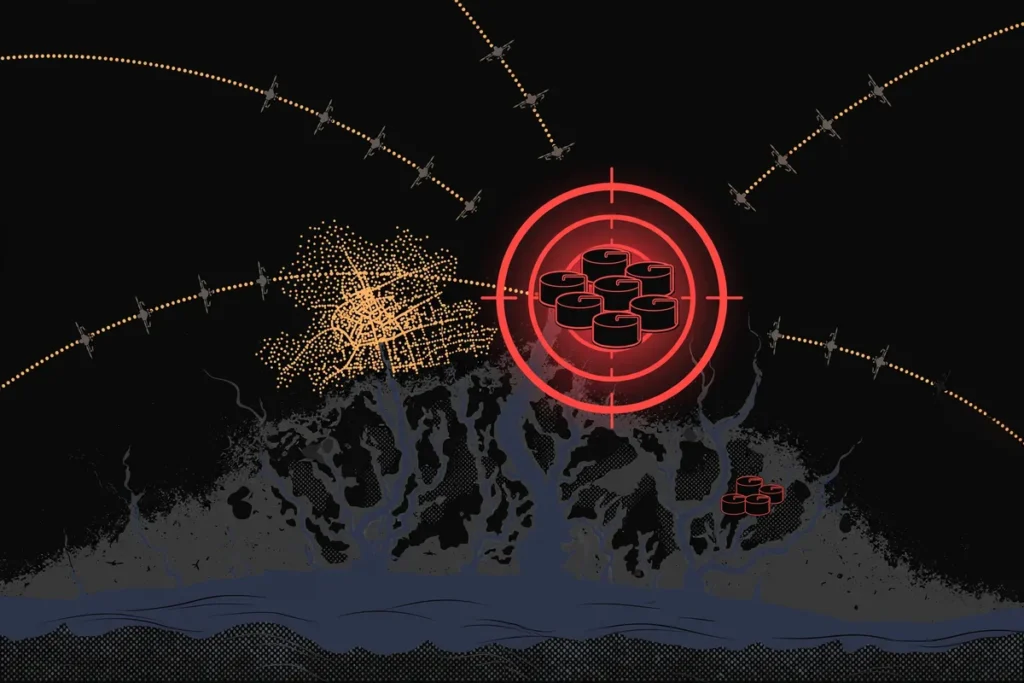
The most strategically significant claim of the night concerned the Volodarsk Linear Production and Dispatch Center near the village of Konstantinovo, around 40 kilometres (25 miles) from downtown Moscow. EA WorldView reported that Ukrainian monitoring channels identified the facility as the target, with eyewitness footage showing flames erupting and smoke billowing from the site. The Kyiv Independent said it was not able to immediately verify those reports.
Why was the Volodarsk oil hub targeted?
The Volodarskaya line production and dispatch station, operated by Transnefteprodukt — part of Russia’s state-owned Transneft oil pipeline company — is described by the Russian investigative outlet Astra as the largest oil depot in the Moscow region, according to the Kyiv Post. It can handle up to 3 million metric tons of petroleum products a year, including petrol, aviation fuel and diesel.
Its importance goes beyond sheer volume. Fuel from the facility is supplied to Moscow’s three major airports — Vnukovo, Domodedovo and Sheremetyevo — making it a critical node in both the capital’s civilian infrastructure and its logistics network. Striking it, if confirmed, would represent one of the deepest and most symbolically significant hits of Ukraine’s energy campaign, roughly 450 kilometres (280 miles) from the Ukrainian border.
Background and timeline
Ukraine’s campaign against Russian oil infrastructure has been running for months, but the tempo and reach have escalated sharply in recent weeks. Recent developments in the sequence:
- October 2, 2026: Ukrainian forces struck the Samara line production and dispatch station in Samara Oblast — described in Russian media as the country’s largest oil hub — triggering a fire at the facility, according to the Kyiv Post.
- October 4, 2026: Ukraine’s Defense Ministry claimed that more than 51 per cent of Russia’s oil refining capacity had been disabled by Ukrainian attacks.
- October 5, 2026: President Volodymyr Zelensky said Kyiv would escalate its strikes on Russian energy targets, blaming Moscow’s attempt to force Ukrainian surrender through airstrikes.
- October 5–6, 2026: Mass overnight drone attack on the Moscow region; Volodarsk oil hub reported hit; Sobyanin claims at least 650 drones were involved.
“We have to respond in any way. With their attacks on our energy, we have to respond on their energy. First of all, oil refiners: what gives money to them for this war.”
— President Volodymyr Zelensky, October 5, 2026, as reported by EA WorldView
By the numbers
| Metric | Figure | Source |
|---|---|---|
| Drones flown toward Moscow | At least 650 (CONFIRMED) | Moscow Mayor Sobyanin, via EA WorldView and Kyiv Post |
| Drones downed near Moscow | 105 (CONFIRMED) | Sobyanin, via EA WorldView and Kyiv Post |
| Drones intercepted in Moscow Oblast | 185 (REPORTED) | Governor Vorobyov, via Kyiv Post |
| Total drones claimed by Russian officials | 679 over 8.5 hours (REPORTED) | Russian officials, via The Sun |
| Casualties in Moscow Oblast | 1 killed, 6 injured (REPORTED) | Vorobyov, via Kyiv Post |
| Volodarsk depot annual throughput | 3 million metric tons (CONFIRMED) | EA WorldView; Kyiv Post |
| Ukraine’s claimed disabled Russian refining capacity | 51 per cent (REPORTED — Ukrainian claim) | Ukraine Defense Ministry, via Kyiv Post and EA WorldView |
CONFIRMED means the figure was reported by two or more independent outlets; all figures originate from Russian officials or Ukrainian claims and have not been independently verified. The Kyiv Independent said it could not immediately verify that the Volodarsk facility was hit.
Why it matters
The October 6 attack is the latest and among the largest in Ukraine’s systematic effort to degrade the Russian oil economy that finances the war. Relentless waves of strikes on refineries and depots have already sparked fuel shortages and queues across parts of Russia, according to reporting in The Sun. Each hit compounds a growing logistics problem: repairs take time, air defence cannot cover every facility, and the economic pain radiates outward into global diesel and petrol markets.
It also carries a political signal. Zelensky’s pledge to escalate came as Donald Trump claimed that Ukraine’s refinery strikes — rather than market fundamentals — were the main cause of soaring diesel prices ahead of November’s US elections. EA WorldView described that claim as false, and energy analysts broadly dispute it, pointing to supply dynamics rather than Ukrainian drones. But the exchange underlines how directly the energy war now touches Western politics.
For Moscow, the optics are damaging: the largest attack on the capital region in two years, a claimed hit on the depot that fuels the capital’s airports, and footage of flames circulating on social media — all while Russian air defences were reportedly firing from within the city.
What this means for US/UK/EU readers
Fuel prices. The attacks feed an already tight global diesel market. China halted October fuel exports amid the diesel squeeze, and the G7 released 100 million barrels of diesel and oil reserves after Trump’s threats — moves covered in recent WarBrief Live reporting on Ukraine’s refinery-strike campaign and its market fallout. US and European drivers could see the effects at the pump if the squeeze deepens, though analysts caution that Ukrainian strikes are only one factor among many in global prices.
Travel. Hundreds of flights in and out of Moscow were delayed or cancelled during the attack. There is no direct impact on US/UK/EU aviation beyond travellers transiting through Russian hubs, but the disruption illustrates how quickly a drone campaign can paralyse a major city’s airspace.
Markets and security. Escalating attacks on energy infrastructure tend to raise the risk premium on oil, which European economies — still sensitive after the 2022 energy crisis — watch closely. The broader pattern is a war increasingly fought through infrastructure: Russia striking Kyiv’s bridges and energy grid, Ukraine answering against Russian refineries. For European policymakers, that means a longer, more economically corrosive conflict, not a shorter one.
Different perspectives
Ukraine frames the strikes as legitimate military action against the revenue streams funding Russia’s invasion — a point Zelensky made explicitly when he tied the escalation to Moscow’s own air campaign. Kyiv’s calculation is that degrading Russian refining capacity shortens the war by draining its economic engine.
Russia describes the attacks as terrorism against civilian infrastructure and has vowed retaliation. Sobyanin’s office emphasised the scale of the interception effort, and Russian state media framed the night as a failed assault that nonetheless killed a civilian in the Moscow region.
International observers are watching two risks: escalation — each round of strikes invites a heavier Russian response against Ukrainian cities — and energy-market spillover. Western capitals have generally tolerated Ukraine’s deep-strike campaign while privately worrying about its effect on fuel prices in an election year.
What to watch next
Three things will determine whether this night was an escalation or a one-off. First, whether Ukraine confirms the Volodarsk hit and whether satellite imagery or official Russian statements corroborate damage — the Kyiv Independent’s inability to verify it so far is a reminder that the fog of war is thick. Second, how Russia retaliates: Putin’s warning of a “no rules” air war against Ukraine, issued earlier this month, suggests the response could be aimed at Ukrainian energy infrastructure again. Third, whether the tempo holds — if strikes of this scale become weekly, Russia’s refining sector faces a compounding crisis that no amount of air defence around Moscow can fully prevent.
Frequently asked questions
What happened in the Moscow drone attack on October 6, 2026?
Ukraine launched a massive overnight drone attack on Moscow and the surrounding region between October 5 and 6. Moscow’s mayor said at least 650 drones flew toward the capital; Russian officials claimed most were destroyed at a distance, with 105 downed near the city and 185 intercepted in the wider Moscow region. Monitoring channels reported that the Volodarsk oil depot was hit.
What is the Volodarsk oil depot and why does it matter?
The Volodarsk Linear Production and Dispatch Center is the Moscow region’s largest oil depot, operated by a Transneft subsidiary with annual throughput of about 3 million metric tons of petroleum products. It supplies fuel to Moscow’s three main airports — Vnukovo, Domodedovo and Sheremetyevo — making it a key node in the capital’s logistics.
How many drones has Ukraine sent against Moscow, and how many were intercepted?
Russian officials reported at least 650 drones in the October 5–6 attack, with 105 destroyed on the approaches to Moscow and 185 intercepted across the oblast. The Kyiv Post also reported one death and six injuries. These figures come from Russian officials and have not been independently verified.
Why is Ukraine attacking Russia’s oil infrastructure?
Kyiv says oil and refined fuel are the financial engine of Russia’s war, and degrading refining capacity weakens Moscow’s ability to sustain the invasion. President Zelensky said on October 5 that Ukraine would escalate such strikes in direct response to Russian attacks on Ukrainian energy infrastructure.
Could the drone attacks on Russian refineries raise fuel prices in Europe?
They are one factor in an already tight diesel market, alongside China’s export halt and broader supply dynamics. Analysts dispute claims — notably from Donald Trump — that Ukrainian strikes are the main driver of price rises, but sustained disruption to Russian refining would add upward pressure on European fuel costs.
Sources
- EA WorldView: Ukraine War, Day 1,685: Kyiv’s Mass Attack Across Moscow Region
- Kyiv Post (via EuropeSays): Ukraine Targets Major Russian Oil Hub During Massive Drone Attack on Moscow Region
- The Sun: Ukraine unleashes barrage of drones in huge strike on Moscow blitzing key oil hub
- Kyiv Independent (via EuropeSays): Ukrainian drones reportedly strike oil facility in mass attack near Moscow