WarBrief Live | October 5, 2026 | Breaking Analysis
A Turkish-owned grain ship caught fire and sank in the Black Sea off Romania on October 5, 2026, killing two crew members in what Ukraine calls a Russian drone strike. The attack on the Royad Mammadov — a 139-metre bulk carrier flying the flag of Saint Kitts and Nevis — is the latest in a sharp escalation of strikes on civilian shipping, and it happened inside a NATO country’s exclusive economic zone. Here is what is confirmed, what is disputed, and why it matters.
Key Takeaways
- The Turkish-owned grain carrier Royad Mammadov caught fire and sank about 30 nautical miles south of Romania’s Sfantu Gheorghe port on October 5, 2026; two crew died and 11 were rescued.
- President Volodymyr Zelensky said “two Russian drones” struck the vessel in “neutral waters”; Romania has not commented on the cause of the fire.
- Turkey’s maritime chamber says 226 civilian and commercial vessels have been attacked in the Black Sea since 2022 — most of them this year.
- The strike fits a pattern: Russia hit Ukrainian port infrastructure in the Odesa region the same morning, and its defence ministry said it had struck two cargo vessels.
- For US, UK and EU readers, the stakes are grain prices, NATO proximity and the safety of one of the world’s key food-export corridors.
What happened to the Royad Mammadov?
Shortly before 11:00 a.m. local time on October 5, 2026, Romania’s Coast Guard was alerted that a fire had broken out aboard a commercial vessel in the Black Sea, according to a statement from the Romanian Interior Ministry. The ship was the Royad Mammadov, a 139-metre (455-foot) bulk carrier sailing under the flag of Saint Kitts and Nevis, Turkish-owned, and loaded with corn. It had last called at the Ukrainian port of Izmail and was bound for Ravenna, Italy, according to shipping-tracking data cited by Reuters.
The vessel was located about 30 nautical miles south of the fishing port of Sfantu Gheorghe — inside Romania’s exclusive economic zone but outside its territorial waters, per the ministry’s statement. Romanian rescue teams evacuated the crew: two people were confirmed dead and 11 were rescued. Zelensky said the ship’s captain was among those killed and that at least one crew member was injured; the Romanian Naval Authority’s spokesperson told AFP that three of the crew were injured and eight were in good condition. The injured were airlifted by helicopter, and the ship later sank.
The fire broke out near an offshore platform operated by the Romanian energy company OMV Petrom; the company told Romanian media the platform was operating normally and was not affected.
By the numbers
| Metric | Figure | Source |
|---|---|---|
| Crew killed | 2 (confirmed, incl. captain) | Romanian Interior Ministry; Zelensky |
| Crew rescued | 11 | Romanian Interior Ministry via Reuters |
| Crew injured | 3 per Romanian Naval Authority; 1 per Zelensky | AFP; Zelensky on X |
| Ship length | 139 m (455 ft) | Romanian Naval Authority via AFP |
| Distance from Romanian coast | ~30 nautical miles south of Sfantu Gheorghe | Romanian Interior Ministry |
| Drones alleged in attack | 2 (Russian, per Kyiv) | Zelensky on X (attributed, not confirmed) |
| Black Sea vessels attacked since 2022 | 226 | IMEAK (Turkish maritime chamber) via AFP |
Caveat: figures marked “confirmed” come from two or more independent sources; the drone-strike claim is attributed to Ukraine and has not been independently verified.
Background and timeline
The Black Sea has become one of the most dangerous shipping zones in the world. Both Russia and Ukraine increasingly rely on naval drones, and commercial vessels have been drawn into the war. Turkey’s Chamber of Maritime Commerce (IMEAK) said last month that 226 civilian and commercial vessels had been attacked in the Black Sea since the start of the war in 2022 — the vast majority of them this year. Turkish seafarers have staged protests over deaths in the attacks, and President Recep Tayyip Erdogan told the UN General Assembly the strikes were “unacceptable.”
- October 5, morning: Russian air strikes targeted industrial and port infrastructure in Ukraine’s Odesa region, Governor Oleh Kiper said; Russia’s defence ministry said it hit Vylkove port, fuel depot facilities in Chornomorsk and cargo vessels, as well as a power station in the Kharkiv region, according to Reuters.
- October 5, ~11:00 local: Romania’s Coast Guard is alerted to the fire aboard the Royad Mammadov, roughly 30 nautical miles south of Sfantu Gheorghe. Rescue operations begin immediately.
- October 5: Zelensky posts on X that “two Russian drones” hit the vessel in “neutral waters,” identifying it as Turkish-owned and carrying corn, with Azerbaijani and Indian nationals aboard. Romania’s Interior Ministry confirms two deaths and 11 rescues but gives no cause for the fire.
- October 5: Russian authorities offer no immediate comment on the Royad Mammadov specifically; an earlier defence ministry bulletin claimed strikes on two cargo vessels, per Sowetan.
Who attacked the Black Sea grain ship?
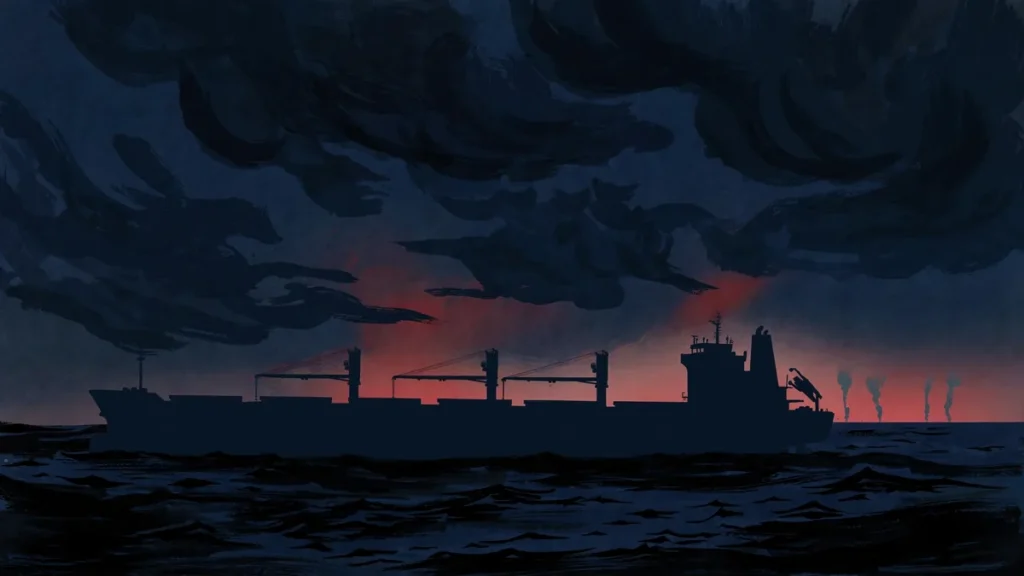
This is the central disputed question. Ukraine’s position is explicit: Zelensky called the incident “a horrific strike by two Russian drones on a civilian vessel in neutral waters carrying corn,” adding that the vessel was owned by Türkiye and that Azerbaijani and Indian citizens were aboard. In a post on X, he wrote:
“A horrific strike by two Russian drones on a civilian vessel in neutral waters carrying corn and owned by Türkiye. Azerbaijani and Indian citizens were on board… As of now, unfortunately, we know that the ship’s captain was killed.”
Romania, in whose waters the rescue occurred, has not endorsed that account. Romanian authorities confirmed the fire, the sinking, the two deaths and the 11 rescues — but said nothing about a cause. A spokesperson for the Romanian Naval Authority told Reuters she could not provide more information, and AFP reported that the defence ministry did not reply when asked whether a drone could have been involved.
Russia has not commented on the Royad Mammadov specifically. Its defence ministry’s daily bulletin did claim strikes on two cargo vessels, though it did not name them — a claim reported by secondary outlets that WarBrief could not independently verify. Moscow has previously said its strikes target vessels it links to Ukraine’s military logistics.
In short: the drone-strike account rests on a single source — Ukraine’s president. Romania’s silence is notable because Bucharest is a NATO ally with every incentive to establish the facts publicly. Until Romania or an independent investigation speaks to the cause, the responsible party is attributed, not confirmed.
Why are civilian ships being hit in the Black Sea?
Regardless of who fired, the trend line is unambiguous. Attacks on Black Sea shipping have surged in 2026. The reasons are strategic: grain exports from Ukraine’s Danube ports, including Izmail, are a major revenue stream for Kyiv’s war economy; Russia has repeatedly targeted port and energy infrastructure in the Odesa region; and naval drones have made it cheap to threaten — and hit — vessels far from shore.
The pattern is geographic as well as political. Romania is a NATO member sharing a 614-km land border with Ukraine, and Reuters notes it has seen Russian drones breaching its airspace as well as mines drifting across key trade and energy routes. A strike 30 nautical miles off its coast — inside its exclusive economic zone — is an escalation in proximity terms even if it falls short of an attack on NATO territory. The incident also occurred near an OMV Petrom offshore platform, underscoring the risk to the region’s energy infrastructure.
The same morning’s Odesa strikes show how the campaign is widening: ports, fuel depots, power stations and cargo vessels hit in a single wave. Read more in our analysis of Odesa Strikes Explained: Russia’s Black Sea Blockade (2026). For the parallel escalation in the Middle East’s waterways, see Hormuz Kill Box: Tanker Attacks Surge, Explained (2026).
What this means for US/UK/EU readers
Food prices. The Royad Mammadov was carrying corn from Ukraine to Italy. Repeated attacks on grain shipping raise freight and insurance costs and can feed through to commodity prices — including bread, cooking oil and animal feed in European markets. The Black Sea is a key artery for Ukrainian agricultural exports, and every incident tightens the screw.
Security. Romania is a NATO ally. A strike on a civilian ship inside its exclusive economic zone raises the risk of miscalculation — rogue drones have already crossed into Romanian airspace before, and Bucharest has previously invoked NATO consultations over airspace violations. US and UK readers should watch for whether Romania requests an Article 4 consultation; that would be the first formal escalation signal.
Shipping costs. War-risk insurance premiums for Black Sea transits have already climbed sharply since 2022. Another deadly attack will push underwriters to reprice again — and those costs land on freight rates and, eventually, consumers. See our conflict zones hub for the latest on affected shipping routes, and the intel desk for ongoing maritime-security assessments.
Travel. Romania’s Black Sea coast — resorts around Constanta — sits well north of the incident area, and no travel warnings have changed. But travelers with cruises or ferry plans through the western Black Sea should monitor UK Foreign Office and US State Department advisories, which have consistently warned against non-essential maritime travel near Ukrainian waters.
Different perspectives
Kyiv frames the attack as deliberate Russian terror against civilian shipping and global food supplies, and is using it to press for more international pressure — including naval security measures — on Moscow.
Moscow has said nothing specific about the Royad Mammadov, while claiming strikes on two cargo vessels it ties to Ukrainian military use. The Kremlin’s standard position is that commercial shipping tied to Ukraine’s war effort is a legitimate target — a claim Western governments reject.
Bucharest has stayed strictly factual: confirm the rescue, confirm the casualties, withhold judgment on the cause. Romania has to balance NATO solidarity, its relationship with Turkey, and the risks of escalating a still-unverified incident.
Ankara is the wildcard. Turkey owns the vessel, brokered the original Black Sea grain deal, and its seafarers have protested over deaths at sea. Erdogan has called the attacks “unacceptable.” A Turkish-owned ship sinking with its captain dead is exactly the kind of incident that has, in past years, drawn Turkey into active diplomacy — or worse.
What to watch next
Four developments will determine where this goes. First, Romania’s investigation: whether Bucharest names a cause — and whom it implicates — is the single most important unknown. Second, Turkey’s response: Ankara has the most direct interest, and its maritime chamber’s data (226 vessels attacked) is becoming a political tool. Third, NATO signaling: any Romanian move toward Article 4 consultations would mark a formal escalation. Fourth, the shipping markets: watch for war-risk premium announcements from London underwriters in the coming days — they are the market’s real-time verdict on how dangerous the Black Sea has just become.
Frequently asked questions
What happened to the Royad Mammadov?
The Turkish-owned grain ship caught fire in the Black Sea about 30 nautical miles south of Romania’s Sfantu Gheorghe port on October 5, 2026. Romanian authorities rescued 11 crew members, confirmed two deaths, and the 139-metre vessel later sank. The ship was sailing from Ukraine’s Izmail port to Ravenna, Italy, carrying corn.
Who attacked the ship?
No party has been officially confirmed as responsible. Ukrainian President Zelensky said “two Russian drones” carried out the strike. Romania has not commented on the cause of the fire, and Russia has not commented on this specific vessel. The responsible party is therefore attributed to Ukraine’s claim, not independently confirmed.
How many people died in the Black Sea ship attack?
Two crew members died, including the ship’s captain, according to Romanian authorities and Zelensky. Eleven crew members were rescued; three were injured according to the Romanian Naval Authority (Zelensky said one was injured). The crew included Azerbaijani and Indian nationals.
Where exactly did the Royad Mammadov sink?
About 30 nautical miles south of the fishing port of Sfantu Gheorghe, in the Black Sea — inside Romania’s exclusive economic zone but outside its territorial waters. Romania is a NATO member sharing a land border with Ukraine.
Is the Black Sea safe for shipping?
Shipping risk in the Black Sea is at its highest level since the war began, with 226 civilian and commercial vessels attacked since 2022 according to Turkey’s maritime chamber. Most transits continue with war-risk insurance, but premiums rise with each attack, and insurers may reassess coverage after this incident.
Sources
- Reuters: Two dead, 11 rescued in serious maritime incident in Black Sea, Romania says
- AFP via Berliner Tageblatt: Ukraine blames Russia for deadly sinking of Turkish ship in Black Sea
- Turkish Minute: Ukraine blames Russia for deadly sinking of Turkish-owned ship in Black Sea
- Sowetan: Two killed in Black Sea ship fire as Ukraine blames Russian drones
- Reuters: Russian air strikes targeted port infrastructure in Ukraine’s Odesa region, governor says