WarBrief Live | October 3, 2026 | Breaking Analysis
The Pentagon is sending a third US aircraft carrier strike group and an additional Marine expeditionary unit to the Middle East, adding 9,000 to 10,000 more troops to the region, as President Donald Trump signals he may resume bombing Iran after the US midterm elections. The buildup, first reported by The Wall Street Journal on October 2, could put three American carrier strike groups in the same theater for the first time since April — if one currently deployed carrier stays put instead of rotating home.
Key Takeaways
- The USS Theodore Roosevelt carrier strike group left San Diego on September 27, joined by the USS Makin Island amphibious ready group carrying the 13th Marine Expeditionary Unit. The Wall Street Journal, citing US officials, reports they will arrive in the region by the end of November.
- Two carriers — the USS George H.W. Bush and USS George Washington — are already deployed in the Middle East, along with the USS Boxer amphibious group. If the Washington remains after the Roosevelt arrives, the region would hold three carrier strike groups for the first time since April.
- Trump recently told aides he expects to resume bombing Iran in November, and said in a Time magazine interview published October 1 that he could resume strikes after the midterms if there is no deal in place. His administration rejected Iran’s latest seven-day ceasefire proposal.
- Defense Secretary Pete Hegseth has extended the deployments of air-defense units that counter Iranian missiles and drones, plus the Army’s 82nd Airborne Division. The US has kept about 20 Navy ships in the region enforcing its blockade of Iranian ports and escorting commercial vessels through the Strait of Hormuz.
- The move piles pressure on an already strained Navy — supply shortages, near-record deployments — and comes as Iran has fired ballistic missiles at American warships in recent weeks, according to the Journal.
What happened
According to the Journal‘s October 2 reporting, the Pentagon is dispatching the USS Theodore Roosevelt and its strike group along with the Makin Island amphibious ready group — three amphibious ships carrying Marines from the 13th Marine Expeditionary Unit — to the Middle East. The Roosevelt left its home port of San Diego on Sunday, September 27, on what was described as a scheduled deployment; the Makin Island group departed a day later.
The ships, jet fighters, Marines and sailors will arrive in the region by the end of November, US officials told the Journal, joining more than 50,000 American troops already in the region. A separate report by AP and CBS News on October 2 put the deploying force at roughly 7,000 sailors and 2,000 Marines and suggested an arrival closer to the end of October — a discrepancy worth watching as the ships cross the Pacific and Indian Oceans.
Crucially, the “third carrier” outcome is not guaranteed. The USS George Washington may leave the region and return to its home port in Japan, which would bring the force back down to two carrier strike groups. The Institute for the Study of War noted on October 2 that the Roosevelt deployment was made “to replace” the Washington group — a reminder that US officials themselves may not yet have decided whether this is a surge or a rotation. Spokespeople for the White House and the Pentagon did not respond to the Journal‘s requests for comment.
If the Washington stays after the Roosevelt arrives, it would bring the region to three carrier strike groups for the first time since April, when the US and Iran clinched a fragile ceasefire that temporarily ended fighting that began on February 28. That ceasefire has since collapsed, and the two sides have fought sporadically.
Background and timeline
The buildup is the latest turn in an eight-month war that has steadily militarized the world’s most important oil artery.
- February 28, 2026: The United States and Israel launch military operations against Iran, beginning the current phase of fighting.
- April 2026: Washington and Tehran agree to a fragile ceasefire. Three US carrier strike groups are in the region for the first time since the war began.
- Summer 2026: The ceasefire collapses. Fighting resumes sporadically; the US tightens its blockade of Iranian ports and begins escorting commercial traffic through the Strait of Hormuz, through which roughly a fifth of the world’s oil ordinarily flows.
- Late September 2026: The US military destroys five Iranian crude oil tankers after Tehran fired missiles at a US warship twice over two days, according to the Associated Press. US Central Command denied Iranian state-media claims that the Revolutionary Guard had struck American warships.
- September 27–28, 2026: The Roosevelt strike group departs San Diego; the Makin Island amphibious group leaves a day later.
- September 29, 2026: After indirect US-Iran talks in New York stall, Secretary of State Marco Rubio orders Iran’s UN delegation, led by Foreign Minister Abbas Araghchi, to leave the United States, Axios first reported. Two US officials confirmed the order to the AP. Iran disputes the expulsion framing, saying the departure was pre-scheduled and communicated to the State Department on September 17. The delegation flew to Doha, where Qatari mediators continue efforts to bridge the gap.
- October 1, 2026: Time publishes an interview in which Trump says he could resume striking Iran after the midterms if there is no deal: “Because by annihilating Iran, we’ve created peace in the world,” he said. “With Iran, I don’t think you could ever have peace.”
- October 2, 2026: The Journal reports the third-carrier deployment and Trump’s private expectation of resuming bombing in November.
Why the third US aircraft carrier deployment matters
A third carrier in the theater is not just symbolism. The Journal notes it would give Trump more options and more firepower if he decides to attack — and the timing is explicit. Trump told aides he expects to resume bombing Iran in November, the same month the new ships arrive. The linkage to the midterm elections is deliberate: the president has framed the eight-month-old conflict as something that would conclude “very soon, one way or the other,” and military planning now maps directly onto that political calendar.
It is also a coercion play. The rejected Iranian proposal — a seven-day ceasefire, the reopening of the Strait of Hormuz, and resumed talks over Iran’s nuclear ambitions in exchange for the US lifting its blockade of Iranian ports — shows what each side is holding back. The US is now arriving at the table, such as it is, with the largest concentration of naval power in the Gulf since 2003, according to regional analysts.
For the US military itself, the cost is real. The Navy has experienced supply shortages and near-record deployments during the conflict. The USS Abraham Lincoln just finished more than 260 days at sea, and the USS Gerald R. Ford spent 11 months deployed, the Journal reported. The Roosevelt’s crew is being prepared for a longer-than-normal deployment — which is why Hegseth’s simultaneous extension of air-defense units and the 82nd Airborne Division matters: Washington is not just surging ships, it is lengthening the entire force posture.
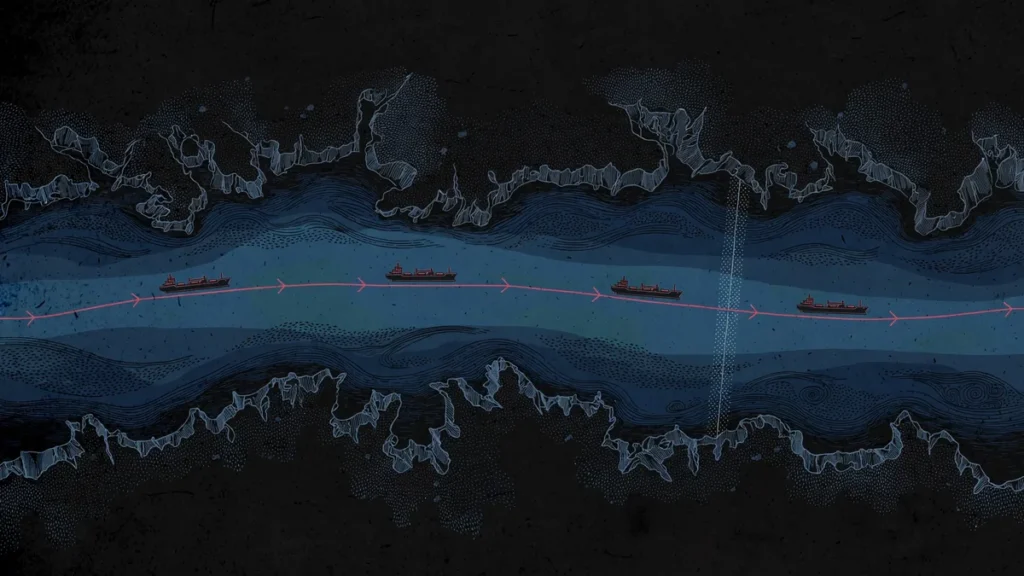
The energy dimension gives the story reach well beyond the region. About a fifth of the world’s oil normally transits the Strait of Hormuz, and Iran has repeatedly struck tankers and threatened shipping lanes in recent days. Our conflict-zone tracker follows how disruptions in the strait feed into fuel prices for American and European consumers.
Different perspectives
The US position: Administration officials describe the buildup as pressure with a purpose — making a post-midterm strike campaign credible while demanding Iran reopen Hormuz and return to nuclear talks. In the Time interview, Trump made the case that force has already produced peace, and that Iran’s leadership cannot be trusted to deal with. The Pentagon’s blockade of Iranian ports and the Treasury Department’s October 1 sanctions on Iran’s auto and rail sectors point to a strategy of strangling the last trade routes before firing a shot.
Iran’s position: Tehran disputes Washington’s account of the New York episode, calling the expulsion claim “baseless and worthless news” in a statement from its UN mission and insisting the delegation’s departure was scheduled weeks in advance. Iranian state media, meanwhile, claims the Revolutionary Guard struck several tankers and two US vessels in retaliation for the American strikes — claims US Central Command called false. Iran’s core demands remain: an end to the blockade, sanctions relief, and negotiations over its nuclear program on terms it can accept.
The analysts’ view: Military researchers are notably more cautious than the headlines. The Institute for the Study of War treats the Roosevelt sailing as a replacement deployment — which means the famous “third carrier” may never materialize if the Washington rotates home. The difference between a surge and a swap matters: one signals imminent escalation, the other signals endurance. Watch which of those the Pentagon eventually confirms.
The regional angle: Saudi Arabia, which has been fighting its own escalating confrontation with the Iran-aligned Houthis, asked Washington twice in recent weeks to join a planned offensive against Houthi targets — including airstrikes to secure the Bab el-Mandeb Strait — and was turned down both times, Axios reported on October 2. A US official said Washington is “not going to take kinetic action for now,” and US Central Command reportedly views Yemen as a distraction from the Iran fight. Trump himself was reportedly close to ordering strikes on the Houthis last week before deciding against it.

What to watch next
Does the Washington stay? The single most important open question is whether the USS George Washington rotates home to Japan or holds position. That decision — due sometime before the Roosevelt arrives — determines whether the “third carrier” is real or a headline.
The arrival clock. The Journal‘s officials say late November; AP/CBS reporting says late October. The ships’ progress across the Pacific is publicly trackable by shipping enthusiasts and OSINT accounts — a genuinely useful indicator of how fast Washington wants the iron on station. For background on what these formations can actually do once they arrive, see our explainer on carrier strike groups.
The midterms. Early November is the political deadline Trump himself has set. Watch for whether the post-midterm window brings strikes, a revived deal track through Qatar, or simply a larger permanent American presence. Our coverage of Trump’s “deal or blow them up” ultimatum traces how this ultimatum logic has shaped the diplomacy.
Yemen as a second front. Reuters reported on October 2 that Saudi Arabia plans to coordinate ground operations and air support for Yemeni government forces in an offensive to retake the Red Sea coastal plain from the Houthis, with Pakistani and Turkish military support already flowing to the Saudi side. If that offensive launches in the coming weeks while Iran pressures Hormuz, the US could face two maritime chokepoint crises at once. Our intelligence desk is tracking both.
Frequently asked questions
Why is the US sending a third aircraft carrier to the Middle East?
The deployment serves two purposes: it gives President Trump more strike options and firepower if he decides to resume bombing Iran after the November midterms, and it sustains the US naval blockade of Iranian ports and the escort of commercial shipping through the Strait of Hormuz. Whether it amounts to a true three-carrier surge depends on whether the USS George Washington rotates home when the Roosevelt arrives.
When will the USS Theodore Roosevelt arrive in the Middle East?
US officials told The Wall Street Journal the Roosevelt strike group and the Makin Island amphibious group will arrive by the end of November, having departed the US West Coast on September 27–28. A separate AP/CBS report suggested the ships could arrive by the end of October. The transit itself takes weeks across the Pacific and Indian Oceans.
Will Trump bomb Iran again after the midterms?
Trump told aides he expects to resume bombing Iran in November, the Journal reported, and said in a Time interview that he could resume strikes after the midterms if there is no deal in place. That is a stated intention, not a confirmed plan — the Pentagon and White House declined to comment on the deployment, and Qatari mediation between the two sides is still underway.
How many US troops are in the Middle East right now?
The Journal, citing a US official, put the existing force at more than 50,000 personnel, with the new deployment adding 9,000 to 10,000 sailors and Marines. The buildup includes carriers, amphibious ships, air-defense units, the 82nd Airborne Division, and about 20 Navy ships supporting the blockade.
What is an amphibious ready group?
An amphibious ready group (ARG) is a naval formation built around amphibious assault ships that carry a Marine expeditionary unit — in this case, the 13th MEU aboard the Makin Island group. Unlike a carrier strike group, which projects air power, an ARG is built for expeditionary landings, crisis response, and moving troops and equipment ashore. The US already has one such group, built around the USS Boxer, in the region.
Sources
- The Wall Street Journal: U.S. Sending Third Aircraft Carrier, Up to 10,000 More Troops, to Middle East
- New York Post: Trump sends third aircraft carrier to Middle East with 10K more troops — as he weighs post-midterm Iran assault
- Institute for the Study of War: Iran Update, October 2, 2026
- Newsmax (via Axios): Report: US Won’t Join Saudi Offensive Against Houthis
- The Diplomatic Insight (Axios/AP): Iran Contests US’ Account of Rubio Asking Iranian Delegation to Leave the Country