WarBrief Live | October 3, 2026 | Explainer
On October 2, 2026, the United States military began moving roughly 9,000 troops aboard ships toward the Middle East, including a third US aircraft carrier strike group, the USS Theodore Roosevelt, as President Donald Trump weighed new strikes against Iran. The move would give Washington three carrier strike groups in one theater by the end of October. This explainer answers the question behind the headlines: what exactly is a US carrier strike group, what can it do, and what does concentrating three of them in the Middle East mean?
Key Takeaways
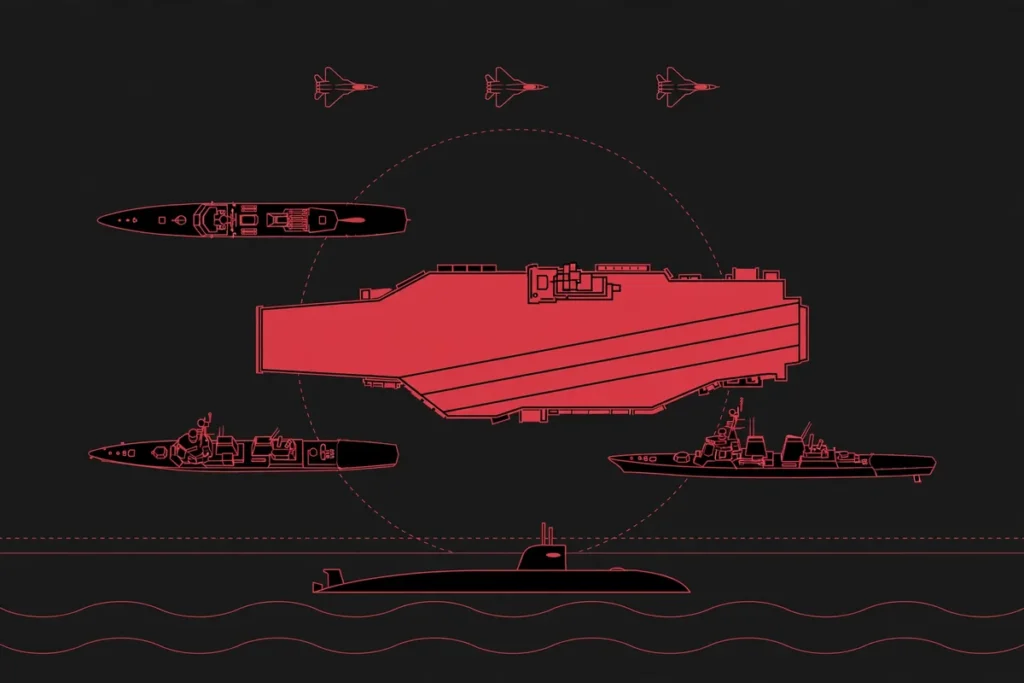
- A US carrier strike group is a roughly 7,000-person naval formation built around one nuclear-powered aircraft carrier, typically screened by a guided-missile cruiser, several destroyers, attack submarines and a 60-plus-aircraft air wing.
- The USS Theodore Roosevelt left San Diego on September 27, 2026, as the centerpiece of Carrier Strike Group 9. It could join the USS George H.W. Bush and the USS George Washington in the Middle East by the end of October — three carrier strike groups in one theater for the first time since April, and only the second time since 2003.
- Sailing alongside it is a different, complementary formation: the USS Makin Island amphibious ready group, carrying the 13th Marine Expeditionary Unit for expeditionary landings and crisis response.
- Naval analysts warn that holding three carriers in the region for an extended period would severely strain the US fleet. The USS Abraham Lincoln just finished more than 260 days at sea, and the USS Gerald R. Ford spent 11 months deployed.
What a US carrier strike group is made of
A carrier strike group (CSG) is the US Navy’s standard way of sending an aircraft carrier to sea: never alone, always surrounded by a tailored formation of warships and aircraft that protect the carrier and multiply what it can do. The Navy notes that strike groups are formed and disestablished on an as-needed basis, so no two are exactly alike — but they are all built from similar types of ships.
A typical formation includes six to eight ships. The centerpiece is one nuclear-powered supercarrier — the US Navy operates eleven of them, ten Nimitz-class carriers and the newer USS Gerald R. Ford — which serves as both the floating airfield and the flagship for the strike group commander. Around it sail one or two Aegis guided-missile cruisers, two to three Arleigh Burke-class guided-missile destroyers, and usually one or two nuclear attack submarines operating beneath the surface. A fast logistics ship trails the formation to refuel and resupply it at sea.
| Element | Typical number | Primary role |
|---|---|---|
| Aircraft carrier (CVN) | 1 | Air power projection, command and control |
| Guided-missile cruiser (CG) | 1 | Air defense, surface warfare, long-range strike |
| Guided-missile destroyers (DDG) | 2–3 | Anti-air, anti-submarine, anti-surface escort |
| Attack submarines (SSN) | 1–2 | Undersea warfare, surveillance, covert strike |
| Logistics ship (T-AOE) | 1 | Fuel, ammunition and stores replenishment |
| Carrier air wing (CVW) | 60+ aircraft | Strike, surveillance, electronic warfare |
The aircraft are the point of the whole formation. A Nimitz-class carrier embarks more than 5,000 people — roughly 1,500 of them dedicated to flying and maintaining over 60 aircraft — while the newer Ford-class carries about 4,500 crew and more than 75 aircraft. Both carrier classes stretch 1,092 feet, longer than three football fields. The carrier’s own weapons are mostly defensive, such as Sea Sparrow missiles and Phalanx close-in weapon systems; the real protection comes from the escort ships, whose Aegis radar systems can intercept incoming missiles at long range.
The result is what the Navy calls a synchronized, multi-mission team. Carrier Strike Group 12, for example, was formed from nine aviation squadrons, five destroyers, a cruiser and an aircraft carrier — integrated through months of exercises so its sensors, weapons and aircraft act as one networked force.
The Roosevelt strike group now heading for the Middle East
The strike group now crossing the Pacific is built to that pattern. The USS Theodore Roosevelt, a Nimitz-class nuclear-powered carrier, departed San Diego on September 27, 2026, as the centerpiece of Carrier Strike Group 9, with Carrier Air Wing 11 embarked.
Its escorts, as reported by defense publication Army Recognition, include the Ticonderoga-class guided-missile cruiser USS Chosin and the Arleigh Burke-class guided-missile destroyers USS Paul Hamilton, USS Decatur and USS Carl M. Levin. Carrier Air Wing 11 gives the group fifth-generation strike capability: according to The War Zone, the wing includes F-35C Lightning II stealth fighters, three squadrons of F/A-18E/F Super Hornets, EA-18G Growler electronic-attack aircraft, E-2D Advanced Hawkeye airborne command-and-control aircraft, MH-60R and MH-60S helicopters, and CMV-22B Osprey transports.
The cruiser USS Chosin plays a distinctive role. It serves as the strike group’s Integrated Air and Missile Defense commander — the ship coordinating protection against airborne and missile threats. Its 122 Mk 41 Vertical Launch System cells carry a larger missile magazine than the 90 to 96 cells on a Burke-class destroyer, a meaningful advantage in a theater where US warships face Iranian missiles and drones.
Why Washington is sending a third carrier — and what it signals
The Associated Press reported on October 2 that the US military is dispatching around 9,000 troops aboard ships to the Middle East — more than 7,000 sailors with the Roosevelt strike group and roughly 2,000 Marines with the amphibious group. A US official, speaking anonymously to discuss sensitive operations, said three carriers could be in the region as early as the end of October.
The timing is political. President Trump said in a Time magazine interview published October 2 that it is “possible” he will ramp up bombing in Iran after the November 3 US elections, and told reporters the new deployment would make any retaliation for Iranian provocation devastating:
“Oh they’ll be hit very hard, don’t worry. You just ask them. They know what happened. They’ll be hit very hard.” — President Donald Trump, October 2, 2026
Trump has said he rejected Iran’s latest ceasefire proposal because it was “not good enough,” citing as one example Tehran’s offer to open up the Strait of Hormuz, the energy chokepoint at the heart of the conflict. The war in Iran has been going for just over seven months with no end in sight, and Iran’s military has offered a $30,000 bounty for killing or capturing US military personnel, according to the AP.
But analysts caution against reading the carrier movement as proof of imminent strikes. The precise structure of the deployment remains unsettled: the Roosevelt could replace one of the two carriers already in the region, or overlap with both. Army Recognition notes that the movement “does not by itself show that new U.S. strikes against Iran are imminent” — it creates additional military capacity that could support larger or more sustained operations if ordered. US officials have characterized the planning as preserving options for the president and military commanders, not as confirmation that another major strike campaign has been ordered.
What three carrier groups can do — and what it costs the Navy
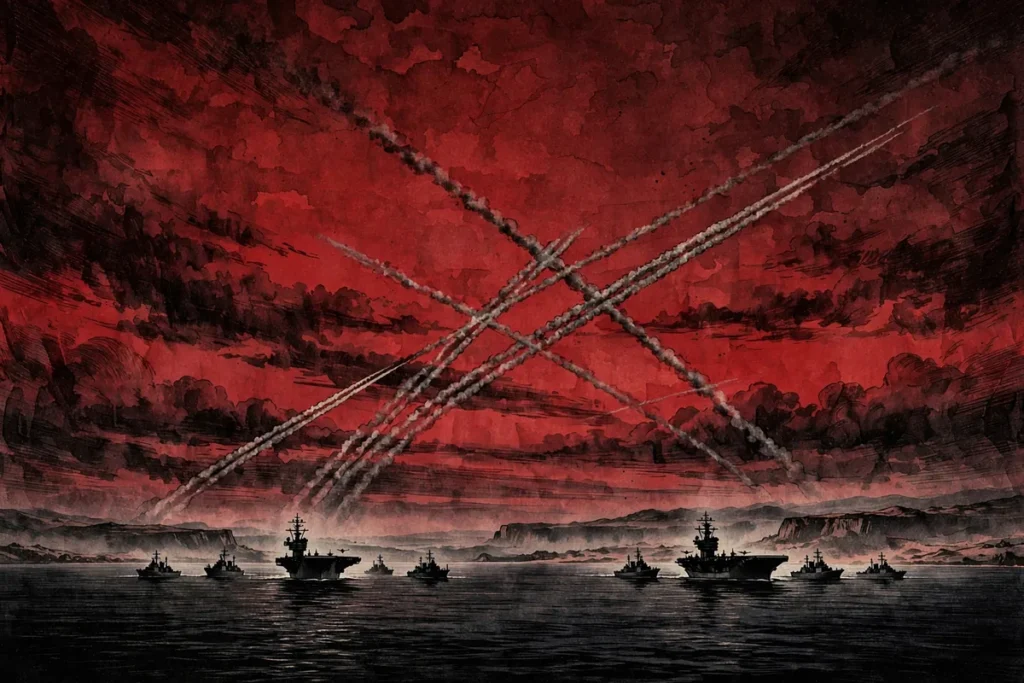
If all three carrier strike groups operate together in the theater, US officials estimate the combined force would include nearly 20,000 personnel, up to 150 fighter aircraft, and numerous guided-missile cruisers and destroyers. That concentration would let commanders distribute aircraft among strike missions, combat air patrols, electronic attack, airborne surveillance and fleet defense — while the extra cruisers and destroyers add missile launchers for both defensive interception and long-range strikes, including Tomahawk cruise missiles.
It also gives the Navy something rarer: surge capacity. A single carrier must balance strike, defense and surveillance across one flight deck. Three carriers can sustain operations across multiple flight decks simultaneously — the difference between intermittent pressure and continuous, overlapping air power. Carriers have also been central to the campaign against Iran so far, alongside the US naval blockade choking off Iranian oil shipments — read how naval blockades actually work for the mechanics.
The cost is measured in strain on the fleet. Ronald O’Rourke, a longtime naval analyst at the Congressional Research Service, warned that a three-carrier presence risks exacerbating the Navy’s readiness problems:
“Maintaining even a two-carrier presence in that area over an extended period of time would be a strain for the carrier force. Maintaining a three-carrier presence in that area for an extended period would be a significantly greater strain.” — Ronald O’Rourke, former Congressional Research Service naval analyst
The numbers behind that warning are stark. The USS Abraham Lincoln, which the USS George Washington relieved in the region, kept its crew at sea for more than 260 consecutive days. The USS Gerald R. Ford was at sea for 11 months. The Navy last kept three carrier strike groups in the Middle East in April — the first time since 2003 — and each deployment eats into maintenance schedules, training cycles and crew recovery that the eleven-ship carrier fleet can never fully get back.
Carrier strike group vs. amphibious ready group: what’s the difference?
Sailing a day behind the Roosevelt is a formation that sounds similar but does something different. The three-ship USS Makin Island Amphibious Ready Group departed San Diego on September 28 with the 13th Marine Expeditionary Unit embarked: the amphibious assault ship USS Makin Island, the transport dock USS Anchorage and the dock landing ship USS John P. Murtha.
An amphibious ready group (ARG) is built around embarked Marines, not carrier aviation. The 13th MEU is an independent Marine Air-Ground Task Force built around Battalion Landing Team 2/4 and Combat Logistics Battalion 13, with aviation elements including MV-22B Osprey tiltrotors, AH-1Z Viper attack helicopters and F-35B Lightning II stealth fighters — the short-takeoff variant that can operate from an amphibious ship’s deck. The ARG gives commanders options for expeditionary aviation, crisis response, ship-to-shore operations and limited ground missions.
Another such group is already there: the USS Boxer Amphibious Ready Group and the embarked 11th Marine Expeditionary Unit were operating in the Arabian Sea, according to USNI News. If the Makin Island group overlaps with Boxer rather than relieving it, the carrier buildup would come with a parallel amphibious reinforcement. The role of stealth aircraft in the US-Israeli strikes on Iran explains why the F-35s embarked on both formations matter in this theater.
Frequently asked questions
What ships make up a US carrier strike group?
A typical US carrier strike group includes one nuclear-powered aircraft carrier, one or two guided-missile cruisers, two to three guided-missile destroyers, one or two nuclear attack submarines and a logistics ship for refueling and resupply — six to eight ships in total, plus a 60-plus-aircraft carrier air wing. The Navy notes that compositions are tailored to the mission, so no two strike groups are exactly alike.
How many aircraft carriers does the US Navy have?
The US Navy operates eleven nuclear-powered aircraft carriers: ten Nimitz-class carriers and one Ford-class carrier, the USS Gerald R. Ford. Only a fraction are deployable at any given time, because carriers regularly cycle through maintenance, training and crew recovery periods.
How many aircraft does a carrier strike group carry?
A carrier air wing typically embarks more than 60 aircraft, including strike fighters, electronic-attack aircraft, airborne early-warning planes, helicopters and transport aircraft. Carrier Strike Group 9’s air wing, for example, includes F-35C stealth fighters, three squadrons of F/A-18E/F Super Hornets, EA-18G Growlers, E-2D Hawkeyes, Seahawk helicopters and CMV-22B Ospreys.
What is the difference between a carrier strike group and an amphibious ready group?
A carrier strike group is built around an aircraft carrier and focused on sea control, air power projection and long-range strikes. An amphibious ready group is built around amphibious assault ships carrying a Marine Expeditionary Unit, and is focused on expeditionary missions: crisis response, ship-to-shore operations and limited ground combat. The two formations complement each other.
Why is the US sending a third carrier to the Middle East now?
The deployment comes as President Trump weighs new strikes against Iran after the November 3 US elections and follows Iran’s rejection-proofing ceasefire diplomacy. A US official told the Associated Press that three carriers could be in the region by the end of October. Analysts stress the movement creates additional military options but does not by itself prove new strikes are imminent.
Sources
- Associated Press (via AAP): Third US carrier, thousands of troops head to Mideast
- Associated Press (via BusinessMirror): US adds carrier, 10K troops to Mideast, official says
- Army Recognition: U.S. Prepares Deployment of Three Aircraft Carriers to Middle East
- US Navy: Team of Teams — Carrier Strike Group 12 integration
- Popular Science: What ships are in an aircraft carrier strike group?
- Wikipedia: Carrier strike group