WarBrief Live | October 3, 2026 | Geopolitics
Strait of Hormuz oil shipping is the energy world’s sharpest split in 2026: on October 2, two more tankers were struck by unknown projectiles near the waterway and Iran’s Revolutionary Guard Navy declared the strait closed again — yet tracker data shows global crude flows through the chokepoint recovering toward pre-war levels while Iran’s own oil exports have collapsed. The war over the strait has become a siege Iran is losing economically.
Key Takeaways
- Two crude oil tankers were struck by unknown projectiles in and near the Strait of Hormuz on October 2; both crews were reported safe and no oil spills were reported, according to the UK Maritime Trade Operations (UKMTO) agency.
- Iran’s IRGC Navy announced on October 2 that the strait would remain closed until the United States lifts its blockade of Iranian ports, even as tracking data shows non-Iranian crude flows rebounding sharply.
- Tracker data cited by the Wall Street Journal puts the seven-day average of oil clearing the strait at 14.19 million barrels per day, approaching the pre-war baseline of 17.13 million — with Iranian barrels the main missing piece.
- Iranian crude exports fell to roughly 255,000 barrels per day in August from about 1.85 million in March, as the U.S. blockade reinstated in July stranded an estimated 20 Iranian-linked tankers off Sri Lanka and dried up Tehran’s revenue.
- Seven OPEC+ members meet virtually on October 4 to set November quotas and are expected to hold targets steady; Brent crude traded at $102.30 a barrel on October 2 while Abu Dhabi’s Murban crude commanded a rare premium at $109.40.
What happened: two tankers struck, strait closed again
The latest flare-up began on October 2, when a crude tanker exiting the strait was struck by an unidentified projectile, starting a fire and knocking out power; the crew contained it and resumed the voyage. Hours later, a second tanker — about four nautical miles east of Oman — reported another projectile strike. UKMTO said all crews were safe with no environmental impact, and advised vessels to transit with caution. Reuters confirmed the second strike early on October 3.
One vessel hit was the Kuwait-flagged tanker MT Kazimah III, en route to Lomé in Togo. India’s Embassy in Oman said it coordinated the rescue of five Indian nationals aboard, who were shifted ashore safely.
Then came the diplomatic escalation. On the evening of October 2, Iran’s IRGC Navy said the strait was closed and would remain shut until the United States lifted its blockade of Iranian ports, warning that “no vessel is to move from its anchorage in the Persian Gulf or the Sea of Oman,” according to Friday evening live news coverage. President Donald Trump said the United States would not let Iran “blackmail” it over the waterway, while adding that “very good conversations” were happening with Tehran. Iran’s Supreme National Security Council said new American proposals were under review.
The battle is turning: the world’s oil gets through
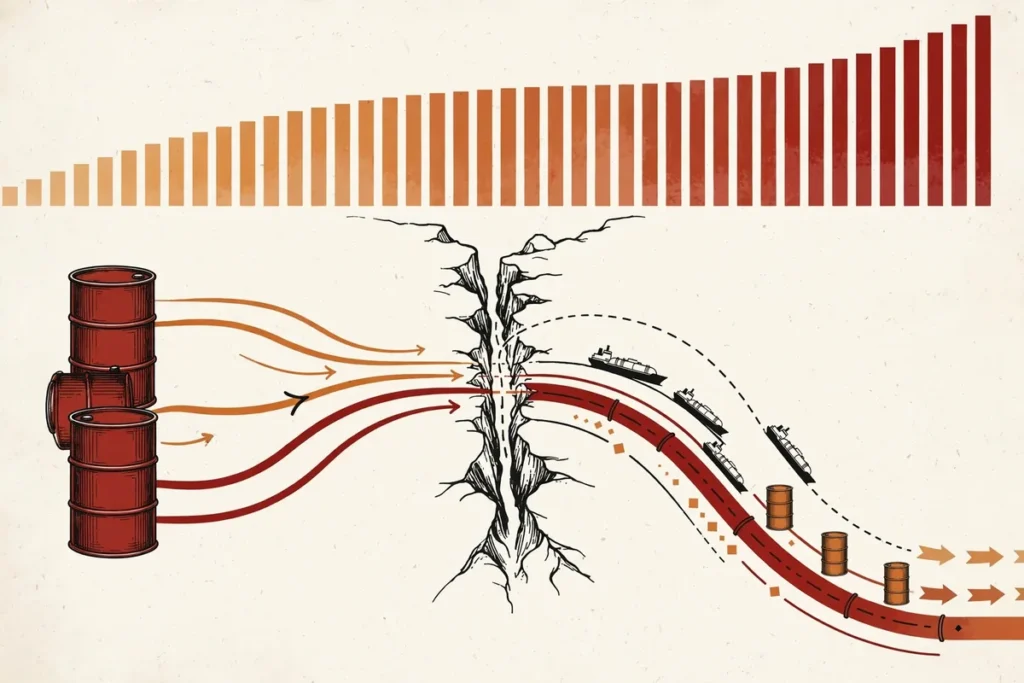
The timing of Iran’s renewed closure threat is telling. In an October 1 editorial titled “The Battle of Hormuz Is Turning,” the Wall Street Journal said tankers-tracking groups now confirm what the Trump administration has been saying: U.S. Central Command has turned around the battle of the strait. Citing tracker Kpler, the editorial said the seven-day average of oil clearing the strait had reached 14.19 million barrels a day — approaching the pre-war baseline of 17.13 million. Most of what is missing, it argued, is Iranian oil stopped by the U.S. blockade.
Separate Wall Street Journal reporting from Dubai showed crude exports from major Middle Eastern producers — Saudi Arabia, Iraq, the UAE and others — had risen to almost 13 million barrels a day via Hormuz and bypass routes, the highest since February, according to tracker Huax. Kpler put shipments via the strait and bypass routes at just under 80 percent of pre-war regional flows; JPMorgan estimates Middle East exports are averaging 17.5 million barrels a day, roughly 98 percent of pre-war levels.
The mechanism of the turnaround is naval power plus infrastructure improvisation. Saudi Arabia has resumed pumping crude through its damaged East-West pipeline to the Red Sea, loading tankers at the port of Yanbu — volumes remain reduced, but every barrel that avoids the strait loosens Iran’s grip. Gulf producers are also running what analysts call a “crude oil shuttle service” in safe waters, moving cargo through coordinated transshipment. As we detailed in our explainer on how naval blockades work, the blockade has shifted from denying everyone to denying Iran specifically.
Why it matters: Iran’s revenue is drying up
For Tehran, the numbers are brutal. Kpler estimates Iranian crude exports fell to roughly 255,000 barrels a day in August, down from about 1.85 million in March — before the U.S. reinstated its maritime blockade in July. Treasury Secretary Scott Bessent has estimated the Iranians will deliver the last of their pre-blockade oil to China in mid-October, and roughly 20 empty Iranian-linked tankers are now stranded off Sri Lanka’s coast, drifting with food, fuel and fresh water running low, according to the Wall Street Journal.
The pressure campaign extends beyond the water. The UAE has cut off trade with Iran, Turkey is closing Iranian banks, and the region is suspending flights to Tehran. The rial has fallen past 2.5 million to the dollar, down from 1.5 million at the start of 2026, while the International Monetary Fund projects Iranian inflation near 69 percent this year.
For American and European consumers, the picture is mixed. Brent crude traded at $102.30 a barrel on October 2, according to OilPrice data, while U.S. benchmark WTI stood at $92.67. The standout was Abu Dhabi’s Murban crude, which surged $7.15 — nearly 7 percent — to $109.40 a barrel, commanding a rare premium over Brent because of its direct exposure to Hormuz risk and strong Asian demand. Diesel remains the acute pain point: China’s halt of October refined fuel exports has tightened global diesel markets, and the G-7 agreed this week to release 100 million barrels of crude and refined products from emergency reserves via the International Energy Agency over four months, front-loading diesel. (For background, see our analysis of fuel prices and our report on China’s export halt.)
Educational note: this article describes market conditions for context. It is not financial advice, and WarBrief Live does not recommend buying or selling any security or commodity.

Background and timeline
- February 28, 2026: The war erupts as U.S. and Israeli strikes hit Iran; the Strait of Hormuz, which handled about a fifth of global oil and LNG supplies before the war, becomes a contested chokepoint.
- July 2026: The United States reinstates its maritime blockade of Iranian ports, and Iran’s ability to move crude through the strait collapses. Iranian-linked tankers are stranded in Asian waters.
- September 6, 2026: Seven OPEC+ members — Saudi Arabia, Russia, Iraq, Kuwait, Kazakhstan, Algeria and Oman — freeze October production quotas at a virtual meeting, pausing four months of output hikes.
- October 1, 2026: The Wall Street Journal publishes “The Battle of Hormuz Is Turning,” arguing Iran’s oil is blocked while the world’s gets through. Trump orders a third U.S. aircraft carrier to the Middle East.
- October 2, 2026: Two tankers are struck by projectiles in and near the strait; the IRGC Navy declares the waterway closed until the U.S. lifts its blockade; Trump says Washington will not be “blackmailed.” Brent holds at $102.30, Murban at $109.40.
- October 4, 2026: The seven OPEC+ members are scheduled to meet virtually to set November quotas; analysts expect targets to hold steady.
Different perspectives
Iran frames the strait as legitimate wartime leverage. Parliament speaker Mohammad Baqer Qalibaf has said the waterway will stay shut until the United States meets Tehran’s conditions — lifting the blockade, ending oil sanctions, releasing frozen assets and halting military operations, according to Reuters. A senior Iranian official told Reuters in September that Iran could reopen the strait within seven days if Washington eased military pressure and lifted the blockade.
The Trump administration’s position, set out in our coverage of the president’s “deal or blow them up” ultimatum, is that the blockade and strikes continue until a peace deal is reached — and that Tehran will not be allowed to use the strait as a bargaining chip. Shippers and insurers sit in the middle: some insurers are advising companies to pause voyages, and vessels are increasingly switching off their public AIS transponders. As Rystad Energy’s Jorge Leon wrote, tanker traffic through the strait “has essentially stopped, which tells you more about risk perception right now than any statement from Washington or Tehran” — a snapshot from a period of acute tension that the recent flow recovery is now challenging.
The risk analysts agree on one thing: as Iran’s economic leverage erodes, the incentive for military escalation rises. The Journal’s Dubai reporting warned the breakdown of Tehran’s chokehold raises the risk Iran will resort to attacks — like Friday’s projectile strikes — to bolster its bargaining position. Whether those strikes were retaliation, a message, or the work of a third party remains unconfirmed; UKMTO and regional authorities said the origin of both attacks is under investigation.
What to watch next
Sunday’s OPEC+ meeting. The seven core members meet virtually on October 4, and two sources told Reuters the group will likely keep November quotas steady — a sign the cartel believes the physical market, not paper targets, is driving prices.
The mid-October clock. Both Kpler and the Treasury Department converge on a mid-October date for when Iran’s stockpiled oil beyond the blockade runs out. If the deadline passes with no diplomatic movement, Tehran’s remaining leverage shrinks to military action or concessions.
The back-channel track. Trump’s claim of “very good conversations” with Iran and Tehran’s acknowledgment that new U.S. proposals are under review suggest the public standoff may coexist with real negotiation.
Insurance and tanker behavior. War-risk premiums, AIS-dark transits and insurer guidance will be the earliest indicators of whether Friday’s strikes were an isolated message or the start of a new campaign against shipping.
Frequently asked questions
Is the Strait of Hormuz closed right now?
Iran’s IRGC Navy said on October 2 that the strait was closed and would remain shut until the U.S. lifted its blockade of Iranian ports. However, tracker Kpler’s seven-day average showed 14.19 million barrels a day of non-Iranian crude transiting the waterway just before that announcement. The practical status of the strait has fluctuated repeatedly since the war began.
Why is Murban crude trading at a premium over Brent?
Abu Dhabi’s Murban rose to $109.40 a barrel on October 2 — about $7 above Brent’s $102.30. Murban is loaded in the UAE, so it is directly exposed to any Hormuz disruption, and strong Asian demand has amplified the premium. The war has inverted normal pricing: grades closest to the conflict carry the highest risk premiums.
How are oil tankers getting through the strait?
Gulf producers and U.S. naval forces have adapted with convoy-style coordination, ship-to-ship transfers in safer waters, the Saudi East-West pipeline to the Red Sea, and vessels switching off public tracking transponders. JPMorgan estimates Middle East exports are running at about 98 percent of pre-war levels.
What does the OPEC+ meeting on October 4 mean for fuel prices?
The seven core OPEC+ members are expected to hold November targets steady, according to Reuters sources, because Gulf producers are already pumping well below their official quotas. Near-term fuel prices will be driven more by events in the strait — tanker attacks, insurance costs and the blockade — than by cartel decisions.
Read next: Trump’s secret Camp David meeting on Iran and Yemen — what Vance, Rubio, Hegseth and the Joint Chiefs weighed as tanker strikes hit the strait and the G7 tapped emergency diesel reserves.
Sources
- Wall Street Journal: The Battle of Hormuz Is Turning (editorial, October 1, 2026)
- Wall Street Journal: Middle East Oil Exports Rebound as Iran’s Chokehold on Hormuz Breaks Down
- Reuters: Crude oil tanker struck by unknown projectile off Oman, UKMTO says (October 2, 2026)
- Reuters: Iran ready to reopen Strait of Hormuz if US eases military pressure and lifts blockade (September 22, 2026)
- Reuters (via Sweet Crude Reports): OPEC+ oil producers to keep output targets steady at Sunday meeting (October 2, 2026)
- Aju Press (via Yonhap): Oil Tanker Struck Near Hormuz Strait, All Crew Safe (October 3, 2026)
- Dow Jones Newswires (via Morningstar): The Week in Oil — Crude Exports Recover But Regional Tensions Remain Elevated (October 2, 2026)
- WE News English: Oil Prices Ease After Sharp Rally As China Curbs Fuel Exports (October 2, 2026)
- UAE Vartha: Two Oil Tankers Struck by Projectiles in Strait of Hormuz Region, UK Maritime Agency Says (October 3, 2026)
- Live coverage (via BBC live blog): Iran says Strait of Hormuz closed until US blockade lifts, as ships report attacks (October 2, 2026) — cited for the IRGC Navy statement, presidential remarks and diplomatic updates of October 2; corroborated where possible against Reuters