WarBrief Live | October 3, 2026 | Sanctions & Compliance
Leaked Russian budget documents show Moscow plans to spend 17.1 trillion rubles — roughly $205 billion — on defense in 2027, the highest level since the war in Ukraine began. Reported by Reuters from draft budget papers, the figure is 27 percent above what Russia originally budgeted. Paying for it will mean tax hikes, record borrowing and the first systematic cuts to welfare, education and healthcare since the war started — a rare, hard-numbers look at how years of Western sanctions are reshaping, but not breaking, the Kremlin’s war machine.
Key Takeaways
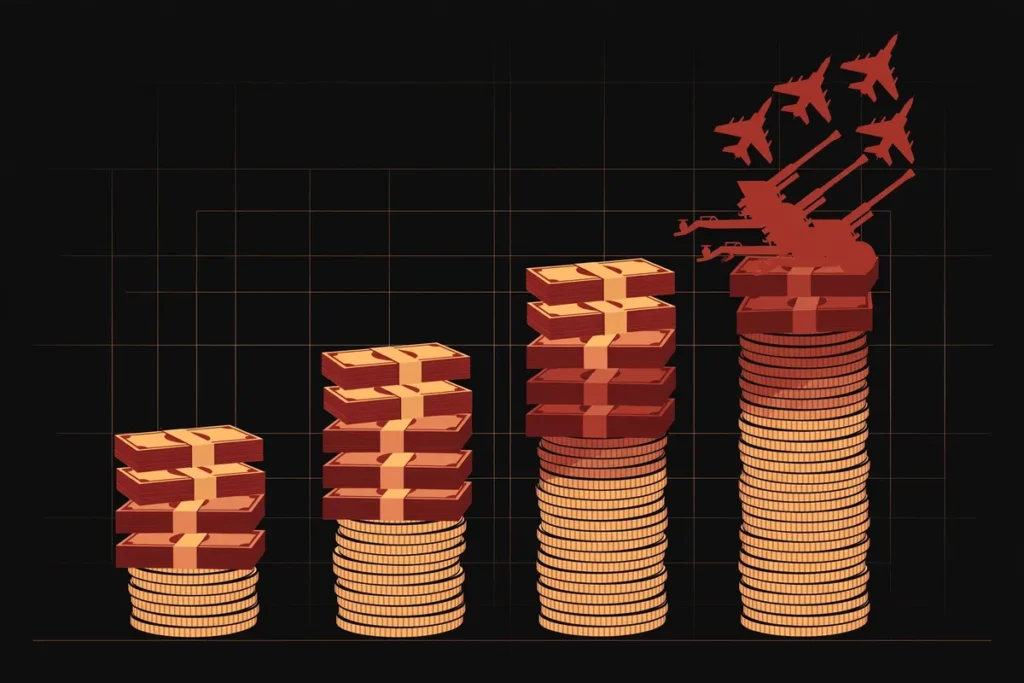
- Russia plans 17.1 trillion rubles ($205 billion) in defense spending for 2027, up 27 percent from the original 13.5 trillion ruble plan and the most since 2022.
- Total military outlays are projected at 50 trillion rubles over the next three years, while the 2026 budget deficit estimate has doubled to 3.2 percent of GDP.
- Welfare funding will fall 7 percent, education 6 percent and healthcare 6.8 percent in 2027 — the domestic economy is being cut to feed the war budget.
- New tax hikes, a windfall levy on metals and mining firms, and 43 percent more state borrowing are the other legs of the financing strategy.
- The numbers fuel the sanctions debate: restrictions are visibly raising Moscow’s costs, but the war economy is still expanding.
What the leaked documents show
Government budget documents seen by Reuters on September 28, 2026, lay out a 2027 defense allocation of 17.1 trillion rubles (about $202.6 billion), up from the 13.5 trillion rubles ($159.8 billion) originally planned — the largest annual military budget since the full-scale invasion of Ukraine in February 2022. Over the next three years, total defense spending is projected at 50 trillion rubles, roughly $592 billion.
The 2026 picture is also darkening. The government doubled its deficit estimate to 3.2 percent of GDP, and total spending is projected to rise 13.2 percent to 48.6 trillion rubles (20.9 percent of GDP). Defense spending for 2026 was planned at 12.1 trillion rubles, but the actual figure is classified — and some military outlays sit in other budget lines, so the headline number understates the true cost.
Financing the surge leans on three levers. First, borrowing: 2027 borrowing jumps 43 percent to 7.7 trillion rubles, pushing state debt to 21.7 percent of GDP — past the 20 percent line Russian officials long treated as safe. Second, reserves: Moscow will spend 459 billion rubles, about 11 percent of the National Wealth Fund’s liquid portion. Third, revenue: new 2027 tax hikes include a windfall levy on metals and mining firms expected to raise 200 billion rubles a year, while the 2026 oil and gas revenue forecast was cut to 7.6 trillion rubles from 8.9 trillion.
According to The Times, defense will account for at least 35 percent of the entire state budget in 2027, with defense and national security together swallowing 43 percent — believed to be a post-Soviet record.
Background and timeline
Russia’s wartime budget has been a story of steadily upward revisions colliding with deteriorating revenues:
- February 2022: Russia launches its full-scale invasion of Ukraine, triggering the first sweeping wave of Western financial, trade and energy sanctions — followed in December by the G7 oil price cap on Russian crude.
- 2022–2024: Moscow raises defense spending every year, covering the surge with oil and gas revenues, domestic borrowing and National Wealth Fund drawdowns.
- 2025: Economic growth stalls to about 1 percent, reserve buffers thin, and the deficit begins overshooting targets repeatedly.
- September 2026: The draft 2027 budget documents seen by Reuters reveal the $205 billion defense plan, the doubled 2026 deficit estimate and the first planned cuts to social spending of the war era.
- October 1, 2026: The government was expected to submit the draft budget to parliament; the State Duma, where the pro-Kremlin United Russia party holds a constitutional majority after September’s parliamentary election, is expected to approve it with the stated priority that winning the war takes precedence over other needs.
Why it matters
The 2027 figures are the clearest evidence yet that the sanctions regime has forced a structural tradeoff inside the Russian state. Moscow is not short of military money — it is choosing, openly, to cannibalize the civilian economy to keep the war funded. Social policy, which covers pensions, payments to war veterans and maternity benefits, shrinks 7 percent in 2027; education falls 6 percent; healthcare drops 6.8 percent; and the “national economy” line covering roads, infrastructure and agriculture subsidies contracts 7.4 percent. Those are cuts to the programs that touch ordinary Russians’ daily lives, made public in an official document — a political signal the Kremlin once avoided.
For US and European readers, the stakes are strategic and economic. Russia’s budget strain tells two stories: sanctions are raising the cost of aggression, and Moscow is willing to pay it for at least three more years. The documents also expose the limits of Russia’s buffers: with the National Wealth Fund’s liquid reserves being drawn down, debt pushed past the self-imposed 20 percent safety line and oil revenues cut by more than a trillion rubles, Moscow’s room for maneuver is narrower than at any point since 2022. Finance Minister Anton Siluanov acknowledged the squeeze, saying spending would focus on “the front” and that budget-balancing would require the state to “dig around somewhere.”
Different perspectives
The Kremlin’s view: Russian officials present the budget as a wartime necessity imposed by NATO’s military support for Ukraine. State media frames the tax hikes and spending shifts as shared sacrifice, and the United Russia majority in the Duma is expected to pass the budget on the principle that victory in Ukraine outranks all other priorities. The documents treat the 2027 figure as a three-year planning baseline — a signal Moscow is preparing for a long war.
The Western assessment: Sanctions architects argue the documents vindicate slow financial strangulation: Moscow can still buy guns, but must now tax citizens more, borrow more and cut hospitals and schools to do it. The doubled 2026 deficit forecast and the raid on the National Wealth Fund are presented as proof the buffer is being consumed. Kyiv reads the record figure as confirmation that pressure alone will not stop the war — Ukraine has been pressing for access to frozen Russian assets to cover its own budget gap.
The skeptics’ view: Critics counter that a record military budget shows sanctions have not changed Moscow’s strategic calculus. They note the headline number excludes off-budget military spending, that Russia’s debt ratio remains far below Western levels even at 21.7 percent, and that taxing metals and mining firms is a transfer from oligarchs, not collapse. On this reading, sanctions impose friction without forcing an end to the war — a distinction with major implications for how the West calibrates pressure in 2027.
What the numbers mean against NATO’s own spending split
Russia’s defense figure lands against a fracturing NATO spending picture. The alliance agreed in June 2025 to spend 5 percent of GDP on defense and security investments by 2035, but unity on the path there is cracking:
| Country | Defense spending | Status / trend |
|---|---|---|
| Russia | ~$205 billion planned for 2027 (~35% of state budget) | Up 27%; record since 2022; 50 trillion rubles over three years |
| Poland | ~$53 billion (4.8% of GDP in 2026) | NATO’s highest spender relative to GDP; pushing for 5% by 2030 |
| Italy | ~€14 billion (down from €21–22 billion planned) | Cabinet agreed an up-to-€8 billion cut amid coalition pressure |
| United States | The world’s largest defense budget by a wide margin | Carrying the largest share of NATO’s military capacity |
The contrast sharpens the sanctions angle: while Moscow expands its war budget at the expense of its domestic economy, NATO member Italy is cutting defense by up to €8 billion under coalition pressure, as Defense News reported on October 2. Deputy Prime Minister Matteo Salvini pushed the reduction through a cabinet meeting, trimming the planned €21–22 billion allocation to about €14 billion. At the other extreme, Poland spends 4.8 percent of GDP on defense and is urging the alliance to hit the 5 percent target by 2030 rather than 2035. The Times notes Russia’s 2027 outlay is more than double Britain’s annual defense spending, though far below American levels.
For more on the alliance’s military buildup, see our intelligence analysis section and the broader conflict zones overview.
What to watch next
Four developments will decide whether the 2027 budget holds. First, the State Duma vote: passage is near-certain given United Russia’s constitutional majority, but debate over the welfare and education cuts — which have already angered some Kremlin supporters — will test the new parliament. Second, the tax hikes: the windfall levy on metals and mining is the first announced, and a larger-than-expected utility tariff rise is already scheduled after September’s election. Third, oil revenues: the budget’s 7.6 trillion ruble oil and gas figure is hostage to sanctions enforcement and crude prices — which the Iran conflict has pushed sharply higher, potentially handing Moscow unexpected relief. Fourth, the three-year trajectory: with 50 trillion rubles earmarked through 2029, further deficit slippage would force still harder choices in 2028.
Frequently asked questions
How much is Russia spending on defense in 2027?
Budget documents seen by Reuters show 17.1 trillion rubles — about $202.6 billion — roughly 27 percent more than originally planned. It is the highest annual figure since 2022 and amounts to at least 35 percent of the entire state budget.
How is Russia paying for the war in Ukraine?
Through oil and gas revenues, domestic borrowing, tax increases and National Wealth Fund drawdowns. The 2027 draft adds a windfall tax on metals and mining companies, 43 percent more borrowing, and the first planned cuts to welfare, education and healthcare since the war began.
Are Western sanctions on Russia working?
Sanctions have not stopped Moscow from expanding its military budget, but they are visibly raising its costs: a doubled deficit forecast, record borrowing, dwindling oil revenues and cuts to civilian programs. Whether that pressure can change Russia’s strategic decisions remains unproven.
Why is Russia cutting welfare, education and healthcare spending?
To cover the soaring military budget. Funding for social policy (pensions, veterans, maternity benefits) will shrink 7 percent in 2027, education 6 percent and healthcare 6.8 percent compared with the initial plan, according to Reuters. Russian officials have said winning the war in Ukraine takes priority over other budget needs.
How does Russia’s defense budget compare with NATO countries’?
Russia’s planned 2027 spending of about $205 billion is more than double Britain’s annual defense spending, per The Times, but far below the United States. Within NATO, Poland spends 4.8 percent of GDP on defense, while Italy is cutting up to €8 billion. NATO agreed in 2025 to a 5 percent of GDP defense target by 2035.
Sources
- Reuters: Russia raises 2027 military spending by 27%, budget documents show
- Reuters: Russia to cut welfare, education funding in 2027 as war spending soars
- Defense News: Russia raises 2027 military spending by 27%, budget documents show
- Defense News: Ukraine war fatigue fuels defense-spending downgrade plan in Italy
- The Times: Putin is counting the cost of a war without an end