WarBrief Live | October 4, 2026 | Energy & Oil
OPEC+ has agreed in principle to keep its November oil quotas steady, with seven core producers meeting by video on Sunday to ratify a decision that acknowledges how little control the group currently has over its own output. With the war over Iran and the Strait of Hormuz keeping Gulf production far below official targets, the OPEC+ November oil quotas are a ceiling almost nobody can reach.
Key Takeaways
- OPEC+ has agreed in principle to hold November oil quotas steady, according to three sources speaking to Reuters ahead of the group’s Sunday virtual meeting.
- The seven core members — Saudi Arabia, Russia, Iraq, Kuwait, Algeria, Kazakhstan and Oman — pumped 25 million bpd in August, roughly 5 million bpd below prewar February levels, per OPEC data.
- Gulf exports are fluctuating at 60–80% of normal levels as the Hormuz blockade continues; the IEA says more than 10 million bpd of Gulf production remains shut in.
- With Brent near $102 a barrel and winter demand approaching, the G7’s emergency 100-million-barrel diesel and crude release — not OPEC+ quotas — is the short-term lever on fuel prices.
- The real pivot is the 2027 capacity-baseline audit: any redistribution of quotas is unlikely before 2027, sources say.
What OPEC+ decided on Sunday
Three sources close to the talks told Reuters ahead of the Sunday meeting that OPEC+ has agreed in principle to keep output targets unchanged for November. The virtual session brings together the same seven core members managing the group’s 2026 strategy: Saudi Arabia, Russia, Iraq, Kuwait, Algeria, Kazakhstan and Oman. The Joint Ministerial Monitoring Committee also meets Sunday to review the market, though it does not decide policy.
The expected rollover is the second consecutive hold. On September 6, the seven core members kept October’s quotas at September’s settings, pausing the monthly increases of much of the year. Two delegates speaking to Bloomberg said the group, having nominally completed the reversal of 2023’s supply cuts, will probably ratify its existing roadmap and leave targets unchanged.
That framing — “nominally completed” — matters. The seven core producers raised quotas by roughly 800,000 bpd from April through July, but the Iran war has prevented Middle Eastern producers from implementing the increases in practice. The quotas are a ceiling almost nobody can reach.
Background and timeline
OPEC+’s 2026 began as a market-share story and became a war logistics story:
- April–July 2026: The seven core members raise production quotas by about 800,000 bpd in monthly steps, completing the phased return of a 2023 supply cut — at least on paper.
- July 2026: CNBC reports that the United Arab Emirates has left the group, while Iraq signals it wants higher quotas.
- September 6, 2026: The seven core members hold quotas steady for October at a virtual meeting. Reuters reports the group needs to review members’ production capacity to set 2027 output baselines, and that a debate over those baselines would likely come later in the year — effectively pausing increases for the fourth quarter.
- October 2, 2026: The G7 agrees an emergency coordinated release of 100 million barrels of diesel and crude over four months after weeks of US threats to ban diesel exports. Brent closed Friday at $102.25.
- October 4, 2026: The seven core OPEC+ members meet virtually and are expected to keep November quotas unchanged, with the capacity review for 2027 now delayed by the war’s distortion of production estimates.
Why the quotas barely matter right now
The headline targets tell only part of the story, and right now they tell the smaller part. The IEA’s September monthly report estimated Gulf production roughly 10 million bpd below prewar levels, with Gulf exports down to about 13 million bpd and shipments through the Strait of Hormuz fallen to 7.6 million bpd. The agency expects Gulf exports in the fourth quarter to remain at only about 60% of prewar levels, pushing any recovery of normal flows into 2027.
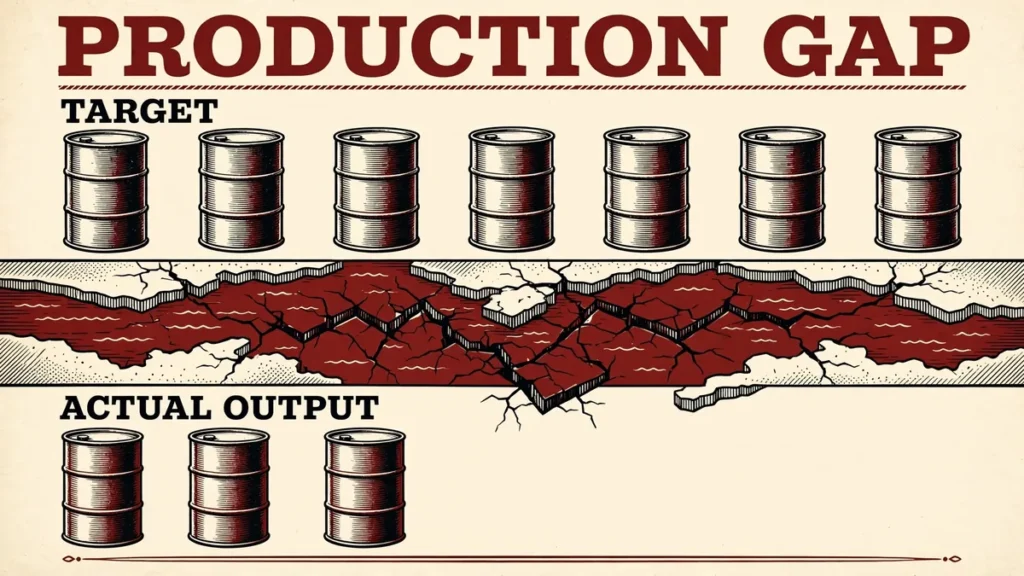
Saudi Arabia illustrates the damage. The kingdom’s crude supply plunged by 2.3 million bpd in August to just 6 million bpd — its lowest level in more than three decades — after attacks hit facilities and shipping routes, according to the IEA. The 17 quota-bound members of the alliance produced 7.3 million bpd below their August target. There are still about 2 million bpd of output cuts in place covering most members, but for Gulf producers the binding constraint is no longer quota discipline — it is the physical impossibility of exporting what the quotas permit.
One partial bright spot: Kpler data cited by market analysts showed Middle East crude exports rebounding to around 16 million bpd in September, the highest since the war began in late February. Brent settled earlier in the week around $103 a barrel — expensive, but well below the $144 spike of April. Yet the IEA warns the structural deficit persists: global oil inventories have fallen to 7.8 billion barrels, their lowest since 2023.
That gap between paper quotas and physical barrels is the single most important thing to understand about Sunday’s meeting: diplomats, not oil ministers, are the real marginal suppliers this year. Our Intelligence Briefing hub tracks the military and diplomatic picture around the strait alongside the energy data.
What it means for fuel prices this winter
For households in the United States and Europe, the practical question is the fuel bill. With Brent near $102 a barrel and winter heating demand building, OPEC+ holding November quotas steady offers neither relief nor additional pain — the market had already priced in a holding pattern, and analysts noted ahead of the meeting that a flagged rollover was unlikely to move crude on its own.
The more immediate lever is the G7’s emergency release agreed on October 2: 100 million barrels of diesel and crude over four months, frontloaded toward diesel in the first 20 days. As we reported on Friday, the move targeted record diesel prices — above $6.50 a gallon in parts of the United States — after the Trump administration threatened a US diesel export ban. That release, not OPEC+ quotas, is the policy action with a timeline short enough to matter before winter.
The IEA adds a sobering demand-side note: it expects global oil consumption to fall by 2.5 million bpd this year, with record fuel prices forcing consumers to use less — classic demand destruction. Refinery disruptions have tightened diesel and middle-distillate markets hardest, which is why pump and heating-oil prices can stay elevated even when crude itself eases.
Educational note: this article explains market developments for information only. It is not financial advice and should not be read as a recommendation to buy, sell, or hold any security or commodity position.

Different perspectives
Gulf producers face the sharpest dilemma: they are losing export revenue not because of quota discipline but because of war — while non-Gulf producers quietly fill the gap. The IEA’s “Americas Quintet” — the United States, Canada, Brazil, Guyana and Argentina — is forecast to add 1.4 million bpd of supply in 2026, with US output averaging 21.8 million bpd. Every barrel of Atlantic Basin growth is a barrel of long-term market share potentially lost to the Gulf.
Russia, the group’s other anchor, has different incentives. Moscow has historically favored restraint to support prices, and a quota hold costs it nothing it was going to deliver anyway, while higher-for-longer prices support its budget.
Iraq and the UAE are the internal fault line. Iraq has signalled it wants higher quotas; the UAE’s reported departure in July removed one voice from that debate but added a question about alliance cohesion in a year when several members cannot produce their own targets. The delayed capacity review, which was supposed to settle 2027 baselines by the end of October, now lands in the middle of this unresolved argument.
Consuming nations have stopped waiting for OPEC+. The G7’s coordinated release and pledges against export restrictions are the consumer bloc’s parallel energy policy — built around reserves rather than quotas. The sanctions and economic pressure hub tracks how the same logic is playing out in the enforcement sphere, where Western governments are squeezing Iran’s workaround trade routes.
What to watch next
Five things will matter more than the headline of Sunday’s communique:
- The statement’s wording on compliance: with Gulf producers 7.3 million bpd below target, any language on underproduction signals how the group frames the gap — as temporary war disruption or a compliance problem.
- The capacity-baseline audit: the seven-country review was due by the end of October, with the full alliance taking it up in late November. Reuters sources say the war has thrown production estimates into uncertainty; a further delay would confirm no quota changes before 2027.
- Iraq’s quota campaign: Baghdad’s push for higher targets is the likeliest source of public friction at or after the meeting.
- The diplomatic track on the Gulf: any de-escalation around Hormuz moves physical supply faster than any quota decision. For the military picture, see our coverage of the battle over the strait.
Frequently asked questions
What did OPEC+ decide at its October 4, 2026 meeting?
The group agreed in principle to keep November production targets unchanged, according to three sources speaking to Reuters ahead of the Sunday virtual meeting. It extends the pause that began on September 6, when October quotas were held at September’s levels.
Why don’t OPEC+ quotas matter as much as they used to?
Because the binding constraint is no longer quota discipline but the war: Gulf producers are pumping millions of barrels per day below their targets due to the Hormuz blockade and attacks on facilities and shipping. A quota change cannot move oil that cannot leave the region.
What is the 2027 capacity-baseline audit?
OPEC+ must review each member’s production capacity to set the output baselines underpinning 2027 quotas. The seven-country review was due by the end of October, with the full alliance considering it in late November — but the war has distorted capacity estimates, and sources say quota changes are unlikely before 2027.
How does the OPEC+ decision affect fuel prices this winter?
The hold is neutral for prices on its own — markets had already priced in a rollover. The near-term drivers are the G7’s 100-million-barrel diesel and crude release and the physical state of Gulf exports, with Brent near $102 a barrel as winter demand builds.
Did the UAE really leave OPEC+?
CNBC reported in July 2026 that the UAE had left the group, and the seven core members meeting on October 4 do not include it. No formal resignation statement has been published, so the exact status remains reported rather than officially confirmed.
Sources
- Reuters (via The Hindu BusinessLine): OPEC+ agrees in principle to keep oil output targets unchanged in November, delegate says
- InvestingLive (Bloomberg delegates): OPEC+ seen holding November quotas steady at Sunday meeting
- OilPrice.com (IEA September monthly report): IEA sees 5.7 million bpd oil supply plunge as Gulf recovery slips to 2027
- Oil & Gas Journal (IEA data): IEA sees oil demand decline deepening as Middle East disruptions persist
- Le Monde: Under pressure from Donald Trump, G7 releases 100 million barrels of oil