
WarBrief Live | October 9, 2026 | Breaking Analysis
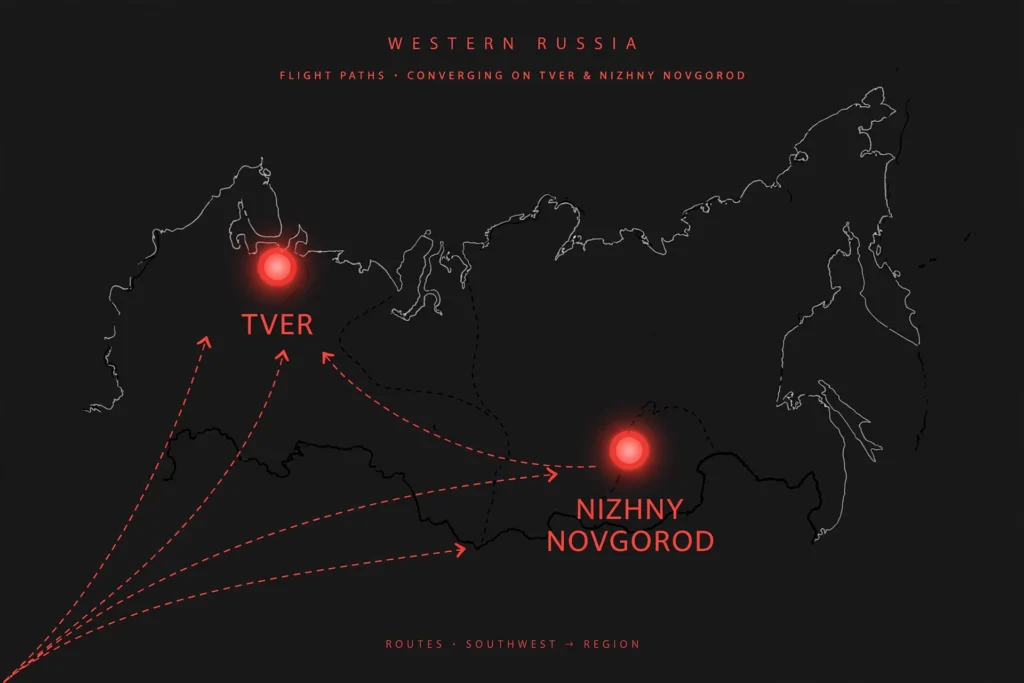
Ukraine carried out overnight strikes against three Russian missile-production facilities, hitting a cruise-missile fuel plant in the Tver region and two missile-infrastructure sites in the Nizhny Novgorod region. Ukraine strikes Russian missile plants like these, the General Staff of the Armed Forces of Ukraine said, to degrade Russia’s ability to produce explosives and rocket fuel for its long-range strike arsenal. Russian regional governors confirmed drone attacks in both regions on October 9, 2026, reporting one serviceman killed and a fire at the Redkino plant that has since been extinguished. This breaking analysis explains what Ukraine says it hit, what is independently confirmed, and why these targets matter for the war.
Key Takeaways
- Ukraine’s General Staff says its forces struck three missile-production facilities inside Russia overnight on October 8–9, 2026.
- The targets were the Redkino Experimental Plant in the Tver region and two sites in the Nizhny Novgorod region: the Barmin Research Institute of Launch Complexes and a centre for disposing of intercontinental ballistic missiles.
- The Redkino plant produces Decilin-M fuel components for Russia’s Kh-55 and Kh-101 cruise missiles, and is under international sanctions.
- Russian governors confirmed drone attacks in both regions: one serviceman was killed in the Nizhny Novgorod region, and a fire at the Redkino plant was extinguished. The extent of the damage remains unconfirmed.
What did Ukraine strike overnight?
According to a statement by Ukraine’s General Staff, the overnight strikes hit three facilities tied to Russia’s missile production chain. The first was the Redkino Experimental Plant near the village of Redkino in the Tver region, a chemical facility that produces components for missile fuel. The second was a branch of JSC CENKI — the Centre for Operation of Ground-Based Space Infrastructure Facilities — near the settlement of Dalne Konstantinovo-5 in the Nizhny Novgorod region: the V. P. Barmin Research Institute of Launch Complexes, which is involved in the development, maintenance and operation of launch complexes, refuelling equipment and missile control systems.
The third target was the Centre for the Disposal of Intercontinental Ballistic Missiles near the village of Surovatikha, also in the Nizhny Novgorod region. The General Staff said the facility for the “liquidation of intercontinental ballistic missiles” was hit to degrade Russia’s ability to source explosives and rocket fuel, Reuters reported on October 9.
The weapons used were not officially specified, but Censor.NET, citing the General Staff, reported the attacks were carried out by the Defence Forces overnight. Reuters noted that Ukraine has been striking Russian oil refining and military production facilities with a growing fleet of domestically produced drones, and sometimes with missiles.
What is Decilin-M, and why does it matter?
The Redkino plant is the most tactically significant of the three targets. According to the Ukrainian General Staff, it manufactures components of Decilin-M fuel for the Kh-55 and Kh-101 cruise missiles — the air-launched weapons Russia has used repeatedly against Ukrainian cities and energy infrastructure — as well as additives for diesel fuel and aviation kerosene. The plant is part of Russia’s military-industrial complex production chain and is subject to international sanctions.
The logic of hitting it is straightforward: missiles are consumables, and a cruise-missile campaign burns through specialised fuel components at a steady rate. Degrading the chemical plants that make those components is a way to throttle Russia’s long-range strike tempo without having to intercept every missile. This is also why the strikes on the Nizhny Novgorod facilities matter — the Barmin institute supports launch and refuelling infrastructure, while the disposal centre, in the General Staff’s framing, is a source of explosives and rocket-fuel materials.
Background and timeline
The October 9 strikes are part of a sustained Ukrainian deep-strike campaign against Russian military industry and energy infrastructure that has intensified through 2026:
- February 2026: the Redkino Experimental Plant was reportedly struck for the first time, with Ukrainian media reporting a major chemical fire across several production workshops. The October 9 attack is the second documented raid on the complex this year.
- October 8, 2026: Ukraine’s General Staff reported strikes on the Omsk Oil Refinery in Siberia — Russia’s largest refinery, some 2,500 kilometres from the Ukrainian border — as part of the same long-range campaign.
- October 8–9, 2026: overnight strikes hit the three missile-production facilities in the Tver and Nizhny Novgorod regions, confirmed by Reuters.
- October 9, 2026: earlier the same morning, WarBrief reported on Zelenskyy’s push for Starlink coverage to support strikes inside Russia — tonight’s operation lands squarely in the middle of that debate.
By the numbers: what is confirmed and what is reported
| Metric | Figure | Source | Status |
|---|---|---|---|
| Facilities targeted overnight | 3 | Ukrainian General Staff | REPORTED (Ukrainian claim) |
| Russian serviceman killed repelling the attack | 1 | Nizhny Novgorod governor, via Reuters | CONFIRMED (Russian official) |
| Drone attacks acknowledged in both regions | Tver, Nizhny Novgorod | Both regional governors, via Reuters | CONFIRMED (Russian officials) |
| Cruise-missile fuel made at Redkino | Decilin-M components for Kh-55 and Kh-101 | Ukrainian General Staff, via Censor.NET | REPORTED (Ukrainian claim) |
| Previous documented strike on Redkino | February 2026 | New Voice of Ukraine | REPORTED |
| Oil depot hit in Belgorod region the same night | 1 facility | OSINT channels, via RBC-Ukraine | UNCONFIRMED (single source) |
Caveat: Ukrainian strike claims and Russian official acknowledgements routinely differ on damage. The actual extent of damage to all three facilities is unconfirmed and is still being assessed.
Why this matters
Russia’s campaign of long-range strikes against Ukraine depends on a steady supply of cruise missiles, and those missiles depend on a thin chain of specialised chemical and engineering facilities. Redkino is exactly that kind of chokepoint: a single plant making fuel components and additives with few ready substitutes. If the strike disrupted production, it could slow the tempo of Russian cruise-missile attacks in the coming weeks — though that depends entirely on the damage, which neither side has documented publicly.
The choice of targets also signals a deliberate escalation in the scope of Ukraine’s deep-strike campaign. Hitting oil refineries degrades the money and fuel that sustain the war; hitting missile-production facilities degrades the weapons themselves. And the inclusion of a facility tied to intercontinental ballistic missiles — even a disposal centre, not an active arsenal — is the kind of strike designed to be noticed in Moscow as well as in Washington.
What this means for US/UK/EU readers
For readers in the US, UK and EU, the direct impact is limited but the strategic signal is not. Sustained Ukrainian strikes on Russian military industry reinforce the case Kyiv makes to Western capitals: that long-range capabilities — drones, missiles and the targeting infrastructure to use them — are among the highest-leverage forms of support, because they strike the production base rather than just the battlefield. Expect these strikes to feature in the next rounds of the debate over air-defence aid, sanctions enforcement on Russia’s military-industrial complex, and restrictions on dual-use chemical exports.
Energy markets are the secondary channel to watch. The parallel campaign against Russian refineries — Omsk on October 8, and the reported Belgorod depot fire the same night as the missile strikes — keeps upward pressure on refined-fuel prices. As WarBrief’s conflict zones coverage has tracked through 2026, every disruption to Russian refining capacity feeds through to diesel and heating-fuel costs in Europe.
Different perspectives
Ukraine frames the strikes as legitimate military operations against the industrial base sustaining Russia’s attacks on Ukrainian cities. The General Staff’s stated aim — degrading Russia’s ability to source explosives and rocket fuel — presents the campaign as defensive in purpose, even when the targets are hundreds of kilometres inside Russia.
Russia’s official response, as reported by Reuters, followed the familiar pattern of minimising the damage: the Nizhny Novgorod governor described the harm as “minimal” and attributed it to drone debris, while the Tver governor reported only a fire that was extinguished. Moscow rarely confirms the significance of struck military-industrial targets.
Independent verification is, as usual, the missing piece. No satellite imagery or independent damage assessment of the three sites had been published at the time of writing, and claims from both sides about the effects of such strikes should be treated as unconfirmed until they are.
What to watch next
Three things will determine how significant this night was. First, commercial satellite imagery of the three sites, which typically surfaces within days and will show whether buildings were destroyed or merely scorched. Second, the Russian response — Moscow has historically answered major deep strikes with intensified missile and drone attacks on Ukrainian cities, a pattern worth watching over the next 48–72 hours. Third, whether Ukraine sustains the tempo: the Omsk strike on October 8 and tonight’s missile-facility strikes suggest the campaign is accelerating, and the coming week will show whether this was a one-night surge or a new phase.
Frequently asked questions
What did Ukraine strike in Russia on the night of October 8–9, 2026?
According to Ukraine’s General Staff, three missile-production facilities: the Redkino Experimental Plant in the Tver region, the Barmin Research Institute of Launch Complexes near Dalne Konstantinovo-5 in the Nizhny Novgorod region, and the Centre for the Disposal of Intercontinental Ballistic Missiles near Surovatikha, also in the Nizhny Novgorod region. Russian governors confirmed drone attacks in both regions.
What is Decilin-M?
Decilin-M is a high-density fuel component used in Russia’s Kh-55 and Kh-101 air-launched cruise missiles, according to Ukraine’s General Staff. The Redkino plant reportedly manufactures components for it, along with additives for military-grade diesel and aviation kerosene. Disrupting its production could slow Russia’s cruise-missile strike tempo.
Why is Ukraine targeting Russian missile factories?
Ukraine says the aim is to degrade Russia’s ability to produce explosives and rocket fuel for the long-range strikes it fires at Ukrainian cities and infrastructure. Hitting the production base is more efficient than intercepting every missile, and it complements the parallel campaign against Russian oil refineries.
Did Russia confirm the strikes?
Partially. The governors of the Nizhny Novgorod and Tver regions confirmed drone attacks and a fire at the Redkino plant, and one serviceman was reported killed repelling the attack in the Nizhny Novgorod region. Moscow has not confirmed damage to the specific facilities Ukraine says it hit.
Could this escalate the war?
Deep strikes inside Russia have historically drawn Russian retaliation against Ukrainian cities, so the next 48–72 hours are the key window. The strikes also land amid the ongoing debate over Western support for Ukraine’s long-range strike capability — a debate WarBrief covered this morning in its analysis of Zelenskyy’s Starlink push.
Sources
- Reuters: Ukraine’s military says it hit three missile facilities in Russia (October 9, 2026)
- Censor.NET: Missile manufacturing facilities have been struck on Russian territory (October 9, 2026)
- The New Voice of Ukraine: Strike hits Russian cruise missile fuel plant in Tver (October 9, 2026)
- UNITED24 Media: Ukraine Strikes Russian Missile Launch Institute and ICBM Disposal Facility (October 9, 2026)


Discussion 0
Share analysis, corrections, or context. Be civil — comments are moderated.