WarBrief Live | November 13, 2026 | Country Profile
Taiwan fields about 169,000 active troops backed by 1.66 million reservists, a record 2026 defence budget of NT$949.5 billion, and a growing fleet of F-16Vs, Abrams tanks and Harpoon missiles, built to make any invasion catastrophically expensive.
Key Takeaways
- Taiwan’s 2026 defence spending reaches NT$949.5 billion (US$31.2 billion), 3.32% of GDP, up 22.9% year on year and above 3% for the first time since 2009.
- The armed forces number about 169,000 active personnel and 1.66 million reservists, against China’s 2.04 million active troops, a gap Taipei offsets with asymmetric weapons and geography.
- New hardware is arriving: the first two of 66 new F-16V Block 70 jets landed in October 2026, all 108 M1A2T Abrams tanks are delivered, and the first home-built submarine, Hai Kun, is in sea trials.
- China staged large unannounced drills around Taiwan in early November 2026, massing more than 100 vessels at their peak, days before the APEC summit in Shenzhen and Taiwan’s November 28 elections.
Overview: a small force facing a much larger neighbour
Taiwan, officially the Republic of China, sits about 130 kilometres off China’s south-eastern coast in the first island chain, the arc of islands running from Japan through the Philippines that frames the western Pacific. Its armed forces are built around one problem: deterring and, if deterrence fails, resisting a much larger People’s Liberation Army (PLA) across a strait that is both a moat and a highway.
The imbalance is stark. The International Institute for Strategic Studies puts Taiwan’s active strength at about 169,000 personnel, against China’s 2.04 million. Taiwan’s answer is a reserve pool of 1.66 million and a doctrine built on survivability: mobile missiles, hardened airfields, sea mines and drones, designed to impose costs rather than match the PLA ship for ship. President Lai Ching-te has pledged to raise defence spending to 5% of GDP by 2030.
What is Taiwan’s military made of?
The Army is the largest service, at roughly 94,000 active soldiers. Its most visible upgrade is complete: all 108 M1A2T Abrams main battle tanks ordered from the United States were delivered by April 2026, and the tanks took part in live-fire drills during the Han Kuang exercises. US-supplied HIMARS rocket launchers, Switchblade 300 loitering munitions and TOW anti-tank missiles are also in service. Conscription, restored to one year from January 2024, now feeds infantry battalions that take part in joint live-fire evaluations, and reservist refresher training has been extended to 14 days.
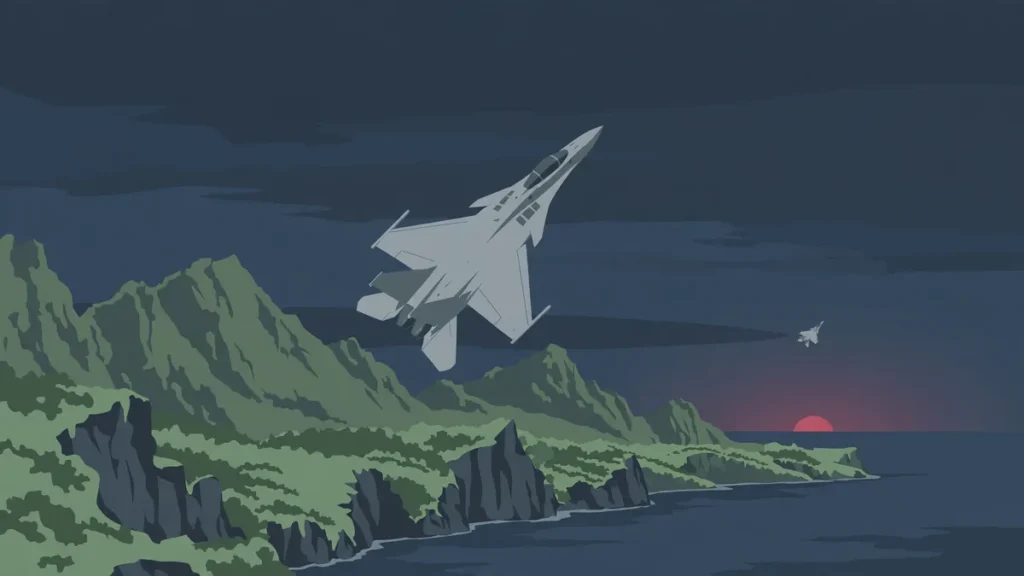
The Air Force is the service under the most pressure, scrambling daily against PLA aircraft crossing the Taiwan Strait median line. Its backbone is the F-16 fleet: the existing jets were upgraded to the F-16V standard in a programme completed in 2023, and the first two of 66 newly built F-16V Block 70 fighters, ordered in 2019 for about US$8 billion, arrived at Chihhang Air Base on October 2, 2026, the first new fighter deliveries in 25 years. Together the fleet will exceed 200 F-16s. The indigenous F-CK-1 fighter and French-built Mirage 2000s round out the combat fleet, and 66 locally built Brave Eagle trainers were completed in September 2026. Air defence layers Patriot PAC-3 batteries, the indigenous Tien Kung III system and Sky Sword II missiles.
The Navy, about 40,000 strong, operates four submarines and 26 principal surface combatants, including Keelung-class destroyers and Cheng Kung-class frigates. Its most watched programme is the first indigenously built submarine, Hai Kun, which began sea trials off Kaohsiung in October 2026 and could be delivered to the Navy before the end of the year.
By the numbers
| Metric | Figure | Source |
|---|---|---|
| 2026 defence budget | NT$949.5 billion (US$31.2 billion), 3.32% of GDP | Taiwan Cabinet / Focus Taiwan |
| Budget increase vs 2025 | +22.9% | Taiwan Cabinet / Focus Taiwan |
| Active personnel | About 169,000 | IISS, The Military Balance |
| Reservists | 1,657,000 | IISS, The Military Balance |
| New F-16V Block 70 jets | 66 ordered; first 2 delivered October 2, 2026 | Taiwan MND / Taipei Times |
| M1A2T Abrams tanks | 108, all delivered by April 2026 | Taiwan MND / Taipei Times |
| Undelivered US arms orders | About US$29.7 billion | Taiwan Security Monitor, September 2026 |
One caution: three of Taiwan’s 24 active US procurement programmes are officially delayed, the MK-48 torpedoes, the AGM-154C glide bombs and the F-16V Block 70 jets, with torpedo and glide-bomb deliveries now scheduled for 2028, according to a Ministry of National Defense report to the legislature in October 2026.
Alliances and posture: strategic ambiguity, asymmetric defence
Taiwan has no formal military allies. Its security rests on the United States under the Taiwan Relations Act of 1979, under which Washington supplies defensive arms, and on a policy of strategic ambiguity: the US has never said explicitly whether it would fight for Taiwan. The US has publicly backed Taiwan raising defence spending above 3% of GDP, and urged the opposition-controlled legislature to approve the budget, which it has repeatedly blocked.
Regionally, Taiwan’s defence is entangled with its neighbours’ security. Japan’s south-western islands sit beside Taiwan’s northern coast, the Philippines guards the Bashi Channel to the south, and the US, Japan and Australia all treat a Taiwan contingency as a regional crisis, not a bilateral one. Taiwan’s own posture is the asymmetric “porcupine” approach: survivable, mobile strike systems, Harpoon coastal-defence missiles, HIMARS, drones and mines, meant to deny the PLA a quick victory and buy time for allies to respond.
The doctrine now extends beyond the military. The 41st Han Kuang exercises in July 2025 were the longest ever, ten days and nine nights, with more than 22,000 troops and unscripted, whole-of-society drills covering civilian infrastructure, energy sites and mass evacuations. The 2026 edition was again scheduled for ten days and nine nights, with 14-day reserve call-ups replacing the old five-to-seven-day system.
Current developments: drills, APEC and an election
Taiwan’s military is being tested in real time. In early November 2026 China carried out a large, unannounced exercise across the western Pacific and around Taiwan, which officials in Taipei described as a campaign of “silent intimidation”. A senior Taiwan security official said China’s military and coast guard massed more than 100 vessels in the region at one point, conducting drills that included simulated attacks on other militaries and cities including Taiwan’s, and that a Chinese submarine launched an intercontinental ballistic missile from the Yellow Sea. The deployment was larger than “Justice Mission 2025”, China’s last formally named drills around Taiwan, and about 70 vessels were still operating within the first island chain on November 13. Read our analysis in our Taiwan Strait conflict profile and our report on China’s Liaoning drills.
On November 12, Chinese President Xi Jinping gave a major policy speech on Taiwan, urging peaceful “reunification” while making no mention of using force. The timing points to next week’s diplomacy: the APEC leaders’ meeting in Shenzhen on November 18 and 19, where US President Donald Trump and Xi are expected to meet for the third time this year, with a possible three-way meeting including Russian President Vladimir Putin still unconfirmed by Beijing. Our APEC Shenzhen preview covers what is at stake.
Domestically, Taiwan votes on November 28 in local elections for mayors and county chiefs, alongside a national referendum, Case No. 22, on whether to abandon the “nuclear-free homeland” energy policy. The referendum needs yes votes from at least 25% of eligible voters to pass. Our Taiwan elections preview has the full picture. For Taipei, the drills, the summit and the vote land in the same fortnight, and the military’s readiness is the thread connecting them.
Frequently asked questions
How large is Taiwan’s military?
Taiwan has about 169,000 active-duty personnel and 1.66 million reservists, according to the International Institute for Strategic Studies. The active force is roughly one-twelfth the size of China’s 2.04 million, which is why Taiwan relies on reserves, asymmetric weapons and geography.
What is Taiwan’s defence budget in 2026?
NT$949.5 billion, about US$31.2 billion, equal to 3.32% of GDP and a 22.9% increase on 2025, according to Taiwan’s Cabinet. It is the first time defence spending has exceeded 3% of GDP since 2009. President Lai Ching-te has pledged to reach 5% by 2030.
Does the United States defend Taiwan?
There is no formal US defence treaty with Taiwan. Under the Taiwan Relations Act of 1979 the United States supplies Taiwan with defensive arms, but Washington has never said explicitly whether it would intervene militarily, a policy known as strategic ambiguity. About US$29.7 billion in ordered equipment remains undelivered.
What are China’s latest drills around Taiwan?
In early November 2026 China staged a large unannounced exercise around Taiwan and across the western Pacific, massing more than 100 vessels at its peak, according to a senior Taiwan security official cited by Reuters. Taipei described it as “silent intimidation” ahead of the APEC summit in Shenzhen. The drills included simulated attacks and a submarine-launched intercontinental ballistic missile test.
Sources
- Reuters: China stages unannounced Pacific drills in ‘silent intimidation’ of Taiwan, officials say
- Focus Taiwan (CNA): Cabinet unveils 2026 central government spending plan
- Taipei Times: Three arms programs facing delays: MND
- Taipei Times: Taiwan’s defense buildup needs more than shiny new toys
- Reuters via BusinessWorld: Five facts about APEC with Trump, Putin and Xi set to attend
- Reuters: Taiwan parliament approves holding of three referendums, including on caning sex criminals
- Radio Taiwan International: Han Kuang exercises conclude successfully
- Brookings: Trump, Xi and Putin: What to Expect From the APEC Summit