WarBrief Live | November 12, 2026 | Country Profile
The United States fields the world’s largest military — about 1.3 million active-duty personnel, 11 nuclear-powered aircraft carriers and the biggest defence budget on earth — and in November 2026 most of its combat power in the Middle East is concentrated on the war with Iran.
Key Takeaways
- Two US carrier strike groups are operating in the Arabian Sea, with a third reported en route, while land-based air power in the theatre is thinner than it was in March 2026.
- The war with Iran had cost $47.1 billion by October 16, according to Pentagon figures given to Congress, and about 65% of the US Patriot interceptor stockpile has been expended.
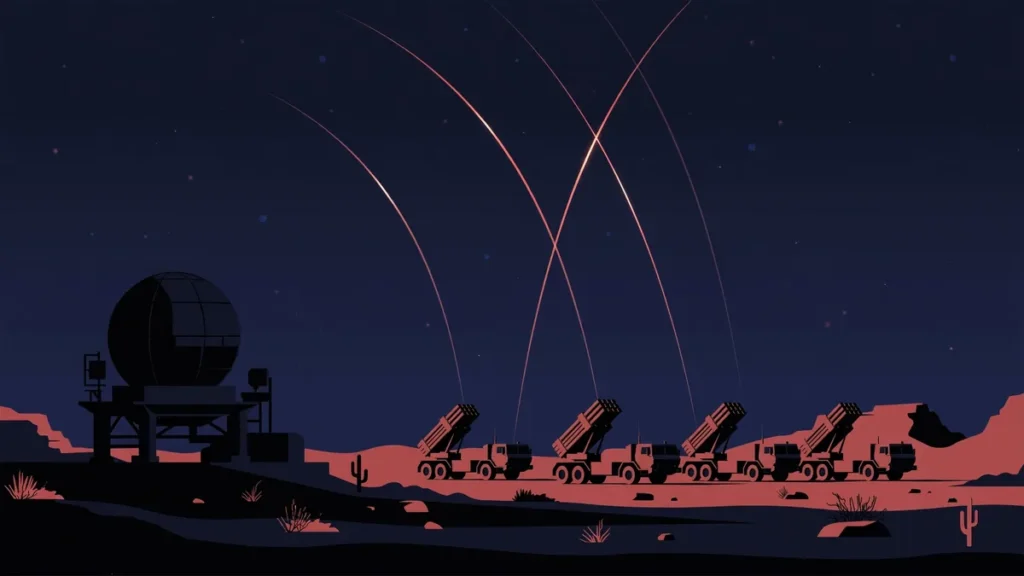
- Air defences in the region are thickening — 7–9 Patriot batteries and 2–3 THAAD batteries — even as interceptor stocks run down.
- A new Democratic Congress, seated in January, will shape defence spending and Ukraine aid, while the APEC summit in Shenzhen on November 18–19 sets the next test of US posture in the Pacific.
United States military capabilities in numbers
| Metric | Figure | Source |
|---|---|---|
| Active-duty personnel | About 1.33 million | IISS, The Military Balance 2026 |
| Reserve personnel | About 800,000 | IISS, The Military Balance 2026 |
| Aircraft carriers | 11, all nuclear-powered | US Navy / IISS |
| Military spending, 2025 | $954 billion (3.1% of GDP) | SIPRI |
| Iran war cost to October 16, 2026 | $47.1 billion | Pentagon / CENTCOM to Congress |
| Patriot interceptor stockpile used | About 65% | Pentagon / CENTCOM to Congress |
| Tomahawk cruise missiles | About 3,000 to about 2,000 since the war began | Council on Foreign Relations |
| US personnel in the Middle East theatre | About 50,000 | INSS Data Center |
Figures are estimates and differ between sources; inventory totals should not be read as systems immediately available for combat.
Overview
The United States remains the world’s leading conventional military power, ranked first of 145 countries in the 2026 Global Firepower index. Its armed forces are all-volunteer, built around carrier aviation, long-range air power, global logistics, space and intelligence capabilities, and a network of allies that no rival matches. The FY2026 national defence budget request totals about $1.01 trillion across defence accounts, including $848.3 billion in Department of Defense discretionary funding.
That scale is now being tested by two simultaneous demands: a war with Iran that has run since February 28, 2026, and a long-planned shift of weight toward the Indo-Pacific. The result is a force that is dominant at sea, stretched in the air over the Middle East, and burning through missile-defence stocks faster than industry can replace them.
How large is the US military?
The US military’s core strength is its ability to project power anywhere on earth. The Navy operates 11 nuclear-powered aircraft carriers, each carrying an air wing of roughly 40–50 aircraft, supported by cruisers, destroyers and submarines. The Air Force fields about 2,444 combat aircraft, according to the IISS, alongside the world’s largest aerial refuelling fleet. The Army and Marine Corps provide the ground and amphibious forces, including Marine expeditionary units embarked on amphibious assault ships.
The nuclear deterrent — about 5,000 warheads in total, according to the Federation of American Scientists — rests on the triad of land-based missiles, submarine-launched missiles and strategic bombers. In space and cyberspace, US capabilities are the most developed of any military, though both are areas where China is closing the gap fastest.
Alliances and posture
The United States anchors NATO, the 32-member alliance that remains the backbone of European security, and maintains treaty alliances across the Indo-Pacific with Japan, South Korea, Australia, the Philippines and Thailand, plus the AUKUS partnership with Australia and the United Kingdom. In the Gulf, US forces operate from bases in Qatar, Bahrain, Kuwait, the United Arab Emirates and Saudi Arabia — the infrastructure that sustains the current Iran war effort.
That alliance network is the force multiplier that raw numbers understate: it supplies the bases, the refuelling tankers, the intelligence sharing and the missile-defence sites that let a relatively small deployed force cover a theatre the size of the Middle East. It is also the network most exposed to Iranian retaliation, which is why air defences around Gulf bases have been reinforced through the autumn. See our Country Profiles hub for how allied states’ forces compare.
What has changed since November 1?
The Iran war footing. According to the Institute for National Security Studies (INSS) situation report for November 1–7, the US posture at sea is similar to March 2026 but thinner in the air. Two carriers — USS George Washington and USS George H.W. Bush — are operating in the Arabian Sea with 11 destroyers and a cruiser, two more destroyers are in the Red Sea, and three destroyers operate under the Sixth Fleet in the Mediterranean. About 17 warships are in the CENTCOM area of responsibility. Land-based strike aviation is down to about 200 fighters, there are no F-22s in theatre, and no bombers have been reported at Diego Garcia. A third carrier, USS Theodore Roosevelt, was in Singapore on November 6 and is expected in theatre by mid-November — though US Naval Institute reporting says it is slated to relieve George Washington, so the three-carrier concentration may be temporary. For the deployment-level detail, see our earlier United States Gulf Force Posture profile.
Readiness costs. Pentagon figures provided to Congress put the cost of the Iran war at $47.1 billion as of October 16 — $29 billion of it to replace expended munitions, $6.1 billion in lost equipment and $11.9 billion in operations — and the figure excludes repairs to US bases damaged by Iranian strikes. About 65% of the Patriot interceptor stockpile has been expended, more than 1,500 interceptors fired with fewer than 830 remaining, and roughly 40% of the 452 THAAD interceptors available at the war’s start have been fired, leaving fewer than 280. The Tomahawk stockpile has fallen from about 3,000 to about 2,000. The Congressional Budget Office estimated in September that operations had cost about $38 billion through August 1, with further costs of $2–3 billion a month.
The blockade widens. The US naval blockade of Iranian ports has lasted more than 100 days and, according to CENTCOM, has denied Iran more than $25 billion in crude oil exports. On November 7, CENTCOM commander Adm. Brad Cooper ordered the establishment of Task Force Iron Gate, a staff of about 20 in Tampa working with other US agencies to stop advanced weapons, dual-use technology, sanctioned materials and revenue crossing Iran’s land borders and the Caspian Sea. Our explainer on the new task force is here.
The new Congress. The November 3 midterm elections delivered a Democratic sweep, and the new Congress sits in January. Its first tests will be defence appropriations, replenishment funding for the depleted interceptor stocks, and the future of Ukraine aid — all of which we examined in After the Midterm Sweep: What a Democratic Congress Means for Ukraine Aid and the Iran War.
The Pacific pivot. President Trump is expected in Manila for ASEAN meetings and in Shenzhen for the APEC Economic Leaders’ Meeting on November 18–19, where a bilateral meeting with China’s Xi Jinping is expected and a possible trilateral meeting with Xi and Russia’s Vladimir Putin has been floated — Beijing has said only that it is “in communication with relevant parties”. The leaders are then due to meet again at the G20 summit in Miami on December 14–15. Our preview of the Shenzhen trip is here.
Frequently asked questions
How many aircraft carriers does the United States have?
The United States operates 11 nuclear-powered aircraft carriers, more than any other country. Two were deployed in the Arabian Sea in early November 2026, with a third reported en route to the region.
How much has the Iran war cost the United States?
Pentagon figures provided to Congress put the cost at $47.1 billion as of October 16, 2026, with $29 billion of that needed to replace expended munitions. The figure excludes repairs to US bases damaged by Iranian strikes.
Why is the US running low on Patriot interceptors?
About 65% of the Patriot interceptor stockpile has been expended in the Iran war, with more than 1,500 fired. Production runs at a fraction of wartime use, so replenishment will take years at current rates.
What is Task Force Iron Gate?
A CENTCOM staff of about 20 military and civilian personnel established on November 7, 2026, to stop advanced weapons, dual-use technology, sanctioned materials and revenue crossing Iran’s land borders and the Caspian Sea. It is an interagency staff, not a new deployment.
Sources
- INSS: US Force Posture in the Middle East vis-à-vis Iran: Situation Report, November 1–7, 2026
- The National: Third US carrier mission to Gulf ‘major indicator’ of new war on Iran
- Signal Post News: Pentagon Puts Iran War Cost at $47.1 Billion (Reuters / USA TODAY reporting)
- The Hustings: Lots of Money. Few Results. MAGA Goes to War (Council on Foreign Relations figures)
- Middle East Forum: Out of Range, Poised to Strike: Mapping America’s Force Posture Against Iran
- Defense and Tech: Russia vs United States: Military Comparison 2026 (SIPRI / IISS figures)