
WarBrief Live | October 17, 2026 | Explainer
9,800 kg
Total weight
11 tons
TNT equivalent
1
Combat use (2017)
15
Bombs built
The GBU-43/B Massive Ordnance Air Blast — universally known as the MOAB, or “Mother of All Bombs” — is the most powerful non-nuclear weapon in the United States arsenal. Weighing roughly 9,800 kilograms and producing a blast equivalent to 11 tons of TNT, it is designed to detonate above ground and flatten everything across a wide area. It has been used in combat exactly once, in Afghanistan in 2017, and it is now being discussed again because of reports that Washington is weighing it as an option against Iranian targets.
What investigators and official records have confirmed is the bomb’s design, its specifications, and its single combat use. What remains unverified is whether the United States actually plans to use it against Iran: that claim comes from a CNN report citing unnamed US officials, and the White House has neither confirmed nor denied it.
Key Takeaways
- The MOAB (GBU-43/B) is the largest non-nuclear bomb in US service: about 9,800 kg, with an 8,500 kg explosive filling and an 11-ton TNT-equivalent blast.
- It is an air-burst weapon, not a bunker buster — it detonates above the surface and cannot destroy deeply buried facilities, according to weapons experts.
- It has seen combat only once: on April 13, 2017, against an Islamic State tunnel complex in Nangarhar, Afghanistan.
- Reports that the US is considering the MOAB for strikes on Iranian nuclear and energy sites are attributed to CNN’s sources and remain officially unconfirmed.
What is the MOAB and how does it work?
The MOAB’s full designation is the GBU-43/B Massive Ordnance Air Blast. It was developed in 2002 by the US Air Force Research Laboratory under designer Albert L. Weimorts Jr., and first tested on March 11, 2003. Only 15 were ever built, at a reported unit cost of around $170,000, according to Wikipedia’s summary of USAF records.
The numbers are striking. The bomb weighs approximately 9,800 kg (about 21,600 lb). Of that, roughly 8,500 kg is H-6 explosive filling, which produces a blast yield of about 11 tons of TNT — equivalent to 46 gigajoules of energy. That makes it the most powerful conventional bomb ever deployed by the United States.
Its size dictates how it is delivered. The MOAB is far too large for a fighter jet or a conventional bomber bay. Instead, it is loaded onto a pallet inside a C-130 Hercules transport aircraft — Al Jazeera notes the MC-130H variant or a C-17 can carry it — and extracted from the rear ramp by drogue parachutes. Once clear of the aircraft, the bomb’s own parachutes stabilise it, and GPS guidance steers it to the target.
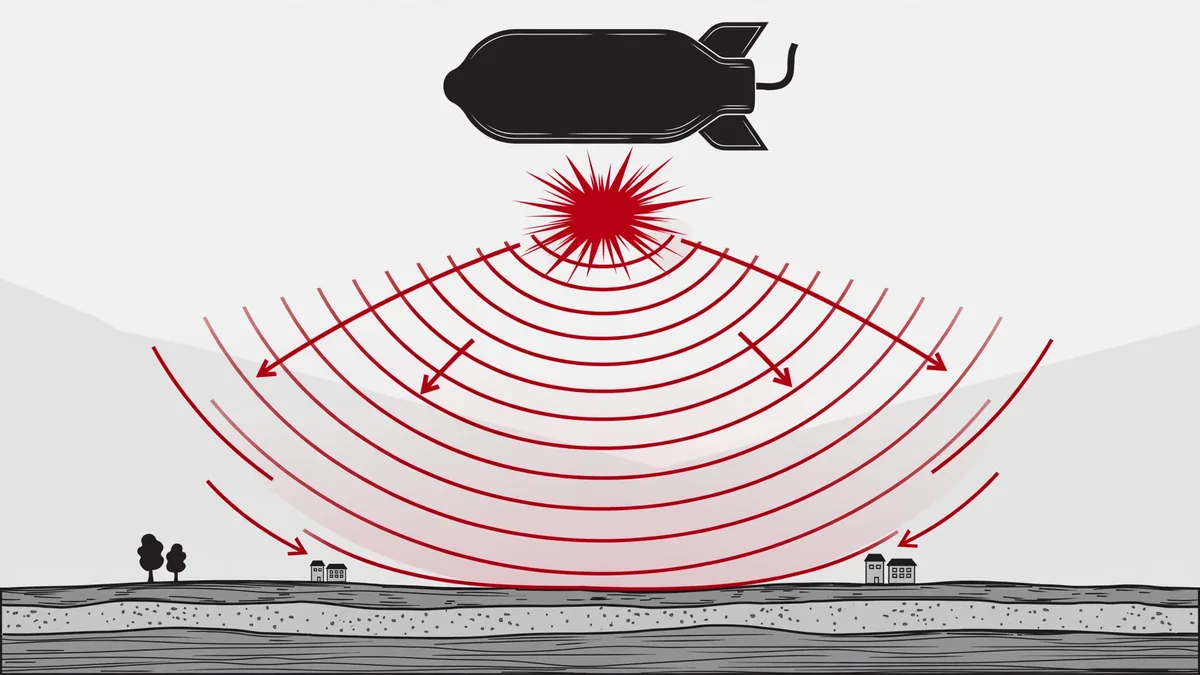
Crucially, the MOAB is not a penetrator weapon. It is designed to detonate above the ground — an air burst — so that its shockwave spreads outward across the surface rather than burrowing into it. That design choice defines both what it is good at and what it cannot do.
The MOAB’s history: from a 2003 test to the 2017 Nangarhar strike
The MOAB was conceived during the run-up to the 2003 invasion of Iraq, as a weapon for destroying large surface targets and tunnel entrances. Its nickname has an unusual origin: it borrows from Saddam Hussein’s 1991 boast that the Gulf War would be “the mother of all battles.” The US Air Force formally acknowledged the nickname in a 2008 article, and it has stuck ever since.
For fourteen years the bomb sat in the arsenal unused. Then, on April 13, 2017, a US MC-130 dropped one on an Islamic State Khorasan Province (ISKP) tunnel complex in Achin District, Nangarhar province, Afghanistan. The target was a network of caves and tunnels used by ISKP fighters, and the air-burst design was chosen precisely because the tunnels were shallow enough for the surface shockwave to collapse them.
The casualty figures from that strike were never firmly settled. An Afghan army spokesman put the death toll at 94 ISKP fighters, a figure cited by Al Jazeera and Wikipedia. Other Afghan officials cited 36 killed, a figure reported by the Washington Examiner and the Times of India. The discrepancy was never resolved, and both numbers should be treated as official claims rather than independently verified counts.
How does the MOAB differ from a bunker buster?
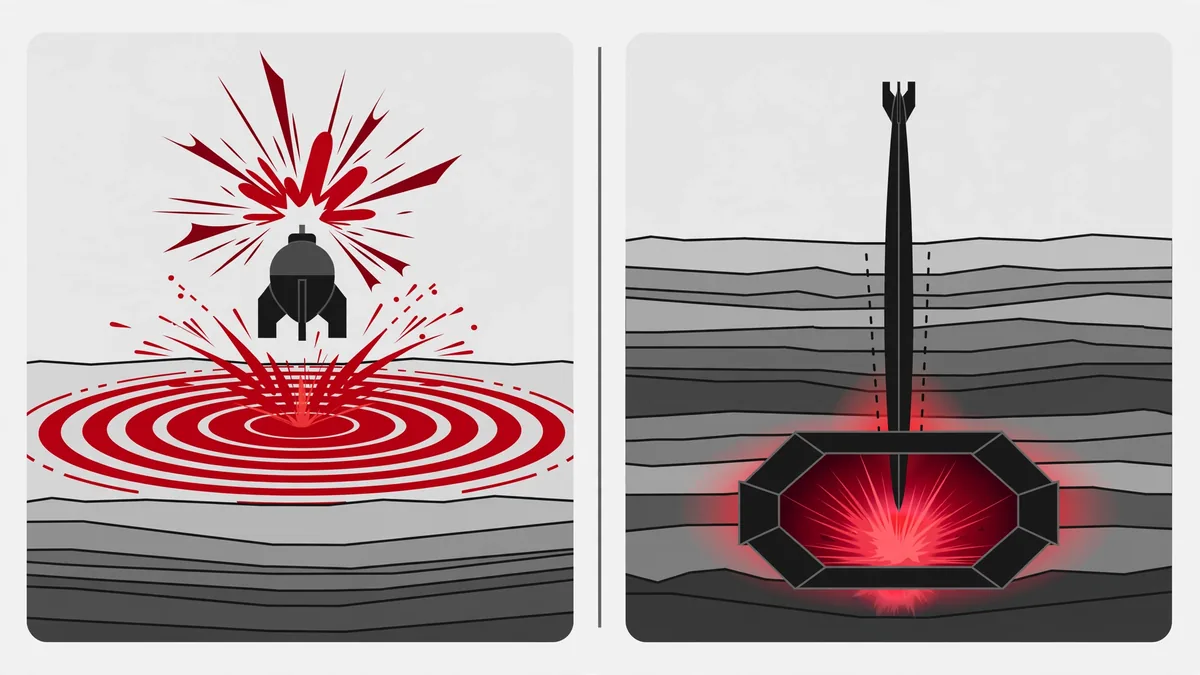
This is the distinction that matters most for the current debate. The MOAB and the GBU-57 Massive Ordnance Penetrator — the weapon commonly called a “bunker buster” — are built for opposite jobs.
The MOAB explodes above the surface. Its destructive power comes from the sheer scale of the blast wave racing across the ground. Colonel Nidal Abu Zeid, a military analyst quoted by Al Jazeera, describes it as destroying everything above ground within roughly a one-kilometre radius. It is devastating against troops in the open, soft buildings, tunnel entrances, and shallow cave systems.
The GBU-57 works the other way. It is a long, slim, hardened bomb of about 30,000 lb (13,600 kg) designed to punch through rock and concrete before detonating deep underground — reportedly penetrating around 200 feet (61 metres) of earth. Where the MOAB spreads destruction wide, the bunker buster concentrates it deep.
That is why weapons experts are sceptical that the MOAB could do meaningful damage to a deeply buried nuclear facility. Spencer Faragasso of the Institute for Science and International Security told the Washington Examiner that the MOAB “would not be a suitable weapon to target deeply buried facilities.” Military analyst Elijah Magnier, quoted by Al Jazeera, went further, calling talk of using it against buried nuclear sites “political theatre.”
| Metric | Figure | Source |
|---|---|---|
| Total weight | ~9,800 kg (21,600 lb) | Wikipedia, Al Jazeera |
| TNT equivalent | ~11 tons (46 GJ) | Wikipedia, NDTV |
| Explosive filling | ~8,500 kg H-6 | Al Jazeera, NDTV |
| Delivery aircraft | C-130 Hercules (MC-130H) | Wikipedia, Al Jazeera |
| Bombs built | 15 | Wikipedia |
| Combat uses | 1 (April 13, 2017, Nangarhar) | All sources |
| 2017 strike death toll | 94 (Afghan army) vs 36 (Afghan officials) | Al Jazeera; Washington Examiner |
| US planning MOAB use against Iran | Reported by CNN, citing US officials — not confirmed | CNN via Al Jazeera |
Figures listed without qualification are confirmed by two or more independent sources. The 2017 casualty counts are conflicting official claims. The reported Iran planning is a single-outlet report citing unnamed officials and remains officially unconfirmed.
Why is the MOAB back in the news over Iran?
The bomb re-entered the headlines after CNN reported, citing unnamed US officials, that the Trump administration is weighing the MOAB as an option for strikes on Iranian energy infrastructure and nuclear facilities — with the Pickaxe Mountain site named among the possible targets. The Times of India, NDTV, Al Jazeera, and the Washington Examiner have all carried versions of the report.
To be precise about what is and is not established: no US official has publicly confirmed such planning. Asked about it, the White House said it does “not comment on sensitive military plans that may or may not exist.” The reporting is therefore best understood as a signal of the options under discussion in Washington, not as confirmation of an operational plan.
The scepticism from weapons specialists is worth weighing. If the objective were a deeply buried enrichment site, the MOAB is arguably the wrong tool — the GBU-57 penetrator was designed for exactly that mission. What the MOAB would offer is spectacle and surface destruction: a demonstration of escalation that destroys everything above ground across a wide area. That is consistent with Magnier’s “political theatre” characterisation — though it is also fair to note that signalling is itself a recognised function of military deployments.
Iranian officials have responded with threats of their own. Al Jazeera reports IRGC-linked commander Mohammad Reza Naghdi warning of action against US troops in the region, and National Security Council chief Mohsen Rezaei threatening strikes on regional digital infrastructure. Both statements come via a single outlet and should be read as rhetoric in an ongoing confrontation, not as confirmed operational intent.
For the wider context of US-Iran tensions — including the recent Graham Act sanctions waiver and Trump’s stated position on the timing of any strikes, covered in our earlier analysis — see our conflict zones hub and intelligence hub. Our explainer on drones, intelligence and cyber warfare in the Iran war covers the other tools Washington is using alongside conventional munitions.
What the MOAB debate means for US/UK/EU readers
For readers in the US, UK, and Europe, the significance of the MOAB story is less about the bomb itself than about what the reporting signals. Talk of the MOAB in the same breath as Iranian nuclear sites is a marker of how far escalation planning has moved — and energy markets read such signals quickly. Any credible prospect of strikes on Iranian energy infrastructure feeds directly into oil price volatility, which passes through to fuel costs and inflation in Western economies. This is educational context, not financial advice: commodity markets move on many factors, and reported military planning is only one of them.
There is also a travel and aviation dimension. Previous rounds of US-Iran confrontation have produced airspace advisories and rerouted flights across the Middle East, raising fares and journey times on Europe–Asia routes. Readers with travel plans in the region should watch official advisories rather than headlines.
Finally, the debate is a window into Western defence procurement. The MOAB’s limitations against buried targets are one reason the US invested in the GBU-57 and its successor programmes — and why European allies are watching the outcome of this confrontation to calibrate their own deep-strike capabilities. France’s parallel work on strategic strike systems, covered in our M51.3 missile explainer, is part of the same picture.
Frequently asked questions
Can the MOAB destroy an underground nuclear facility?
According to weapons experts, no. The MOAB is an air-burst weapon that detonates above the surface, so its blast wave cannot reach deeply buried chambers. Spencer Faragasso of the Institute for Science and International Security told the Washington Examiner it “would not be a suitable weapon to target deeply buried facilities.” A penetrator such as the GBU-57 bunker buster is designed for that mission instead.
Has the MOAB ever been used in combat?
Once. On April 13, 2017, a US MC-130 dropped a MOAB on an Islamic State tunnel complex in Achin District, Nangarhar province, Afghanistan. Reported death tolls ranged from 36 to 94 ISKP fighters depending on which Afghan official count is cited, and the figures were never independently verified.
How big is the MOAB compared with other US bombs?
At roughly 9,800 kg, it dwarfs the 2,000-lb (900 kg) JDAMs that are the workhorses of US air campaigns. It is lighter than the 30,000-lb GBU-57 bunker buster, but the two are not comparable by weight alone — the MOAB maximises surface blast, while the GBU-57 maximises penetration depth.
Why is it called the “Mother of All Bombs”?
The nickname plays on Saddam Hussein’s 1991 boast that the Gulf War would be “the mother of all battles.” The US Air Force formally acknowledged the MOAB nickname in a 2008 article, and it has been the bomb’s popular name ever since.
Is the US actually planning to use the MOAB against Iran?
That is reported, not confirmed. CNN cited unnamed US officials as saying the option is under consideration for Iranian energy and nuclear targets. The White House declined to confirm or deny, saying it does not comment on military plans that “may or may not exist.”
Sources
- Al Jazeera: What is the ‘Mother of All Bombs’ the US could use in Iran?
- Washington Examiner: What to know about the ‘Mother of All Bombs’ amid the Iran war
- Wikipedia: GBU-43/B Massive Ordnance Air Blast
- Times of India: What is the ‘Mother of All Bombs’, the massive US weapon in focus over Iran
- NDTV: What is the ‘Mother of All Bombs’ and why is it called that?

Discussion 0
Share analysis, corrections, or context. Be civil — comments are moderated.