
WarBrief Live | November 20, 2026 | Defence Technology
| 1,000 km/h Reported top speed of the Geran-6 (Ukrainian intelligence) | 500–1,000 km/h Speed band of Russia’s jet-powered drones | ~60% Jet Geran-4s intercepted, against 90%+ for slower Shaheds | ~4,000/month Reported Geran-4/5 production (HUR, October 2026) |
The Geran-6 is a jet-powered Russian strike drone that Ukrainian intelligence says is being tested and could reach 1,000 km/h — as fast as a cruise missile, and far too fast for Ukraine’s interceptor drones to catch. The claim comes from a single source — a Ukrainian MP citing military intelligence on 18 November — and Moscow has said nothing about the weapon. But the context is well documented: Russia is mass-producing jet drones, Ukraine’s interception rate against them has fallen sharply, and jet-powered drones made up a large share of the overnight attack on Kyiv on 20 November. This explainer sets out what is confirmed, what is only reported, and why the Geran-6’s speed matters.
Key Takeaways
- Russia is reported to be testing the Geran-6, a jet-powered strike drone that Ukrainian intelligence says could reach 1,000 km/h and carry a large warhead.
- Jet drones fly at 500–1,000 km/h, comparable to cruise missiles. At around 800 km/h, an interceptor must match the target’s speed, making a kinetic kill extremely difficult.
- Ukraine intercepts around 60% of jet Geran-4s, against more than 90% of the slower propeller-driven Shaheds, according to Euromaidan Press.
- Kyiv’s answers are missiles, fighter aircraft and electronic warfare — including an electronic-warfare dome over the capital — not interceptor drones alone.
- The Geran-6’s reported speed is unconfirmed: it rests on a single Ukrainian intelligence claim relayed by one MP, with no independent verification and no Russian comment.
What is the Geran-6 drone?
The Geran-6 surfaced publicly on 18 November, when Fedir Venislavskyi, a member of Ukraine’s parliament and of its Committee on National Security, Defence and Intelligence, disclosed the programme in an interview with RBC-Ukraine. Venislavskyi said the information came from Ukrainian intelligence, and that Russia is conducting experimental tests of the aircraft. “It will be capable of reaching speeds of up to 1,000 kilometers per hour and carrying a fairly large warhead,” he said. “We must be prepared for this.”
Venislavskyi described the Geran-5 and the Geran-6 as effectively small cruise missiles rather than conventional drones, and said Russia is increasing its use of such weapons as much as possible. The Kyiv Post, The New Voice of Ukraine and the defence outlet mezha all carried the same account within a day, each tracing it to the same RBC-Ukraine interview. That matters for how the story should be read: the Geran-6 is reported by several outlets, but they all rest on one source — Ukrainian intelligence, relayed by one lawmaker. No photographs, wreckage or independent confirmation of the Geran-6 have been published, and Russia has made no public comment on the weapon.
What is not in doubt is the direction of travel. The Geran-6 is the latest step in a drone family that has gone from slow propeller aircraft to jet-powered weapons in under five years. Ukraine’s military intelligence reported in October 2026 that Russia had raised monthly production of the jet-powered Geran-4 and Geran-5 to approximately 4,000 units — about double its reported output of the older propeller-driven Geran-2.
How fast is the Geran-6, and why does speed defeat interceptors?
Speed is the whole problem. Venislavskyi put it plainly: jet-powered Shaheds and other jet-powered drones fly at 500 to 1,000 km/h, just like cruise missiles. At around 800 km/h, he said, an interceptor must fly at least as fast to pursue the target, and under those conditions a kinetic kill becomes extremely difficult. For comparison, Russia’s Kalibr cruise missiles are estimated to fly at up to 965 kph, according to the Missile Defense Advocacy Alliance, cited by the Kyiv Post — so a Geran-6 at its reported top speed would be travelling at roughly cruise-missile pace.
That pace breaks the tool Ukraine built to defeat the first generation of drones. Interceptor drones such as the Sting and STRILA top out at roughly 300–370 km/h, according to defence analysis, so they cannot catch a jet drone in a tail chase. Tymofii Yurkov, co-founder of the counter-drone firm Contra-Drone, told RBC-Ukraine that interceptor drones become less effective once a target is flying at 650–700 km/h and above — although they remain relevant against non-jet drones. The result shows in the interception figures: Ukrainian crews stop around 60% of jet Geran-4s, against more than 90% of the slower Shaheds, Euromaidan Press reported.
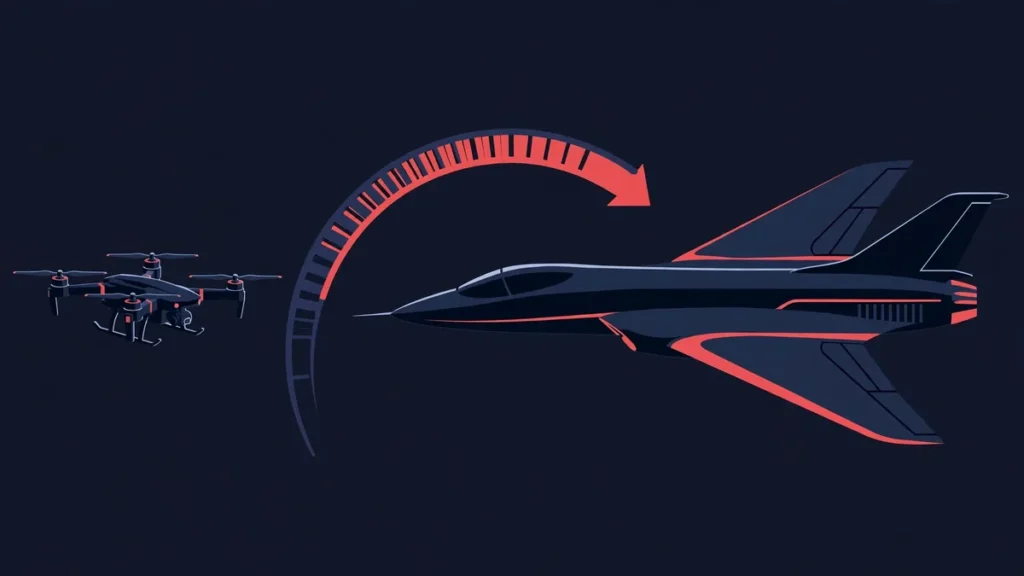
From Shahed to Geran-6: how Russia’s drone family evolved
The first Shahed-type drones Russia flew in 2022 were slow, cheap and loud: around 200 kg, with top speeds above roughly 185 km/h, according to a 2025 analysis by the Ukrainian defence-technology firm VGI-9. They were designed to be shot down in large numbers and still get through. Ukraine’s defences learned to kill more than 90% of them, and the Geran family is Russia’s answer: make the drone faster, heavier and harder to see coming.
- February 2022: propeller-driven Shahed-type drones enter service over Ukraine; early models fly at roughly 185 km/h.
- 2025–2026: the jet-powered Geran-4 appears — a reinforced airframe with a Chinese-designed turbojet, cruising at 350–500 km/h, with a range of up to 850 km and a 50 kg or 90 kg warhead.
- Early autumn 2026: Ukraine’s military intelligence identifies the Geran-5 K5-K in attacks, a modified Geran-5 with a 1,000 km range, a cruising speed above 450 km/h and a 90 kg thermobaric warhead. A near-intact specimen yielded 93 foreign-made electronic components, 52 of them from US manufacturers.
- October 2026: Ukrainian military intelligence reports Geran-4 and Geran-5 production at about 4,000 units a month, twice the reported output of the older Geran-2. Other estimates put the figure closer to 3,000 a month.
- 18 November 2026: Venislavskyi discloses that Russia is testing the Geran-6, reported to reach 1,000 km/h.
- 20 November 2026: Russia’s overnight attack on Ukraine includes about 120 jet-powered drones among roughly 400 drones and 100 missiles, according to Ukrainian officials — a measure of how central jet drones have become to the nightly campaign. WarBrief Live covered the barrage here.
By the numbers: the Geran family
| Metric | Figure | Source | Status |
|---|---|---|---|
| Geran-6 reported top speed | Up to 1,000 km/h | Ukrainian intelligence, via MP Venislavskyi (RBC-Ukraine) | REPORTED |
| Jet-drone speed band | 500–1,000 km/h | Venislavskyi (RBC-Ukraine) | REPORTED |
| Geran-5 K5-K range | 1,000 km | Ukrainian military intelligence, via mezha | REPORTED |
| Geran-5 K5-K warhead | 90 kg thermobaric | Ukrainian military intelligence teardown, via h.ua | REPORTED |
| Geran-4/5 monthly production | ~4,000 units | Ukrainian military intelligence, October 2026, via Kyiv Post | REPORTED |
| Jet Geran-4 interception rate | ~60% | Euromaidan Press | REPORTED |
| Slower Shahed interception rate | Over 90% | Euromaidan Press | REPORTED |
| Jet drones in the 20 November attack | 120 of ~400 drones | Ukrainian officials, via CNN | REPORTED |
Figures marked REPORTED rest on a single source, usually Ukrainian military intelligence relayed through Ukrainian media, and have not been independently verified. No figure in this article is presented as confirmed unless two independent sources carry it.
What is Ukraine doing about jet drones?
Kyiv’s answer, in Venislavskyi’s words, is missiles — not more interceptor drones. Surface-to-air and air-to-air missiles are, he said, the most effective means of countering jet-powered targets, whether fired by a fighter jet or a ground-based air-defence system. That is an expensive answer: every missile fired at a drone costs far more than the drone, and stocks are finite. President Volodymyr Zelenskyy proposed at the 17 November Ramstein contact group meeting that partners transfer available Patriot and IRIS-T interceptors from their own stocks in exchange for newer missiles Ukraine has already ordered. EU Defence Commissioner Andrius Kubilius said on 18 November that Russia may use about 2,000 ballistic missiles against Ukraine in 2026, and that the EU is working on ways to supply Patriot PAC-3 interceptors, including two joint EU-Ukrainian counter-ballistic projects, FREYJA and Bliksem EXO.
Electronic warfare is the second pillar. In early November, presidential adviser Serhii “Flash” Beskrestnov reported that an electronic-warfare dome had been completed over Kyiv, disrupting the MESH radio communications of jet-powered Shaheds — an operation he said forced Russia to pause and upgrade its drones. Yurkov, of Contra-Drone, said almost all jet-powered Shaheds are currently shot down by aircraft or suppressed by electronic-warfare systems. Interceptor drones have shown good results, Venislavskyi added, but are not yet used on a large scale because the technology is so demanding; Ukrainian manufacturers keep demonstrating new models, and he believes they will significantly improve interception rates. The pattern is visible in the Geran-4 and Geran-5 production story: every Ukrainian countermeasure so far has bought time, not a solution.

What the Geran-6 means for US/UK/EU readers
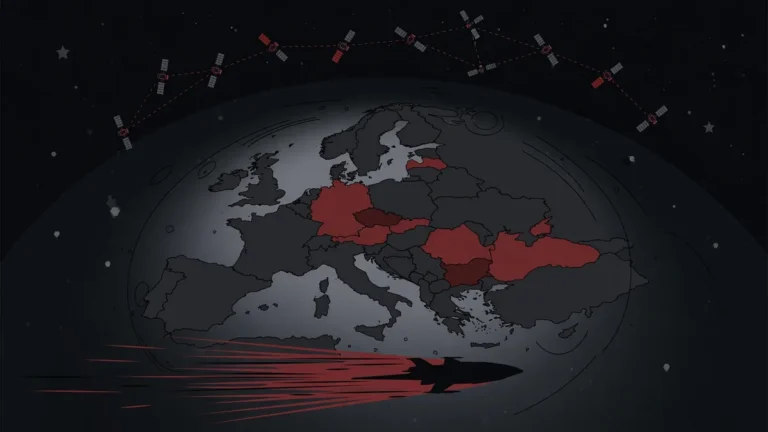
The most direct consequence for readers outside Ukraine is range. A Geran-5 with a stated range of 1,000 km already puts NATO’s eastern and southeastern flanks within potential reach, Andrii Yusov of Ukraine’s military intelligence told the Donbas Realii programme — and Russia is building the launch infrastructure to match, with at least 12 equipped droneports confirmed and plans for at least 89 administrative units by 2030. The spillover risk is not theoretical: during the overnight attack on 20 November, Poland’s defence minister said two Russian missiles and a drone crashed on Polish territory, with nobody reported hurt.
The second consequence is cost. Air defence is becoming a contest of magazines: Russia produces jet drones by the thousand each month, while Ukraine and its partners ration missiles that cost many times more per shot. That is why the Patriot interceptor debate in Brussels matters — it is, in effect, a decision about how much of Europe’s own air-defence stockpile goes to Ukraine’s skies. The third is the shape of the winter campaign: jet drones are increasingly aimed at energy and transport infrastructure, and three bridges across the Dnipro were damaged on 20 November. For households in the US, UK and EU, the near-term effect is indirect — energy prices and insurance costs move on the same headlines. This is an educational summary, not financial advice.
Three views of the Geran-6 problem
Kyiv sees a physics problem with a procurement answer. The speed of the new drones has outrun the interceptor drones built to kill their predecessors, so the capital’s case to its partners is for more missiles, more fighters and more electronic-warfare capacity — and for the industrial help to build its own jet interceptors. Moscow has said nothing about the Geran-6; the programme is known only through Ukrainian intelligence, and Russia has no reason to confirm a weapon still in testing. What Moscow has shown, through the expansion of the Alabuga production site and the droneport network, is intent to produce jet drones at scale.
Defence analysts frame it as a cost-exchange problem: a jet drone costing a fraction of the missile needed to kill it, produced at 3,000–4,000 a month, can exhaust a defender’s magazines even at a 60% interception rate. Ukrainian counter-drone specialists counter that electronic warfare and fighter aircraft already catch most jet drones, and that the Geran-6’s reported 1,000 km/h may prove harder to achieve in service than in testing. Both views agree on one point: the propeller era of the drone war is over.
What to watch next in the Geran race
The first test is combat. If a Geran-6 appears in wreckage or in Ukrainian air-force reporting, the weapon moves from reported to confirmed. The second is the winter campaign: whether jet drones keep arriving in triple figures on the nights Russia targets energy infrastructure, as they did on 20 November. The third is Ukraine’s jet-interceptor programmes — a domestic interceptor that can match 800 km/h would change the cost-exchange maths entirely. The fourth is the European missile decision: whether the Patriot PAC-3 supply arrangements Kubilius described on 18 November turn into deliveries before the heaviest winter strikes. WarBrief Live will update this explainer as the Geran-6 moves from a reported test programme to a weapon seen in the sky — follow the wider drone campaign in our intelligence reports, our coverage of Ukraine’s deep-strike campaign and the KN-23 missile threat.
Frequently asked questions
What is the Geran-6?
The Geran-6 is a jet-powered Russian strike drone that Ukrainian intelligence says is being tested and could reach 1,000 km/h while carrying a large warhead. It was disclosed on 18 November 2026 by Ukrainian MP Fedir Venislavskyi, citing military intelligence. The claim is reported, not independently confirmed, and Russia has not commented on it.
Why is the Geran-6 hard to shoot down?
Speed. At around 800 km/h, an interceptor must fly at least as fast to catch the target, and a kinetic kill becomes extremely difficult. Ukraine’s interceptor drones top out at roughly 300–370 km/h, so they cannot catch a jet drone in a tail chase. Missiles fired from aircraft or ground-based air-defence systems, and electronic warfare, are the effective counters.
How is the Geran-6 different from the Shahed?
The first Shahed-type drones were propeller-driven, weighed around 200 kg and flew at roughly 185 km/h. The Geran-6 is jet-powered, is reported to reach 1,000 km/h, and is described by Ukrainian officials as effectively a small cruise missile. Its predecessor, the Geran-5 K5-K, has a 1,000 km range and a 90 kg thermobaric warhead.
Has the Geran-6 been used in combat?
Not that has been confirmed. As of 20 November 2026, only experimental tests have been reported. Jet drones of the earlier Geran-4 and Geran-5 types are already flying in combat — about 120 took part in the overnight attack on Ukraine on 20 November, according to Ukrainian officials.
What is Ukraine doing about jet drones?
Kyiv is prioritising surface-to-air and air-to-air missiles, fighter interceptions and electronic warfare, including an electronic-warfare dome over the capital completed in early November. Ukraine is also testing its own jet-powered interceptor drones, and has proposed swapping Patriot and IRIS-T interceptors with partners to speed up deliveries.
Sources
- RBC-Ukraine: Russia tests new Geran-6 jet drone missile capable of reaching 1,000 km/h
- Kyiv Post: Russia Tests New Geran-6 Jet Drone Capable of 1,000 kph
- The New Voice of Ukraine: Russia tests Geran-6 attack drone capable of 1,000 km/h, challenging interceptors
- mezha (OBORONKA): Russia Testing Geran-6 Drone with Speeds Up to 1,000 km/h
- Euromaidan Press: Russia’s first Shaheds flew at about 185 km/h. Its newest jet-powered drone may hit 1,000
- Al Jazeera: Russia unleashes retaliatory barrage on Kyiv bridges
- epik.eu: Russia’s jet-powered drones and how to stop them

Discussion 0
Share analysis, corrections, or context. Be civil — comments are moderated.