
WarBrief Live | November 16, 2026 | Explainer
128
states party to the Convention on Certain Conventional Weapons, meeting in Geneva
163–5
UN General Assembly vote in favour of opening negotiations on autonomous weapons rules
0
legally binding treaties governing lethal autonomous weapons exist today
5 days
for the Geneva review conference, November 16–20, to decide what happens next
Lethal autonomous weapons are systems that can identify, select and engage a target without a human being making that decision. This week, 128 states meet in Geneva to decide whether to start negotiating binding international rules for them — and the states that build the most advanced systems are the ones resisting.
The Seventh Review Conference of the Convention on Certain Conventional Weapons (CCW) opened on Monday, November 16, at the Palais des Nations in Geneva, under the presidency of Swiss Ambassador Julien Thöni. It runs until Friday, November 20. The question on the table is narrow but consequential: should governments launch negotiations on a legally binding instrument covering lethal autonomous weapon systems (LAWS), the diplomat’s term for what campaigners call “killer robots”?
Key Takeaways
- A lethal autonomous weapon system can identify, select and engage a target without human intervention in those functions — the working characterisation agreed by governments in September 2026.
- No binding international treaty governs these weapons today, although existing international humanitarian law applies to their development and use.
- On October 29, the UN General Assembly’s First Committee voted 163 to 5 in favour of opening negotiations, with the United States, Russia, Belarus, Israel and North Korea opposed.
- The conference chair has proposed a two-year mandate to negotiate a binding protocol; Washington has proposed five years of talks towards a non-binding agreement instead.
- The CCW works by consensus, so any single state can block a negotiating mandate — and observers expect the major military powers to try.
What is a lethal autonomous weapon?
The definition governments now work from was agreed by the CCW’s Group of Governmental Experts (GGE) on Lethal Autonomous Weapon Systems, which adopted its final report by consensus on September 4, 2026. The United Nations’ own explainer reproduces the characterisation in full: a lethal autonomous weapon system is “a combination of one or more weapons and technological components operating together, that is capable of identifying, selecting, and engaging a target in a way that results in loss of life, without intervention by a human being operating the system.”
Three points in that wording matter. First, autonomy is a function, not a type of vehicle: a drone is not automatically an autonomous weapon, and an autonomous weapon need not be a drone. Second, the definition still covers a system even when a human programmed the set of potential targets in advance — what matters is whether a human intervenes in identifying, selecting and engaging the specific target. Third, it also covers systems used in ways that damage or destroy objects or cause injury, not only those that kill.
“Killer robots” is the public shorthand, not a legal term. The UN is explicit that it is an informal expression rather than an established technical or legal designation — but it is the phrase that has carried the campaign for rules into the public debate, and it is the phrase the Secretary-General himself used when he opened the Geneva conference.
What lethal autonomous weapons are not
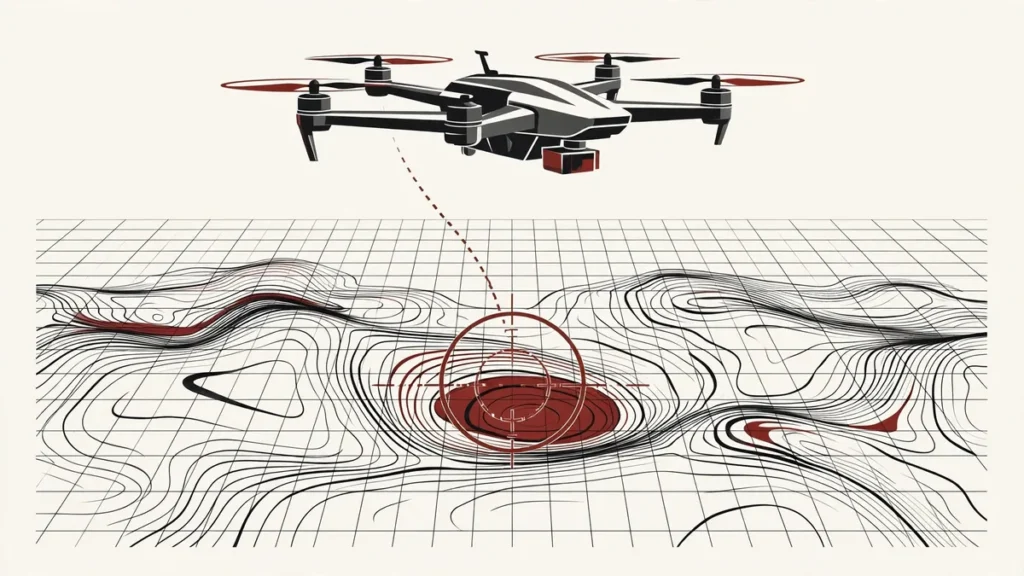
Confusion around the term is one reason the debate has taken a decade to reach this point. A landmine is autonomous in a narrow sense — it explodes when someone steps on it — yet no one in Geneva is debating landmines this week; they are already covered by the CCW’s protocols. The regulatory question is about systems that can select and engage a target that was not predetermined, adapting to their environment without human intervention, as Jean-Marc Rickli of the Geneva Centre for Security Policy put it to Agence France-Presse.
Most drones in service today are also not autonomous weapons. An armed drone flown by a remote operator who selects the target and decides to attack is a remotely piloted weapon, not an autonomous one. The line is crossed when the machine itself performs the identify-select-engage sequence. That distinction also separates lethal autonomous weapons from AI decision-support tools: a system that recommends targets for a human to approve is a different problem from a system that fires on its own recommendation, even if both raise questions about how meaningful the human’s role really is when approval takes seconds.
Not every autonomous weapon uses artificial intelligence, either. The UN notes that AI is not a prerequisite for autonomy, and that autonomy is not determined by whether AI is involved. But when AI is used to identify, select and engage targets, the UN warns, it can make a weapon’s behaviour harder to predict or explain — with direct implications for human judgement, control and accountability.
Where have autonomous weapons already been used?
The UN’s position is that autonomous capabilities are no longer a future prospect; they are part of the evolving military environment. But it also cautions that, from publicly available information, it is not always possible to determine the precise configuration of a system or the degree of autonomy involved in a particular operation. That uncertainty shapes everything reported below: these are reported cases, not confirmed findings.
The most frequently cited case comes from Libya. A UN Security Council Panel of Experts report published in March 2021 said a Turkish-made Kargu-2 loitering munition “hunted down and remotely engaged” retreating forces in 2020 — a passage widely described as the first reported instance of a lethal autonomous weapon attacking human targets in warfare. The panel’s account has been contested and the degree of human involvement in that strike remains disputed, which is itself the point: battlefield autonomy is often asserted and rarely provable from the outside.
In Ukraine, Russia has reportedly used fully autonomous drones to deadly effect, according to Agence France-Presse reporting carried on the eve of the Geneva conference, while Ukraine’s own defence industry is pushing to develop autonomous drone swarms. In the US-Israeli war against Iran this year, analysts have noted the deployment of autonomous systems, and Rickli told AFP that the Americans engaged as many as 1,000 targets per day inside Iran — a figure that illustrates the scale AI-assisted targeting has already reached, even where a human nominally remains in the loop.
A different but related case is Lavender, the AI system reported by +972 Magazine in 2024 to have analysed surveillance data on 2.3 million people in Gaza and produced strike recommendations that intelligence officers said could be approved in about 20 seconds, often without meaningful human review. Lavender is a targeting-support system, not a weapon that fires itself, but campaigners cite it as evidence that the human role can shrink to a rubber stamp long before full autonomy arrives. Israel has not confirmed the system’s use as described.
At the other end of the spectrum sit systems that look autonomous but are not. South Korea’s sentry robots along the Demilitarised Zone can identify targets, but a human must intervene before an attack takes place. The distinction between those two cases — a machine that finds and a human that fires, versus a machine that does both — is the line the Geneva talks are trying to draw in law.
What is the UN deciding in Geneva this week?

The conference is the Seventh Review Conference of the CCW, a 1980 treaty framework that restricts weapons considered excessively injurious or indiscriminate and already covers landmines, incendiary weapons and blinding lasers. It has 128 High Contracting Parties. Its Group of Governmental Experts on lethal autonomous weapons, created in 2016, met annually from 2017 and finished its mandate with the September 2026 consensus report. The review conference must now decide what mandate, if any, to give the next phase of work.
Two proposals frame the argument. The chair has proposed a two-year mandate under which government experts would negotiate a new protocol on lethal autonomous weapons and report a draft by 2028. Reuters reported that the United States has proposed the opposite shape: five years of talks aimed at a non-binding agreement, favouring guidelines over binding rules. Campaigners and the International Committee of the Red Cross (ICRC) want negotiations to begin immediately and conclude within a year.
The opening day set the tone. Proceedings were briefly suspended on Monday morning after Russia objected to observer participation, Agence France-Presse reported, and Moscow has signalled it plans to block the European Union, which attends as an observer, from taking the floor, according to a senior Western diplomat cited by Reuters. The conference operates by consensus, giving every state an effective veto — which is why a majority in favour of negotiations does not guarantee that negotiations will happen.
UN Secretary-General António Guterres addressed the delegates by video message on the opening day. UN News reported his call to “move towards negotiating a legally binding instrument to regulate the rapidly evolving technology, to include clear prohibitions and restrictions”, and his warning to “seize this moment” and “take action to prevent the use and spread of these merciless weapons”. Pope Leo XIV has made the same argument, and the UN human rights chief, Volker Türk, said on November 13 that “a machine must never have the power to decide whether a human being survives or dies”.
The Geneva decision, by the numbers
| Metric | Figure | Source | Status |
|---|---|---|---|
| States party to the CCW | 128 | UN News / UNODA | CONFIRMED |
| UN General Assembly First Committee vote, October 29, 2026 | 163 in favour, 5 against, 9 abstentions | AFP / Japan Times | CONFIRMED |
| UN General Assembly Resolution 78/241, December 2023 | 152 in favour, 4 against, 11 abstentions | UN News | CONFIRMED |
| Chair’s proposed negotiation mandate | 2 years; draft protocol by 2028 | Reuters | CONFIRMED |
| US proposed alternative | 5 years; non-binding instrument | Reuters / AFP | CONFIRMED |
| Targets engaged per day by the US in Iran | As many as 1,000 | Analyst estimate via AFP | REPORTED |
| Countries backing a binding instrument | 130 | Stop Killer Robots campaign count | REPORTED |
Figures marked CONFIRMED rest on two or more sources; REPORTED figures come from a single source or a campaign count and should be treated with caution.
Who wants binding rules, and who is blocking them?
The numbers favour the campaigners. On October 29, the UN General Assembly’s First Committee adopted a resolution calling for negotiations on autonomous weapons rules by 163 votes to five, with nine abstentions. The five against were the United States, Russia, Belarus, Israel and North Korea. Iran, Saudi Arabia and China abstained — China maintaining what one analyst called a “carefully cultivated ambiguity”. It was the fourth year running that the Assembly has passed a text on the subject; the December 2023 resolution passed 152 to 4. The Stop Killer Robots campaign says 130 countries now support a legally binding instrument, with more than 70 prepared to move towards negotiations.
But the CCW is not the General Assembly. Inside the convention, the states that matter most militarily are the obstacle. The United States, Russia and Israel oppose a binding path, arguing that existing international humanitarian law is sufficient — a position Reuters reported ahead of the conference, citing diplomats and rights groups. Russia has not publicly stated its position going into the talks, but has resisted binding proposals before. China has not committed either way.
The ICRC is calling for a ban on two categories: unpredictable autonomous weapons, and weapons designed or used to directly target humans. Human Rights Watch warned that the Geneva meeting would leave civilians “dangerously exposed” if it failed to act decisively. Guterres and ICRC President Mirjana Spoljaric Egger first called jointly in 2023 for states to conclude a binding instrument by 2026 — a deadline that has now passed without one — and renewed the call in August 2026, warning that the world was “dangerously close to crossing a moral red line: the autonomous targeting of humans by machines”.
The blocking logic is familiar from other arms-control fights: states that have acquired a capability are reluctant to have their hands tied. As one observer put it to the Japan Times, the same dynamic that governs nuclear weapons applies here — the technology’s possessors set the terms of its restraint. The difference is speed: autonomous weapons are spreading through commercial drone technology and open-source AI far faster than nuclear weapons ever did, and several analysts at the conference argue the window for rules that bite is closing.
What the Geneva talks mean for readers in the US, UK and EU
For American readers, the immediate stakes are budgetary and legal. The Pentagon has requested record funding for AI and autonomous research, and the rules Washington resists in Geneva are the same rules that would constrain how US systems are built, tested and used. A binding protocol would not stop American development, but it would set legal limits that US commanders, contractors and export customers would have to observe — and it would shape the export controls that decide which allies receive which systems.
For British and European readers, the stakes are closer to home. The UK and EU states are among the strongest supporters of negotiations, and European defence firms are among the fastest-growing suppliers of autonomous drone technology — Munich’s Tytan Technologies opened a new production facility for autonomous interceptor drones on November 9. A binding instrument would land directly on European procurement and export policy, and on the EU’s own role as an observer at the talks, which Russia is already trying to limit.
For everyone, the practical consequence of failure is a battlefield norm set by use rather than by law. If the conference ends on Friday with no mandate, the next year’s wars will be fought with systems whose rules are written by their manufacturers and their users, not by treaty. The accountability question the UN keeps returning to — who is responsible when a machine kills the wrong person — would remain unanswered, and the answer would keep being decided after the fact, in inquiries and courts, rather than before it, in design and doctrine.
What to watch next in Geneva
The week’s programme puts the autonomous-weapons text before Main Committee II on Tuesday, with work on the conference’s final document continuing through Wednesday and Thursday. The UN disarmament chief, Izumi Nakamitsu, is due to brief reporters on Wednesday morning. Three outcomes are possible by Friday, November 20: a mandate to negotiate a binding protocol, a mandate to develop non-binding guidelines, or no agreement at all, with the decision deferred to a future meeting.
Watch for three signals. First, whether the chair’s two-year proposal survives contact with the consensus rule — any single state can kill it, and the United States and Russia have the motive. Second, whether China moves from abstention to a stated position; Beijing’s ambiguity is the largest single variable in the room. Third, whether the final document contains any language on autonomous weapons at all: in September, the United States and Russia succeeded in watering down a GGE text on the subject, and a weak final document would be read as a win for the opponents of binding rules.
If Geneva fails, the campaigners’ fallback is a standalone negotiation outside the CCW — the route taken for the landmine ban and the cluster munitions convention, both of which bypassed consensus-based forums. That path took years in both cases, and it left the largest military powers outside the treaties. For now, the Geneva conference remains the only table where all 128 states sit together, and its five days end on Friday.
Frequently asked questions
What is a lethal autonomous weapon?
A weapon system that can identify, select and engage a target without a human being intervening in those functions. The working characterisation was agreed by governments in the CCW’s Group of Governmental Experts in September 2026. Campaigners and the media often call them “killer robots”, but that is an informal term, not a legal one.
Are “killer robots” already being used in war?
Systems with autonomous functions are reported in use, but the exact degree of autonomy is rarely provable from public information. A UN expert panel reported a Kargu-2 drone attacking forces in Libya in 2020; Russia has reportedly used fully autonomous drones in Ukraine; and analysts have noted autonomous systems in the US strikes on Iran. None of these cases has been confirmed as a fully autonomous lethal engagement.
Are lethal autonomous weapons legal under international law?
There is no specific legally binding treaty governing them, but existing international humanitarian law applies fully to their development and use — including the duties to distinguish civilians from combatants and to avoid excessive civilian harm. The legal question is whether those rules can be respected when a machine selects the target, and whether additional specific rules are needed.
What is the UN deciding in Geneva this week?
The Seventh Review Conference of the Convention on Certain Conventional Weapons, running November 16–20, must decide whether to launch negotiations on a legally binding instrument for lethal autonomous weapons. The chair has proposed a two-year negotiating mandate; the United States has proposed five years of talks towards a non-binding agreement. The conference works by consensus, so any state can block a decision.
Which countries oppose binding rules on autonomous weapons?
The United States, Russia, Belarus, Israel and North Korea voted against the UN General Assembly resolution calling for negotiations on October 29, 2026. China, Iran and Saudi Arabia abstained. The United States, Russia and Israel argue that existing humanitarian law is sufficient and oppose a binding instrument.
Sources
- United Nations: Autonomous Weapon Systems — Frequently Asked Questions
- UN News: Guterres calls for a legally binding instrument for ‘killer robots’
- The Japan Times: U.N. to debate rules for ‘killer robots’
- Malay Mail (AFP): Lethal autonomous weapons — why the UN is scrambling to regulate ‘killer robots’
- The Korea Herald (Reuters): US, Russia to oppose talks on limiting weapons
Read next: AI Autonomous Weapons: How Close Are We to Machines Fighting Without Humans? · The Future of Autonomous Weapons Systems: Ethical and Strategic Considerations · AI Drone Warfare: Why Autonomous Drones Could Transform the Battlefield · DronTech Asia 2026: Drones, Loitering Munitions and the AI Shift · Intelligence Reports · Conflict Zones


Discussion 0
Share analysis, corrections, or context. Be civil — comments are moderated.