
WarBrief Live | November 15, 2026 | Explainer
| 9 invocations since 1949 | 0 invocations during the Cold War | 5 of the 9 invoked by Türkiye | 1 Article 5 invocation ever |
NATO Article 4 is the consultation clause of the North Atlantic Treaty: any of the alliance’s 32 members can demand urgent talks in the North Atlantic Council when it believes its territory, independence or security is threatened. It orders discussion — not military action.
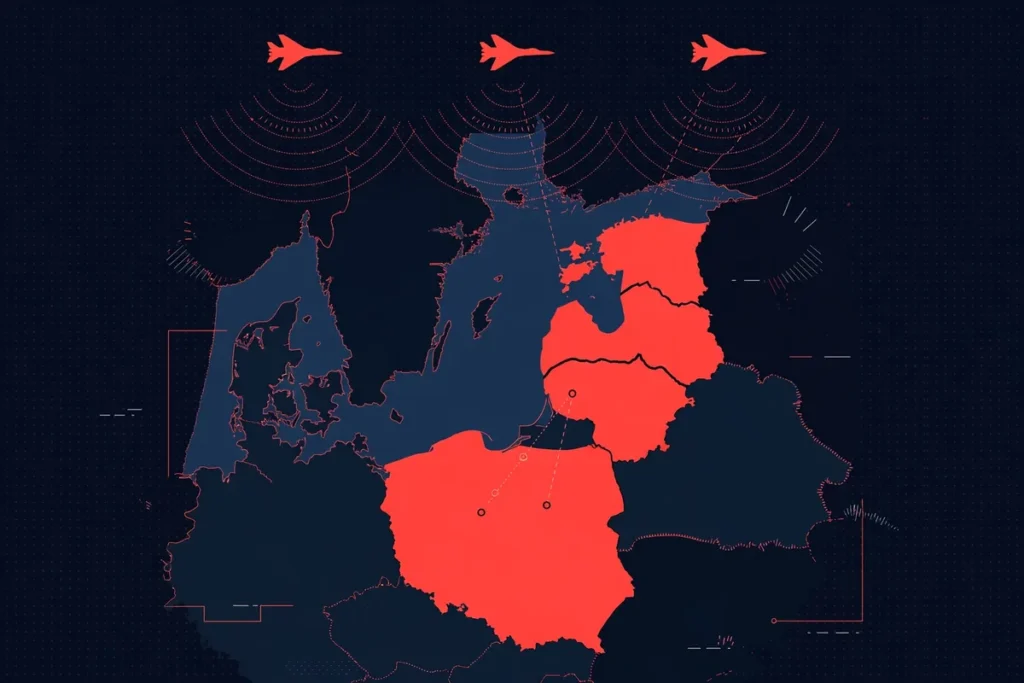
The clause has been in the news more in the past fourteen months than in the previous seventy-five years. Poland invoked it in September 2025 after Russian drones crossed its airspace, Estonia followed thirteen days later after Russian fighter jets entered its airspace, and Denmark publicly weighed invoking it the same month after drone incursions shut two of its airports. Yet Article 4 remains one of the most misunderstood parts of the NATO treaty — often described, wrongly, as a step that commits the alliance to war.
Key Takeaways
- Article 4 is a consultation clause, not a defence trigger: it forces an urgent meeting of the North Atlantic Council, and nothing more, unless the allies then agree on action.
- It has been invoked nine times since 1949 — never during the Cold War, and twice in September 2025 alone.
- Türkiye accounts for five of the nine invocations; the other four came from Poland, Estonia and a joint eight-country request in 2022.
- Article 4 does not lead automatically to Article 5, the collective-defence clause, which has been invoked only once — after the September 11, 2001 attacks.
What is NATO Article 4?
Article 4 is the shortest of the fourteen articles in the North Atlantic Treaty, signed in Washington on April 4, 1949. In full, it reads: “The Parties will consult together whenever, in the opinion of any of them, the territorial integrity, political independence or security of any of the Parties is threatened.” That single sentence is the whole clause. There is no list of qualifying threats, no threshold of damage and no automatic response.
The point of the article is procedural, not military. Any member state that feels threatened can put its concern on the agenda of the North Atlantic Council (NAC), NATO’s principal political decision-making body, and force the other allies to discuss it as a matter of priority. The Council’s 32 ambassadors meet most weeks in Brussels, and can be convened at short notice; the Secretary General chairs the meeting. As NATO itself puts it, once Article 4 is invoked “the issue is discussed and can potentially lead to some form of joint decision or action on behalf of the Alliance” — but it does not have to.
The clause was written for threats that fall short of an armed attack. A 2019 study of the treaty’s drafting history in the Emory International Law Review notes that the text was accepted as final on January 14, 1949, and that the parties confirmed in a written interpretive minute that Article 4 applies to a threat “in any part of the world, to the security of any of the Parties, including a threat to the security of their overseas territories.” The Central and Eastern European think tank CEPA adds that the article was originally included partly to cover Europe’s declining colonial interests, and has since expanded in practice to cover terrorism and organised crime. In other words, Article 4 was designed as a flexible alarm bell for dangers the drafters could not yet name.
What happens when a country invokes Article 4?
Invocation starts a meeting, not a mobilisation. The requesting country presents its case to the Council, the allies exchange information and assessments, and the discussion continues until the members reach consensus — the rule that governs all NATO decisions. Because every decision needs the agreement of all 32 allies, an Article 4 meeting can end with a joint statement, a concrete measure, or nothing at all.
When action has followed, it has been defensive and limited. After Türkiye’s first invocation in February 2003, NATO agreed a package of defensive measures and ran Operation Display Deterrence, a deployment of AWACS aircraft and Patriot missile batteries, from late February to early May 2003. After Türkiye’s October 2012 invocation, the alliance agreed to deploy Patriot batteries along the Turkish-Syrian border. And after Poland invoked the article in September 2025, NATO launched Operation Eastern Sentry two days later to reinforce its eastern flank with aircraft and air defences. In each case the Council chose the response; the article itself chose nothing.
That is also why analysts describe Article 4 as a diplomatic tool as much as a security one. Bob Deen of the Clingendael Institute told the Associated Press it is “designed to promote better coordination and understanding within the alliance on external threats”, giving every ally “the opportunity to urgently put certain threats or developments on the agenda”. The Human Security Centre makes a similar point: by forcing members to examine whether a threat actually exists, and how best to counter it, consultation can prevent escalation that would otherwise drag NATO into a conflict. NATO’s own history of the clause captures the spirit in a Latin motto once engraved on the Council chamber wall: Animus in consulendo liber — “in discussion, a free mind”.
How many times has Article 4 been invoked?
Nine times, according to NATO’s own record — and every one of them in the 21st century. The clause was never invoked during the Cold War, despite being written for exactly that era. Five of the nine invocations came from Türkiye, all connected to the wars in Iraq and Syria. The full list:
| Date | Invoked by | Trigger | Outcome |
|---|---|---|---|
| February 10, 2003 | Türkiye | Threat from the war in neighbouring Iraq | Defensive package; Operation Display Deterrence |
| June 22, 2012 | Türkiye | Syrian air defences shot down a Turkish fighter jet | NAC consultations |
| October 3, 2012 | Türkiye | Syrian shells killed five Turkish civilians | Patriot missile deployment agreed |
| March 3, 2014 | Poland | Russia’s actions in Ukraine and the annexation of Crimea | NAC consultations |
| July 26, 2015 | Türkiye | Terrorist attacks on Turkish territory | NAC consultations |
| February 28, 2020 | Türkiye | Turkish soldiers killed in airstrikes in Idlib, Syria | NAC consultations |
| February 24, 2022 | Bulgaria, Czechia, Estonia, Latvia, Lithuania, Poland, Romania, Slovakia | Russia’s full-scale invasion of Ukraine | NAC consultations |
| September 10, 2025 | Poland | Multiple Russian drones violated Polish airspace | Operation Eastern Sentry launched |
| September 23, 2025 | Estonia | Three Russian fighter jets violated Estonian airspace on September 19, 2025 | NAC consultations |
Two points about the list are often missed. First, the February 2022 entry counts as a single invocation even though eight countries requested it together — it was one joint request, not eight separate ones. Second, the emergency Council meeting after a missile landed in Poland in November 2022 was not a formal Article 4 invocation, and NATO’s official count of nine does not include it. The distinction matters: allies can and do meet urgently without invoking the clause, and invoking it is a deliberate, public signal in its own right.
By the numbers
| Metric | Figure | Source |
|---|---|---|
| Total Article 4 invocations since 1949 | 9 (CONFIRMED) | NATO |
| Invocations during the Cold War (1949–1991) | 0 (CONFIRMED) | NATO |
| Invocations by Türkiye | 5 (CONFIRMED) | NATO; Associated Press |
| Invocations in September 2025 | 2 (CONFIRMED) | NATO |
| NATO member states | 32 (CONFIRMED) | NATO; Associated Press |
| Article 5 invocations since 1949 | 1 (CONFIRMED) | NATO |
All figures above are confirmed by NATO’s own published record of the consultation process. No figure in this article rests on a single secondary source.
Article 4 vs Article 5: what is the difference?
The confusion between the two articles is the most common error in reporting on NATO, so the difference is worth stating plainly. Article 4 requires allies to talk. Article 5 requires allies to act — it is the collective-defence clause under which an attack on one member is treated as an attack on all. Article 4 can be invoked without triggering Article 5, and Article 5 can be invoked without Article 4: when the United States invoked Article 5 on September 12, 2001, the day after the September 11 attacks, it bypassed Article 4 entirely.
| Article 4 | Article 5 | |
|---|---|---|
| What it does | Requires consultation in the North Atlantic Council | Commits allies to collective defence |
| Trigger | A member believes its territory, independence or security is threatened | An armed attack against a member |
| Automatic action | None — discussion only, unless the Council agrees more | Each ally assists as it deems necessary, including armed force |
| Times invoked | 9 | 1 (September 12, 2001) |
| Decision rule | Consensus of all 32 allies | Consensus of all 32 allies |
Think of Article 4 as the step before Article 5, but not a step towards it in any automatic sense. As the Human Security Centre puts it, Article 4 is a “preparatory phase” in which consultations are held before determining how the alliance would respond under Article 5 — if at all. CEPA calls it the “neglected younger sibling” of the more famous clause: less dramatic, used more often in recent years, and arguably more important to how the alliance actually works day to day.

Why NATO Article 4 is back in the headlines
Three developments explain why a clause that sat unused for 54 years is now invoked roughly once a year. The first is the pattern of Russian airspace violations on NATO’s eastern flank. Poland’s September 2025 invocation followed multiple Russian drones entering its airspace, and Estonia’s followed three Russian fighter jets crossing into its airspace on September 19, 2025. Both were the kind of incident Article 4 was built for: serious enough to demand an allied response, short of an armed attack that would raise Article 5.
The second is the widening of the threats allies bring to the Council. Denmark considered invoking Article 4 in September 2025 after unidentified drones forced the closure of two airports and disrupted military installations — and then decided not to, with Foreign Minister Lars Løkke Rasmussen confirming on September 26, 2025 that the government had no plans to do so. The episode showed the clause being weighed for drone incursions over civilian infrastructure, not only for battlefield spillover. Commentary has since asked whether Denmark could invoke it in other contexts entirely, including over Greenland — a measure of how far the clause has travelled from its original purpose.
The third is Ukraine. President Volodymyr Zelenskyy revealed on November 14, 2026 that the United States delegation at the Abu Dhabi talks had proposed NATO membership for Ukraine in exchange for a Ukrainian withdrawal from the whole of Donbas, a proposal he said he would put to a referendum. Whether or not that proposal advances, it has put the alliance’s treaty machinery — including the consultation clause that would be any member’s first recourse in a crisis — back at the centre of the debate. WarBrief’s intel report on the Abu Dhabi proposal examines what was actually offered, and our report on the Dublin talks explains how Europe won a seat at the negotiating table. The Coalition of the Willing summit in Berlin on November 19 is the next date to watch, and the alliance’s newest members — Finland and Sweden — have already changed the geography of the consultation itself: the Baltic Sea is now almost entirely NATO water.
What the Article 4 debate means for US, UK and EU readers
For readers in the United States, Britain and the European Union, Article 4 matters less as a legal curiosity than as an early-warning indicator. An invocation is the closest thing NATO has to a public alarm: it tells you that at least one ally considers a threat serious enough to force a Council debate, and that the allies are about to decide — in public — whether to respond. The September 2025 invocations were followed within days by a visible reinforcement of the eastern flank, Operation Eastern Sentry, with European aircraft and air defences. Watching for the next invocation is therefore a practical way to read alliance intent before it becomes a deployment.
There are more direct consequences too. Drone incursions of the kind Denmark faced in September 2025 closed airports and disrupted civilian flights, and airspace closures are the first thing travellers notice when a consultation is under way. Defence spending is the second: each invocation strengthens the case for the higher military budgets allies have been debating, and for the air-defence systems — Patriots in 2012, Eastern Sentry in 2025 — that consultations keep producing. And for anyone following the Ukraine talks, the clause is a reminder of the gap between membership and protection: Ukraine, as a non-member, cannot invoke Article 4 at all, which is precisely why the question of NATO membership carries such weight in the negotiations.
The wider lesson is about how alliances actually function. NATO is usually described through Article 5, the promise that an attack on one is an attack on all. But the alliance’s day-to-day work runs on Article 4 — the obligation to consult, to share assessments, and to decide together. The clause was never used during the Cold War and has been used nine times since 2003. That shift, from a dormant provision to a regularly used instrument, is the clearest sign of how the security environment in Europe has changed.
What to watch next in the Article 4 debate
First, the Berlin summit on November 19, where the Coalition of the Willing meets to discuss Ukraine’s security guarantees — any new guarantee framework will have to define its relationship to NATO’s own consultation and collective-defence clauses. Second, whether any ally invokes Article 4 again over airspace violations: the September 2025 pattern of drones over Poland and jets over Estonia established a precedent, and further incursions would test whether the clause becomes a routine response. Third, Denmark’s drone incursions remain unattributed in public reporting, and any attribution — or repeat — could revive the question of an invocation there. Finally, watch the Donbas-for-NATO proposal itself: if it advances, the consultation clause would become the mechanism a future Ukrainian member would use first in any crisis, which is why its meaning is being debated so intensely now. WarBrief’s conflict zones hub tracks the eastern flank incidents as they develop, and our Budapest Memorandum explainer covers the security assurances Ukraine received — and lost — in 1994.
Frequently asked questions
What is NATO Article 4 in simple terms?
It is the consultation clause of the North Atlantic Treaty. If any of NATO’s 32 members believes its territory, political independence or security is threatened, it can demand an urgent meeting of the North Atlantic Council, where all the allies must discuss the threat together. It requires talk, not troops.
Does invoking Article 4 mean NATO goes to war?
No. Invoking Article 4 triggers a meeting, and any response — a statement, a deployment, new air defences — has to be agreed by consensus afterwards. It does not commit any ally to military action, and it does not automatically lead to Article 5, the collective-defence clause.
How many times has Article 4 been invoked?
Nine times since NATO was founded in 1949, according to NATO’s own record. All nine came in the 21st century: Türkiye five times (2003, twice in 2012, 2015 and 2020), Poland in 2014 and September 2025, eight countries jointly in February 2022, and Estonia in September 2025.
What is the difference between Article 4 and Article 5?
Article 4 requires allies to consult when a member feels threatened; Article 5 commits them to treat an armed attack on one member as an attack on all. Article 4 has been invoked nine times; Article 5 has been invoked once, on September 12, 2001, after the September 11 attacks.
Can any NATO member invoke Article 4?
Yes. Any of the 32 allies can formally invoke it, and the North Atlantic Council must then discuss the issue. The invocation does not need the agreement of the other members — but anything decided as a result of the discussion does, because NATO decides by consensus.
Sources
- NATO: The consultation process and Article 4
- Associated Press: Explaining NATO’s Article 4 after Estonia sought consultations over Russian airspace violation
- CEPA: A Neglected Younger Sibling — NATO’s Article 4
- Human Security Centre: NATO’s Article 4 — What it is and how it works
- Emory International Law Review: Article 4 of the North Atlantic Treaty (Bumgardner, 2019)
- Times of India: Poland invokes NATO Article 4 after Russian drone incursion


Discussion 0
Share analysis, corrections, or context. Be civil — comments are moderated.