
WarBrief Live | November 9, 2026 | Energy & Oil
| 2.8 GW power generation knocked out | >70% of Kurdistan left without power | 0 casualties reported | 0 claims of responsibility |
The Khor Mor gas field drone attack of November 2026 halted production at the Khor Mor field on the night of November 8, cutting about 2.8 gigawatts of power and leaving more than 70 percent of Iraqi Kurdistan without electricity.
What is confirmed: a single explosive-laden drone hit a liquefied petroleum gas (LPG) storage tank, starting a fire that operator Dana Gas says is now under control, with no casualties reported. What remains unverified: who launched the drone, where it came from, and whether the attack is connected to the United States’ war with Iran. No group has claimed responsibility, and no government has publicly named a culprit.
Key Takeaways
- A drone hit an LPG storage tank at the Khor Mor gas field in Iraqi Kurdistan on the night of November 8, 2026, halting production and cutting about 2.8 GW of power generation.
- More than 70 percent of the Kurdistan region lost power, with gas supply suspended to power plants in Erbil, Sulaimaniyah, Bazian, Chamchamal and Duhok.
- No casualties were reported in the initial assessment, and operator Dana Gas says the fire is under control while production stays suspended pending a damage assessment.
- No group has claimed responsibility. A single-source claim that the drone was launched from Tuz Khurmatu has not been independently confirmed, and any link to the US war with Iran is explicitly unresolved.
What happened at the Khor Mor gas field?
At about 11:00 pm local time on Sunday, November 8, 2026 (2000 GMT), an explosive-laden drone struck the Khor Mor gas field in Chamchamal district, Sulaymaniyah province, in Iraq’s semi-autonomous Kurdistan region. AFP reported that a Kurdish security source described the weapon as an explosive-laden drone, and that the Kurdistan Regional Government called the incident a “terrorist attack”.
Two security sources told Reuters that a single drone hit the field’s LPG storage tank, setting it ablaze, with smoke seen rising from the site. An engineer working at the field said all crew were ordered into shelters for fear of further attacks. Al Jazeera reported that its fact-checking agency Sanad verified footage of smoke and flames rising from the vicinity of the gas field.
The immediate effect was a blackout across the region. Omid Ahmed, spokesperson for the Kurdistan Regional Government’s Ministry of Electricity, said the attack suspended gas supply to power plants in the cities of Erbil, Sulaimaniyah, Bazian, Chamchamal and Duhok, and knocked between 2,500 and 2,800 megawatts of electricity generation off the grid. Security sources cited by Al Jazeera put the reduction in the energy grid’s capacity at 70 to 80 percent. The electricity ministry said in a statement that about 2.8 GW of power generation was taken out by the attack.
On Monday, November 9, joint field operator Dana Gas said in a statement that its Khor Mor facility had been targeted in a suspected drone attack on Sunday night, that the fire had been brought under control, and that no injuries had been reported among employees. Production operations remained suspended while the company assessed the damage. Iraqi Prime Minister Ali al-Zaidi said there were no casualties as a result of the attack, based on an initial assessment.
Who attacked the Khor Mor gas field?
Nobody has claimed the attack, and nobody has been publicly named as responsible. That is the single most important fact about attribution — and the one most likely to be blurred in the coming days.
Kurdish officials have blamed Iranian-backed militias for previous attacks on the field, and the region’s natural resources and electricity ministries described this incident as a “terrorist attack” in a joint statement. But that condemnation does not identify who launched this strike, and no evidence linking any specific group to the November 8 attack has been published. Reporting that presents past blame as proof of present responsibility would be wrong, and this article does not do so.
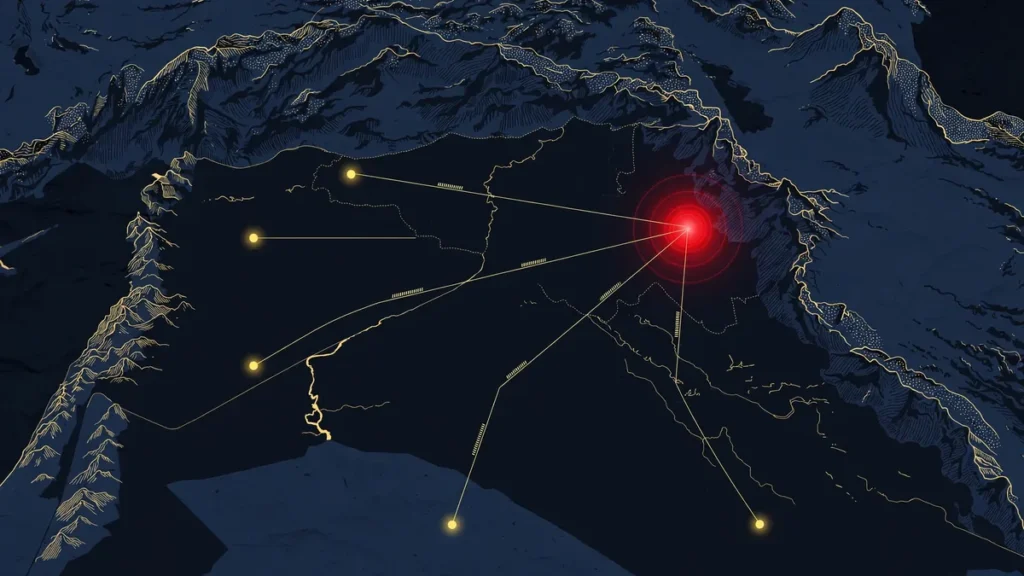
One claim is circulating and must be treated with care. A security source told the Kurdish outlet Rudaw that the attack was launched from the disputed town of Tuz Khurmatu, in Salahaddin province. That claim has not been independently confirmed, and Rudaw’s own reporter at the scene said a source could not say whether the projectile was a drone or a rocket. Until a second source or an official investigation confirms it, the launch site is reported, not established.
Whether the attack is connected to the wider regional war is equally unresolved. Al Jazeera reported that it was not clear who was responsible for the attack or whether it was related to the United States and Israel’s war on Iran. The strike came one night after the United States confirmed new strikes on Qeshm Island and two days after US Central Command stood up Task Force Iron Gate to disrupt Iran’s land-based supply routes — but proximity in time is not evidence of a connection, and no official has drawn one.
Background and timeline: a field that has been hit before
Khor Mor is one of the largest gas fields in the Kurdistan region and the backbone of its electricity supply. It is operated by the United Arab Emirates-based Dana Gas and Crescent Petroleum through the Pearl Petroleum consortium, and it supplies most of the region’s power stations. Dana Gas has reported output of about 452 million standard cubic feet of gas a day, and says an expansion completed in October 2025 raised the field’s processing capacity by about half. That is why a single strike on one storage tank could darken a region: the field is not one asset among many, it is the asset.
The November 8 attack is the latest in a pattern of strikes on the field:
- April 26, 2024: Two drones struck the site, killing four Yemeni workers and injuring two others. Gas supplies to power plants were halted, cutting about 2,500 MW of generation. No group claimed responsibility.
- November 26, 2025: An explosive drone hit a storage tank, starting a fire and halting supplies to power plants. The electricity ministry said generation fell by nearly 80 percent. No casualties were reported, and no group claimed responsibility.
- July 2026: Dana Gas shut down the field’s main production facilities as a precaution after credible security threats and regional tensions, restarting production later the same month.
- November 8, 2026: A drone hit the LPG storage tank, production was suspended, and about 2.8 GW of generation was lost. No casualties, no claim of responsibility.
Local reporting adds one detail that investigators will examine: the Kurdistan24 outlet reported that this strike hit the field’s “Old Field” section, which produces LPG and had not been targeted before. That detail is reported, not confirmed by the operator, but if it holds it suggests the attackers chose a part of the facility they had previously left alone.
Why Khor Mor matters for Kurdistan’s power grid
The scale of the outage is the story. Losing 2.8 GW in a region whose entire grid depends on a single gas field is not a disruption to one city — it is a system-wide failure. Power plants in five cities lost their fuel supply at once, and the region’s electricity ministry described the loss in the same breath as the attack itself, because the two are inseparable: Khor Mor is the fuel, and without the fuel there is no power.
Recovery from the last comparable attack took days. After the November 2025 strike, generation climbed back gradually, with the electricity minister reporting output recovering through the following days and gas production returning to about three-quarters of its pre-attack level before full recovery. There is no published timetable for this restart, and Dana Gas has said only that it is assessing the damage. For households and businesses across Kurdistan, the practical question is not who fired the drone but how many nights the lights stay out — and with November nights getting colder, heating demand makes each day of outage harder than the last.
The attack also lands on a region already living with energy insecurity. Kurdistan’s power supply has been fragile for years, and the field’s repeated targeting has turned a technical question — how to keep the gas flowing — into a security question that neither Erbil nor Baghdad has answered. The Kurdistan Regional Government’s electricity minister has repeatedly called for an anti-drone air defence system to protect the facility, a request Dana Gas shares. No such system is in place.

By the numbers: what is confirmed and what is reported
| Metric | Figure | Source | Status |
|---|---|---|---|
| Power generation lost | About 2.8 GW (2,500–2,800 MW) | KRG Ministry of Electricity | CONFIRMED |
| Share of region without power | More than 70% | Al Jazeera; KRG officials | CONFIRMED |
| Grid capacity reduction | 70–80% | Security sources via Al Jazeera | CONFIRMED |
| Casualties | None reported (initial assessment) | PM Ali al-Zaidi via INA | CONFIRMED (initial) |
| Production status | Suspended pending damage assessment | Dana Gas statement, November 9 | CONFIRMED |
| Weapon and target | Single explosive-laden drone; LPG storage tank hit | Reuters (two security sources) | CONFIRMED |
| Claim of responsibility | None | Reuters; Al Jazeera | CONFIRMED (absence) |
| Launch site | Tuz Khurmatu | Single security source via Rudaw | REPORTED — not independently confirmed |
| Section hit | “Old Field” LPG section | Kurdistan24 | REPORTED |
| Link to the US–Iran war | Unclear | Al Jazeera | UNVERIFIED |
Figures marked CONFIRMED are corroborated by at least two sources or an official statement; REPORTED figures rest on a single source and remain unverified.
What the Khor Mor attack means for US/UK/EU readers
For readers in the United States, Britain and Europe, the direct market impact is limited — and it is worth saying so plainly. Khor Mor’s gas is consumed inside Iraqi Kurdistan, not exported, so the attack does not by itself move Brent crude or European gas prices. Anyone claiming an immediate effect on your fuel bill is overstating it. Our earlier analysis of why oil prices fell in November 2026 explains what actually drives the Iran war premium in Brent — and a domestic Kurdish gas outage is not on that list.
What does matter is the escalation signal. Energy infrastructure is now being hit in the shadow of a live US–Iran war, days after American strikes on Qeshm Island and the creation of a US task force to choke Iran’s land supply routes. If attacks spread from Kurdistan’s domestic gas to Iraq’s export infrastructure — the Basra oil terminals and pipelines that do feed world markets — prices would move fast. The Khor Mor strike is a warning about the direction of travel, not yet a market event.
There are three more concrete implications. First, for investors: Dana Gas is listed in Abu Dhabi, and a second suspension of its flagship field in four months will be priced into the stock and into the perceived risk of operating in Iraqi Kurdistan. Second, for Iraq’s energy ambitions: Baghdad wants Kurdish gas to reduce Iraq’s dependence on Iranian gas imports, and every attack on Khor Mor pushes that goal further away. Third, for travellers: the UK and US already advise against all travel to much of Iraq, and a drone campaign against energy sites reinforces that advice rather than changing it. The conflict zones hub tracks the wider regional picture as it develops.
What to watch next in Iraq’s energy war
The first thing to watch is Dana Gas’s damage assessment and restart timetable. The company has said production is suspended pending assessment; the speed of the restart will tell us how badly the LPG storage tank and surrounding equipment were damaged, and whether the fire spread beyond the tank itself. The November 2025 recovery took days; a longer outage this time would signal worse damage.
The second is the investigation. Iraq’s Joint Operations Command has previously opened investigations into Khor Mor attacks with a 48-hour target for identifying the assailants, and the November 2025 probe concluded the drones were launched from east of Tuz Khurmatu. Whether this investigation reaches a public conclusion — and whether it names a launch site or a group — will determine whether attribution stays in the realm of single-source reporting.
The third is whether the pattern spreads. The attack came in the same week as US strikes on Qeshm Island, covered in our report on Trump’s confirmation of the Qeshm strikes, and as Washington stood up Task Force Iron Gate — the subject of our analysis of Iran’s rejected seven-day roadmap and the wider US pressure campaign. If more energy sites are hit in the coming days, the question of whether these attacks are coordinated — and by whom — becomes unavoidable. If Khor Mor stands alone, it remains what it is today: a serious but contained attack on a repeatedly targeted field, with no one claiming it and no one proven to have done it.
Finally, watch the diplomacy. Europe has joined the Abu Dhabi talks opening on November 10, and the wider region’s energy security will be part of the background to every negotiation this week — even when it is not on the agenda. For the deeper context on how the war is reshaping energy markets, see our guide to how the Iran war is reshaping global energy geopolitics.
Frequently asked questions
What happened in the Khor Mor gas field drone attack in November 2026?
On the night of November 8, 2026, an explosive-laden drone hit an LPG storage tank at the Khor Mor gas field in Iraqi Kurdistan, starting a fire and halting production. About 2.8 GW of power generation was lost and more than 70 percent of the Kurdistan region was left without electricity. No casualties were reported.
Who is responsible for the Khor Mor drone attack?
No group has claimed responsibility and no government has publicly named a culprit. Kurdish officials have blamed Iranian-backed militias for past attacks on the field, but no evidence linking any group to this attack has been published. A single-source claim that the drone was launched from Tuz Khurmatu has not been independently confirmed.
How much power did the Khor Mor attack cut?
The Kurdistan Regional Government’s Ministry of Electricity said the attack knocked between 2,500 and 2,800 megawatts of generation off the grid — about 2.8 GW — and security sources cited by Al Jazeera put the reduction in grid capacity at 70 to 80 percent. Gas supply was suspended to power plants in Erbil, Sulaimaniyah, Bazian, Chamchamal and Duhok.
Is the Khor Mor attack connected to the US war with Iran?
That is not clear. Al Jazeera reported that it was not clear whether the attack was related to the United States and Israel’s war on Iran. The strike came days after US strikes on Qeshm Island, but proximity in time is not evidence of a connection, and no official has drawn one.
When will Khor Mor gas production restart?
There is no published timetable. Operator Dana Gas said on November 9 that the fire was under control and production remained suspended while it assessed the damage. Recovery from the comparable November 2025 attack took days.
Sources
- Reuters: Production suspended at Iraq’s Khor Mor gas field after drone attack, sources say
- Al Jazeera: Drone attack suspends production at Iraq’s Khor Mor gasfield
- Arab News (AFP): Attack on Iraq gas complex, cuts supply: authorities
- Khaleej Times: UAE-based Dana Gas suspends Khor Mor operations after suspected drone attack in Iraq
- The Insight International: Drone attack halts gas production at Khor Mor field in Sulaimani

Discussion 0
Share analysis, corrections, or context. Be civil — comments are moderated.