
WarBrief Live | November 8, 2026 | Defence & the Pacific
| 6,000+ proposed annual aircraft operations | 4 airfields across 3 islands | Nov 29 2026 deadline for public comments | Mid-2028 final environmental decision expected |
The US Air Force has proposed more than 6,000 aircraft operations a year at four airfields in the Northern Mariana Islands, including Tinian North Field, the Second World War bomber base. Island residents have until November 29, 2026, to comment.
The proposal, published as a notice of intent by the Department of the Air Force on October 28, 2026, would turn a cluster of Pacific airfields — two of them civilian airports — into a regular training ground for the Air Force’s dispersed-operations concept. At its heart is Tinian North Field, silent since 1945 and now being cleared and rebuilt after eight decades under jungle. Nothing is decided yet: the notice opens an environmental review, not a construction order, and the final decision is not expected before the middle of 2028.
Key Takeaways
- The Department of the Air Force published a notice of intent on October 28, 2026, to prepare an environmental impact statement for training and exercises at four Northern Mariana airfields.
- The proposal caps each airfield at 1,200 fixed-wing and 320 rotary-wing operations a year — more than 6,000 in total — in support of Agile Combat Employment, the Air Force’s plan to disperse aircraft across many small bases.
- Tinian North Field, inactive since 1945 and being restored under a roughly $409 million contract awarded in April 2024, is the centrepiece of the plan.
- Public meetings run November 18–21, 2026, on Saipan, Tinian and Rota; written comments are due November 29, 2026; a draft environmental statement is expected in autumn 2027 and a final one in mid-2028.
What did the Air Force propose for Tinian North Field?
On October 28, 2026, the Department of the Air Force published a notice of intent to prepare an environmental impact statement covering training and exercises at four airfields in the Commonwealth of the Northern Mariana Islands (CNMI), an unincorporated US territory in the north-west Pacific. The four sites are Saipan International Airport, Tinian International Airport, Tinian North Field and Rota International Airport, according to Defense News.
The proposal would allow more than 6,000 aircraft operations a year across the four airfields, with each one hosting up to 1,200 fixed-wing and 320 rotary-wing operations — take-offs and landings — annually. The arithmetic of those caps adds up to 6,080 operations a year. Training would take the form of small, medium and large exercises held several times a year, each lasting a few weeks, rather than a permanent build-up. During training periods, each airfield could host up to 1,000 personnel and 550,000 gallons of fuel, according to the notice as reported by Common Defense.
The environmental review will assess the potential social, economic and environmental effects of the training. The notice also outlines an alternative with a higher ceiling — up to 7,136 total operations a year, according to The Profiler — but that figure rests on a single report and has not been corroborated by other outlets. The review process explicitly includes a “no action” option, meaning the Air Force could still decide to do none of this.
Why is the US Air Force rebuilding Tinian North Field now?
The short answer is dispersal. For two decades the US Air Force has concentrated its Pacific air power on a small number of large bases, above all on Guam. That concentration is now seen as a vulnerability: a single base can be watched, targeted and, in a conflict, shut down. The Tinian proposal is the latest step in a long-running effort to spread aircraft, fuel and crews across many smaller fields so that no single strike can ground the force.
The strategic pressure behind the shift is China’s missile arsenal. Reporting on the proposal notes growing concern that China’s expanding stock of missiles could threaten American installations across the region, and the plan is framed as a direct answer to that threat. The Air Force’s Agile Combat Operations concept, which the exercises would support, is built around exactly this problem: keeping aircraft flying from many places at once, and moving them between airfields faster than an adversary can target them.
Tinian is the most visible part of the effort because of what it was. In 1945 North Field was one of the busiest airfields on Earth, a vast complex from which waves of B-29 Superfortresses flew long missions against Japan. Its restoration has been under way for years, and the new notice would give the rebuilt field a formal training role for the first time since the war.
What is Agile Combat Employment?
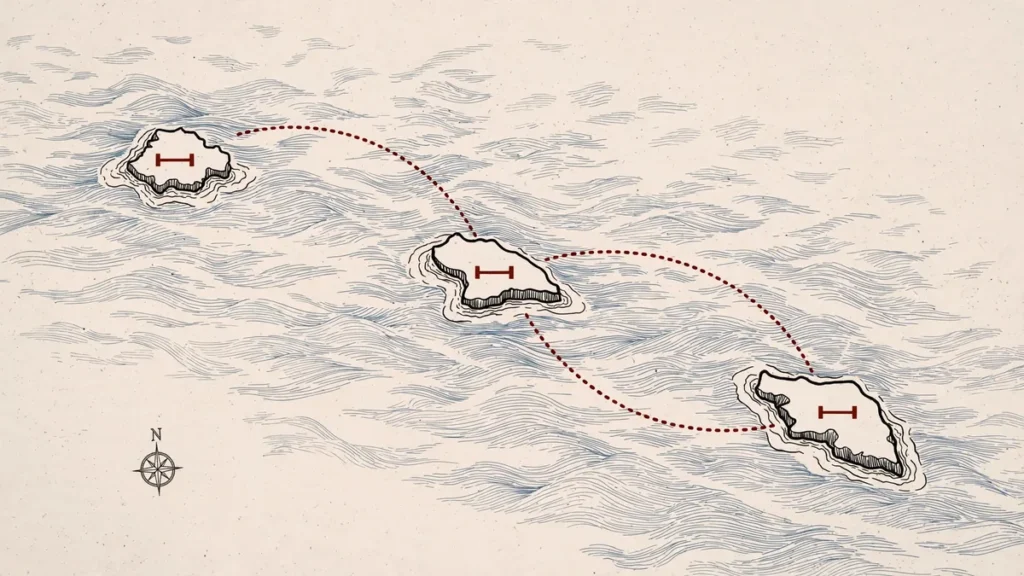
Agile Combat Employment, usually shortened to ACE, is the US Air Force’s operating concept for fighting from dispersed locations. Instead of massing aircraft at one big base, ACE spreads them across a network of airfields — large and small, military and civilian — and practises moving aircraft, crews, fuel and munitions between them at short notice. The aim, in the Department of the Air Force’s own words quoted by Defense News, is to use airfields that “collectively provide a training environment that enables [the Air Force] to exercise distributed operations, test and employ tailorable force packages, strengthen sustainment and maneuver capabilities, and enhance operational resilience”.
The concept matters because it changes what an adversary has to hit. A single base can be saturated by missiles; a dozen airfields, each able to receive, refuel and relaunch aircraft, cannot be shut down by one strike. The trade-off is complexity: fuel, spares, maintenance and communications must be pre-positioned across the network, and crews must practise working from austere fields with little infrastructure. That is what the proposed Northern Mariana exercises are designed to rehearse — several times a year, for a few weeks at a time, at up to four airfields simultaneously.
ACE is not unique to Tinian. It shapes how the Air Force thinks about its posture across the whole Indo-Pacific, from the wartime command arrangements with South Korea to the carrier strike groups that provide the Navy’s mobile air power in the same waters. Tinian is one node in that wider network — and, because of its history, the most symbolic one.
What is Tinian North Field’s history?
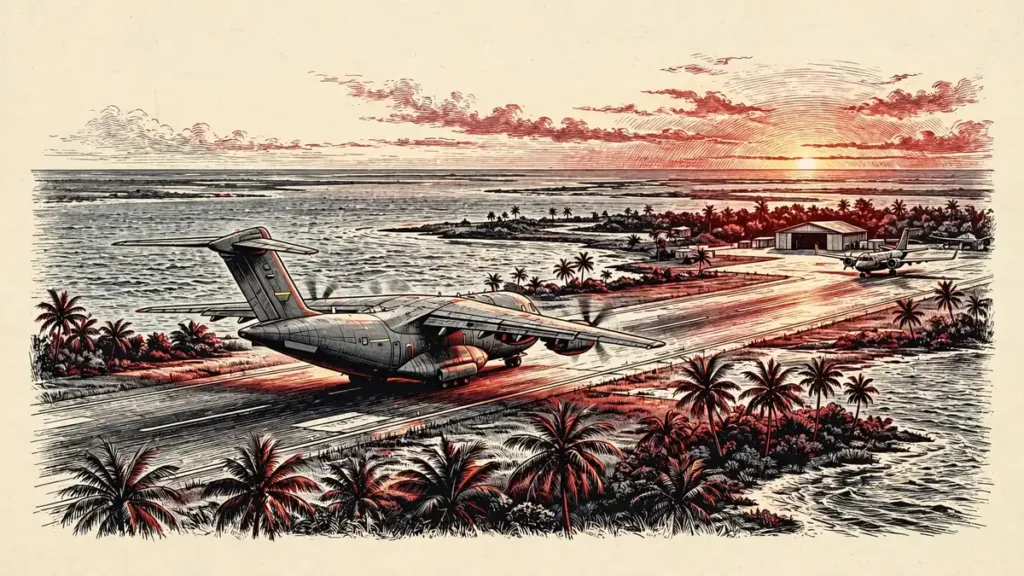
North Field’s place in history is hard to overstate. Built during the Second World War, it was the headquarters of the 509th Composite Group, and on August 6, 1945, the B-29 Enola Gay took off from its runways carrying the atomic bomb dropped on Hiroshima. Three days later, Bockscar departed from the same field for Nagasaki. At its wartime peak the field was among the busiest airfields in the world.
After the war it fell silent. The runways sat inactive and were largely swallowed by vegetation for almost eighty years, until a rehabilitation effort began in late 2023, according to Defense News. Since then, Air Force engineers have been clearing the jungle, testing the old pavement and rebuilding the field — work that the commander of US forces in the Pacific, Adm. Samuel Paparo, has inspected in person.
The restoration is already a major contract. In April 2024 the Air Force awarded engineering firm Fluor a task order worth approximately $409 million for pavement and transportation support at North Field, under the Air Force Contract Augmentation Program, with a 60-month period of performance, according to Fluor’s announcement and Defense News. That figure is the verified contract value; a larger figure of about $800 million sometimes quoted for Tinian covers two airfields, and published figures for North Field alone do not match, so it should not be read as the cost of this field. Tinian sits about 3,050 kilometres from Shanghai, according to The Profiler — close enough to matter in any Pacific contingency, and far enough that reaching it is itself a statement of reach.
When are the public meetings — and how can residents comment?
The notice opens a 30-day public scoping period, and the Air Force has scheduled three public meetings in the islands this month, according to the Marianas Variety:
- Saipan: November 18, 2026, 5–8 p.m., Pacific Islands Club, San Antonio
- Tinian: November 19, 2026, 5–8 p.m., Tinian Western Lodge, Marpo Heights
- Rota: November 21, 2026, noon–3 p.m., Rota Mayor’s Office, Tatachog (the courthouse or the Round House are possible alternate venues)
Written comments are due by November 29, 2026. They can be submitted at the meetings, on the project website at www.CATEEIS.com, by email to PACAF.NEPA.CATEEIS@us.af.mil, or by post to AFIMSC Det 2/CEV, ATTN: CATE EIS, 25 E St. Ste. C-310, JBPHH, HI 96853. After the scoping period, the Air Force plans to publish a draft environmental impact statement for public comment in autumn 2027, with a final version in mid-2028. Only after that would a decision be taken on whether the training goes ahead — and at what scale.
That timeline is the most important fact in the story for anyone reading it as a done deal. The Air Force has published a notice of intent, not an order. The environmental review, the public meetings and the “no action” alternative are real parts of the process, and the final decision is more than eighteen months away.
By the numbers: the Tinian proposal
| Metric | Figure | Source |
|---|---|---|
| Proposed annual aircraft operations, four airfields | 6,000+ | Dept of the Air Force notice, via Defense News |
| Fixed-wing operations per airfield, per year | Up to 1,200 | Dept of the Air Force notice, via Defense News |
| Rotary-wing operations per airfield, per year | Up to 320 | Dept of the Air Force notice, via Defense News |
| North Field restoration contract (Fluor, April 2024) | About $409 million | Fluor / Business Wire; Defense News |
| Written-comments deadline | November 29, 2026 | Dept of the Air Force notice, via Military Times |
| Draft environmental impact statement | Autumn 2027 | Dept of the Air Force notice, via Defense News |
| Final environmental impact statement | Mid-2028 | Dept of the Air Force notice, via Defense News |
| Personnel hosted per airfield during training (reported) | Up to 1,000 | Dept of the Air Force notice, via Common Defense |
| Fuel per airfield during training (reported) | Up to 550,000 gallons | Dept of the Air Force notice, via Common Defense |
| Alternative ceiling, total annual operations (reported) | Up to 7,136 | The Profiler |
| Distance from Tinian to Shanghai (reported) | About 3,050 km | The Profiler |
Figures marked “reported” rest on a single outlet’s account of the notice and have not been independently corroborated; all other figures above appear in the Department of the Air Force notice as reported by at least two outlets. The often-quoted figure of about $800 million covers two Tinian airfields, not North Field alone, and is not used here as a North Field cost.
What the Tinian plan means for US/UK/EU readers
For American readers, the plan is a money and priorities story as much as a strategy story. Roughly $409 million is already committed to restoring North Field, and Military Times reports that the rehabilitation has raised questions among Air Force leaders about resourcing and funding, “particularly as the war with Iran has placed new demands on the force”. The Tinian proposal will therefore be argued over in Washington as a claim on a defence budget that is already being pulled in several directions at once — and the public comment process is the one formal route for ordinary Americans, including the roughly 50,000 residents of the Northern Marianas, to weigh in before the decision is taken.
For British and European readers, the direct impact is limited, and it is worth saying so plainly. No UK or EU forces are involved, and the proposal does not change travel advice or flight routes. What it does signal is the direction of American defence planning: the United States is investing in the ability to keep flying from many small Pacific airfields if its big bases come under attack, and it is doing so years before any conflict. That matters to allies because it shapes what a US-led response in the Pacific would look like — dispersed, harder to suppress, and dependent on a network of small islands rather than a single fortress. Travellers to Saipan, Tinian or Rota should expect periodic military exercise activity and temporary airfield disruption during training weeks if the plan proceeds.
For readers anywhere, the plan is a reminder that the infrastructure of a possible future war is being built in peacetime, in public, through environmental paperwork. The notice of intent, the scoping meetings and the 2028 decision date are the visible surface of a much larger shift in how the United States intends to fight in the Pacific — and the documents are open for anyone to read and comment on until November 29.
What to watch next in the Northern Mariana Islands
The immediate dates are the public meetings on November 18, 19 and 21, and the written-comments deadline on November 29. Watch what residents and local leaders raise: noise, land use, access to the airfields, and the economic effects of hosting several hundred visiting personnel a few times a year are the issues that typically dominate scoping meetings, and the Air Force is required to address them in the draft statement.
Beyond November, watch the funding argument in Washington. If resourcing questions harden into opposition, the scope of the training — or its timetable — could shrink before the draft statement appears in autumn 2027. Watch also for the Air Force’s own progress reports on the North Field restoration, and for any sign of when aircraft might first use the rebuilt runways. The proposal covers training and exercises; the restoration is a separate, already-funded effort, and the two will converge only when the environmental review is complete.
The wider context is the US posture across the Pacific, from the conflict zones the US military watches most closely to the alliance arrangements that underpin it. Tinian is a small island with an outsized history; the next two years will decide whether it becomes a working airfield again, and what that means for the balance of power in the western Pacific.
Frequently asked questions
What is Tinian North Field?
Tinian North Field is a Second World War airfield on Tinian, in the Northern Mariana Islands. It was the headquarters of the 509th Composite Group and the departure point for the B-29s that dropped the atomic bombs on Hiroshima and Nagasaki in August 1945. It has been inactive since the war and was largely overgrown until a rehabilitation effort began in late 2023.
Why is the Air Force planning 6,000 flights a year from the Northern Mariana Islands?
The flights would support Agile Combat Employment, the Air Force’s concept of dispersing aircraft across many small airfields so that no single base can be shut down by an attack. The proposal covers four airfields — Saipan International, Tinian International, Tinian North Field and Rota International — each capped at 1,200 fixed-wing and 320 rotary-wing operations a year.
When is the deadline to comment on the Tinian airfield plan?
Written comments are due by November 29, 2026. They can be submitted at public meetings on Saipan (November 18), Tinian (November 19) and Rota (November 21), on the project website at www.CATEEIS.com, by email, or by post.
When will a final decision be made on the Tinian plan?
Not before mid-2028. The Air Force plans to publish a draft environmental impact statement in autumn 2027 and a final version in mid-2028. The process includes a “no action” alternative, so the training may still be scaled back or dropped.
How much is the Tinian North Field restoration costing?
About $409 million: in April 2024 the Air Force awarded Fluor a task order of approximately that value for pavement and transportation support at North Field, with a 60-month period of performance. A larger figure of about $800 million sometimes quoted for Tinian covers two airfields, not North Field alone.
Sources
- Defense News: US Air Force eyes reviving WWII air bases in the Pacific
- Military Times: US Air Force eyes reviving WWII air bases in the Pacific
- Common Defense: Air Force Advances Plan to Revive WWII Pacific Airfields for 6,000 Annual Operations
- Marianas Variety: Air Force to study training at 4 CNMI airfields; public meetings set for November
- The Profiler: World’s most powerful military revives Pacific air base used to launch atomic bombing missions against Japan
- Business Wire: Fluor Awarded U.S. Air Force Contract Augmentation Program V Task Order for Tinian


Discussion 0
Share analysis, corrections, or context. Be civil — comments are moderated.