
WarBrief Live | November 5, 2026 | Energy & Oil
$94.62
Brent, November 4 settle — down 8.7% in a day
$88.12
WTI, November 4 settle — down 8.3% in a day
17.1m bpd
Gulf oil exports in October (Vortexa)
1.4m bpd
Global oil surplus in October (JPMorgan)
Oil prices fell because traders cut the odds of new US strikes on Iran after Democrats won both chambers of Congress, while Gulf shipments recovered and the market slipped back into surplus. Brent crude settled at $94.62 a barrel on November 4, down 8.7% in a single session, and West Texas Intermediate settled at $88.12, down 8.3%.
The sell-off was the sharpest one-day fall in months and the fourth consecutive daily decline. By the morning of November 5, Brent had dipped to about $93.82 in Asian trading before recovering to $95.40 by 09:00 GMT — a reminder that the market stays volatile even as the immediate war premium drains away.
Key Takeaways
- Brent settled at $94.62 a barrel on November 4, down $8.98 or 8.7%, and WTI settled at $88.12, down $7.97 or 8.3% — the lowest settlements for both since August 31.
- The trigger was political: the Democrats’ midterm sweep, President Donald Trump telling the Financial Times that the US has no immediate plans to strike Iran, and Vice President JD Vance blaming the war for the Republican defeat.
- Physical supply helped push prices down: Gulf exports averaged 17.1 million barrels per day in October, and JPMorgan put the global market back into a 1.4 million barrel per day surplus.
- The risk has not vanished. Eurasia Group still puts the chance of renewed US strikes at 60% and warns that escalation could take Brent to $110–$125 a barrel.
Why did oil prices fall after the US midterms?
The proximate cause was the result of the November 3 midterm elections. Democrats won control of both the House of Representatives and the Senate, a sweeping defeat for President Donald Trump’s Republican Party that immediately changed how traders price the Iran war. Our assessment of what the election means for markets sets out the wider picture; for oil, the logic was direct. A Democratic Congress able to constrain military spending gives the White House less room to escalate — and more incentive to negotiate.
Trump himself fed that reading. He told the Financial Times on November 4 that the United States had no immediate plans to strike Iran, and on November 5 he acknowledged that the Iran war had played a role in his party’s defeat. Vice President JD Vance went further, distancing himself from the decision to go to war and blaming it entirely for the electoral rebuke. As Dennis Kissler, senior vice president of trading at BOK Financial, told Reuters, Democratic control of Congress “could also tighten US military spending in the Middle East and further heighten the possibility of a peace deal sooner than later.”
June Goh, senior oil analyst at Sparta Commodities, put the market’s thinking plainly: “Markets are assessing the impact of the midterm elections on Donald Trump’s next steps with the Iran war, pricing in more likelihood for the war to end.” Not every analyst agrees. Carl Larry, who leads trading and North America risk at Enverus, told Reuters he was “more concerned that we can see an escalation in Iran sooner than a resolution,” a warning that the relief rally in reverse could unwind just as fast.
Diplomacy is moving in parallel. Qatar stepped up mediation efforts to avert a renewed escalation after the US elections, and Iranian officials have been meeting Qatari mediators carrying proposals to Washington. But a senior Iranian official told Reuters on November 4 that Iran and the United States remain far from a deal to end their war, and Supreme Leader Ayatollah Mojtaba Khamenei said in a written statement that US hostility would persist regardless of which party controls Congress. The market is pricing a lower probability of war, not a settlement.
One claim from the day deserves care. Yemen’s Houthis said they had targeted King Khalid International Airport in Riyadh. There was no confirmation from Saudi authorities, and the claim should be treated as unverified until Riyadh or an independent source confirms it.
What is the Iran war premium — and how much of it has come off?
The “war premium” is the extra margin built into the oil price for the chance that barrels will be lost — to a closed strait, a damaged terminal, or a wider regional war. It is the part of the price most sensitive to headlines, because it reflects probability rather than physical supply. When the perceived probability of disruption falls, the premium can shrink even before a single extra barrel reaches the market.
The premium had been large. The war, launched by the United States alongside Israel in February 2026, pushed Brent up 13.6% in October and WTI up 15.2%, a fourth straight monthly gain, as tanker attacks in the Strait of Hormuz and Houthi strikes on Saudi Arabia took both benchmarks to their highest settlements in six months. Then the diplomacy headlines began to bite. Brent fell sharply on November 2 as Qatar-mediated talks raised hopes of a deal, and the November 4 plunge — $8.98 off Brent, $7.97 off WTI — took both benchmarks to their lowest settlements since August 31. Just two days earlier, Brent had bounced after the previous 7% plunge, a reminder of how violently this market has swung in both directions this month.
The November 5 session captured the same whipsaw in miniature. Reuters reported Brent down 0.85% at $93.82 a barrel in Asian trading at 04:26 GMT, with WTI down 1.36% at $86.92 — the fourth consecutive day of declines. By 09:00 GMT, Brent had recovered to $95.40, up 0.8% on the day, and WTI to $88.23. The direction of travel is clear; the day-to-day path is not.
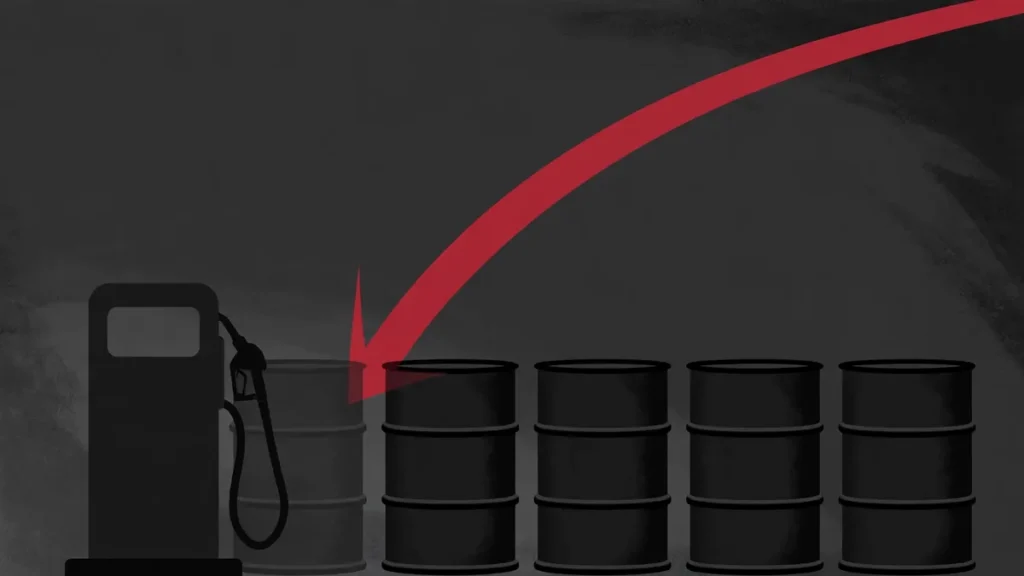
By the numbers: the November 5 oil slump
| Metric | Figure | Source |
|---|---|---|
| Brent, November 4 settle | $94.62 (down $8.98, 8.7%) | Reuters |
| WTI, November 4 settle | $88.12 (down $7.97, 8.3%) | Reuters |
| Brent, November 5 Asian session | $93.82 (down 0.85%) | Reuters |
| Brent, November 5 at 09:00 GMT | $95.40 (up 0.8%) | Reuters |
| Gulf oil exports, October | 17.1 million bpd | Vortexa via Reuters |
| Global oil surplus, October | 1.4 million bpd | JPMorgan via Reuters |
| Chance of renewed US strikes on Iran | 60% (cut from 65%) | Eurasia Group |
| Brent if escalation resumes | $110–$125 a barrel | Eurasia Group scenario |
Settlements and intraday prices are confirmed market data reported by Reuters. Eurasia Group figures are analyst estimates and a scenario, not a forecast. The 17.1 million barrels per day figure covers Gulf exports of crude, condensate and refined products, excluding liquefied petroleum gas.
What the Brent slump means for US, UK and EU fuel prices
Crude is the largest single cost in a litre of petrol or diesel, so a $9 fall in Brent, if it holds, should eventually feed through to what drivers pay. The key words are “if it holds” and “eventually.” Pump prices follow wholesale fuel costs, which follow crude with a lag of days to weeks, and the pass-through is filtered through refining margins, taxes and — for the UK and EU — the exchange rate. A one-day plunge does not cut pump prices the next morning.
In the United States, the picture is mixed. US crude, gasoline and distillate inventories all fell last week, the Energy Information Administration said, and demand hit its highest in a year. Crude stocks fell by 865,000 barrels to 409.8 million barrels in the week ended October 30, against analysts’ expectations in a Reuters poll for an 877,000-barrel rise. Tight inventories and strong demand limit how far and how fast US gasoline prices can fall, even with crude down sharply. Our earlier analysis of the last oil plunge and pump prices explains the same lag in detail.
For the UK and the EU, Brent is the benchmark that matters most, because European refineries price off it. A Brent price in the low $90s eases the pressure on wholesale petrol and diesel costs after months in which the war premium pushed them up. But the sterling and euro exchange rates against the dollar, and refining margins that have been squeezed by the same disruption, decide how much of the fall reaches the forecourt. Drivers should expect gradual relief over the coming weeks if Brent stays near current levels — and a quick reversal if it does not. Brent’s intraday recovery to $95.40 on November 5 is a warning against budgeting on the morning low.

What could push oil back up: the escalation scenario
The case for lower prices is a probability judgement, and the probabilities are still uncomfortably high. Eurasia Group lowered its estimate for the chance of renewed US strikes on Iran to 60% from 65%, but it also cut the probability of a deal to 10% from 20% and raised the likelihood of a continued standoff to 30% from 15%. Its warning is blunt: despite the recent drop, escalation is likely to produce a sharper increase into a band of $110 to $125 a barrel for Brent. That is an analyst scenario, not a forecast — but it shows how much premium could return, and how fast.
Citi added a different warning in a note: with the midterms over, the White House could focus on its executive powers in foreign policy and potentially escalate the conflict with Iran. The new Congress does not take office until January, and until then the president’s freedom of action on military matters is largely unchanged.
The physical picture also has thin buffers. Commercial oil inventories in major consuming countries are near their lowest in 15 years, according to energy consultancy XAnalysts, which means any new disruption would bite faster than it would have a year ago. And on November 5, Iran’s Islamic Revolutionary Guard Corps claimed that two oil tankers and a tugboat had caught fire in separate incidents after attempting to use unauthorised routes through the Strait of Hormuz. That claim is unverified, and it sits awkwardly against the flow data: crude shipments through the strait have recovered to close to pre-war levels, according to analysts, although at a higher cost.
Longer term, the region is hedging. The United Arab Emirates is considering building a third oil pipeline that would deliver crude outside the Strait of Hormuz, Bloomberg reported, citing people familiar with the matter, as the country aims to sharply reduce its dependence on the waterway. A bypass pipeline takes years to build; it does not change this winter’s arithmetic, but it signals that Gulf producers expect the strait to remain a risk for a long time.
What to watch next in the oil market
First, whether the new Congress, once seated in January, actually constrains military spending in the Middle East — the bet the market made on November 4, and the one most likely to be tested. Second, Qatar’s mediation and any movement toward US-Iran talks, remembering that both sides remain far from a deal. Third, the flow data: Vortexa’s Gulf export figures and the EIA’s weekly inventory reports will show whether the physical recovery is real or a one-month blip. Fourth, the price level itself. Goldman Sachs has raised its oil price forecasts, citing growing risks to global supplies — a reminder that the banks are not all on the same side of this trade. If Brent holds below $95, the war premium is mostly gone; if it reclaims $100, the market has decided the midterm signal was noise. Either way, the conflict in the Gulf remains the single variable that matters most for the price at the pump.
WarBrief Live covers energy markets for educational purposes. This article is not financial advice.
Frequently asked questions
Why did oil prices fall in November 2026?
Traders cut the odds of new US strikes on Iran after Democrats won both chambers of Congress in the November 3 midterms, President Trump said the US had no immediate plans to strike Iran, and Vice President Vance blamed the war for the Republican defeat. Recovering Gulf shipments and a return to a global oil surplus added to the downward pressure.
What is the Iran war premium in oil prices?
It is the extra margin built into the price of crude for the chance that barrels will be lost to a closed strait, a damaged terminal or a wider regional war. It reflects probability, not physical supply, so it can shrink quickly on diplomatic headlines even before shipments recover.
Will petrol and diesel prices fall now?
Probably, gradually, if Brent stays near current levels — but pump prices follow wholesale fuel costs with a lag of days to weeks, and taxes, refining margins and exchange rates all filter the pass-through. US inventories are tight and demand is strong, which limits how fast American gasoline prices can fall.
What happens to oil prices if the US strikes Iran again?
Eurasia Group estimates escalation could push Brent into a $110 to $125 a barrel band. That is an analyst scenario rather than a forecast, and the firm still puts the chance of renewed strikes at 60%.
Is the Strait of Hormuz open for oil shipments?
Crude shipments through the strait have recovered to close to pre-war levels, according to analysts cited by Reuters, although transportation costs remain elevated. Gulf exports averaged 17.1 million barrels per day in October, and the UAE is considering a third pipeline to bypass the strait entirely.
Sources
- Reuters via BusinessWorld: Oil slumps after midterm election rebuke to Trump raises bets on Iran war exit
- Reuters via MIX-FM: Oil rises as investors weigh uncertainties around Iran war
- Reuters via Free Press Journal: Brent Crude Oil Falls Below $94 As US Midterm Results Raise Hopes Of Iran War De-Escalation
- The Economic Times: US oil prices crash below $90 as JD Vance blames Iran War for GOP election loss
- HDFC Sky: Crude Extends Sharp Fall; Brent at $93.9 on Iran De-Escalation Hopes


Discussion 0
Share analysis, corrections, or context. Be civil — comments are moderated.