
WarBrief Live | November 2, 2026 | Explainer
At a glance: 11 ASEAN members | 8 Plus partners | 7 working groups | First meeting: Hanoi, 2010
ADMM-Plus is Asia’s defence ministers’ forum: the ten-plus-one ASEAN members sit down with eight outside partners — Australia, China, India, Japan, New Zealand, Russia, South Korea and the United States — to talk security and run practical joint work, without becoming an alliance. It is the region’s only ministerial-level defence forum that puts ASEAN in the chair and the great powers at the same table.
Key Takeaways
- ADMM-Plus pairs ASEAN’s defence ministers with eight “Plus” partners; ASEAN, through the ADMM, drives the forum — the partners do not run it.
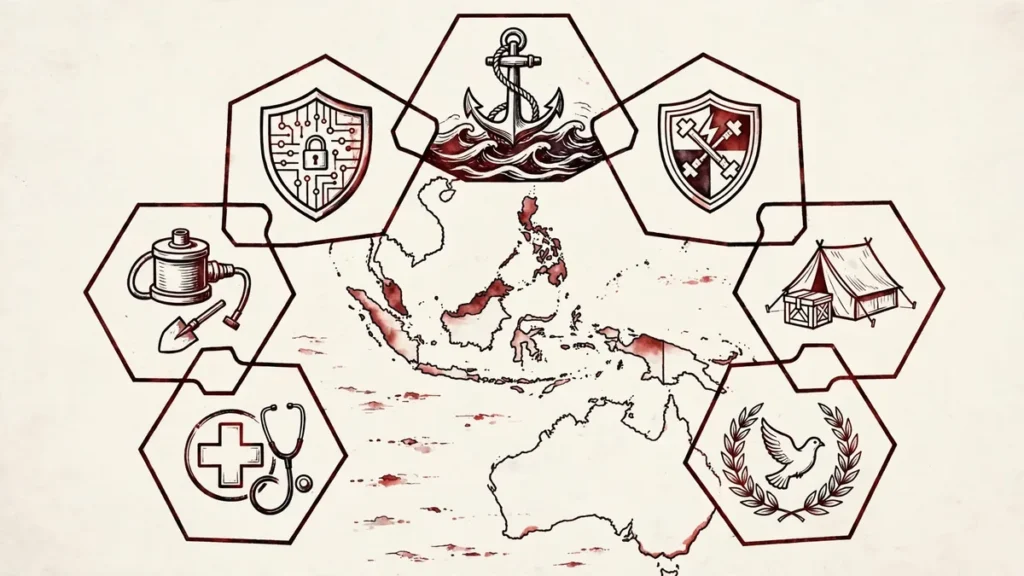
- Its real work happens between ministerials, in seven Experts’ Working Groups covering maritime security, counter-terrorism, disaster relief, peacekeeping, military medicine, mine action and cyber security.
- It is not an alliance: it carries no collective-defence obligation and no treaty binding members to fight for one another.
- The 13th ADMM-Plus met in Cebu on October 28 and 29, 2026 — and a row over China’s late invitation showed how fragile the forum’s inclusivity can be.
What is ADMM-Plus?
The ASEAN Defence Ministers’ Meeting-Plus, universally shortened to ADMM-Plus, is a platform for ASEAN and its eight dialogue partners to strengthen security and defence cooperation for peace, stability and development in the region, in the words of the forum’s own official description published by ASEAN’s ADMM site. Its parent body, the ADMM, was inaugurated in Kuala Lumpur in 2006 and is described in the Manila Joint Declaration of October 28, 2026 as the highest defence consultative and cooperative mechanism in ASEAN. The “Plus” format was added four years later: the inaugural ADMM-Plus was convened in Hanoi, Vietnam, on October 12, 2010, and since 2017 the ministers have met annually.
Two design principles explain almost everything about how the forum behaves. The first is ASEAN centrality: the ADMM is the forum’s driving force, and the Plus countries participate on ASEAN’s terms. The second is consensus: decisions are taken by consultation among all participants, which is why ADMM-Plus statements tend to be broad and why disagreements — over the South China Sea, for example — usually surface as omissions or careful phrasing rather than as votes.
Who are the members of ADMM-Plus?
On the ASEAN side sit Brunei, Cambodia, Indonesia, Laos, Malaysia, Myanmar, the Philippines, Singapore, Thailand, Timor-Leste and Vietnam — eleven members in the 2026 reporting of the meeting. The eight Plus countries are Australia, China, India, Japan, New Zealand, the Republic of Korea, Russia and the United States. Together that is nineteen participants, and the membership deliberately mirrors the East Asia Summit: the forum is meant to gather the countries that define Indo-Pacific security dynamics in one room.
Readers may notice older explainers giving a total of eighteen — ten ASEAN members plus eight partners. Those accounts predate Timor-Leste’s full membership of ASEAN, and the 2026 meeting reporting lists eleven ASEAN members. The discrepancy is a useful reminder to check the date on any ADMM-Plus explainer: the forum’s membership has grown since 2010, and older pages have not always caught up.
Each country sends its defence minister — or, in a telling exception examined below, a lower-ranking representative. The Philippines chaired the ADMM and ADMM-Plus in 2026 as ASEAN chair, hosting the ministerials in Cebu, and the chair was due to pass to Singapore for 2027.
What does ADMM-Plus actually do?
The ministerial meeting itself is the visible tip of the forum. Ministers exchange views on regional and international security issues — the 2026 theme in Cebu was an exchange of views on exactly that — and hold bilateral meetings on the sidelines. India’s defence minister, Rajnath Singh, for example, held bilateral talks with counterparts from the Philippines, South Korea, Japan, the United States and Australia during the Cebu meeting.
The durable work, however, is done by the seven Experts’ Working Groups (EWGs), each co-chaired by one ASEAN member state and one Plus country on a three-year cycle. The seven areas of practical cooperation, as listed by ASEAN, are maritime security, counter-terrorism, humanitarian assistance and disaster relief, peacekeeping operations, military medicine, humanitarian mine action and cyber security. Their output is deliberately practical: standard operating procedures, information-sharing portals such as the maritime security community portal, tabletop exercises that test planning, and full field exercises involving ships, troops and rescue teams. The counter-terrorism group, co-chaired by India and Malaysia for the 2024–2027 cycle, held its 16th meeting in New Delhi from January 14 to 16, 2026, alongside the final planning conference for its tabletop exercise.
That exercise-and-procedure output is the forum’s answer to its critics. ADMM-Plus does not deploy forces, impose sanctions or settle territorial disputes. What it can do is make nineteen defence establishments familiar with one another’s procedures before a crisis — so that a disaster-relief operation or a maritime incident does not begin with strangers.
What is ADMM-Plus not?
Three common misunderstandings are worth clearing up. First, ADMM-Plus is not an Asian NATO: there is no Article 5-style commitment, no integrated command and no obligation to defend another member. Second, it is not the ASEAN Summit: heads of government do not attend, and its statements do not carry the political weight of a leaders’ declaration. Third, it is not a dispute-settlement body: it can discuss the South China Sea or the Korean peninsula, but it cannot adjudicate claims, and its consensus rule means any single participant can block language it dislikes.
Understanding those limits is the key to reading ADMM-Plus news sensibly. A joint statement is a success; the absence of one is not necessarily a failure; and the most consequential outcomes are often the unglamorous ones — an agreed procedure, a shared portal, a completed exercise — rather than the communique.
Why the 2026 Cebu meeting made headlines
The 13th ADMM-Plus, held in Cebu on October 28 and 29, 2026 alongside the 20th ADMM, should have been a routine anniversary-year meeting: the Manila Joint Declaration marked twenty years of the ADMM itself. Instead, the meeting’s aftermath was dominated by a diplomatic row. In a statement posted on Facebook late on November 1, the Chinese Embassy in Manila accused Philippine Defence Secretary Gilberto Teodoro Jr. of delaying China’s invitation, claiming the Philippines sent it only on October 22 — after other members had received theirs in late September or early October — leaving Beijing fewer than five working days to prepare and two days to complete registration, according to Philstar’s November 2 report.
China consequently sent its defence attache in Manila, Senior Captain Yang Lei, rather than Defence Minister Dong Jun — which Philstar described as China’s lowest level of representation at the forum since its launch in 2010. The Philippine side’s account, as reported, is that the invitation was sent through a letter signed by Defence Undersecretary Ignacio Madriaga, and Defence Secretary Teodoro said on October 23 that China had been sent notice only the previous day. The embassy’s claims about motive — that the invitation came only after other ASEAN countries objected — are Beijing’s account, not an established fact: the Department of National Defense had not publicly answered the embassy’s specific claims when BusinessWorld reported the row on November 2. The episode matters because it tests the forum’s founding promise of openness and inclusivity — the very principle the embassy said had been disregarded.
The row also drew in the United States: on November 2, US Ambassador Lee Lipton reaffirmed what he called Washington’s “ironclad” defence commitment to the Philippines, days after Secretary of War Pete Hegseth attended the Cebu meeting. The timing underlines how ADMM-Plus sidelines have become a stage for bilateral signalling as much as for multilateral business.
What the Cebu row means for US/UK/EU readers
For readers in the United States, Britain and Europe, ADMM-Plus can look remote — a talking shop in a distant sea. Three reasons it is not. First, the forum covers the sea lanes through which a large share of Europe’s and America’s Asian trade travels: when its maritime security group agrees procedures for navies operating in crowded waters, that is risk reduction for commercial shipping as well as for warships. Second, its disaster-relief work is the machinery that would coordinate an international military response to the next major earthquake or typhoon in Southeast Asia — the kind of operation in which British, American and European forces have repeatedly taken part. Third, and most immediately, the forum is a barometer: when China and the Philippines cannot agree even on an invitation, that friction tends to show up later in coastguard encounters and trade politics that do reach European and American consumers. A forum that keeps rivals talking has value precisely when the talking gets difficult.
By the numbers: ADMM-Plus
| Metric | Figure | Source |
|---|---|---|
| ASEAN members at the 2026 meeting | 11 | DD India / IANS, October 27, 2026 |
| Plus partner countries | 8 | ASEAN ADMM official site |
| Areas of practical cooperation (EWGs) | 7 | ASEAN ADMM official site |
| Inaugural ADMM-Plus | October 12, 2010, Hanoi | ASEAN ADMM official site |
| Annual meetings since | 2017 | ASEAN ADMM official site |
| 13th ADMM-Plus | October 28–29, 2026, Cebu | Philippines chair programme reporting |
| Days China says it had to prepare (REPORTED) | Fewer than 5 working days | Chinese Embassy in Manila, via Philstar |
Caveat: figures in the first six rows are confirmed by official or multiple reputable sources. The final row is REPORTED — it is the Chinese Embassy’s claim about its invitation timing, disputed in its implications by Manila’s account, and is not WarBrief’s own finding.
What to watch next in ADMM-Plus
Three things will show whether the Cebu row was a blip or a turning point. The first is Singapore’s 2027 chairmanship: whether the handover restores routine invitations and ministerial-level attendance from all eight partners. The second is the next EWG cycle: the 2024–2027 cycle ends in 2027, and the choice of new co-chairs and exercise hosts will reveal which cooperation areas members genuinely prioritise. The third is the South China Sea: the forum’s maritime security group, co-chaired in recent years by the Philippines and Japan, is where any practical de-escalation measures would first appear — or conspicuously fail to. WarBrief’s earlier preview of the Cebu meeting and our report on the Cebu talks carry the meeting-level detail; this explainer is the reference to return to when the next headline lands. Readers following Southeast Asia’s security balance may also want our profile of Thailand’s military capabilities, and the wider picture sits on our conflict zones hub.
Frequently asked questions
What is ADMM-Plus in simple terms?
It is a defence ministers’ forum in which ASEAN’s members meet eight outside partners — Australia, China, India, Japan, New Zealand, Russia, South Korea and the United States — to discuss security and run practical cooperation such as joint exercises and shared procedures. ASEAN chairs it; it is not an alliance.
Who are the members of ADMM-Plus?
Eleven ASEAN members (Brunei, Cambodia, Indonesia, Laos, Malaysia, Myanmar, the Philippines, Singapore, Thailand, Timor-Leste and Vietnam) plus eight Plus countries (Australia, China, India, Japan, New Zealand, Republic of Korea, Russia and the United States). Older explainers sometimes list ten ASEAN members, predating Timor-Leste’s full membership.
What are the seven ADMM-Plus working groups?
Maritime security, counter-terrorism, humanitarian assistance and disaster relief, peacekeeping operations, military medicine, humanitarian mine action and cyber security. Each has an Experts’ Working Group co-chaired by one ASEAN state and one Plus country on a three-year cycle.
Is ADMM-Plus a military alliance?
No. It involves no collective-defence obligation, no integrated command and no treaty commitment to fight for another member. Its decisions rest on consultation and consensus, and its output is dialogue, procedures and exercises.
Why did China send only a defence attache to Cebu in 2026?
Beijing says its invitation arrived on October 22, leaving fewer than five working days to prepare, and sent Senior Captain Yang Lei instead of its defence minister. Manila says the invitation was sent through a letter signed by a defence undersecretary. The dispute over motive remains a claim by Beijing, not an established fact.
Sources
- ASEAN ADMM: About the ASEAN Defence Ministers’ Meeting Plus
- Singapore Ministry of Defence: Manila Joint Declaration on the 20th Anniversary of the ADMM
- Philstar: China says Gibo gave Beijing less than five working days’ notice for ASEAN defense talks
- BusinessWorld: China says it had fewer than five days to prepare for ASEAN meeting
- DD India: Rajnath Singh leaves for Philippines to attend 13th ASEAN Defence Ministers’ Meeting-Plus


Discussion 0
Share analysis, corrections, or context. Be civil — comments are moderated.