
WarBrief Live | October 22, 2026 | Geopolitics
How do oil sanctions work? The short version: they do not stop the oil — they tax it. On October 21, Norway aligned with the European Union’s 21st sanctions package against Russia, locking in a $47.60-per-barrel price cap on Russian crude and listing 105 more shadow-fleet tankers. On October 22, the US Treasury sanctioned a Panama-and-Greece-based law firm and shipping agents accused of supporting Iran’s own shadow fleet. Sanctions on oil are the West’s most ambitious economic weapon, built from price caps, vessel blacklists, and service bans — and shadowed by a parallel tanker fleet built to defeat them.
Key Takeaways
- Oil sanctions work mainly through a price cap: Western insurers and shippers may not handle Russian crude sold above $47.60 a barrel — the cap squeezes revenue, not volume.
- A shadow fleet of ageing tankers — estimates range from roughly 800 to over 1,900 vessels depending on the methodology — moves an estimated 70% of Russia’s seaborne crude outside Western services.
- Enforcement now targets the ships themselves: the EU has listed 632 shadow-fleet vessels, and a 2026 study found targeted vessel designations cut the shadow fleet’s share of seaborne exports from about 63% to 52%.
- The next escalation is already drafted: the EU’s proposed 22nd package could include a full ban on maritime services to Russian oil tankers — but it has not been adopted yet.
What is the oil price cap, and how does it actually bite?
The price cap is the centerpiece of the oil-sanctions architecture. In December 2022, the G7, the EU, and Australia agreed that Russian seaborne crude could keep flowing to world markets — but only if sold at or below $60 per barrel. Caps on refined products followed in February 2023: $100 per barrel for products trading at a premium to crude, such as diesel and kerosene, and $45 for discount products like fuel oil.
The mechanism does not seize cargoes or blockade ports. Instead, it weaponises the services every tanker needs. Companies in G7 and EU jurisdictions — shipowners, charterers, insurers, reinsurers, and brokers — are prohibited from providing maritime services for Russian oil cargoes priced above the cap. Because the world’s dominant shipping and marine-insurance firms sit in London, Europe, and the United States, the cap was designed to make selling above the limit commercially impractical. Compliance runs on an attestation process: each party in the supply chain must retain and share price information proving the cargo was bought at or below the cap. Analysts at Columbia, UCLA, and the Kyiv School of Economics found that the cap’s logic holds only where Western service providers are involved — companies in China, India, and Russia itself are outside its reach.
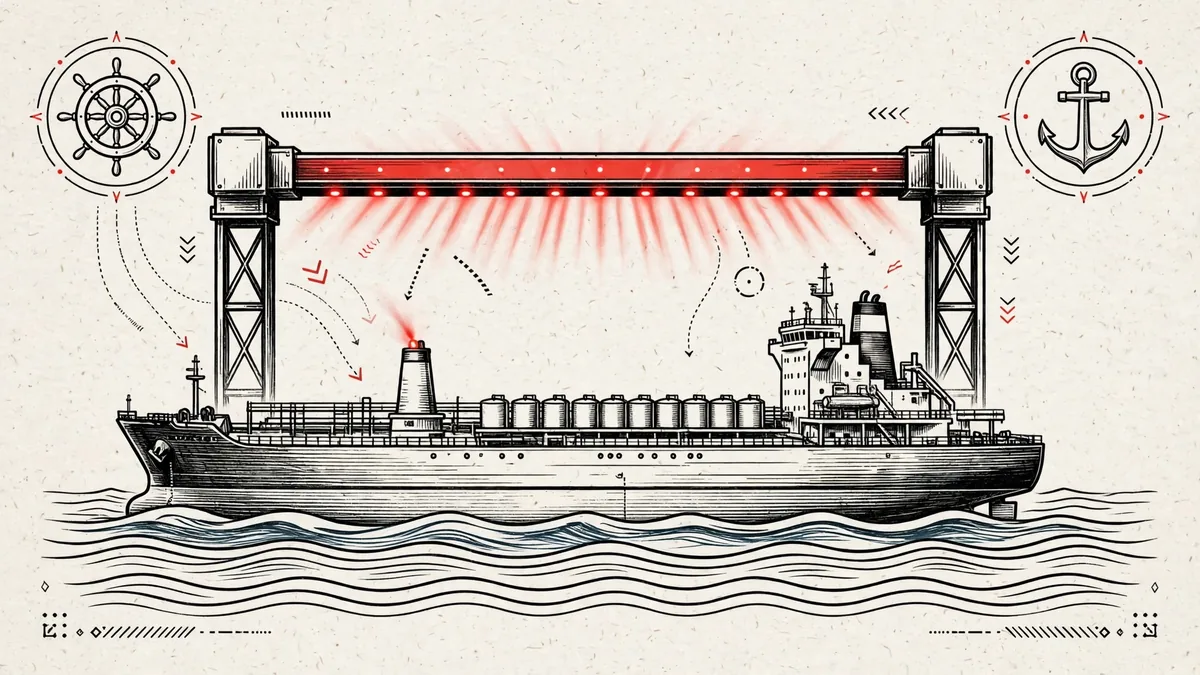
Why $47.60? The moving target of the crude price cap
The original $60 figure did not last. As Urals crude — Russia’s main export blend — kept trading above the cap, the EU and the UK moved in 2025 to lower their ceiling to $47.60 per barrel, roughly 15% below the average market price of Urals at the time, and built in a dynamic mechanism to keep the cap 15% below Urals automatically. The United States did not follow: Washington kept the original $60 cap, creating a split that lets Russian sellers route business through US-aligned service jurisdictions to sell closer to the higher ceiling.
Then the Strait of Hormuz crisis rewrote the arithmetic. With roughly a fifth of the world’s oil and gas flows passing through the strait and Brent crude spiking, the EU feared that a falling automatic cap would let Russia earn windfall revenue from the war premium. So the EU’s 21st package — adopted by the Council on July 23, 2026, and aligned with by Norway on October 21 — suspended the automatic adjustment for a full year, until July 2027. The cap stays at $47.60 a barrel no matter where Urals trades. Norway’s alignment, announced by Oslo’s foreign ministry and reported on October 20, extends the same rules to a major energy producer that is not an EU member.
Industry data suggests the cap still catches a meaningful share of the trade: the West of England P&I Club told members that cover is only available for voyages where the crude was bought at $47.60 or below, and insurance-industry reporting estimates that up to 30% of seaborne Russian oil is still traded under the cap. The rest moves through the shadow fleet.
How does the shadow fleet evade the sanctions?
The shadow fleet — sometimes called the dark fleet — is the parallel shipping system that carries sanctioned oil outside Western oversight. It grew explosively after the 2022 invasion: ageing tankers that mainstream operators were retiring were bought cheaply and absorbed into a network that operates beyond the price cap’s reach. Russia is by far the largest user, but Iran has run its own parallel network for over a decade, and Venezuela uses shadow ships to move heavy crude to Asia.
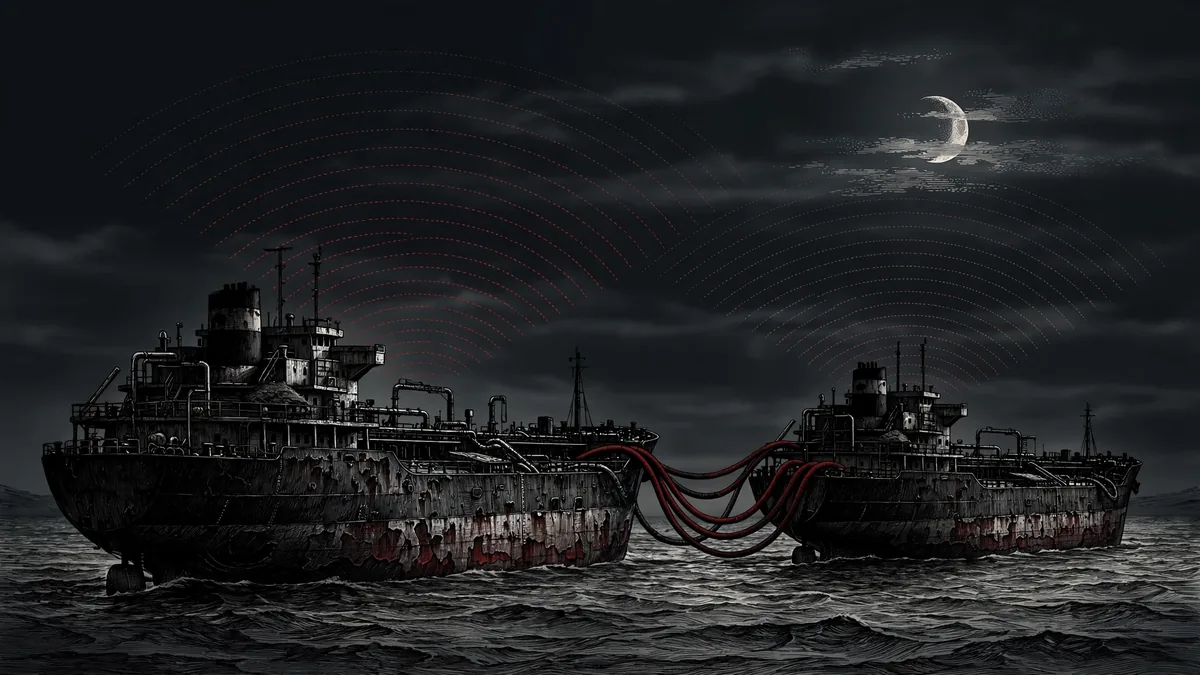
The evasion toolkit has four layers. First, layered ownership: single-ship companies in closed registries, managed through operators in the UAE and parent companies in places like the British Virgin Islands, bury the real owner. Second, flag hopping: vessels rotate through permissive registries — St Kitts, Gabon, the Cook Islands, San Marino, Palau. Third, AIS manipulation: tankers switch off their transponders, spoof false positions, or — as researchers recently documented in the Black Sea — transmit two sets of coordinates at once, appearing to be in two places simultaneously. Fourth, dark ship-to-ship transfers: cargo is passed between vessels in international waters, far from inspections, often with falsified paperwork. The fleet runs on a domestic Russian insurance stack — RNRC, Ingosstrakh, AlfaStrakhovanie, Sogaz — that Western port-state control cannot verify.
How big is it? That depends on the definition, and estimates vary widely — which is why any single number should be treated with care. The EU’s own vessel list reached 632 ships after the 20th package in April 2026. The maritime intelligence firm Windward counts 1,229 vessels above 20,000 deadweight tonnes, more than three-quarters of them sanctioned by the US, UK, or EU. Ukraine’s sanctions commissioner puts the total between 800 and 1,200 tankers, with a core of at least 400 that made three or more voyages from Russian ports between 2024 and 2026. The broadest commercial count, by Kpler, reached 3,154 ships in August 2026 — but that sweeps in vessels with only tangential links to sanctioned trade. One industry analysis estimates the fleet carries roughly 70% of Russia’s seaborne crude and controls nearly a fifth of global tanker capacity. The biggest buyers are China — especially independent “teapot” refineries — followed by India and Turkey.
By the numbers: oil sanctions in October 2026
| Metric | Figure | Source |
|---|---|---|
| Current EU/UK crude price cap | $47.60/barrel (dynamic adjustment frozen until July 2027) | CONFIRMED — Fenech & Fenech; West of England P&I Club |
| Original G7 crude cap / product caps | $60 (Dec 2022) / $100 premium, $45 discount (Feb 2023) | CONFIRMED — G7/EU statements |
| US crude cap | $60 (Washington did not adopt the lower EU/UK cap) | CONFIRMED — CEPA analysis |
| EU-listed shadow-fleet vessels | 632 (after the 20th package, April 2026) | CONFIRMED — European Commission statement |
| Seaborne Russian oil traded under the cap | Up to ~30% | REPORTED — Insurance Journal, June 2026 |
| Seaborne Russian oil via shadow fleet | ~70% | REPORTED — industry analysis (Primonautic) |
| Norway’s 21st-package alignment (Oct 21) | 105 shadow tankers listed, transaction bans on 33 more banks, 218 individuals/entities | REPORTED — CryptoCompass (single source) |
| Urals discount to Brent | ~$12/barrel (early 2026) | REPORTED — The Oil Slick |
| Brent / WTI (October 22, 2026) | $111.64 / $99.39 | CONFIRMED — Reuters |
| IRGC claim: vessels “hit and caught fire” / mine strikes near Hormuz | 4 / 3 | UNVERIFIED — IRGC Navy claim, October 22; attributed, not confirmed |
Figures marked REPORTED come from single or secondary sources; the IRGC figures are a one-sided claim and should not be treated as confirmed.
How does enforcement actually work?
Enforcement has shifted from the price level to the ships. The EU’s 21st package added 105 shadow-fleet tankers to its blacklist on top of the 632 already listed, imposed transaction bans on 33 more Russian banks, and sanctioned 218 individuals and entities — including 94 financial institutions, the Russian Direct Investment Fund, and 14 digital-asset platforms in the UAE, Panama, and Georgia used to move money around the financial sanctions. Listed vessels face port-access and service prohibitions across the EU: they cannot dock, cannot buy EU services, and their IMO numbers — not their frequently changed names and flags — are the identifier that matters, a point the Danish Maritime Authority stresses to compliance teams.
The UK’s October designations went further up the supply chain, capturing what the law firm Skadden describes as more than 90% of Russia’s oil production capacity, plus payment and crypto intermediaries outside Russia. And the United States keeps expanding the net beyond Russia: on October 22, the Treasury sanctioned the Panama-and-Greece-based law firm Karnakis and Karnakis and shipping agents in other countries accused of supporting Iran’s shadow fleet, under an operation Washington calls Economic Outcast — aimed, it said, at cutting off “Iran’s remaining economic lifelines.”
Does it work? A 2026 study using 25,399 vessel-level cargo records found the price cap itself was never a binding constraint — but targeted vessel designations were: after a January 2025 wave of tanker sanctions, the shadow fleet’s share of seaborne exports fell from about 63% to about 52%. The same research estimates cumulative post-invasion Russian revenue losses of $87–130 billion, against a war economy in which hydrocarbon sales still fund more than 40% of the federal budget. The Joint Expeditionary Force — ten northern European states — now tracks identified shadow vessels approaching undersea infrastructure after the Eagle S cable-damage incident, and navies have begun boarding suspect ships.
The next step is drafted but not decided. EU foreign-policy chief Kaja Kallas has proposed a 22nd package targeting shadow-fleet infrastructure — ship managers and owners, buyers of sanctioned energy — and Brussels is openly discussing a complete ban on maritime services to Russian oil tankers. Whether that happens depends heavily on the Strait of Hormuz: with the strait disrupted and prices near five-month highs, officials are weighing how much more pressure the market can take. To be precise: the record October 12 designations (1,646 listings against Russia’s military-industrial complex) were explicitly not the 22nd package — that package is still under discussion. Our Sanctions Tracker follows the draft as it develops.
What this means for US/UK/EU readers
Oil sanctions are felt at the pump through a chain of friction costs. On October 22, Brent crude traded at $111.64 a barrel and US WTI at $99.39 — up more than $2 in a day after Houthi attacks on Saudi Arabia, including a drone strike on an oil field that killed two people and an airport attack in Dammam. US crude inventories fell by 3.06 million barrels last week, the Energy Information Administration reported, tightening the market further.
Sanctions add costs even when crude is not sanctioned: war-risk insurance and freight rates spike across the region, shadow-fleet voyages run longer and less safe routes, and the compliance burden falls on refiners and traders. That is one reason US diesel still costs over $6 a gallon in places, and why EU energy ministers meet on October 29 with winter gas security on the agenda. Travellers should note the security backdrop too: Washington has ordered embassy staff and families out of Saudi Arabia, and the families of staff in the UAE, Jordan, Qatar, and Bahrain, as Houthi strikes on the kingdom — and the mine strikes in the Strait of Hormuz — continue. Qatar and France jointly demanded on October 21 that shipping through Hormuz be restored “without restrictions or fees.”
Will oil sanctions keep working? What to watch
The honest bottom line, as one energy analyst put it, is that oil sanctions are a revenue tax collected through friction, not an embargo: they make sanctioned crude cheaper, slower, and riskier to move, but they do not make it disappear. The discount on sanctioned barrels — Urals at roughly $12 below Brent in early 2026 — is the real scoreboard of how hard the sanctions bite, because every dollar off the benchmark is a dollar out of the seller’s treasury.
Four things will decide what happens next. First, whether the EU adopts the 22nd package and its possible full maritime-services ban — the single biggest escalation still on the table. Second, whether the US narrows its $60 cap toward the EU/UK $47.60 level, closing the biggest enforcement loophole. Third, whether vessel designations keep outpacing the fleet’s regrowth: the shadow fleet added a net 49 vessels in August alone, per Kpler data. And fourth, the Hormuz wildcard — physical attacks on tankers and infrastructure, like the October 17 mine strikes and the October 21 Shaybah drone attack, move prices faster than any sanctions committee. The Sanctions Tracker hub and our Strategic Petroleum Reserve explainer follow both tracks as they develop.
Frequently asked questions
What is the oil price cap?
It is a G7/EU/Australia rule, in force since December 2022, that bans Western companies from shipping, insuring, or financing Russian seaborne crude sold above a set price — currently $47.60 a barrel under EU and UK rules ($60 under US rules). Refined products have their own caps: $100 for premium products like diesel, $45 for discount products like fuel oil.
What is Russia’s shadow fleet?
A network of ageing tankers — estimated at anywhere from 800 to over 1,900 vessels depending on the definition — that moves sanctioned oil outside Western services. The ships use opaque shell-company ownership, frequently changed flags, AIS spoofing or blackouts, and covert ship-to-ship transfers in international waters. An estimated 70% of Russia’s seaborne crude now moves this way.
Why doesn’t the West just ban Russian oil completely?
A full embargo was the EU’s first instinct in 2022, but the G7 chose the price cap as a compromise: cutting several million barrels a day of Russian crude out of the market overnight would have caused a global price shock, hurting importing countries — including developing economies — more than Russia. Even a ban would not stop third-country flows; it would simply push more oil into the shadow fleet.
Do oil sanctions actually work?
Partially, and in the way they were designed to. They have not stopped Russian oil exports, but they have imposed a persistent discount — Urals traded about $12 below Brent in early 2026 — and one 2026 study estimated cumulative Russian revenue losses of $87–130 billion since the invasion. Targeted vessel sanctions have proven more effective than the price cap itself: designating tankers cut the shadow fleet’s share of seaborne exports from about 63% to 52%.
How do oil sanctions affect fuel prices in the US, UK, and EU?
Sanctions raise the friction costs of moving oil — war-risk insurance, longer shadow-fleet voyages, compliance overhead — and those costs filter into refined-fuel prices. They are one factor among several: refinery capacity, inventories, and physical disruptions like the Houthi attacks on Saudi infrastructure move prices faster. On October 22, Brent stood at $111.64 a barrel, near a five-month high, after the latest attacks.
Sources
- Fenech & Fenech: An Overview of the EU’s 21st Sanctions Package — A Maritime Perspective
- Hellenic Shipping News / West of England P&I Club: Lower price cap for Russian crude enters into force
- OxInt: Russia’s Shadow Fleet — How 287 Sanctioned Tankers Keep Urals Crude Flowing
- Brussels Signal: What Is Russia’s Shadow Fleet and How Does It Work?
- LB.ua: EU discusses draft 22nd sanctions package against Russia, Vlasiuk says
- Ukrainska Pravda: Norway aligns new sanctions on Russia with EU’s 21st package
- Reuters: Oil jumps $2 on escalating Middle East tension (Brent $111.64, WTI $99.39)
- Gulf News live blog: US Treasury sanctions Iran-linked shipping network; IRGC vessel claims
- Eastflank: Russia’s Shadow Fleet and the Limits of Western Sanctions
WarBrief Live is an educational publication. This article explains how oil sanctions work; it is not financial advice and does not recommend buying or selling any security or commodity.
Discussion 0
Share analysis, corrections, or context. Be civil — comments are moderated.