
WarBrief Live | October 19, 2026 | Global Conflicts
A third oil tanker in less than 48 hours has struck a naval mine in the Strait of Hormuz, according to Iran’s Islamic Revolutionary Guard Corps (IRGC) Navy, which announced on October 19 that the vessel suffered an explosion and an engine-room fire while trying to transit the chokepoint with its navigation systems switched off. The announcement sharpened Tehran’s new “firm response” doctrine: any ship moving through Hormuz and the Gulf with deactivated transponders will be treated as a hostile contact. Every detail of the incident itself comes from IRGC statements carried by Iranian state media and has not been independently verified — but the pattern is now unmistakable, and oil markets are reacting.
Key Takeaways
- The IRGC Navy says a third commercial tanker in under 48 hours struck a mine in the southern Strait of Hormuz on October 19, triggering an engine-room fire. The vessel’s identity, flag and any casualties are undisclosed — all incident details are single-sourced to IRGC statements.
- Tehran says the tanker was using an “unauthorized southern route” with its positioning and navigation systems deactivated, and warns ships in Hormuz and the Gulf with switched-off transponders face a “firm response.”
- Brent crude traded near $108-$110 a barrel on October 19 after jumping almost 4% on Friday; the waterway normally carries about a fifth of the world’s petroleum shipments.
- Foreign Minister Abbas Araqchi told Iranian media Tehran’s seven-day plan to reopen the strait remains on the table, but implementation of June’s US-Iran freedom-of-navigation memorandum has stalled.
What happened in the Strait of Hormuz on October 19?
According to a statement carried by Iranian state media and reported by Anadolu Agency, the IRGC Navy announced late on Sunday that an oil tanker struck a naval mine in the southern part of the strait while attempting to leave the waterway. The blast hit the engine room and set it on fire.
“An oil tanker, which was in violation, struck a naval mine south of the Strait of Hormuz, resulting in an explosion and a fire in its engine room.”
That line — attributed to the Guards and quoted across international coverage — is the sum of the official record. No name, no flag, no crew manifest and no independent confirmation have emerged. What makes the October 19 announcement significant is not the blast alone but the rule Tehran attached to it: the IRGC said the tanker had switched off all positioning and navigation systems from the start of its voyage and tried to exit through what Tehran calls the strait’s unauthorized southern route.
What is Iran’s “firm response” warning — and which ships does it target?
The IRGC Navy’s statement went beyond describing the explosion. It warned that vessels operating in the Strait of Hormuz and the Gulf with their navigation and identification systems switched off would be dealt with “severely and decisively,” NDTV reported, citing Iranian state media.
The warning formalizes a position IRGC Naval Commander Admiral Ali Ozmaei laid out earlier in the week: any merchant vessel that switches off its tracking and navigation systems in the chokepoint would be classified as a hostile contact by Iranian coastal defense forces.
Read plainly, this is the doctrine behind the mine campaign. Since seizing effective control of the strait after the war with the United States and Israel erupted in late February 2026, Iran has demanded that all commercial ships obtain its authorization before transiting. Ships that try to slip through without broadcasting their identity — “dark” transits — are now, by Tehran’s stated rules, legitimate targets of what the IRGC calls enforcement. That is the “firm response” doctrine: a blanket warning that converts an operational practice (mine strikes on unidentified hulls) into a standing threat.
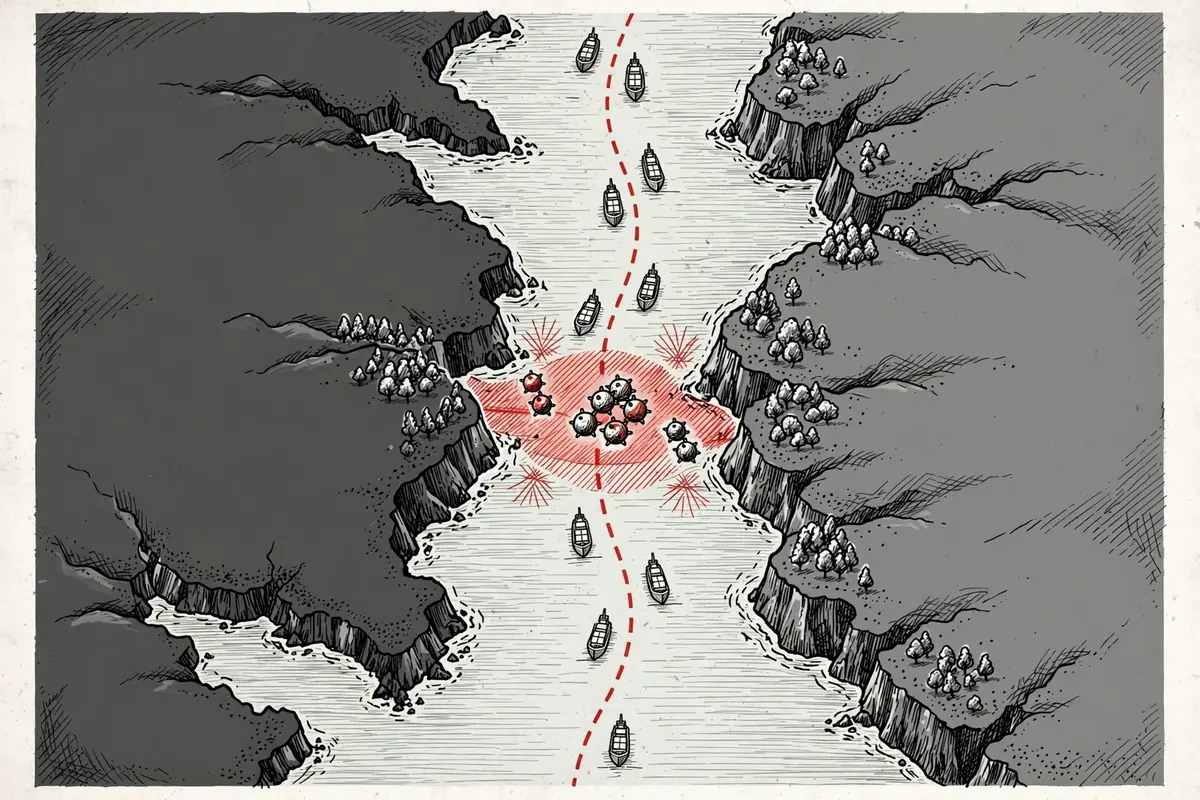
Three tankers in 48 hours: how the Hormuz mine campaign escalated
The October 19 blast is the third mine strike on commercial shipping in the strait in under two days, following a weekend sequence the IRGC itself has described:
- October 17: The IRGC Navy reported that another tanker struck a mine, triggering an explosion and fire — the first of the weekend sequence, covered by WarBrief here.
- October 18: The Guards said a second supertanker — described as carrying more than 2 million barrels of crude — struck a naval mine and caught fire while attempting to cross through an unauthorized route.
- October 18-19: A third tanker struck a mine south of the strait with its transponders deactivated, suffering an engine-room fire.
The mine campaign sits inside a much older confrontation. After the February 28 outbreak of war, Tehran effectively closed the strait; Washington answered with a naval counter-blockade on Iranian oil exports, and commercial traffic has since operated under what the IRGC presents as mandatory prior authorization. A June memorandum of understanding between the US and Iran on freedom of navigation was supposed to ease the standoff, but implementation stalled over disagreements about security arrangements in the waterway.
The broader tanker-war context runs deeper still. WarBrief’s earlier analysis of the Hormuz “kill box” pattern and the GFS Pride mine sinking shows that mine warfare in these waters is not new — what is new is the IRGC’s public doctrine turning transponder status into a targeting criterion.
By the numbers: confirmed facts vs reported claims
The table below separates what two or more independent outlets corroborate from what rests on IRGC statements alone.
| Metric | Figure | Status | Source |
|---|---|---|---|
| Tankers struck in the strait in under 48 hours | 3 | Confirmed | Reuters, Anadolu, NDTV |
| Location of the October 19 strike | Southern Strait of Hormuz | Confirmed | Reuters, Anadolu, NDTV |
| Engine-room fire in the October 19 strike | Yes | Confirmed (as claimed) | IRGC via state media, reported by Reuters/Anadolu |
| Brent crude, October 19 | ~$107.6-$109.9 per barrel | Confirmed | Reuters, Daily Post |
| Share of global petroleum shipments via Hormuz | ~One-fifth | Confirmed | Reuters |
| Saturday supertanker’s cargo | Over 2 million barrels of crude | Reported (IRGC only) | Anadolu, citing IRGC |
| Identity and flag of the October 19 tanker | Undisclosed | Reported (IRGC only) | Anadolu |
| Casualties or damage extent | None reported | Unconfirmed | No outlet has casualty figures |
Caveat: “Reported” figures come from IRGC statements carried by Iranian state media and have not been independently verified; tanker identities and casualty details remain undisclosed.
Why the Hormuz mine attacks matter for global oil markets
Oil traders treated the third strike as confirmation of a structural, not episodic, threat. Brent futures surged almost 4% on Friday to a five-month high, then eased about 2% to $107.57 a barrel on Monday morning as investors took profits and weighed reassuring signs — including a US statement that American forces helped escort more than 100 million barrels of oil through the strait over the previous week. The market’s verdict: the mines are pushing prices up, Washington’s escorts are pushing them down, and the tug-of-war keeps crude in triple digits.
Refined products are feeling it harder. Diesel and jet fuel have rallied even faster than crude, and physical markets keep signaling scarcity — tight middle-distillate balances in Europe, strong US refinery runs in the low-90% range, and backwardation deepening in futures. With roughly a fifth of the world’s seaborne oil normally passing through the strait, even a partially restricted waterway acts as a permanent risk premium on every barrel.

What the third Hormuz tanker strike means for US/UK/EU readers
Fuel prices: US diesel was already running above $6 a gallon in parts of the country before this weekend; another leg up in crude makes relief at the pump less likely through November. In the UK and the EU, where middle distillates are already tight, wholesale diesel strength feeds directly into heating oil and haulage costs ahead of winter.
Inflation and rates: Every $10 rise in oil is, as market analysts have put it this week, an implicit vote for higher interest rates — energy inflation in key import regions is already running near 20% year on year. A sustained Hormuz premium complicates any central-bank easing path.
Shipping and insurance: War-risk premiums for Gulf transits will keep climbing with each mine strike; expect slower, escorted convoys and higher freight costs on Asia-Europe routes. Travelers should watch for rerouted air corridors around the Gulf and possible schedule changes on Middle East routes.
Markets: Gulf stock markets opened subdued on Monday, with Saudi Aramco and regional banks under pressure. Energy equities benefit, airlines and refiners without hedging do not.
Educational note: this section describes market mechanics, not investment advice. Nothing here recommends buying or selling any security.
Different views: Tehran, Washington and the shipping industry
Tehran frames the mine strikes as enforcement of lawful transit rules: obtain authorization, keep your transponders on, use designated lanes — or accept the consequences. In this telling, the “firm response” doctrine is defensive, and the strait’s closure is a wartime security measure.
Washington treats the closure and the mine campaign as coercion. The US naval counter-blockade on Iranian oil exports, the escorted transits of Gulf oil, and the Trump administration’s extended ultimatums all aim to break Tehran’s grip on the chokepoint without conceding the principle that the strait must stay open.
Shipowners and insurers are caught between the two. Complying with Iran’s authorization regime exposes crews to US sanctions risk; running dark invites an IRGC mine. The industry’s interim answer has been escorts and war-risk surcharges — expensive, slow, and fragile if the mine campaign accelerates.
What to watch next in the Strait of Hormuz
Three questions will decide whether this weekend becomes a turning point. First, does the IRGC’s “firm response” doctrine produce a fourth strike within days — evidence of a standing minefield rather than a warning volley? Second, does Tehran’s seven-day reopening offer survive the week, or does the mine campaign kill the diplomacy? And third, does Washington escalate its escort posture into direct mine-clearance operations, which would turn the strait from a blockade into an active naval theater? WarBrief’s conflict zones hub tracks these developments as they unfold.
Frequently asked questions
Is the Strait of Hormuz open right now?
Effectively no — not for normal commercial traffic. Iran has restricted the waterway since the war broke out in late February 2026, demanding prior authorization for transits, while the US runs escorted movements and a counter-blockade on Iranian oil exports. Some traffic moves under escort, but the strait is far from open.
Why is Iran targeting tankers with naval mines?
According to the IRGC Navy, the strikes punish ships that violate its transit rules — using unauthorized routes and switching off positioning and navigation systems. The Guards’ naval commander says such vessels are treated as hostile contacts; critics call it coercion aimed at oil markets and Western resolve.
Will oil prices keep rising because of the Hormuz attacks?
Markets are pricing in a sustained risk premium: Brent is holding near $108-$110 a barrel, and refined products like diesel are rallying harder. Analysts say the floor stays firm while mines keep hitting ships, though US escorts and potential Russian fuel exports are acting as counterweights.
How many tankers have been hit in the Strait of Hormuz in October 2026?
Three in under 48 hours as of October 19 — one on October 17, one on October 18 (described by the IRGC as carrying over 2 million barrels of crude), and one on October 18-19 — plus earlier incidents including the GFS Pride sinking. All strike details come from IRGC statements and remain single-sourced.
Sources
- Reuters: Gulf bourses subdued as regional worries weigh; oil tanker blast in Hormuz
- Anadolu Agency: Iran’s Revolutionary Guard says oil tanker struck mine and caught fire in Strait of Hormuz
- NDTV: Oil tanker on ‘unauthorised route’ hits mine in Hormuz, catches fire
- The Economic Times: Oil tanker on fire after hitting mine in Hormuz
Discussion 0
Share analysis, corrections, or context. Be civil — comments are moderated.