
WarBrief Live | October 18, 2026 | Geopolitics
|
20th
anniversary edition of the ADMM
|
13th
ADMM-Plus ministerial meeting
|
~30
defense ministers expected in Cebu
|
2,200
troops drilled in September’s Exercise Trident Resolve
|
On October 28 and 29, defense ministers from across the Indo-Pacific will gather at the Mactan Expo Center in Lapu-Lapu City, Cebu, for the 20th ASEAN Defence Ministers’ Meeting (ADMM) and the 13th ADMM-Plus — a double milestone, as the Philippines chairs ASEAN in 2026 and the ADMM marks its 20th anniversary. With the United States, China and Russia all invited to the same table and maritime tensions still simmering in the South China Sea, the Cebu meetings are the region’s most important defense-diplomacy event of the year. Here is what to expect from ADMM-Plus 2026: what is on the agenda, who is coming, and what it could actually change.
What is confirmed at this stage: the dates, the venue, the edition numbers, the expected attendance of around 30 ministers, and the Philippine chair’s stated priorities. What remains unverified: which dialogue-partner ministers will attend in person rather than send deputies, and whether the final joint statements will name the South China Sea explicitly.
Key Takeaways
- The 20th ADMM and 13th ADMM-Plus meet October 28–29, 2026, in Lapu-Lapu City, Cebu, with related activities running October 26–30, hosted by the Philippines as 2026 ASEAN chair.
- Around 30 defense ministers are expected, including ASEAN’s 10 members and its eight dialogue partners — among them the United States, China, India, Japan and Russia.
- Manila says it will push regional peace and stability, adherence to the UN Convention on the Law of the Sea (UNCLOS), maritime security, and disaster-response coordination.
- Don’t expect a South China Sea breakthrough: the forum works by consensus, and the separate Code of Conduct negotiations continue in their own diplomatic track.
What is the ADMM-Plus — and how is it different from the ADMM?
The ASEAN Defence Ministers’ Meeting (ADMM) is ASEAN’s highest defense consultation mechanism, inaugurated in Kuala Lumpur, Malaysia, on May 9, 2006. The “Plus” version adds eight external dialogue partners to the ten ASEAN member states: Australia, China, India, Japan, New Zealand, the Republic of Korea, Russia and the United States. The first ADMM-Plus convened in Hanoi in October 2010, and it has met annually since 2017. In short: the ADMM is ASEAN talking to itself; the ADMM-Plus is ASEAN plus the great powers talking together.
The forum’s mandate is confidence-building and practical cooperation rather than collective defense. Its working engine is a set of Experts’ Working Groups (EWGs) on areas such as maritime security, counterterrorism, humanitarian assistance and disaster relief (HADR), military medicine, peacekeeping and cybersecurity. Each group is co-chaired by one ASEAN state and one dialogue partner on a three-year cycle — the Philippines and Japan, for example, currently co-chair the maritime security group.
What is on the agenda for the Cebu meeting?
Philippine Defense Secretary Gilberto Teodoro Jr., who chairs both the ADMM and the ADMM-Plus this year, has said Manila will push for regional peace and stability and adherence to international law, including the United Nations Convention on the Law of the Sea, according to the Philippine Information Agency. He named maritime security and stronger coordination during natural disasters as the Philippines’ other priorities — unsurprising for an archipelago that faces both gray-zone pressure at sea and some of the world’s worst typhoons.
Beyond the set-piece ministerials, expect the usual ADMM-Plus machinery: adoption of a joint statement, reviews of the Experts’ Working Groups’ three-year work plans, and bilateral “pull-aside” meetings between ministers on the margins — historically where the real business gets done. Counterterrorism, HADR coordination and cybersecurity cooperation are the standing agenda items least likely to generate friction, and therefore most likely to produce concrete deliverables such as new exercise commitments or information-sharing arrangements.
Who is coming to Cebu — and who is missing?
Organizers anticipate around 30 defense ministers and other senior delegates in Cebu, with security and logistics preparations coordinated between the Department of National Defense, the Cebu provincial government and Lapu-Lapu City officials through late September, SunStar and the Cebu Daily News reported. The ministers’ sessions are scheduled for October 28 and 29, with related activities running October 26 to 30, per ASEAN’s official ADMM calendar published on admm.asean.org.
All ten ASEAN members are expected at ministerial level. Among the eight dialogue partners, attendance is the variable to watch: the US, Chinese, Russian, Indian and Japanese defense chiefs are all invited, but as of October 18 no official delegation lists have been published, so individual attendance remains unconfirmed. The forum’s value has always depended on who actually shows up in the room — a deputies-level showing from any great power would itself be a signal.
One notable absence from the table by design: neither the United Kingdom nor the European Union is an ADMM-Plus dialogue partner. London and Brussels follow the proceedings closely — the EU is an ASEAN strategic partner in other forums — but they have no seat at this one.
Why the South China Sea will dominate the talks
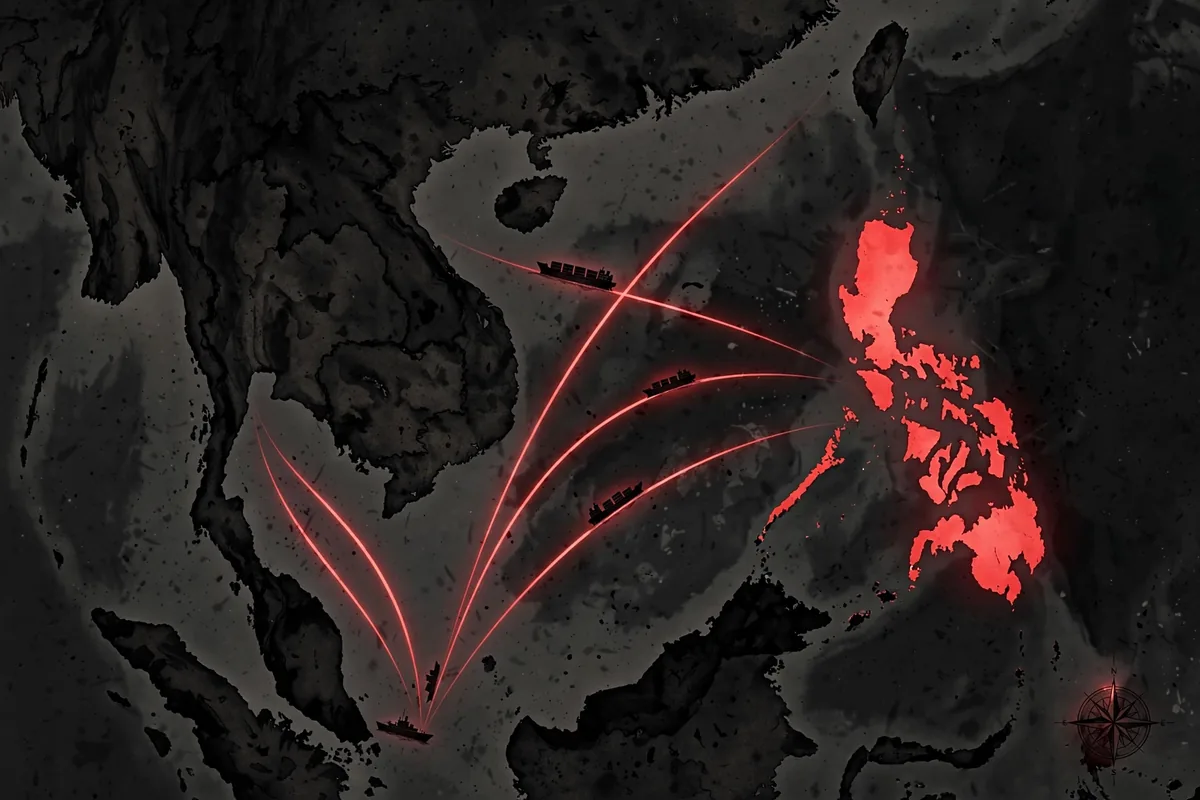
Whatever the formal agenda says, the South China Sea will hang over every session. The Philippines, this year’s chair, is also the ASEAN member in the most direct confrontation with China at sea: this site recently covered the Pratas Island water-cannon clash, part of a pattern of gray-zone encounters that has made Manila the alliance’s front line in the dispute. Teodoro’s emphasis on UNCLOS is directed at precisely these encounters.
The separate diplomatic track on a Code of Conduct for the South China Sea continues in parallel — an ASEAN-China working group met in Manila from August 19 to 21, according to China’s Foreign Ministry — but the ADMM-Plus is not where that negotiation happens. What Cebu can do is set the political weather: a joint statement reaffirming international law and freedom of navigation would be read in Beijing as a collective signal, while silence would be read as division. Analysts should watch the adjectives in the final text, not just the nouns.
What happened in the run-up to Cebu?
The ministers will arrive with fresh practical cooperation to point to. From September 20 to 26, about 2,200 personnel from the militaries of all 19 ADMM-Plus countries — plus civilian agencies — took part in Exercise Trident Resolve in Banten, Indonesia, the largest ADMM-Plus exercise in a decade, Singapore’s Defence Ministry announced. It was the first combined field training exercise spanning three working groups at once — cybersecurity, HADR and military medicine — and included the first-ever field exercise of the ADMM-Plus cybersecurity group, focused on protecting information systems during a multinational disaster response.
In the same week, the Philippines and Japan opened the ADMM-Plus maritime security working group’s Joint Cooperative Activity and Future Leaders’ Program in Subic Bay, with Indian naval ships Sahyadri and Kulish joining regional navies for the sea phase. The message of September’s activity is the one Manila wants carried into October: practical, multilateral, and centered on ASEAN.
| Metric | Figure | Source |
|---|---|---|
| ADMM edition (2026) | 20th — 20th anniversary; first met Kuala Lumpur, May 9, 2006 | Philippine Information Agency — CONFIRMED |
| ADMM-Plus edition (2026) | 13th; inaugural meeting Hanoi, October 2010 | Multiple outlets — CONFIRMED |
| Main ministerial dates | October 28–29, 2026; related activities October 26–30 | ASEAN ADMM official calendar — CONFIRMED |
| Venue | Mactan Expo Center, Lapu-Lapu City, Cebu | PIA / SunStar — CONFIRMED |
| Expected attendance | Around 30 defense ministers and senior delegates | Manila Times / Inquirer — CONFIRMED (as organizers’ estimate) |
| ADMM-Plus membership | 18 states: 10 ASEAN + 8 dialogue partners | RSIS / ASEAN — CONFIRMED |
| Exercise Trident Resolve (Sep 2026) | ~2,200 personnel, 19 countries, Sep 20–26 | Singapore MINDEF — CONFIRMED |
| Annual trade via the South China Sea | ~$3–5 trillion (widely cited range) | Multiple analyses — REPORTED estimate, not an official figure |
Caveat: the trade figure is a widely cited estimate, not a measured total; methodologies differ between studies.
Will Cebu produce a South China Sea breakthrough?
Almost certainly not — and that is by design. The ADMM-Plus operates by consensus, which means any single member can block language it dislikes; the forum has never produced a binding security commitment in its sixteen-year history. Its real products are slower and quieter: standard operating procedures for navies that might otherwise misread each other, hotlines, and the habit of meeting.
What would count as success in Cebu is therefore modest but real: a joint statement that reaffirms UNCLOS and freedom of navigation without euphemism, new working-group deliverables on HADR and cybersecurity, and full ministerial-level attendance from the dialogue partners. Failure would look like a watered-down chairman’s statement, conspicuous absences, or a split between the maritime claimants and the rest. For context on why the region’s navies are drilling together in the first place, see our overview of naval competition in the Indo-Pacific and the recent US-Japan Keen Sword 27 exercises near Taiwan.
What the Cebu defense talks mean for US, UK and EU readers
For American readers, the stakes are alliance credibility: the Philippines is a US treaty ally, and Washington’s posture toward Manila’s maritime confrontations will be read across the region as a measure of US staying power in the Indo-Pacific. For British and European readers, the stakes are economic. Roughly $3–5 trillion in annual trade is widely estimated to transit the South China Sea — everything from semiconductors to liquefied natural gas — so any escalation that forced rerouting or spiked war-risk insurance would show up quickly in European energy prices and supply chains.
None of this will be decided in Cebu. Ministerial meetings do not change military commitments, navigation rules or the balance of forces by themselves; the clearest test is what governments publicly adopt or announce afterward. What readers in the US, UK and EU should watch for is narrower: whether the joint statement names international law plainly, whether new practical cooperation (exercises, information-sharing, disaster-response protocols) is announced, and whether the great-power ministers all show up. Those three signals, taken together, will tell you whether the region’s defense diplomacy is holding together or fraying. For the wider picture, our conflict zones hub tracks the Indo-Pacific flashpoints behind these talks.
What to watch next in the Indo-Pacific after Cebu
- The joint statements’ wording — expect them within hours of the October 29 close; compare the ADMM and ADMM-Plus texts on UNCLOS and the South China Sea.
- Delegation levels — which dialogue partners sent their defense ministers versus deputies, and what that signals about their ASEAN engagement.
- Bilateral pull-asides — US–Philippines, Japan–Philippines and any US–China defense minister contact on the margins will matter more than the plenary.
- The Code of Conduct track — the next ASEAN-China working-group round after the August Manila session; Cebu’s political signal feeds directly into it.
- Follow-on exercises — whether the working groups announce 2027 activities building on September’s Trident Resolve, particularly in cybersecurity.
Frequently asked questions
What is the ADMM-Plus?
The ASEAN Defence Ministers’ Meeting-Plus is a defense ministers’ forum comprising the ten ASEAN member states and eight dialogue partners — Australia, China, India, Japan, New Zealand, South Korea, Russia and the United States. Founded in 2010, it focuses on confidence-building and practical cooperation in areas like maritime security, counterterrorism, disaster relief and cybersecurity.
Which countries are members of the ADMM-Plus?
Eighteen in total: the ten ASEAN members (Brunei, Cambodia, Indonesia, Laos, Malaysia, Myanmar, the Philippines, Singapore, Thailand and Vietnam) plus eight dialogue partners (Australia, China, India, Japan, New Zealand, South Korea, Russia and the United States). Timor-Leste participates in ASEAN processes as its newest member state.
What is the difference between the ADMM and the ADMM-Plus?
The ADMM is ASEAN’s internal defense ministers’ forum, founded in 2006. The ADMM-Plus adds the eight external dialogue partners, bringing the great powers into the same room. The ADMM meets on ASEAN business; the Plus format handles wider Indo-Pacific security cooperation.
When and where is the 2026 ADMM-Plus meeting?
The 13th ADMM-Plus meets alongside the 20th ADMM at the Mactan Expo Center in Lapu-Lapu City, Cebu, Philippines, on October 28 and 29, 2026, with related activities running October 26 to 30. The Philippines chairs both meetings as the 2026 ASEAN chair.
Will the 2026 meeting resolve the South China Sea dispute?
No. The ADMM-Plus works by consensus and has never produced a binding security agreement; the Code of Conduct negotiations run in a separate ASEAN-China diplomatic track. Realistic outcomes are a joint statement reaffirming international law, new practical-cooperation initiatives, and the signaling value of who attends.
Sources
- Philippine Information Agency: Cebu Capitol, defense officials firm up preparations for ASEAN ministers’ meetings
- SunStar: Lapu-Lapu gears up for ASEAN defense meetings
- Cebu Daily News / Inquirer: Lapu-Lapu City sets security measures for ASEAN defence summit
- The Manila Times: Lapu-Lapu security up for ASEAN meetings
- Singapore Ministry of Defence: Largest ADMM-Plus exercise in a decade (Exercise Trident Resolve)
- ASEAN ADMM official site: 2026 meetings calendar
- RSIS: Future of ADMM-Plus — Asia’s Growing Defence Engagements



Discussion 0
Share analysis, corrections, or context. Be civil — comments are moderated.