
WarBrief Live | October 18, 2026 | Breaking Analysis
Ukrainian drones struck St. Petersburg overnight, setting the St. Petersburg Oil Terminal ablaze in what Russian officials described as a “massive” attack on Russia’s second city. The October 2026 raid hit energy, logistics and digital infrastructure in a single night — an oil terminal, the Ruchyi oil depot, an Ozon logistics hub and a VKontakte data centre — leaving one person dead and five injured, according to the city governor.
Key Takeaways
- Ukrainian long-range drones struck St. Petersburg and the surrounding Leningrad region overnight on October 17–18, 2026, starting at about 2:50 a.m. local time.
- The St. Petersburg Oil Terminal caught fire, as did the Ruchyi oil depot, industrial warehouses, an Ozon logistics centre and a VKontakte data centre, according to Russian officials and the companies involved.
- One person was killed and five injured in St. Petersburg; 12 apartment buildings and two houses were damaged, city governor Alexander Beglov said.
- Russia claims its air defences shot down 1,015 Ukrainian drones nationwide overnight — a single-source claim that has not been independently verified.
- Hours before the St. Petersburg raid, Russia struck Ukraine with an Iskander-M ballistic missile and 180 drones, as Volodymyr Zelenskyy accused Moscow of 76 attacks on Ukrainian energy sites in a week.
What did Ukraine’s drones hit in St. Petersburg?
The main confirmed target was the St. Petersburg Oil Terminal, a major petroleum-products facility in the Greater Port of St. Petersburg, where a fire broke out in the oil storage area. Governor Alexander Beglov confirmed the strike on Telegram, and photos and videos shared by local residents showed the fire still burning at 7:30 a.m.
Fires were also reported at the Ruchyi oil depot and at industrial warehouses in the Kolpinsky District. Beglov said emergency crews were still battling the blazes when he briefed the public. Twelve apartment buildings and two private homes were damaged by falling debris, and power outages affected residential areas.
Two non-energy targets were struck as well. Ozon, Russia’s large e-commerce company, said its logistics centre in St. Petersburg caught fire, forcing staff to evacuate; no injuries were reported at the site. And VKontakte, Russia’s biggest domestic social network, said drones attacked one of its data centres in the Leningrad region. According to Ukrainian military analysts at Militarnyi, the facility is in Novosergiyevka and houses four data halls, 640 server racks and more than 20,000 servers; the nearby 330 kV Vostochnaya substation was also targeted, and some residents lost electricity.
Ukraine has not publicly claimed responsibility for the attack — Kyiv rarely confirms individual long-range strikes. The Kyiv Independent noted it could not independently verify the targets or the extent of the damage at the time of publication.
Why St. Petersburg? The 856-kilometre reach of Ukraine’s drones
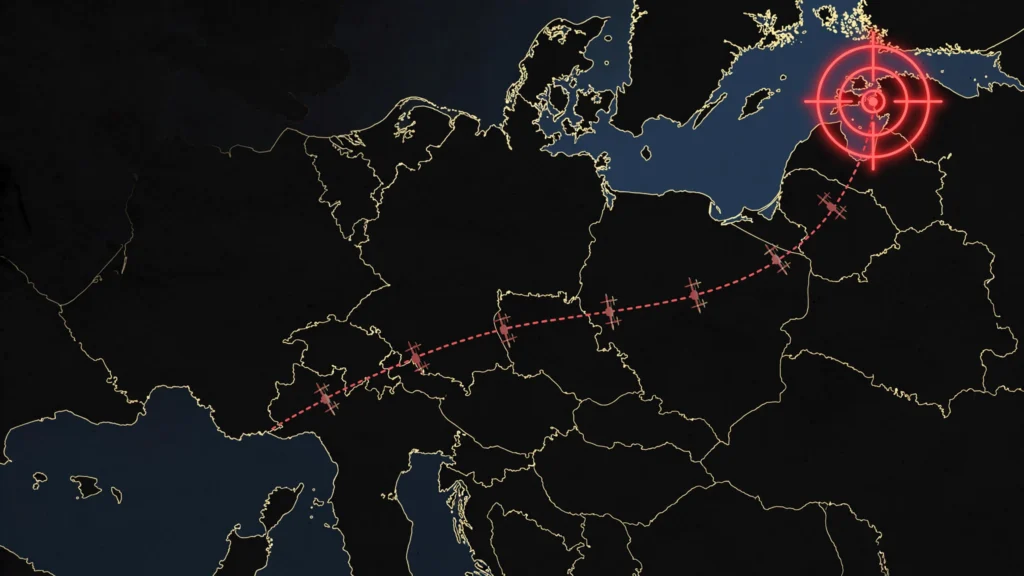
St. Petersburg is Russia’s second-largest city, a city of 5.6 million people on the Baltic coast, and home to significant oil infrastructure. The Kyiv Independent reported the city lies about 856 kilometres (530 miles) from the Ukrainian border — a distance that demonstrates how far Ukraine’s long-range drone campaign now reaches.
The Baltic port is not new to this war. The St. Petersburg Oil Terminal was previously hit by Ukrainian drones in June, on the opening day of a major economic forum attended by Russian and foreign officials. And since the start of October, Ukrainian forces have repeatedly struck data centres, most of them belonging to the technology company Yandex — a campaign WarBrief has tracked in detail.
The October 18 raid extends that campaign to Russia’s most important northern port. Ukraine has spent much of 2026 systematically degrading Russian refining and export infrastructure in response to Russian bombardments of its own energy grid — a strategy with global fuel-market consequences. Zelenskyy said this week that Kyiv would resume attacks on Russian refineries after accusing Moscow of violating a halt to energy strikes.
By the numbers: what is confirmed and what is reported
Claims from both sides in this war deserve scrutiny. Figures below are marked CONFIRMED only where at least two independent outlets reported them; everything else is REPORTED — from a single official source and not independently verified.
| Metric | Figure | Source |
|---|---|---|
| Killed in St. Petersburg | 1 | CONFIRMED — Gov. Alexander Beglov (Kyiv Independent, Arab News) |
| Injured in St. Petersburg | 5 | CONFIRMED — Gov. Alexander Beglov (Kyiv Independent, Arab News) |
| Apartment buildings damaged | 12 (+2 private homes) | CONFIRMED — Gov. Alexander Beglov (Kyiv Independent, ANews) |
| Russian drones launched at Ukraine overnight | 180, of which 152 downed | CONFIRMED — Ukrainian Air Force (NV, Ukrainska Pravda) |
| Drones shot down over Leningrad region | 126–127 (reports differ) | REPORTED — Gov. Alexander Drozdenko, single source |
| Drones destroyed nationwide overnight | 1,015 | REPORTED — Russian Defence Ministry, single source |
| Drones heading toward Moscow | 512 | REPORTED — Moscow Mayor Sergey Sobyanin, single source |
| Oil terminal annual throughput | 12.5 million tonnes | REPORTED — operator data (DeepDraft SITREP) |
Caveat: “CONFIRMED” means reported by at least two independent outlets. “REPORTED” means from a single official source and not independently verified. Neither side’s interception claims can be checked against open-source evidence yet.
What is the St. Petersburg Oil Terminal and why does it matter?
The St. Petersburg Oil Terminal is one of Russia’s major petroleum-export facilities on the Baltic coast, handling export movements through the Gulf of Finland and the Baltic Sea. According to Militarnyi’s analysis, its tank farm holds 442,000 cubic metres across 32 storage tanks, and the operator publishes a petroleum-product loading capacity of roughly 1.1 million tonnes per month.
The facility serves the Baltic export trade that became central to Russia’s oil flows after EU sanctions reshaped its European shipments. Any sustained disruption there feeds directly into global fuel markets: oil is already at $106 a barrel this winter, and repeated drone strikes on Russian refining have been a key driver of the diesel crisis hitting US and European pumps.
So far, however, there is no verified terminal-wide loading suspension, tanker casualty, oil spill or export-volume loss from the October 18 attack — the extent of damage to storage tanks, pipelines and marine loading infrastructure remains unconfirmed. Fires at an oil terminal do not automatically mean exports stop.

How did Russia respond to the St. Petersburg drone attack?
Moscow’s retaliation was already under way before the St. Petersburg raid began. Overnight, Russian forces attacked Ukraine with one Iskander-M ballistic missile launched from Voronezh Oblast and 180 attack drones of various types, including 26 jet-powered Shahed variants, according to Ukraine’s Air Force. Air defences shot down or suppressed 152 of the drones, but strikes were recorded at 20 locations, and the attack was still ongoing at 8 a.m.
The energy grid took the heaviest punishment. In Vinnytsia Oblast, Russian strikes damaged critical infrastructure, triggering emergency power outages. A ballistic missile reportedly struck Kharkiv, causing injuries. In Zaporizhzhia, a residential building was hit, killing a 27-year-old woman; in Poltava, a drone struck private homes, killing one person and injuring two.
Zelenskyy said the strikes continued a week of punishment against the grid. Writing on X, he said that since US President Donald Trump announced a halt to attacks on energy infrastructure a week ago, Russia had “deliberately attacked Ukraine’s energy and oil and gas sectors 76 times”, with the latest strikes hitting substations in the Vinnytsia, Zhytomyr, Khmelnytskyi and Odesa regions. Tens of thousands of families were without electricity, 12 people were injured including two children, and two people died. Over the past week, he said, Russia launched nearly 2,700 attack drones, 1,700 air bombs and 66 missiles at Ukraine — “the main targets are the energy infrastructure; Russia is trying to create a blackout.”
One important note: Reuters reported that neither Kyiv nor Moscow has confirmed the ceasefire agreement Trump announced. The “energy ceasefire” exists in Trump’s announcement, not in any verified bilateral commitment.
What the energy war means for US/UK/EU readers
For readers in the US, UK and EU, the October 18 exchange is a reminder that the drone war on energy infrastructure has direct household consequences. Ukrainian strikes on Russian refineries and export terminals have been a major driver of the 2026 diesel crisis — US diesel prices hit record territory in September — and each new attack on Baltic export capacity risks another leg up in refined-fuel prices. That feeds into transport costs, food prices and winter heating bills.
There is also an aviation angle: St. Petersburg’s Pulkovo Airport restricted operations during the attack, and drones over the Baltic have repeatedly forced air-traffic disruptions this year. Travellers between Europe and the region should expect last-minute schedule changes.
The broader picture matters for policy too. The same week, the US is pressing a peace framework that reportedly includes economic incentives — with oil at $106, the cost of the war’s energy dimension is now one of the main levers in any negotiation. This article is educational only and is not financial advice.
What to watch next after the St. Petersburg strikes
Four questions will decide what this raid meant. First, the terminal: satellite imagery and port traffic in the coming days will show whether the fire caused lasting export disruption or was contained to storage. Second, Russia’s response: the overnight retaliation was the heaviest in days, and Moscow typically escalates after deep strikes on symbolic targets. Third, Ukraine’s campaign tempo — Kyiv has signalled renewed strikes on Russian refineries, and the October 18 raid suggests that campaign is widening geographically. Fourth, the energy ceasefire that Trump announced: without confirmation from either side, it remains a declaration, not an agreement.
WarBrief is tracking this exchange on our conflict zones hub, including the drone campaign against Russian energy and the grid war inside Ukraine.
Frequently asked questions
Why is Ukraine attacking St. Petersburg?
Ukraine has spent 2026 running a long-range drone campaign against Russian energy and logistics infrastructure in response to Russian bombardments of its own power grid. St. Petersburg hosts a major oil export terminal on the Baltic coast, and the city has been targeted before — including a June 2026 drone strike. Kyiv rarely claims individual strikes publicly.
What is the St. Petersburg Oil Terminal?
It is a major petroleum-products handling facility in the Greater Port of St. Petersburg, serving oil exports through the Gulf of Finland and the Baltic Sea. The operator lists annual throughput capacity of 12.5 million tonnes; analysts report a tank farm of 442,000 cubic metres across 32 storage tanks. No verified export suspension has been established from the October 18 attack.
How far is St. Petersburg from Ukraine?
About 856 kilometres (530 miles) from the Ukrainian border, according to the Kyiv Independent. The attack demonstrates the growing reach of Ukraine’s long-range drone programme, which has previously hit refineries, airbases and data centres deep inside Russia.
Did Russia respond to the drone attack?
Yes. Overnight, Russia struck Ukraine with an Iskander-M ballistic missile and 180 drones, with strikes recorded at 20 locations and damage to energy infrastructure in Vinnytsia, Kharkiv, Zaporizhzhia and Poltava. Zelenskyy said Russia had attacked Ukraine’s energy and oil-and-gas sectors 76 times in the previous week.
Sources
- Reuters: Zelenskiy says Russia attacked Ukrainian energy sector 76 times in past week
- Kyiv Independent: Massive Ukrainian drone attack hit oil facility, bridge, and data centers in St. Petersburg
- Arab News: Official: 1 killed, 5 injured in Ukrainian drone attack on Russian city
- Militarnyi: Drones Strike VKontakte Data Center and Oil Terminal in Russia’s Leningrad Region
- New Voice of Ukraine: Russia attacks Ukraine with missile, 180 drones on Oct. 18
- Mathrubhumi English: Ukrainian Drone Swarm Strikes St Petersburg, Igniting Oil Terminal Fire
Discussion 0
Share analysis, corrections, or context. Be civil — comments are moderated.