
WarBrief Live | October 15, 2026 | Breaking Analysis
The “energy ceasefire” between Russia and Ukraine lasted less than four days. In an interview with the Financial Times published on October 15, 2026, President Volodymyr Zelenskyy declared Ukraine’s pause on strikes against Russian oil refineries over — and within hours, Ukrainian drones and cruise missiles hit the Rosneft refinery in the Ryazan region, roughly 300 kilometres southeast of Moscow. “The block (on attacking refineries) is out. We’re done,” Zelenskyy said, setting the stage for a renewed campaign against Russia’s energy infrastructure and exposing the deepest strain yet in Kyiv’s relationship with Washington.
Key Takeaways
- President Zelenskyy told the Financial Times that Ukraine’s three-day pause on refinery strikes is finished, saying “The block (on attacking refineries) is out. We’re done.”
- Hours after the interview, a major Ukrainian attack hit the Rosneft-owned Ryazan refinery; a fire was confirmed by the regional governor and Russia’s Defence Ministry, and a senior Ukrainian official confirmed the strike to AP.
- Zelenskyy accused Washington of cutting US early-warning intelligence and slowing Starlink service, claiming American officials warned Kyiv it would lose intelligence unless energy strikes stopped: “It was not a technical problem, it was the will.”
- Kremlin spokesman Dmitry Peskov accused Kyiv of flouting the spirit of US peace efforts, saying Moscow never saw Ukraine comply with the ceasefire — while Russia acknowledged striking seven Ukrainian energy facilities on October 14.
- Zelenskyy said he would accept another pause only if the United States supplied more Patriot interceptor missiles, calling that the “minimum” that would be acceptable.
What happened at the Ryazan refinery overnight?
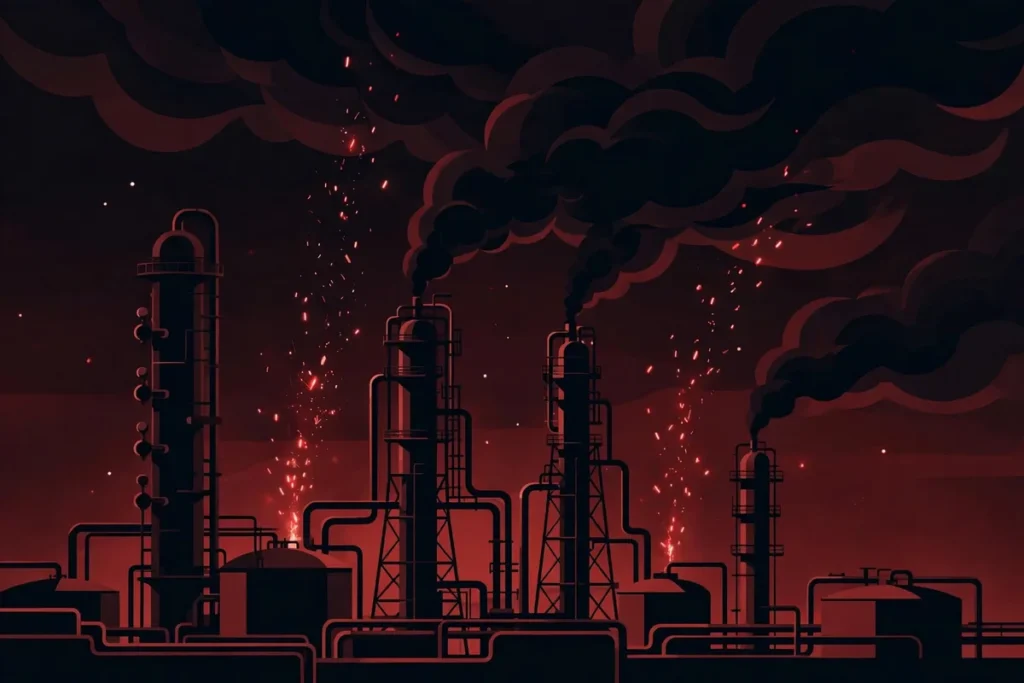
Early on October 15, Ukrainian forces launched what Russia’s Defence Ministry described as a major combined attack on the refinery in the Ryazan region. Ryazan Governor Pavel Malkov said on Telegram that a large Ukrainian drone attack had caused a fire at the refinery, with emergency services on the scene and damage being assessed. The Times reported that no casualties were reported but 39 schools and nurseries were temporarily closed as a precaution.
Russia’s Defence Ministry said its air defences had shot down four Ukrainian Flamingo cruise missiles and 69 drones during the attack, but that drone fragments sparked the fire. According to AP, a senior Ukrainian official confirmed that Ukraine had hit the Ryazan refinery during the overnight attack.
The target is significant. The Ryazan refinery is owned by state oil major Rosneft and, according to the Ukrainian outlet Militarnyi, has an annual crude capacity of around 17 million tonnes — reportedly about five per cent of Russia’s total refinery throughput and a key supplier of fuel to Moscow. The facility has been hit before: on September 6, Ukrainian drones damaged its Isomalk-2-LIN-800 isomerisation unit, a critical stage in producing high-grade Euro-5 motor fuel.
Ukraine’s military also said it had damaged six Russian Su-34M fighter-bombers in an overnight strike on the Borisoglebsk airfield in the Voronezh region. That claim comes from a single Ukrainian source and could not be independently verified.
Why did Zelenskyy declare the energy ceasefire over?
The answer, in Kyiv’s telling, is that Moscow never observed it. On October 11, US President Donald Trump announced an “ENERGY CEASEFIRE” on Truth Social, writing: “Effective immediately, there is an ENERGY CEASEFIRE in the War between Russia and Ukraine. Both parties have agreed. Do not break it!” Hours after that announcement, Russian strikes hit Ukrainian energy sites near Kharkiv, WarBrief reported at the time.
Zelenskyy told the Financial Times that Ukraine had halted attacks on Russian energy facilities for three days at Washington’s request, even as Russian forces continued striking Ukrainian infrastructure. Reuters, reporting on the interview, said the Ukrainian president accused Russia of launching a large overnight assault that left at least 600,000 people without electricity.
In a post on X on October 14, Zelenskyy said Russian forces had used ballistic missiles and attack drones against energy facilities in Kyiv, the Kyiv region and Kharkiv, damaging equipment at 26 power system facilities and four oil and gas sector facilities. Russia, for its part, said on October 14 that it had struck seven Ukrainian energy infrastructure facilities — the exchange that shattered the ceasefire we reported on October 14.
The collapse also had a political trigger in Washington. Reuters reported that Trump had, on October 11 — the day after announcing the US-Russia diesel supply deal — called for Ukraine to replace Zelenskyy and railed against Ukraine’s attacks on Russian oil infrastructure. Zelenskyy told the Financial Times he was critical of Washington’s eagerness to strike business deals with Moscow and of Trump’s apparent admiration for Russia’s Vladimir Putin.
The intel-and-Starlink rift behind the decision
The most consequential part of the interview was not about refineries at all, but about the intelligence pipeline Kyiv depends on. Zelenskyy said that during the three-day pause, Ukrainian forces stopped receiving US early warnings about incoming Russian ballistic missiles, while Starlink satellite connectivity deteriorated across the country — hampering frontline operations and medium-range strike missions against Russian military sites.
According to the Ukrainian president, American counterparts had directly warned Ukrainian military officials that intelligence sharing could be blocked unless Kyiv stopped striking Russian energy infrastructure. When the disruption arrived, Kyiv was told it was a technical problem. “This was not a technical problem, it was a matter of will,” Zelenskyy said, dismissing the idea that the Starlink slowdown was caused by a fault.
The dispute points to a wider dependence problem. Under the current US administration, Washington has already halted weapons supplies to Ukraine while allowing European allies to keep buying American arms on Kyiv’s behalf — and, as the South China Morning Post noted, Europe has no ready-made alternatives to Starlink or to the US satellite systems used to detect Russian missile launches.
How Moscow answered: Kremlin says Kyiv flouts US peace efforts
Moscow moved quickly to frame the strikes as a Ukrainian violation. Reuters reported that Kremlin spokesman Dmitry Peskov told reporters on October 15 that Ukraine’s strikes on Russian refineries ran counter to US peace efforts, saying Moscow did not perceive that Kyiv had ever complied with the ceasefire and that the Ryazan strike was “nothing new”.
“The Ukrainian regime in Kyiv continues to strike these facilities, thereby, of course, coming into serious contradiction with the peace efforts of the United States and of the American negotiators who are indeed making very vigorous efforts to somehow initiate the peace process,” Peskov said.

Russia’s own position has shifted through the week: having never publicly committed to Trump’s ceasefire, Moscow said the scope of the arrangement was never determined — and on October 14 it openly acknowledged striking seven Ukrainian energy facilities. Both sides now accuse the other of never observing the truce, and the competing claims could not be independently verified.
The 96-hour life of the energy ceasefire
- October 11: Trump announces the “ENERGY CEASEFIRE” on Truth Social, saying both sides agreed. Ukraine says it learned of the deal from media reports. Trump separately calls for Zelenskyy’s replacement and criticises Ukrainian refinery strikes, one day after announcing a diesel supply deal with Russia (Reuters).
- October 12: Ukraine begins its three-day pause on refinery strikes. Russia strikes Ukrainian gas infrastructure, a power plant and a substation, and begins diesel exports under the Trump deal.
- October 14: Russia launches a large overnight assault; Zelenskyy says more than 850 drones were launched (Ukrainian claim), the Ukrainian Air Force says 536 were intercepted, three people are killed in Kirovohrad, and a Naftogaz gas extraction facility in Poltava is damaged. Russia says it struck seven Ukrainian energy facilities.
- October 15: Zelenskyy’s Financial Times interview declares the pause over; overnight, drones and Flamingo missiles hit the Ryazan refinery; the Kremlin accuses Kyiv of flouting US peace efforts.
By the numbers: the night’s strikes, confirmed vs reported
| Metric | Figure | Source |
|---|---|---|
| Fire at Ryazan refinery | Confirmed (governor + Russian MoD + AP) | CONFIRMED — Malkov, Russian MoD, AP |
| Casualties at Ryazan | None reported | CONFIRMED — The Times / Russian authorities |
| Schools/nurseries temporarily closed | 39 | REPORTED — The Times, citing authorities |
| Drones + missiles downed, per Russia | 69 drones, 4 Flamingo cruise missiles | REPORTED — Russian MoD claim (single source) |
| Ryazan refinery capacity | ~17 million tonnes/year; ~5% of Russian throughput | REPORTED — Militarnyi / SCMP (single-source each) |
| Russian drones launched overnight | 850+ | REPORTED — Zelenskyy claim |
| Russian drones intercepted | 536 | REPORTED — Ukrainian Air Force |
| Killed/wounded in Kirovohrad | 3 killed, 6 wounded | REPORTED — Ukrainian Emergency Services |
| Ukrainians without power | 600,000+ | REPORTED — Zelenskyy claim |
| Ukrainian energy facilities hit, per Russia | 7 (Oct 14) | REPORTED — Russian claim via Reuters |
Caveat: figures labelled CONFIRMED are supported by at least two independent sources; figures labelled REPORTED come from a single side’s claim and have not been independently verified.
What the Ryazan strike means for US/UK/EU readers
The immediate oil-market signal is modest — one refinery, even a large one, does not set global prices by itself. But the context matters: Brent crude is already trading near $106 amid the Iran war, and the Ryazan plant is a major fuel supplier to Moscow. Each successful strike tightens Russian gasoline and diesel availability, and the resumed campaign makes the US-Russia diesel deal’s promised price relief harder to deliver.
For European readers heading into winter, the second-order effect is the one to watch: Russian diesel exports were just restarted under the Trump deal, and renewed refinery outages could push European diesel and heating-oil prices higher if alternative supply does not arrive. For American readers, the bigger story is the intelligence row — a public rupture in US-Ukrainian cooperation that European capitals are already reading as a warning about their own dependence on American systems.
WarBrief provides educational context only and does not give financial advice; nothing here is a recommendation to buy or sell any security or commodity.
What to watch next on the energy front
First, whether Russia escalates against Ukraine’s grid as winter approaches — the October 14 barrage hit 26 power facilities, and Ukrainian officials expect the campaign to intensify. Second, whether Washington restores full intelligence sharing and early-warning coverage, and whether Zelenskyy’s price for another pause — more Patriot interceptor missiles as “the minimum” — is met. Third, the verification of Ukraine’s claim to have damaged six Su-34M bombers at Borisoglebsk, which would be a significant parallel success if confirmed. And finally, how the renewed refinery campaign interacts with the Trump-Putin diesel arrangement: if Russian fuel exports falter while Moscow’s own refineries burn, the political logic of the deal changes fast. Track the wider conflict picture on our conflict zones hub.
Frequently asked questions
Why did Zelenskyy end the energy ceasefire?
Zelenskyy told the Financial Times that Ukraine paused refinery strikes for three days at Washington’s request, but Russia kept attacking Ukrainian energy infrastructure — including a large October 14 assault he said left 600,000 people without power. “The block (on attacking refineries) is out. We’re done,” he said. Russia disputes this, saying Kyiv never complied in the first place.
What happened at the Ryazan refinery?
Overnight on October 15, Ukrainian drones and Flamingo cruise missiles attacked the Rosneft-owned refinery in Russia’s Ryazan region, about 300 kilometres southeast of Moscow. The regional governor confirmed a fire; Russia’s Defence Ministry said it downed four missiles and 69 drones but fragments sparked the fire. No casualties were reported. A senior Ukrainian official confirmed to AP that Ukraine carried out the strike.
What did Zelenskyy accuse the United States of?
Zelenskyy said the US stopped sharing early warnings of Russian ballistic missile launches and that Starlink service slowed across Ukraine during the pause, after American officials warned Kyiv it would lose intelligence access unless energy strikes stopped. Washington framed the disruption as a technical glitch; Zelenskyy called that false, saying “it was not a technical problem, it was the will.”
What did Russia say about the strikes?
Kremlin spokesman Dmitry Peskov said Ukraine’s refinery strikes ran counter to US peace efforts and that Moscow never saw Kyiv comply with the ceasefire. Russia has also said the scope of the ceasefire was never determined, and on October 14 it openly acknowledged striking seven Ukrainian energy facilities.
Could the energy ceasefire come back?
Possibly, but Zelenskyy set a price: he told the Financial Times he could agree to another pause only if the United States supplied more Patriot interceptor missiles, which he called the “minimum” acceptable. Whether Washington meets that condition — and whether Russia would actually hold its fire — remains open.
Sources
- Reuters: Kremlin accuses Ukraine of flouting spirit of US peace efforts with strikes on Russian oil refineries
- Reuters via ThePrint: Zelenskiy says Ukraine will resume strikes on Russian refineries, FT reports
- AP via DT Next: Ukraine resumes attacks on Russian oil refineries, officials say, after brief truce
- The Times: Ukraine restarts attacks on Russian refineries amid Starlink row
- SCMP: ‘We’re done’: Ukraine resumes Russian refinery strikes, defying Trump
- Militarnyi: Ukraine Strikes Ryazan Oil Refinery After Announcing Resumption of Attacks
- Times of India: Russia begins diesel exports after Trump deal amid global oil market concerns
Discussion 0
Share analysis, corrections, or context. Be civil — comments are moderated.