
WarBrief Live | October 7, 2026 | Energy & Oil
Two narrow strips of water now sit at the center of the world’s biggest energy shock in decades. The Strait of Hormuz, the Persian Gulf’s only sea exit, and Bab el-Mandeb, the Red Sea’s southern gate, are both under threat at the same time — a dual-chokepoint squeeze analysts describe as having no modern historical precedent. This guide compares Bab el-Mandeb vs the Strait of Hormuz: how much oil each carries, who controls them, what happened in 2026, and what it means for fuel prices where you live.
Key Takeaways
- The Strait of Hormuz carried about 20.9 million barrels of oil per day in early 2025 — roughly five times Bab el-Mandeb’s 4.2 million, according to the U.S. Energy Information Administration (EIA). By Q2 2026, Hormuz had collapsed to 4.9 million bpd while Bab el-Mandeb’s flows rose to 8.1 million as Saudi Arabia rerouted crude.
- Hormuz is the bigger oil shock; Bab el-Mandeb is the bigger trade shock, carrying around 15% of global maritime commerce and 30% of container traffic.
- Both straits are disrupted at once in 2026: the EIA estimates Hormuz flows fell from 21.6 million bpd (Q4 2025) to 4.9 million (Q2 2026), while Houthi forces seized Perim Island in Bab el-Mandeb in September.
- One expert estimates the combined disruption plus the Saudi East-West pipeline shutdown affects 39% of global trade — forcing costlier reroutes around Africa.
- The EIA’s October 2026 outlook raised its Q4 Brent forecast to $105 a barrel, citing the pipeline attack and record tanker rates. This post is educational and is not financial advice.
What is Bab el-Mandeb, and what is the Strait of Hormuz?
Bab el-Mandeb — Arabic for the “Gate of Tears” — is the strait connecting the Red Sea to the Gulf of Aden and the Indian Ocean, between Yemen on the Arabian Peninsula and Djibouti and Eritrea in Africa. Every ship traveling between the Suez Canal and Asia passes through it. It is narrow: the strait is split in two by Perim Island (also called Mayun), leaving two navigable channels only a few miles wide each. Our conflict zones hub tracks how both waterways became active fronts in the 2026 Iran war.
The Strait of Hormuz connects the Persian Gulf to the Gulf of Oman and the open ocean, between Iran and Oman. It is the only sea route for the oil and gas exports of Saudi Arabia, Iraq, Kuwait, the United Arab Emirates, Qatar and Iran itself. Iran sits on its northern shore; Oman’s Musandam Peninsula on the southern side, through whose waters the main shipping lanes run.
The two are sometimes confused, but they are different places at opposite ends of the Arabian Peninsula — and for some Gulf-to-Europe energy routes, a single cargo can depend on both.
Bab el-Mandeb vs Strait of Hormuz: the side-by-side comparison
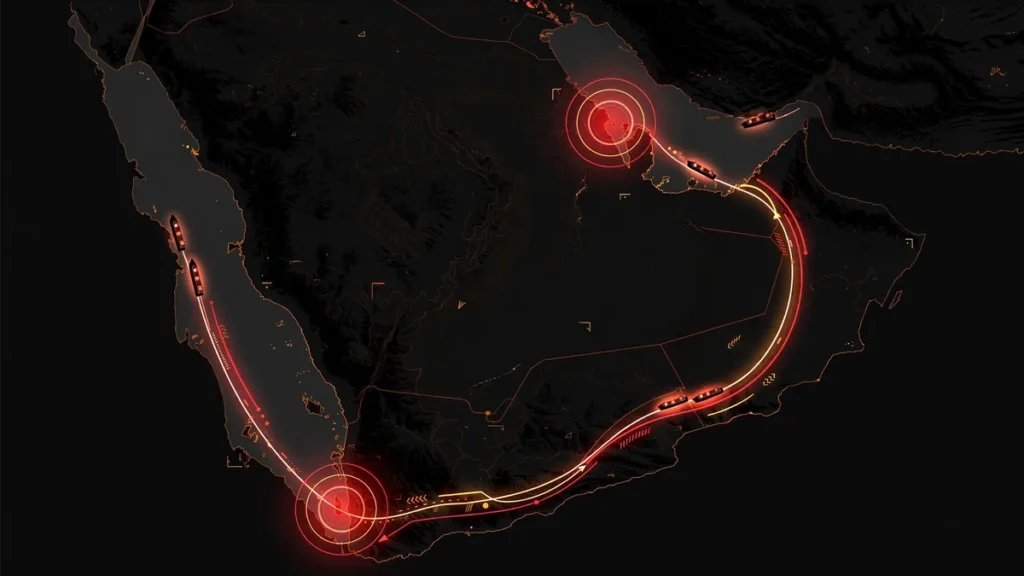
Here is how the two chokepoints compare on the measures that matter:
| Metric | Strait of Hormuz | Bab el-Mandeb |
|---|---|---|
| Location | Between Iran and Oman | Between Yemen and Djibouti/Eritrea |
| Connects | Persian Gulf ↔ Gulf of Oman | Red Sea ↔ Gulf of Aden |
| Oil flow (EIA, H1 2025) | ~20.9 million barrels/day | ~4.2 million barrels/day |
| Share of global seaborne oil trade | ~20% | ~10–14% of maritime trade; ~12% of crude transport |
| LNG significance | ~20% of global LNG (mainly Qatar) | Reported ~80% of LNG shipped north to Europe passes here |
| Broader trade role | Mostly energy | ~15% of global maritime commerce; 30% of container traffic |
| Who can disrupt it | Iran (northern shore); US/Iran tanker war in 2026 | Houthi forces in Yemen (Perim Island since Sept 2026) |
| 2026 status | Reported 93% traffic collapse; 7 ships/day on Sept 10 | Houthi island seizures; traffic down, reroutes rising |
By the numbers: the two chokepoints in 2026
| Metric | Figure | Source |
|---|---|---|
| Oil through Hormuz, H1 2025 | 20.9 million bpd (petroleum and other liquids) | U.S. EIA |
| Oil through Bab el-Mandeb, H1 2025 | 4.2 million bpd | U.S. EIA |
| Bab el-Mandeb oil flow, 2023 vs 2024 | 9.3 million bpd → 4.1 million bpd | U.S. EIA |
| Hormuz flows, Q4 2025 vs Q2 2026 | 21.6 million bpd → 4.9 million bpd | U.S. EIA (Aug 2026 STEO, via Reuters) |
| Bab el-Mandeb flows, Q4 2025 vs Q2 2026 | 5.4 million bpd → 8.1 million bpd (Saudi reroute via East-West pipeline to Yanbu) | U.S. EIA (Aug 2026 STEO) |
| Middle East production shut-in, Aug 2026 | 6.7 million bpd | U.S. EIA (Sept 2026 STEO, via Dow Jones) |
| EIA Q4 2026 Brent forecast | $105/barrel (raised from $91) | U.S. EIA (Oct 2026 STEO, via Dow Jones) |
| Hormuz daily vessel traffic, Sept 10, 2026 | 7 vessels (reported 93% collapse) | TradingNews, Sept 2026 |
| IMO-verified attacks on shipping near Hormuz since Feb 28 | 80 attacks; at least 22 seafarers killed | International Maritime Organization |
| US retail diesel, Sept 2026 | Above $6/gallon (all-time high) | TradingNews, Sept 2026 |
| Brent crude close, Sept 10, 2026 | $107.63/barrel (up 6%+ on the day) | TradingNews, Sept 2026 |
| Combined disruption estimate (both straits + pipeline shutdown) | 39% of global trade; 31% of global shipments | Prof. Nada Sanders, Northeastern University |
Caveat: EIA figures, as reported by Reuters, Dow Jones and energy trade press, are confirmed across multiple outlets. IMO figures and the Bab el-Mandeb 2023–2024 decline are attributed to single secondary sources citing those agencies. Figures attributed to TradingNews, analysts and the Saudi-backed coalition are reported by a single outlet and should be treated as reported, not independently confirmed.
What happened to the two straits in 2026?
February 2026: The Iran war begins, and the United States and Iran start trading attacks on tankers in and around the Strait of Hormuz — a campaign we have tracked in our Hormuz tanker-attacks explainer. Commercial traffic through the strait — normally more than 100 vessels a day — begins a steep fall.
Summer 2026: Red Sea insecurity, which had already cut Bab el-Mandeb oil traffic from 9.3 million barrels a day in 2023 to 4.1 million in 2024, deepens. More vessels divert around the Cape of Good Hope, adding weeks to Asia–Europe voyages. Brent swings wildly — from $69 on July 2 after a US–Iran memorandum of understanding, to $105 on July 23 as tanker attacks resume.
August 2026: The EIA’s Short-Term Energy Outlook puts numbers on the reroute: Hormuz flows averaged just 4.9 million bpd in Q2 2026, down from 21.6 million in Q4 2025, while Bab el-Mandeb flows jumped from 5.4 million to 8.1 million bpd as Saudi Arabia diverted crude through its East-West pipeline to the Red Sea port of Yanbu. Middle East production shut-ins hit 6.7 million bpd in August.
September 2026: Houthi forces capture Perim Island — the 13-square-kilometer rock that splits Bab el-Mandeb into two channels — along with Zuqar and the Hanish islands, Mokha and Mayun, putting fighters within about 32 kilometers of the US base in Djibouti. As MarineTraffic analyst Ana Subasic cautioned, the capture “does not itself amount to full control of Bab el-Mandeb, but it materially increases the group’s geographic leverage over the approaches to the strait.” On September 10, only seven vessels cross Hormuz in a day, a reported 93% collapse; Brent crude surges more than 6% to close at $107.63, and US retail diesel breaks above $6 a gallon.
September 2026: Saudi Arabia’s East-West crude pipeline — the 1,200-km alternative route from eastern oil fields to Yanbu — is attacked, removing the main Hormuz bypass. The EIA’s October outlook raises its Q4 Brent forecast to $105 a barrel from $91, citing the pipeline attack, record September tanker rates and rising insurance costs.
October 6–7, 2026: Saudi-backed Yemeni government forces claim a counteroffensive has pushed Houthi fighters away from the Bab el-Mandeb approaches, retaking the Dhubab district and advancing into the port of Mocha with heavy Saudi air and naval support. The Houthis deny losing coastal ground, and independent verification is scarce — treat the battlefield map as provisional.
Which strait matters more?
It depends on what you measure. “Hormuz is the greater stand-alone oil shock. Bab el-Mandeb is the broader trade and logistics shock,” says Nada Sanders, Distinguished Professor of Supply Chain Management at Northeastern University. Hormuz moves roughly five times as much oil; Bab el-Mandeb moves far more stuff — electronics, automotive components, machinery, food, fertilizer and raw materials in container ships.
The real danger is both at once. “When both close simultaneously, the consequences compound rather than simply add,” Sanders says, estimating the dual closure combined with the pipeline shutdown has disrupted 39% of global trade and 31% of global shipments — “a supply shock with no modern historical precedent in terms of combined rerouting constraints.” Caroline Rose of the Soufan Center describes the Houthi island seizures as creating “a chokehold which will force shipping operators to reconsider costlier alternatives,” replacing the Red Sea and Suez route with “a much more onerous path through Asia, the Cape of Good Hope, the Atlantic, then to Europe.”
What this means for US, UK and EU readers
United States: Diesel above $6 a gallon is a reported all-time high, and diesel is what moves America’s freight. Higher diesel means higher trucking costs, which feed into food and goods prices within weeks. The G7’s emergency release of 100 million barrels of diesel and oil — covered here — is aimed at capping exactly this pain.
United Kingdom and EU: Europe’s exposure runs through Bab el-Mandeb: the strait is reported to carry about 80% of the LNG shipped north to Europe, and roughly 30% of container traffic transits it. Longer Cape of Good Hope reroutes add an estimated 10–14 days to Asia–Europe voyages, raising freight rates, insurance costs and delivery times for everything from electronics to fertilizer — costs that land on household bills and farm inputs. Read our explainer on how war-risk insurance surcharges work for the mechanism that turns distant attacks into price tags.
Travel and markets: Air cargo capacity tightens when belly freight is rerouted; equity markets in import-dependent economies wobble on each escalation headline. The educational takeaway: when two chokepoints on opposite sides of Arabia strain at once, there is no quick alternative route — only slower, costlier ones.
This section is educational context about economic effects, not financial advice. Do not make investment decisions based on this article.
Frequently asked questions
Which strait is more important, Hormuz or Bab el-Mandeb?
For oil alone, Hormuz: it carried about 20.9 million barrels a day in early 2025 versus 4.2 million for Bab el-Mandeb, per the U.S. EIA. For overall trade, Bab el-Mandeb punches above its oil weight, carrying about 15% of global maritime commerce and 30% of container traffic. Experts describe Hormuz as the bigger oil shock and Bab el-Mandeb as the bigger logistics shock.
How much oil passes through the Strait of Hormuz?
The U.S. Energy Information Administration estimated 20.9 million barrels per day of petroleum and other liquids passed through Hormuz in the first half of 2025 — about one-fifth of global seaborne oil trade. Reported traffic has collapsed by more than 90% since the Iran war began in February 2026.
Can ships avoid the Strait of Hormuz?
Barely. Saudi Arabia’s East-West pipeline to the Red Sea port of Yanbu was the main bypass, but it shut down in September 2026. There is no canal or alternative waterway around Hormuz; oil that cannot pass must stay in the Gulf or move by the limited pipeline capacity that remains.
Who controls Bab el-Mandeb?
No single power controls the strait. Yemen’s Houthi forces captured the strategic Perim (Mayun) Island in September 2026, increasing their leverage over the approaches, but analysts stress that holding an island is not the same as controlling all maritime traffic. Djibouti — home to US, French, Chinese and other military bases — sits on the African side.
Why are they called chokepoints?
A chokepoint is a narrow channel along a widely used global sea route where shipping has no practical alternative. Disrupting one forces long, expensive detours — and as 2026 shows, disrupting two at once compounds the damage far beyond either alone.
Sources
- Reuters: Some Middle East oil output will stay shut through next year, US EIA says (Aug 2026 STEO)
- Dow Jones via Morningstar: EIA Raises Crude Price Estimates as Constraints Persist (Oct 2026 STEO)
- Reuters: Hormuz shipping traffic falls to single digits, data shows
- Hellenic Shipping News: US EIA raises Brent outlook on Hormuz shipping constraints
- Northeastern Global News: Will the Bab el-Mandeb Blockade Impact Oil and Shipping Prices?
- TradingNews: WTI ($104) and Brent ($107) Rip on Saudi Cargo Cancellations
- Silmaril Media: Both Straits, One Crisis



Discussion 0
Share analysis, corrections, or context. Be civil — comments are moderated.