WarBrief Live | October 4, 2026 | Conflict Briefing
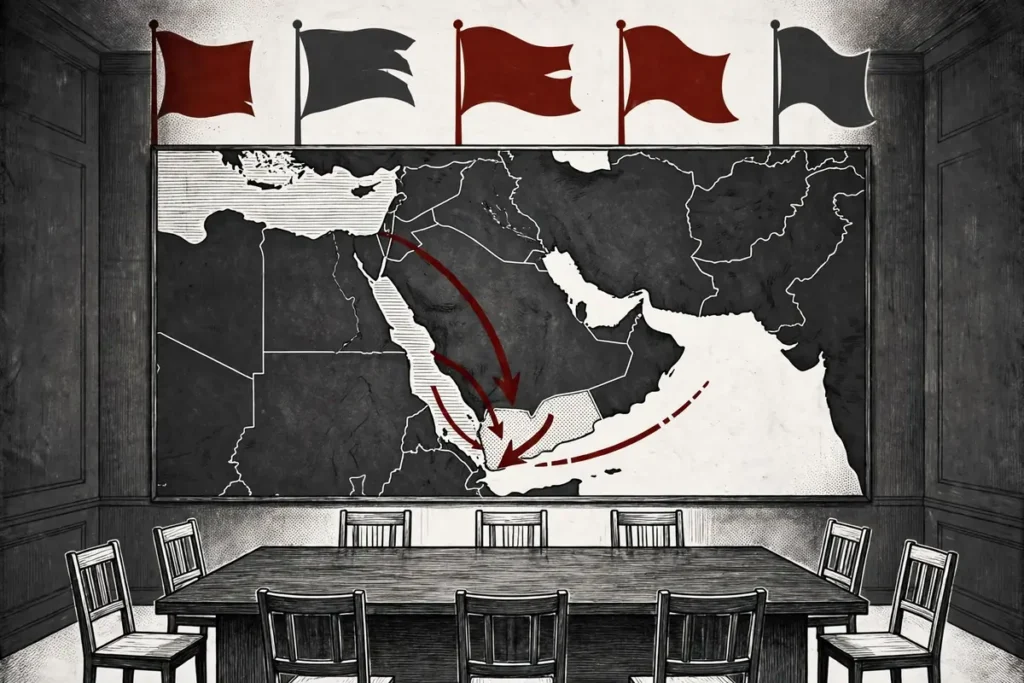
Yemen’s Saudi-backed leader has declared the start of a major military operation against the Iran-backed Houthis, ending the de-escalation phase and opening the most dangerous chapter of Yemen’s civil war in years. The announcement, made in a televised address on Sunday, October 4, 2026, sets the stage for a ground and air campaign aimed at retaking Houthi-held territory — including the strategic Bab el-Mandeb strait that controls the southern entrance to the Red Sea. This Yemen offensive against the Houthis is already sending shockwaves through energy markets and shipping routes that Europe and the United States depend on.
Key Takeaways
- Rashad al-Alimi, head of Yemen’s Presidential Leadership Council, announced the start of military operations “to retake the remaining territory of the republic” from the Houthis on October 4, 2026.
- The declaration follows the Houthis’ September seizure of Yemen’s Red Sea coast and the Bab el-Mandeb strait — their largest land grab in years — and a new Houthi push toward Taiz and its last road link to Aden.
- Regional and Western officials told Reuters that Saudi Arabia is preparing a coordinated assault: Saudi air power backing Yemeni ground forces, with as many as 100,000 troops potentially mobilized.
- The Houthis claimed they retaliated by firing ballistic missiles and drones at Saudi Aramco sites in Riyadh and Khurais — a claim Saudi Arabia has not confirmed.
- President Trump has so far resisted calls to join the campaign with US airstrikes, unwilling to abandon the US-Houthi ceasefire reached last year.
What happened: al-Alimi declares the offensive
On Sunday, October 4, 2026, Rashad al-Alimi, the chairman of Yemen’s Presidential Leadership Council and commander-in-chief of the armed forces, appeared in a televised address broadcast from Riyadh to announce that his government was moving from mobilization to open military operations against the Houthis.
“Today, I announce the start of military operations to retake the remaining territory of the republic and extend the authority of the state and its institutions across the entire national territory,” al-Alimi said, according to Reuters’ reporting from Aden. He ordered the armed forces, security forces, and all military formations to begin carrying out their assigned tasks under approved plans.
The president framed the decision as a last resort. He said “all opportunities for de-escalation have been exhausted” and accused the Houthis of answering every calming effort with further mobilization and escalation. “Our position today is to assume the national responsibility of confronting the Houthi militia, after all opportunities for de-escalation have been exhausted,” he said.
Al-Alimi also issued assurances aimed at civilians in Houthi-held areas, saying the campaign was not directed against the inhabitants of Sanaa, Saada, Hodeidah or other provinces under Houthi control, and urging residents to keep away from military positions, troop concentrations, and supply routes. He renewed an offer of amnesty and safe return for Houthi fighters who lay down their weapons. He called on the international community to support the operation.

Background and timeline: how Yemen reached the brink again
Yemen’s civil war has ground on for more than a decade. Saudi Arabia entered the conflict in 2015 at the head of an Arab coalition backing the internationally recognized government, which the Houthis had driven out of the capital Sanaa. A truce agreed in 2022 largely held for four years — until this year, when the fighting exploded again.
- 2015: Saudi Arabia leads an Arab coalition into Yemen’s civil war in support of the government the Houthis ousted from Sanaa.
- 2022: A truce between the warring parties takes hold and largely holds for four years.
- Early 2026: The Houthis begin missile and drone attacks on Saudi shipping and oil infrastructure, a spillover from the Iran war, shattering the ceasefire.
- September 3, 2026: The Houthis launch an offensive in Taiz and Hodeidah provinces.
- September 2026: In a lightning advance down the coast, Houthi forces seize Yemen’s Red Sea coastline and the strategic Bab el-Mandeb strait — their largest land grab in recent years — as government forces collapse.
- October 2, 2026: Yemen’s military launches around 20 airstrikes on Houthi targets around Taiz as the battle for the city intensifies.
- October 3–4, 2026: In the last 48 hours before the announcement, Houthi forces make gains on strategic hilltops near Taiz and advance on the last road connecting the city with Aden, the seat of al-Alimi’s government, stopping traffic on the main Taiz–Aden road.
- October 4, 2026: Al-Alimi formally declares the start of the major military operation against the Houthis.
Regional and Western officials had told Reuters earlier this week — before the declaration — that Saudi Arabia and its Yemeni allies were preparing the assault. The reported plan puts Saudi Arabia in charge of aerial combat while Yemeni forces fight on the ground. Officials described options ranging from a coastal push to secure the Red Sea shipping route to an assault on multiple fronts, with more than 100,000 Yemeni troops potentially mobilized depending on the scale. For context on the American military buildup shadowing this crisis, see our reporting on the third US aircraft carrier heading to the Middle East and the secret Camp David meeting on Iran and Yemen.
Why it matters: the Red Sea, oil, and global shipping
The timing of this Yemen offensive against the Houthis turns a civil war into a global economic risk. The Bab el-Mandeb is the southern exit passage of the Red Sea, a key shipping route between the Mediterranean and Asia — and it has grown even more important this year as an alternative to the Strait of Hormuz, which the Iran conflict has effectively closed.
That makes the strait a double chokepoint crisis. With Hormuz still blocked and Bab el-Mandeb now contested by a full-scale offensive, the world’s two most important energy and trade arteries in the region face simultaneous disruption. Insurers, freight operators, and energy traders were already pricing a geopolitical risk premium into oil markets as OPEC froze November quotas; a prolonged ground campaign on the Red Sea coast will push those costs higher.
Diplomats are watching two wild cards. The first is escalation beyond Yemen: the Houthis claimed on October 4 that they fired ballistic missiles and drones at Saudi Aramco sites in Riyadh and the Khurais area, saying the attacks caused major fires in response to what they described as 50 Saudi-led air and missile strikes on Yemen in the previous 12 hours. There was no immediate confirmation from Saudi Arabia — treat the claim as unverified until independently corroborated. If confirmed, it would mark a sharp widening of the battlefield onto Saudi soil, with oil infrastructure directly in the line of fire.
The second is the United States. President Trump has, for now, resisted entering the fray with American airstrikes, according to officials cited by Reuters. He has made clear he is not inclined to abandon the ceasefire the US reached with the Houthis after weeks of clashes last year, despite Saudi requests for more help as the Houthis threaten oil and commerce in the Red Sea. Whether that restraint holds once a ground offensive is underway — and once American energy and shipping interests feel the impact — is the central question of this crisis. Track the wider conflict picture on our conflict zones page.
Different perspectives
The Yemeni government and Saudi Arabia frame the operation as a legitimate effort to restore state authority after the Houthis exploited a restraint period to seize territory, including the Bab el-Mandeb. From their perspective, the September coastal collapse and the threat to the Taiz–Aden road proved that de-escalation was exhausted.
The Houthis, meanwhile, portray themselves as responding to aggression — they cited 50 Saudi-led strikes in the 12 hours before their claimed Aramco retaliation — and have spent weeks demonstrating that they still hold the initiative on the ground, advancing even as the counteroffensive was announced.
The United States appears determined, at least for now, to protect its separate ceasefire with the Houthis and avoid being drawn into a new campaign, a position that creates daylight between Washington and Riyadh just as the offensive begins.
Aid agencies and humanitarian observers warn of the civilian cost. Taiz has been besieged for more than a decade, and any major ground operation — particularly one aimed at retaking dense urban and coastal terrain — risks severe displacement in a country already facing one of the world’s worst humanitarian crises.
What to watch next
First, the opening moves: whether the operation begins with the reported coastal push toward Bab el-Mandeb or with strikes on Houthi positions around Taiz, Sanaa, and Saada — Yemeni military sources say “vital targets” in Sanaa and Saada were already hit overnight, though details are unverified. Second, Saudi confirmation or denial of the claimed Aramco strikes, which would indicate whether the war is expanding onto the kingdom’s oil infrastructure. Third, Washington’s posture: any shift from Trump’s current refusal to join the campaign would signal a major escalation. And fourth, the markets — Monday’s oil futures and war-risk insurance rates will show how seriously traders take the threat to Red Sea shipping. This is a developing story; WarBrief will update this analysis as the situation evolves.
Frequently asked questions
What did Yemen’s leader announce on October 4, 2026?
Rashad al-Alimi, head of Yemen’s Presidential Leadership Council, announced the start of a major military operation to retake Houthi-held territory and extend state authority across all of Yemen. He said all opportunities for de-escalation had been exhausted and ordered the armed forces, security forces, and all military formations to carry out their assigned tasks.
Who are the Houthis and why is Yemen at war with them?
The Houthis (Ansar Allah) are an Iran-backed movement that seized Yemen’s capital Sanaa, driving out the internationally recognized government. Saudi Arabia intervened in 2015 at the head of an Arab coalition to back the government. A 2022 truce held for four years until the fighting resumed this year, with the Houthis attacking Saudi shipping and oil infrastructure and seizing Yemen’s Red Sea coast in September 2026.
How will the Yemen offensive affect Red Sea shipping and oil prices?
The Bab el-Mandeb strait, which the Houthis seized in September, is the southern gateway to the Red Sea — a vital shipping lane between the Mediterranean and Asia. With the Strait of Hormuz already effectively closed by the Iran conflict, fighting around Bab el-Mandeb threatens the region’s last major energy artery, pushing up freight costs, war-risk insurance, and oil prices. This is educational analysis, not financial advice.
Will the United States join the offensive against the Houthis?
Not so far. Officials told Reuters that President Trump has resisted Saudi requests for US airstrikes and is not inclined to abandon the ceasefire the US reached with the Houthis last year. That position could change if the offensive escalates or American interests come under direct threat.
Sources
- Reuters: Yemen leader announces major military operations against Iran-backed Houthis (via Northland News Radio)
- TBS News: Yemen leader announces major military operations against Iran-backed Houthis
- Demócrata: The President of Yemen launches a major counteroffensive against the Houthis
- AP (via Reflector): Yemen’s government declares a major operation against the Houthis