WarBrief Live | October 3, 2026 | European Union
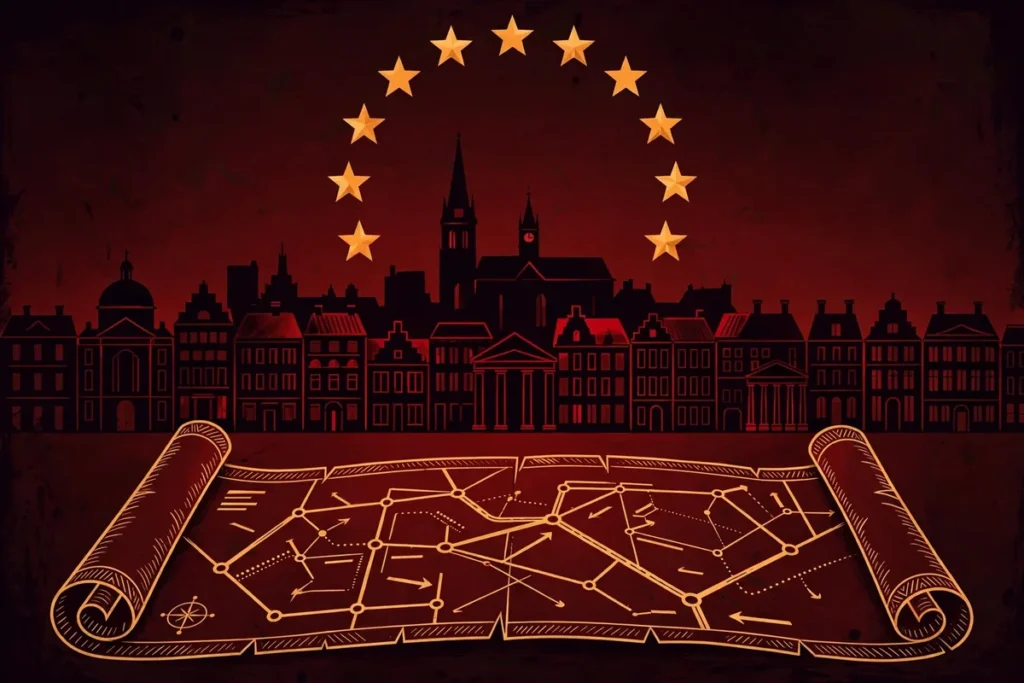
On October 28, the European Commission is expected to adopt its 2026 Enlargement Package — putting Ukraine at the center of the EU’s October 2026 enlargement package debate. For the first time, the annual review of EU hopefuls will come with targeted accession roadmaps for the four most advanced candidates: Ukraine, Moldova, Albania and Montenegro. The roadmaps, announced by Commission President Ursula von der Leyen in her State of the Union address on September 16, promise a step-by-step path to membership with indicative timelines for closing negotiating chapters. But with new safeguard clauses that could strip backsliding members of their voting rights, unanimity still required at every stage, and fresh warnings that Kyiv’s 2027 target is out of reach, October 28 may mark the start of the EU’s most ambitious — and most contested — enlargement drive in two decades.
Key Takeaways
- The College of Commissioners is expected to discuss and adopt the 2026 Enlargement Package on October 28, including the first-ever accession roadmaps for Ukraine, Moldova, Albania and Montenegro, according to reporting on the Commission’s published agenda.
- The roadmaps will set out reforms, deliverables and indicative timelines — and create commitments for EU member states as well as candidates, since unanimity is still required throughout the accession process.
- A draft proposal seen by Reuters would harden the EU against backsliding: a “temporary political commitment” against vetoes, suspension of a new member’s rights by qualified majority, and transition-period restrictions on workers’ movement and agriculture.
- Enlargement Commissioner Marta Kos says Ukraine cannot join the EU on January 1, 2027, while Albania’s prime minister says promises of membership under the current procedure “are a lie” — the political fight is already underway.
On this page: What the package contains · Three dates that decide the next month · Four countries, four races · Different perspectives · What to watch next · FAQ
What the October 28 package will contain
The Enlargement Package is the Commission’s annual health check on the accession process: a strategic communication reviewing the past year plus country-specific reports assessing each candidate’s progress and remaining gaps, particularly on the rule of law. This year’s edition adds something new. According to The New Union Post, which cites two EU sources, the Commission has started work on targeted accession roadmaps for the four frontrunners — and the College of Commissioners is expected to adopt the full package on October 28.
Each roadmap is expected to restate the EU reforms and conditions required of each candidate in line with its negotiating framework, then spell out what needs to happen at each stage of the process if those conditions are met — together with indicative timelines for closing the negotiating chapters. That makes the roadmaps more than the usual annual recommendations, but they build directly on the existing enlargement documents: the Commission’s 2025 package already treated Montenegro, Albania, Ukraine and Moldova as particularly advanced.
Crucially, the roadmaps are designed to bind Brussels as well as the candidates. The step-by-step approach would create commitments not only for the candidate countries but also for EU member states, since unanimity is currently required at every stage of accession — and could give candidates a clearer political assurance of membership once reforms are delivered. The catch: several EU capitals are reluctant to hand the Commission authority to set even indicative timelines, so much will depend on the format in which the roadmaps are put before the Council, which has the final say.
The three dates that decide the next month
October 28 does not arrive out of nowhere. Three milestones in the next four weeks will shape what the package can actually deliver.
October 6 — the pre-enlargement reviews. After almost a year of delays, the Commission will publish its communication on pre-enlargement policy reviews, postponed from September 30 because von der Leyen’s Western Balkans tour and the UN General Assembly left the text unfinished. It is a soft-law instrument — a strategic approach with no legally binding force — but it will frame the debate: Commissioner Marta Kos has said it will focus on “the Treaties, the budget and the decision-making process,” but only where a broad consensus is emerging. The communication is expected to reference the four roadmaps and to propose enhanced gradual integration — giving candidates access to selected EU programs and policy areas before formal accession — which Kos’s team now sees as the only proposal with a realistic chance of success.
October 15–16 — the European Council summit. EU leaders will hold their strategic discussion on enlargement and EU institutional reform in Brussels, the summit our preview of the October European Council covers in detail, including the parallel fights over Ukraine funding and European defence. What leaders conclude — or fail to conclude — will set the political ceiling for the roadmaps.
October 28 — the package itself. The Commission adopts the communication, the country reports and the four roadmaps, 25 days from now. A separate draft proposal, reported by Politico, would open the EU’s single market to candidates through “gradual integration” — including unhindered trade and access to research programs — but only on condition that candidates align with EU foreign policy and do not share key technologies with hostile states or industrial competitors. Priority sectors named in the draft include semiconductors, quantum technologies, biotechnology, artificial intelligence and space — and the access would be reversible: “If these commitments are not fulfilled, participation must remain reversible.”
Why it matters: four countries, four different races
The four roadmap recipients are at very different stages of the journey, and the package will land differently in each capital.
| Candidate | Where things stand | What October 28 could decide |
|---|---|---|
| Montenegro | Negotiating since 2012; all 33 chapters opened, 18 provisionally closed — the most advanced candidate by far. | Von der Leyen said in Podgorica that Montenegro could become the EU’s 28th member by 2028. More chapters are expected to close at a mid-October Intergovernmental Conference, and an Accession Treaty working group has been running since April. |
| Albania | Applied 17 years ago; candidate status for over 12 years; negotiations formally opened in 2022. | Euronews reported the Commission is poised to formally back Tirana’s 2027 deadline ambition, with a closing-benchmark assessment spelling out the reforms needed to close remaining gaps — replicating the approach that worked for Montenegro. |
| Ukraine | EU candidate since June 2022; opened the Fundamentals cluster on June 15, 2026 and External Relations on July 14, 2026. | The roadmap will set milestones, but Commissioner Kos has ruled out President Zelensky’s January 1, 2027 target — and a September civil-society assessment puts implementation of the priority Kachka–Kos reform plan at just 15%. |
| Moldova | Advanced candidate seen in Brussels as vulnerable to Russian interference, especially around elections. | A leaked Commission document reported by EUalive would give Moldova progressive entry into key segments of the single market well before formal accession — while analysts say Brussels wants to avoid “a repeat of the Georgian scenario.” |
For the countries left off the roadmap list — Serbia, Bosnia and Herzegovina, North Macedonia, Kosovo, Georgia and Türkiye — the message is a slower track. Politico notes concerns in Brussels that they may disengage or gravitate toward Russia or China, and the Commission’s answer is gradual integration rather than a timetable.
The security logic runs through everything. As one regional analyst told AnewZ, the acceleration is driven less by economics than by security: Russia’s war against Ukraine and the EU’s desire to prevent instability on its eastern and southeastern frontiers. Montenegro has aligned closely with EU foreign policy, including sanctions on Russia; Moldova is viewed as exposed to Russian interference; Ukraine’s bid is tied to locking in its Western orientation while the war continues — though the same analyst notes unresolved territorial disputes remain Kyiv’s largest obstacle.
Different perspectives
The Commission: merit-based, but harder-edged. “Enlargement strengthens Europe,” the Commission wrote in the draft seen by Reuters — but a larger membership “places greater demands on decision-making, administration, enforcement, infrastructure and financing.” The safeguards are the sharp end: a “temporary political commitment” in which a new member declares it will not oppose consensus decisions for a limited period; a clause letting existing members suspend a new member’s rights, including voting rights, with a qualified majority of 15 of the 27 members representing 65% of the bloc’s population; and time-limited safeguards in accession treaties covering free movement of workers and agriculture. The Commission also wants qualified-majority voting extended to sanctions — an area where vetoes have repeatedly blocked action — while adding that greater QMV “should be accompanied by appropriate safety measures for essential national interests.” Reuters notes the push follows the bloc’s difficulties with Hungary under Viktor Orban, and the EU’s new emergency security protocol for hybrid attacks shows the same instinct: faster decisions when the bloc is under pressure.

Kyiv: the 2027 deadline is dead. In an interview with Italy’s Corriere della Sera published October 2, Enlargement Commissioner Marta Kos rejected President Volodymyr Zelensky’s target outright:
“The date of Jan. 1, 2027, was set by President Zelensky. Accession is based on merit: it’s clear that this date is not possible.”
Kos added that there are “no privileges or concessions” in the process, while stressing that Ukraine is fighting a war for survival and that helping it is the EU’s duty. She hopes Kyiv and Brussels can open as many negotiating clusters as possible by the end of the year — but the reform ledger is thin: the Kachka–Kos plan, ten priority justice and anti-corruption commitments agreed in December 2025 with implementation due by the end of 2026, was rated at 15% implementation in a September civil-society assessment, with 114 EU-related bills still moving through parliament as of mid-September. The fight over frozen Russian assets to cover Ukraine’s funding gap runs on a parallel track — and Finland’s prime minister has made using those assets for Kyiv one of his key messages for the October summits.
Tirana: the system itself is the problem. Albanian Prime Minister Edi Rama went further. In an interview with Germany’s Die Welt reported on October 3, Rama said Ukraine will never join under the normal accession procedure: “What Ukraine is being promised is a lie. Everyone knows it.” He called for a fundamental reform of enlargement policy — involving candidates immediately in the Union’s consultative bodies and working mechanisms, granting membership only after clear reform objectives are met — and for abolishing the member states’ veto, which he says enables deadlocks and bilateral disputes. His comparison: after the fall of the Berlin Wall, West German Chancellor Helmut Kohl did not tell East Germans to work through 33 negotiating chapters before reunification.
The capitals: reluctant and watching their elections. Several member states resist even indicative timelines, unwilling to delegate enlargement authority to the Commission. The October 15–16 summit will test whether leaders can agree on the roadmap format at all — and the politics are shifting under the process: France elects a new president next year, and a less supportive government in Paris could slow decisions or demand new conditions, since every accession step requires unanimity. For background on how EU states fit into the wider picture, see our country profiles and conflict zone coverage.
What to watch next
- October 6: the pre-enlargement communication lands — watch whether the safeguard “catalogue of options” and gradual-integration offer survive in the final text.
- October 15–16: the European Council’s strategic debate. Any conclusions on enlargement reform, veto limits and the roadmap format will define what October 28 can deliver.
- Mid-October: the Intergovernmental Conference where Montenegro expects to close further negotiating chapters.
- October 28: the package itself — the four roadmaps, the country reports, and whether the Commission formally backs Albania’s 2027 ambition.
- End of 2026: the deadline for Ukraine’s Kachka–Kos priority reforms. At 15% implementation in September, the gap between the roadmap’s milestones and Kyiv’s delivery will be the story of next year.
- 2027: France’s presidential election — a variable that could reshape the unanimity math for every candidate.
Frequently asked questions
When will Ukraine join the EU?
There is no agreed date. President Zelensky set January 1, 2027 as a target, but Enlargement Commissioner Marta Kos said on October 2, 2026 that this date is “not possible” because accession is merit-based. Ukraine opened its Fundamentals negotiating cluster on June 15, 2026 and the External Relations cluster on July 14, 2026. The October 28 accession roadmap is expected to set milestones and indicative timelines, but full membership requires completing deep judicial and anti-corruption reforms — rated at 15% implementation in a September 2026 civil-society assessment — and unanimous approval by all EU member states.
What is the EU Enlargement Package?
It is the European Commission’s annual review of the EU accession process, comprising a strategic communication and country-specific reports assessing each candidate’s progress and remaining gaps, especially on the rule of law. The 2026 edition, expected on October 28, will be the first to include targeted accession roadmaps — step-by-step plans with reforms, deliverables and indicative timelines — for the four most advanced candidates: Ukraine, Moldova, Albania and Montenegro.
Which countries are closest to joining the EU?
Montenegro is the most advanced: negotiating since 2012, with all 33 chapters opened and 18 provisionally closed, and a Commission political horizon of 2028. Albania, which opened negotiations in 2022, may get formal Commission backing for a 2027 deadline ambition. Ukraine and Moldova are treated as frontrunners on geopolitical grounds but face larger reform gaps. No new country has joined the EU since Croatia in 2013.
What are safeguard clauses in EU accession treaties?
They are provisions designed to protect the EU if a new member backslides on democracy or the rule of law. A draft Commission proposal reported by Reuters would add: a “temporary political commitment” in which a new member pledges not to oppose consensus decisions for a limited period; a clause allowing existing members to suspend a new member’s rights — including voting rights — by a qualified majority of 15 of the 27 members representing 65% of the population; and time-limited restrictions in areas such as free movement of workers and agriculture.
What does “gradual integration” mean for candidate countries?
It means giving candidates access to parts of the EU — such as the single market, research programs and selected policy areas — before formal membership. Under a draft reported by Politico, Ukraine, Moldova, Albania and Montenegro would get staged market and program access, but only if they align with EU foreign policy and protect sensitive technologies; the access would be reversible if commitments are not met. Commissioner Kos presents gradual integration as preparation for accession, not a substitute for it.
Sources
- Reuters: EU Commission floats new safeguards as bloc considers expansion
- The New Union Post: 2026 Enlargement Package to include four accession roadmaps
- The New Union Post: The pre-enlargement policy reviews postponed to 6 October
- Politico (via EuropeSays): The EU will propose opening the single market to accession candidates, but there is a condition
- Kyiv Post (via EuropeSays): No EU Membership for Ukraine on Jan. 1, 2027, Brussels Admits
- How Brussels plans for a bigger EU: roadmaps, passerelle clauses and institutional reform
- EUalive (via EuropeSays): Moldova promised deeper single market access before EU membership
- AnewZ: EU accession of Ukraine, Moldova, Montenegro and Albania
- Euronews (via GITFiConline): EU Commission poised to formally back Albania’s 2027 accession deadline
- IBNA: Montenegro’s EU Accession — Von der Leyen sets 2028 horizon
- Finnish Government: European Council to focus on defence — Prime Minister Orpo to represent Finland
- Informat.ro: Albania’s Prime Minister maintains that Ukraine will never join the EU through the current procedure