WarBrief Live | October 3, 2026 | Breaking Analysis
Russian President Vladimir Putin ordered his military commanders to lift all remaining restrictions on Russia’s air campaign against Ukraine, Ukrainian President Volodymyr Zelensky told the Financial Times on October 2, quoting intercepted Kremlin communications in which Putin declared: “He said there are no rules now.” The allegation, which the Kremlin denies, came as Russian drones and missiles struck Kyiv’s bridges for a third straight day and a jet-powered drone hit a Kyiv school with more than 160 students and teachers sheltering underground.
Key Takeaways
- Zelensky says Ukrainian intelligence intercepted Kremlin communications showing Putin ordered an unrestricted air war in September, with schools, hospitals, data centers and nuclear-linked infrastructure as targets. The intercepts have not been publicly released and cannot be independently verified.
- Kyiv’s Southern Bridge was hit repeatedly on October 1–2, the Northern Bridge was struck on the morning of October 3, and traffic across the Dnipro is paralyzed — part of what Ukrainian officials describe as a campaign to isolate Kyiv, Kharkiv, Odesa and Lviv before winter.
- Moscow denies deliberately striking civilians; Putin, at the Valdai forum on October 1, framed attacks on economic targets as retaliation for Ukrainian strikes on Russian oil refineries that he said cost Russia 1% of its GDP.
- Ukrainian and EU officials warn Russia aims to sever nuclear plants from the energy grid and trigger a new refugee wave into Europe, seeking to force Kyiv to accept Russian demands in early 2027. Track the wider war on our conflict-zones hub.
What happened: the “no rules” interview
Zelensky delivered the accusation from an unusual setting: the bomb shelter of a Kyiv school struck by a Russian jet-powered drone the previous day, in an interview with the Financial Times published on October 2. According to multiple accounts of the interview, Zelensky said Ukrainian intelligence had intercepted communications between Kremlin officials showing that Putin, in September, scrapped the constraints that had governed earlier Russian air strikes.
“He said there are no rules now,” Zelensky told the paper, recounting the alleged order. He said the directive coincided with a sharp intensification of strikes on Kyiv, with schools, hospitals, telecommunications facilities and data centers increasingly hit. The attacks, he added, are intended not only to destroy infrastructure but “to pressure people” and instill fear in civilians.
The FT interview also contained an account from the journalist who conducted it, Christopher Miller, that Ukrainian and European officials fear a winter campaign aimed at the country’s four largest cities — Kyiv, Kharkiv, Odesa and Lviv — with the goal of isolating them, destroying morale, sowing chaos and sparking a new flood of refugees into the European Union. Most alarming, officials said, is the claim that Russia wants to sever Ukraine’s nuclear facilities from the energy grid.
The evidence trail: three days over Kyiv
Whether or not the alleged order exists, the tempo of Russian strikes on the Ukrainian capital in the first days of October was extraordinary:
- October 1: Russian drones smashed into a Kyiv school and the Southern Bridge over the Dnipro River, triggering fires, Reuters reported. A 25-storey residential building in the southeast of the city was hit; one person was killed and at least two wounded, according to Ukrainian authorities. The school, struck by a jet-powered drone shortly after 9 a.m., housed 104 students and 60 teachers who had reached the underground shelter in time. Ukrainian authorities said the drone’s 50-kilogram warhead pierced a floor but failed to detonate; the impact damaged the building and started a fire.
- October 2: The Southern Bridge was struck again — the fourth drone attack in two days, Kyiv’s mayor Vitali Klitschko said. Traffic across the Southern Bridge and the Paton Bridge was closed in both directions. Klitschko convened a city defense council, warning that “we’re talking about survival” and accusing Russia of trying to “sow panic.” Air-raid sirens sound almost around the clock for a city of roughly three million people.
- October 3: Early on Saturday morning, at around 6:30 a.m., explosions hit the Northern Bridge across the Dnipro, damaging its surface and overhead power lines for trolleybuses as vehicles crossed, Klitschko said. Movement was halted. It was the third consecutive day of strikes on Kyiv’s bridges — the arteries linking the city’s two halves, across which some 500,000 people commute daily.
Zelensky later called attacks on educational institutions “a deliberate tactic,” saying Russia was attempting to terrorize civilians and disrupt ordinary life. Ukrainian official records cited in Ukrainian media count more than 4,700 attacks on educational institutions and over 3,000 verified strikes on healthcare facilities since the full-scale invasion began.

Why it matters: a winter campaign to empty the cities
The allegation points to a strategic shift. With the front line largely static and Russia unable to capture Ukraine’s eastern Donbas region after four and a half years of war, Moscow appears to be betting that punishment from the air can succeed where ground offensives have stalled. In an excerpt of the interview quoted across international media, Zelensky said: “The Russians have failed to occupy us. So now they are carrying out massive attacks and mass killings. They want to destroy our bridges… our data centres, the internet, mobile networks, hospitals, kindergartens, schools, universities – everything. They want people to flee their cities.”
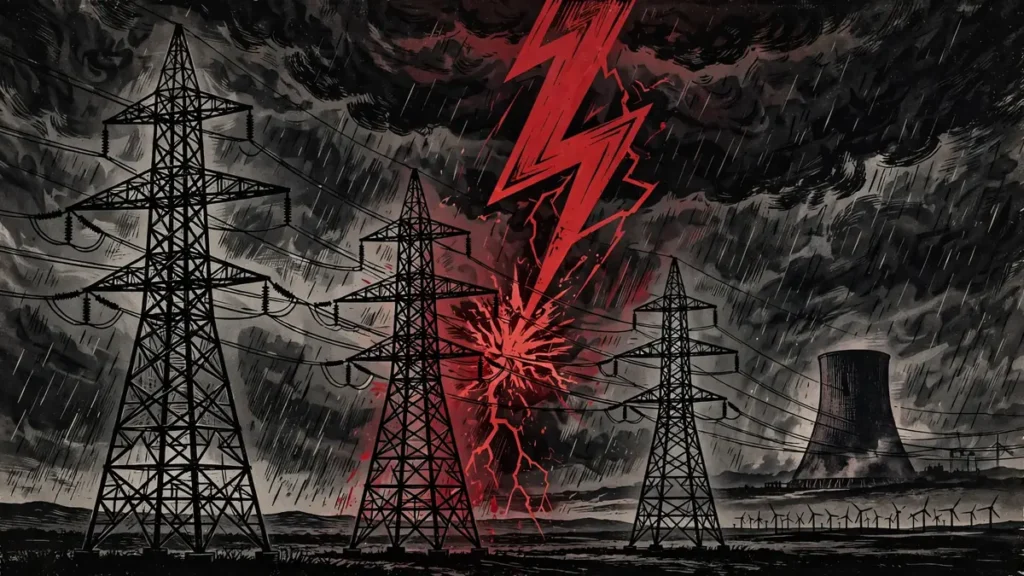
The nuclear dimension raises the stakes further. Ukraine relies on nuclear power for a large share of its electricity, and its plants are connected to the grid by high-voltage lines that have been struck repeatedly during the war. Ukrainian officials told the FT that Moscow wants to sever those connections this winter — a move that would threaten blackouts across the country, risk nuclear safety incidents, and, in Kyiv’s telling, pressure Ukraine toward accepting Russian demands in early 2027.
The refugee dimension carries European consequences. Kyiv officials say destabilization tactics include triggering new flows of Ukrainian refugees into neighboring countries such as Poland, where fatigue with the conflict and anti-immigrant sentiment are already rising — a calculation that, if accurate, makes the winter campaign a weapon aimed at European politics as much as at Ukrainian cities.
Different perspectives
The Kremlin’s position. Moscow categorically denies deliberately striking civilians. Kremlin spokesman Dmitry Peskov insisted Russian forces do not intentionally target schools or hospitals, and Russia typically justifies its strikes as hitting military-linked buildings or critical logistics. At the Valdai foreign policy forum on October 1, Putin framed attacks on Ukrainian economic targets as direct retaliation for Ukraine’s strikes on Russian oil refineries and Black Sea shipping — the same drone campaign against refineries that has reshaped global energy markets this year. “Now from every direction we’re receiving calls ‘let’s stop’. But they started it,” Putin said. Reuters reported that Putin has acknowledged the refinery strikes cost Russia 1% of its GDP and left long lines at filling stations, with industrial facilities in Volgograd targeted by Ukrainian drones this week.
Ukraine’s position. Kyiv treats the intercepted order as genuine and the civilian toll as the intended result. Zelensky posted on X that “we know from intelligence and people around Putin that at the start of September Putin said, ‘No rules now’,” and told reporters separately: “They want Ukrainians to leave the capital … and show that if you don’t have the capital you don’t have the country.” In the FT interview, Zelensky also accused China and India of helping Russia circumvent Western sanctions, and said Ukraine is working to strengthen its defenses against Russian drones.
Independent analysts. What is known: the strikes happened, the targets were largely civilian, and the tempo is rising. What is not known: the content of the alleged intercepts, which Kyiv has not released. Independent verification of the “no rules” order is therefore impossible for now — and caution is warranted before treating an intercepted claim from one side of the war as established fact. What is independently verifiable is the pattern: a sustained, intensifying bombardment of the cities and infrastructure Russia would need to isolate and empty, consistent with the strategy Zelensky describes.
What to watch next
Five developments will show whether the “no rules” warning is becoming a winter doctrine. First, the energy grid: watch for strikes on the high-voltage substations and transmission lines that connect Ukraine’s nuclear plants to consumers — the specific threat Kyiv says it has intelligence on. Second, air defense: Ukraine says it is upgrading drone defenses, and Western partners face renewed pressure to accelerate interceptor and air-defense deliveries before the cold sets in. Third, nuclear safety: the International Atomic Energy Agency monitors Ukraine’s plants, and any loss of off-site power at an operating reactor is a radiological emergency in waiting. Fourth, the refugee channel: flows into Poland and the EU will signal whether the pressure campaign is achieving its reported aims. Fifth, diplomacy: Putin’s Valdai remarks — that everyone is now calling for the fighting to stop — hint that Moscow may be positioning the air campaign as leverage, a pattern familiar from earlier Russian escalation threats. Follow the latest assessments in our intelligence briefing hub.
Frequently asked questions
What did Zelensky claim Putin ordered in September 2026?
Speaking to the Financial Times on October 2, Zelensky said Ukrainian intelligence intercepted Kremlin communications showing Putin ordered military commanders to lift all remaining restrictions on the air campaign against Ukraine, declaring “there are no rules now.” The intercepts have not been publicly released, so the order itself cannot be independently verified.
Is there proof Russia is deliberately targeting civilians?
Documented evidence confirms Russian strikes hit a Kyiv school, the Southern and Northern bridges, hospitals, data centers and apartment buildings in early October 2026, with casualties. Moscow denies deliberately striking civilian infrastructure, saying it targets military-linked sites. The allegation of an explicit order to do so rests solely on Ukrainian intelligence claims for now.
Why would Russia target Ukraine’s nuclear plants?
According to Ukrainian and European officials cited in the FT, the aim is not to strike reactors directly but to sever nuclear facilities from the energy grid — cutting a major source of winter electricity, threatening nuclear safety systems that depend on off-site power, and forcing blackouts that pressure Kyiv politically.
Which Ukrainian cities are under the heaviest attack?
Kyiv, Kharkiv, Odesa and Lviv are named by Ukrainian and EU security officials as the focus of the intensified campaign. In Kyiv, repeated strikes on the Southern, Paton and Northern bridges have paralyzed traffic across the Dnipro for a city of roughly three million people.
How does this fit Russia’s stated justification?
At the Valdai forum on October 1, Putin said attacks on Ukrainian economic targets were a response to Ukrainian drone strikes on Russian oil refineries and Black Sea ships, which he said cost Russia 1% of GDP. Kyiv, by contrast, presents the air campaign as a deliberate strategy to terrorize civilians and depopulate cities.
Sources
- Reuters: Russian air strikes hit Southern Bridge in Kyiv again, mayor says
- New York Post: Putin orders military leaders to target civilians and nuclear facilities, Zelensky warns
- NewsBeep: ‘No Rules Now’ — Putin orders civilian attacks, Zelensky says
- Dagens.com: Zelensky says Putin has abandoned the rules of war by ordering civilian attacks
- EA WorldView: Ukraine War — Russia targets Kyiv bridges for 3rd straight day