
WarBrief Live | November 17, 2026 | Naval Warfare
5,000–6,000
estimated naval mines in Iran’s arsenal (IFRI estimate, via AFP)
~20%
of the world’s oil exports pass through the Strait of Hormuz
2 nautical miles
width of each shipping lane through the strait
$1,500
estimated cost of the mine that caused about $90 million of damage to USS Samuel B. Roberts in 1988
A naval mine is a sealed explosive charge that waits in the water for a ship to come to it. It fires on contact, or when its sensors detect a passing hull’s magnetism, noise or pressure. In the Strait of Hormuz, that simple design is doing outsized work: tankers have struck mines there repeatedly in November 2026, and insurers, navies and oil markets are all watching the water. This explainer sets out how naval mines work, the four types in use, how they are laid and cleared, and what the Hormuz incidents mean for readers in the US, the UK and the EU.
Key Takeaways
- A naval mine is an explosive charge that waits for a ship. It fires on contact, or when its sensors detect a hull’s magnetic, acoustic or pressure signature.
- There are four main types — drifting, moored, bottom and rising — plus smaller limpet mines fixed to a hull by hand.
- Mines rarely sink a modern double-hulled tanker, but a single hit can disable a ship, start a fire and close a shipping lane for days.
- Clearing mines is slow and dangerous. Hunting finds each mine one by one; sweeping sets them off at a distance. Either job can take weeks, and some seas still hold mines from the world wars.
- Iran is estimated to hold 5,000 to 6,000 naval mines. The Strait of Hormuz, about 21 miles wide at its narrowest, is one of the few places where so few weapons can threaten so much trade.
What is a naval mine, and how does it explode?
A sea mine is a sealed case holding an explosive charge and a firing mechanism, placed in the water to sink or cripple ships that come near it. That is the whole weapon: no engine, no crew, no guidance. It sits and waits, sometimes for years, until a ship does the work of triggering it. The weapon is back in the headlines because tankers have been striking mines in the Strait of Hormuz, the narrow waterway that carries about a fifth of the world’s oil exports.
There are two basic ways a mine fires. A contact mine goes off when a hull physically strikes it. The classic design carries protruding horns, known as Hertz horns: when a ship’s hull bends one, it closes the firing circuit and the charge detonates. Contact mines are the oldest working design, and they were the standard weapon of the first and second world wars. “Modern mines have fairly little to do with those,” Johannes Peters, an undersea warfare expert at Kiel University’s Institute for Security Policy, told DW.
An influence mine needs no touch at all. It carries sensors instead of horns and fires when a passing ship’s signature matches what it is set to detect. There are three main kinds of sensor. A magnetic sensor picks up the way a steel hull disturbs the Earth’s magnetic field. An acoustic sensor listens for the noise of engines and propellers. A pressure sensor registers the drop in water pressure under a large ship moving overhead. Many modern mines combine two sensors, most often magnetic and acoustic, and some carry a ship counter that lets the first few ships pass before the mine fires — which is why a lane that ships have already crossed safely is not proof that it is clear.
The four types of naval mine
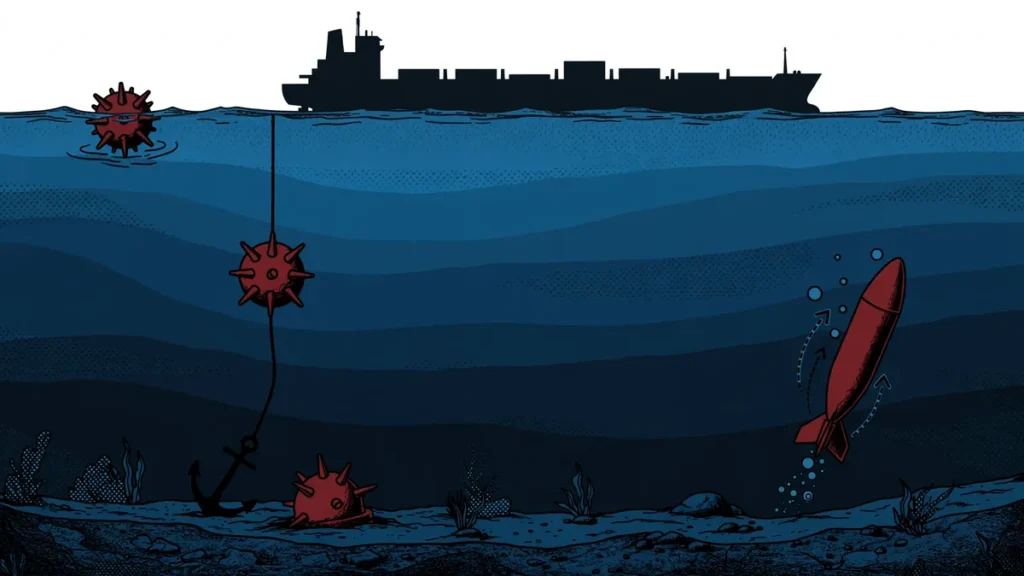
Mines are usually grouped by where they sit in the water. The placement decides how they are found, how they are cleared, and which ships they threaten.
| Type | Where it sits | How it fires | Why it matters in Hormuz |
|---|---|---|---|
| Drifting | Floats freely at or near the surface, carried by currents | Contact or influence; it moves with the current | The hardest to find, and the most indiscriminate — it can threaten any ship, including the side that laid it |
| Moored | Buoyant, held just below the surface by a cable fixed to an anchor on the seabed | Contact horns or influence sensors | The classic strait weapon; a sweep can cut its cable and float it to the surface |
| Bottom | Rests on the seabed, so it works only in fairly shallow water | Influence sensors: magnetic, acoustic, pressure | The Gulf is shallow enough for bottom mines, and pressure mines are the hardest to sweep because a ship’s pressure signature is difficult to fake |
| Rising | Waits on the seabed | Fires a warhead upward at a ship passing above | Iran is reported to hold the Chinese-designed EM-52 rocket mine, which works this way |
There is also a fifth, smaller category: the limpet mine. It is a charge fixed directly to a ship’s hull, usually by divers or from a small boat, and typically set off by a timed fuse. Limpet mines are a different kind of threat from the others — they are placed on a chosen ship rather than left waiting in the water — and analysts have blamed them for earlier tanker attacks in the Gulf.
How do influence mines tell a warship from a tanker?
An influence mine is not a blind trap. Its sensors can be tuned, and navies go to considerable effort to make that tuning work in their favour. To programme a mine for a particular class of vessel, Peters explained to DW, “submarines can help determine the acoustic profile of a hostile ship. These hostile vessels will trigger the mines with their acoustic signatures, while friendly ships can continue to pass through the mined area without any trouble.” A ship counter adds a further layer: the mine can be set to ignore the first few passing vessels and fire on a later, larger one, which makes a minefield harder to test and harder to trust.
Navies answer by shrinking their own signatures. Steel warships carry degaussing coils that cancel much of their magnetic field. The US Navy’s Avenger-class minehunters were built with wooden hulls sheathed in fibreglass so they could work inside a minefield without setting off the weapons they were hunting. Iran’s own influence types include the moored Maham-3, which listens for a ship’s sound, and the Maham-2 and Maham-7 bottom mines.
How does a naval mine damage a ship?
When a naval mine detonates underwater, it generates a powerful shock wave. The blast also forms a rapidly expanding gas bubble that can damage a ship’s hull, disrupt its electronic and mechanical systems, and destabilise the vessel. The severity of the damage depends on the size of the ship and the depth at which the mine explodes. One Iranian mine model described by US military sources carries roughly 120 kilogrammes of explosives — enough to tear a large hole in a ship’s hull and disable it, even if the vessel does not sink.
That distinction matters. Most modern mines are designed to produce what militaries call a mission kill: the ship does not sink, but it is damaged enough that it cannot continue its task. Modern tankers, which have an inner and an outer hull to prevent oil spilling into the ocean, are especially unlikely to be sunk by a mine. A disabled tanker in a narrow strait is, for the side laying the mines, often enough: the ship blocks the lane, the fire has to be fought, the crew has to be rescued, and every other ship in the area has to stop and wait.
The cost asymmetry is the point of the weapon. The Iranian mine that holed the US frigate Samuel B. Roberts in the central Gulf on April 14, 1988, was estimated to cost about $1,500. Repairing the ship cost about $90 million. Of the 19 US Navy ships sunk or seriously damaged since the end of the Second World War, 15 were hit by mines. On February 18, 1991, USS Tripoli struck a moored contact mine and USS Princeton set off two Italian-made Manta bottom influence mines in the northern Gulf, in the same minefield, on the same day.
How are naval mines laid, and how are they cleared?
Laying mines is easy. Almost anything that floats or flies can do it: warships, converted cargo vessels, small boats, submarines and aircraft. Iran has relied on small boats in the current war, and the US Defense Intelligence Agency said in a 2019 report that Iran can rapidly deploy mines in the Persian Gulf and the Strait of Hormuz using high-speed small craft. In September 1987, US forces caught the Iranian landing ship Iran Ajr laying M-08 contact mines at night near Bahrain. That is the weapon’s strategic appeal: a navy that cannot match its opponent ship for ship can still close a strait with a handful of small boats working at night.
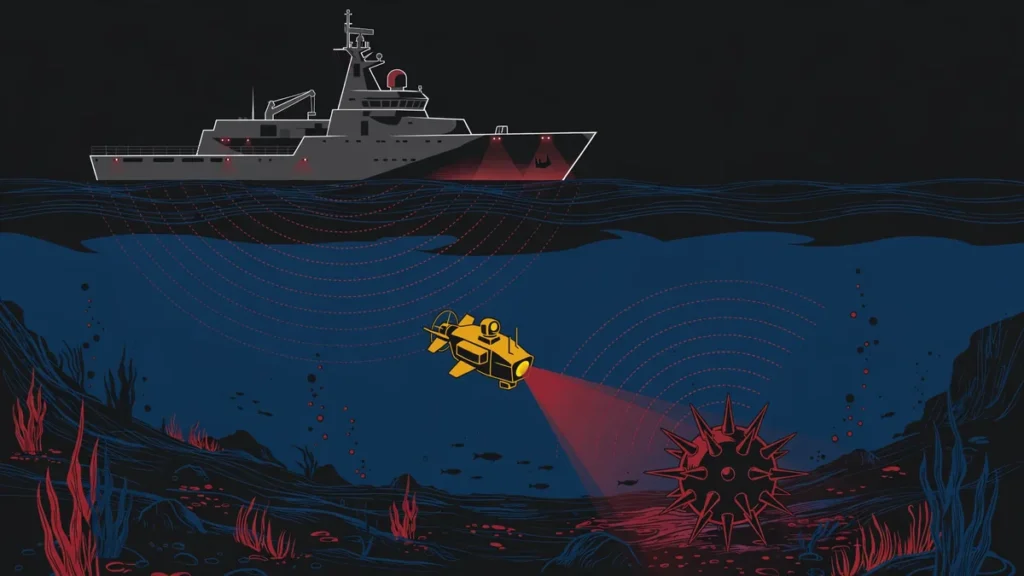
Clearing mines is the hard part, and navies do it in two ways. Sweeping sets mines off, or cuts them loose, from a distance. A mechanical sweep is a wire towed behind a ship, fitted with cutters that sever the cables of moored mines; the freed mines float to the surface, where they are destroyed by gunfire or by bomb-disposal teams. An influence sweep imitates a ship: towed cables carry an electric current to create a magnetic field, and towed noisemakers copy a ship’s sound, so the mine fires harmlessly behind the sweeper. Pressure mines are the hardest to sweep, because a ship’s pressure signature is difficult to fake.
Hunting is slower but more certain. Sonar on a ship, helicopter or underwater drone finds mine-like objects, a diver or remotely operated vehicle identifies each one, and a charge is placed on or beside it. Germany’s navy has moved much of this work onto autonomous systems. “We predominantly use autonomous systems to search the seafloor,” a frigate captain of the 3rd Minesweeping Squadron told DW. “Autonomous systems mean those 40 lives no longer have to be put at direct risk.” The drones send footage back for humans to assess, but it is still people who decide whether an object is a mine and how to deal with it. One German company, Euroatlas, says its Greyshark underwater drone can sustain 10 knots for six hours, and a fuel-cell version allowing week-long deployments is expected by the end of the year.
Clearing a field takes time, and history is blunt about how much. Off Wonsan, Korea, in October 1950, North Korea laid about 3,000 mines, and two US minesweepers, the Pirate and the Pledge, were sunk on October 12 while clearing a path for a landing that the minefield held up for days. In the Black Sea, Ukrainian clearance teams are still finding mines from the Second World War, and even some from the First World War. Germany has offered to supply mine-clearance vessels and maritime reconnaissance to help secure the Strait of Hormuz, Chancellor Friedrich Merz said in November 2026 — an offer that underlines how seriously European governments now take the threat.
Why the Strait of Hormuz is so hard to clear
The strait is one of the world’s most important maritime chokepoints, and its geography works in the mine-layer’s favour. At its narrowest, the channel used by ships is only about 21 miles wide, and each of the two shipping lanes through it is about two nautical miles wide, with a two-mile buffer between them. The water at the strait’s narrowest point is only about 200 feet deep — shallow enough to lay minefields, and shallow enough for bottom mines to work. Around a fifth of the world’s oil exports move through that corridor, so even a handful of mines forces shipowners, insurers and navies to make decisions about every transit.
The November 2026 incidents show how fast the threat can escalate. Three tankers struck mines in the strait on November 15. The following day, Iran’s navy said another tanker had caught fire after hitting a mine. On November 17, Iran’s Revolutionary Guards said two more vessels had caught fire after hitting mines, one of them reportedly carrying two million barrels of crude oil. Separately, the Panama-flagged tanker Tara Gas was struck on November 16 about seven nautical miles north of Khasab, Oman; the vessel’s 25 crew, including 24 Indian nationals, were initially reported safe, but the UK Maritime Trade Operations agency later reported a second strike and said the crew were “currently unaccounted for”. Iran’s army warned commercial vessels on November 17 not to be “fooled” by taking “fake American routes” through the strait, citing the threat of “sea mines, fire and explosion”. The International Maritime Organization has recorded 136 security incidents involving vessels in the Strait of Hormuz and the wider Middle East between March 1 and November 11.
| Metric | Figure | Source | Status |
|---|---|---|---|
| Tankers that struck mines, November 15 | 3 | WarBrief reporting, November 15 | CONFIRMED |
| Additional tanker reported hit by a mine, November 16 | 1 | Iranian navy, via IRNA and Dawn | REPORTED |
| Vessels reported hit by mines, November 17 | 2 (one reportedly carrying 2 million barrels of crude) | IRGC, via IRNA and Dawn | REPORTED |
| Crew of the tanker Tara Gas | 25, including 24 Indian nationals; safe after the first strike, unaccounted for after a second strike | UKMTO, Vanguard and AFP, via Dawn | CONFIRMED (first strike); crew status UNCONFIRMED after the second strike |
| IMO security incidents in Hormuz and the wider Middle East, March 1 – November 11 | 136 | International Maritime Organization | CONFIRMED (as reported) |
| Estimated naval mines in Iran’s arsenal | 5,000 – 6,000 | IFRI estimate, via AFP | REPORTED (estimate) |
Figures marked REPORTED rest on a single source, usually Iranian state media, and have not been independently confirmed. The November 15 count of three tankers is the last figure confirmed by multiple sources. The context matters too: President Donald Trump said on August 25 that all mines in the strait’s international waters had been removed or detonated. The November incidents show the threat returned, or never left. For the wider cost of this disruption — insurance, rerouting and freight — see our guide to what the tanker war costs, and for how the strait compares with the other great chokepoint in the region, see Bab el-Mandeb vs Strait of Hormuz.
Are naval mines legal?
Yes. Naval mines are not banned, but the Hague Convention of 1907 on submarine contact mines limits how they may be used. It remains the only treaty governing naval mines. Article 1 forbids laying unanchored automatic contact mines unless they are built to become harmless within one hour at most after the side that laid them loses control of them, and forbids anchored mines that stay dangerous after breaking loose from their moorings. Article 2 forbids laying automatic contact mines off the coast and ports of the enemy with the sole object of intercepting commercial shipping. Article 3 requires that when anchored mines are used, every possible precaution must be taken for the security of peaceful shipping.
The treaty was written before influence mines existed, and its rules address contact mines only. Its one-hour rule is aimed at drifting mines, which can travel far from where they were laid and threaten any ship in their path. In practice, the law is only as strong as the willingness of the parties to follow it — and a drifting mine, by definition, cannot be recalled once it is in the water.
What the Hormuz mine attacks mean for US, UK and EU readers
For readers in the US, the UK and the EU, the mine threat in Hormuz reaches home through fuel, freight and flights. The strait carries about a fifth of the world’s oil exports, so a closure scare moves the price of crude, and with it the price of diesel and petrol at the pump and the cost of heating as winter approaches. Brent crude has fallen for a second week despite the attacks, as traders weigh a forecast supply surplus against the risk premium — but the premium can return in a day if a tanker is hit, and insurers have already raised war-risk premiums for Gulf transits, a cost that lands on freight rates and, eventually, on the price of goods.
Travel is affected directly. The European Union Aviation Safety Agency has extended its warnings for airlines across most of the Middle East until January 31, 2027, keeping its advice not to fly in Iranian, Iraqi and most Lebanese airspace, as well as over much of the Gulf, and continuing to recommend that airlines avoid parts of Saudi airspace where Yemen’s Houthis have attacked airports in recent months. Expect longer routings, higher fares on Gulf routes, and sudden schedule changes if the security picture shifts. The Red Sea corridor, where the Houthi campaign against shipping continues, is the other half of the same problem: see our Red Sea shipping corridor profile for the full picture.
What to watch next in the Strait of Hormuz
Watch whether more mine strikes are reported in the coming days, and whether the UK Maritime Trade Operations agency issues new advisories for the strait. Watch for US and allied mine-countermeasure deployments, and whether Germany’s offer of mine-clearance vessels turns into a multinational mission — and on what legal basis. Watch insurers: war-risk premiums are the fastest public signal of how seriously the shipping industry takes the threat. Watch the International Maritime Organization for any formal statement, and watch traffic levels through the strait itself: a sustained fall in transits would tell you more than any single claim. Follow the developing situation on our conflict zones hub. Above all, watch the gap between what is confirmed and what is merely claimed. In a mine war, the weapon’s power lies as much in the fear of it as in the explosion — and the fear is doing its work already.
Frequently asked questions
How do naval mines work?
A naval mine is a sealed explosive charge placed in the water to sink or cripple ships that come near it. A contact mine fires when a hull strikes its horns. An influence mine fires when its sensors detect a passing ship’s magnetic field, engine noise or the drop in water pressure overhead. Some modern mines combine two sensors and carry a ship counter that lets the first few vessels pass before firing.
Can a naval mine sink a large oil tanker?
It can, but it usually does not. A mine detonation produces a shock wave and a gas bubble that can tear a hole in a hull and disable a ship, but modern tankers have double hulls and are especially unlikely to sink. The usual result is a mission kill: the ship cannot continue, the lane is blocked, and the fire and rescue operation takes days.
How are naval mines cleared?
Navies clear mines in two ways. Sweeping sets them off or cuts them loose from a distance, using towed wires, magnetic cables and noisemakers that imitate a ship. Hunting finds each mine one by one with sonar, divers or underwater drones, and destroys it where it lies. Both jobs are slow: Ukrainian clearance teams in the Black Sea are still finding mines from the world wars.
How many naval mines does Iran have?
Estimates vary. A researcher at the French Institute for International Relations estimated Iran holds around 5,000 to 6,000 naval mines, including drifting mines that are extremely difficult to intercept. The US Defense Intelligence Agency said in a 2019 report that Iran can rapidly deploy them in the Persian Gulf and the Strait of Hormuz using high-speed small boats.
Are naval mines legal under international law?
Yes, but their use is limited. The Hague Convention of 1907, the only treaty governing naval mines, forbids drifting mines that do not become harmless within an hour, forbids anchored mines that stay dangerous after breaking loose, and forbids mining off an enemy’s coast and ports with the sole aim of stopping commercial shipping. Parties using anchored mines must take every possible precaution for the safety of peaceful shipping.
Sources
- Inquirer / DW: Mines in the Strait of Hormuz: How dangerous are they?
- Moneycontrol: Why sea mines remain one of Iran’s most disruptive weapons
- Hindustan Times / AFP: Iran’s sea mines explained: How deadly are they for ships in the Strait of Hormuz
- Silent Dossier: How Do Sea Mines Work? Contact, Influence and Limpet Mines Explained
- Dawn: Live Updates: War returns to Iran with Israel, US strikes
- Hague Convention (VIII) relative to the Laying of Automatic Submarine Contact Mines, 1907 (text via ICRC)

Discussion 0
Share analysis, corrections, or context. Be civil — comments are moderated.