
WarBrief Live | November 28, 2026 | Shipping & Logistics
20m
Barrels of oil and oil products that crossed the Strait of Hormuz each day in 2025, per the US Energy Information Administration
20%
Share of the world’s oil shipments that normally pass through the strait
33km
Width of the Strait of Hormuz at its narrowest point
2
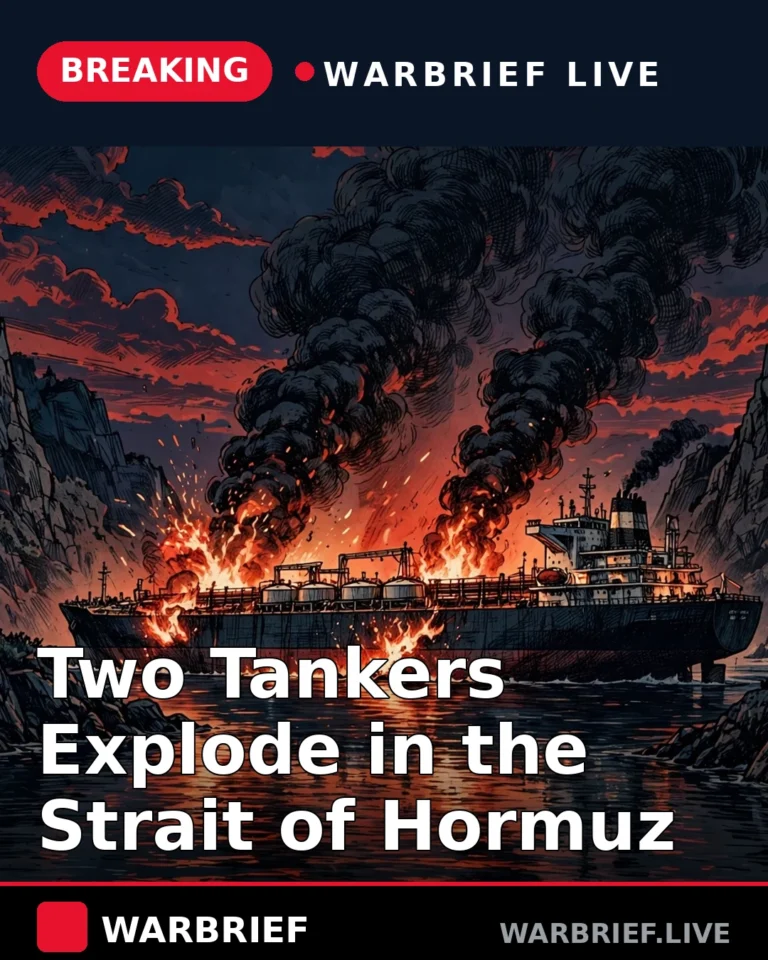
Tankers Iran’s Revolutionary Guard Corps said struck naval mines near the strait on November 28, 2026
The naval mines Strait of Hormuz explained question is back at the centre of the Gulf war: Iran’s Revolutionary Guard Corps said on Saturday, November 28, 2026, that two oil tankers struck naval mines while sailing unauthorised routes near the Strait of Hormuz. The claim has not been independently verified — but it shows why the mine is the most feared weapon in these waters: a device invented in the 19th century can still close the artery that carries a fifth of the world’s oil.
Key Takeaways
- Iran’s Revolutionary Guard Corps Navy said two oil tankers struck naval mines while attempting to navigate unauthorised routes near the Strait of Hormuz, Iranian state media reported on Saturday, November 28, 2026. The IRGC gave no independently verified details of the tankers, their flags, crews or the extent of damage.
- About 20 million barrels of oil and oil products passed through the Strait of Hormuz each day in 2025, according to the US Energy Information Administration — about 20 percent of global oil shipments and about 20 percent of global liquefied natural gas trade, mostly from Qatar.
- The strait is about 33 kilometres wide at its narrowest point, with shipping lanes only two miles wide in each direction, and it is the only sea passage from the Gulf to the open ocean.
- The United States has enforced a naval blockade of Iranian ports since April 2026, briefly lifting it during negotiations and reinstating it in July. US Central Command says its forces have redirected 158 ships and disabled six that refused to comply, including the Palau-flagged Pacific Archer on November 26.
What happened today
Iran’s Islamic Revolutionary Guard Corps Navy said two oil tankers struck naval mines while attempting to navigate unauthorised routes near the Strait of Hormuz, according to Iranian state media, reported on Saturday, November 28, 2026. The IRGC has not provided independently verified details about the tankers, their identities, flags, crew members or the extent of damage. The report came two days after the United States disabled the Palau-flagged bulk carrier Pacific Archer in the Gulf of Oman — see our briefing on the Pacific Archer strike — and on the same day Saudi Arabia and the Houthis traded more than 100 strikes — see our briefing on the Saudi-Houthi escalation.
The mine report fits the pattern of the last nine months. Since the US-Israeli war on Iran began on February 28, 2026, the strait has been effectively closed to most commercial shipping: daily traffic collapsed from roughly 20 million barrels of oil a day to a trickle, and at least 21 vessels had been hit or targeted by mid-March, according to an AFP tally. The United States launched a naval escort mission to clear mines and protect shipping, but it was paused in May after limited success.
How a mine closes a strait
A naval mine is the cheapest area-denial weapon in warfare. There are two basic kinds: contact mines, which detonate when a ship’s hull touches them, and influence mines, which sense a ship’s magnetic field, the sound of its propellers or the pressure of its hull passing overhead, and explode underneath it — where a hull is thinnest and the blast does the most damage. A mine costs a few thousand dollars. The ship it sinks can cost hundreds of millions. And the threat alone is enough: insurers raise war-risk premiums, owners refuse to sail, and a strait closes without a single detonation.
Clearing mines is slow, dangerous and incomplete. Minesweepers must pass over every square metre of a shipping lane, and modern mines can be programmed to ignore the first few ships and detonate under the fifth — or to lie dormant for months. Iran is reported to hold a stockpile of up to 6,000 naval mines, and clearing even a fraction of a mined strait takes weeks of work by specialist ships, under fire, while the war continues. That is why the mine is Iran’s weapon of choice in the strait: it cannot win a conventional naval battle against the United States, but it can make the water itself hostile.
Why the strait matters
The Strait of Hormuz is the world’s most important oil chokepoint. Bounded to the north by Iran and to the south by Oman and the United Arab Emirates, it is the only sea passage from the Persian Gulf to the open ocean. In 2025, about 20 million barrels of oil and oil products passed through it each day, according to the US Energy Information Administration — nearly $600 billion of energy trade a year. The oil comes not only from Iran but from Iraq, Kuwait, Qatar, Saudi Arabia and the UAE, and about 20 percent of global liquefied natural gas also moves through the strait, mostly from Qatar.
The strait has never been fully or permanently closed, but every tremor there registers on world prices. During the Iran-Iraq War of 1980-1988, Iran laid mines in 1987 during the Tanker War, pushing oil prices from over $30 a barrel to more than $45 and doubling tanker freight rates. In June 2025, after US strikes on Iran’s nuclear facilities, Tehran’s parliamentary consensus to close the strait triggered a 6 percent jump in Brent crude. On Friday, November 27, Brent settled at $95.44 a barrel, Reuters reported — up about 3 percent on the week as the Gulf war widened.
Confirmed vs reported
Confirmed: about 20 million barrels of oil and oil products crossed the strait each day in 2025, per the US Energy Information Administration; the strait is about 33 kilometres wide at its narrowest, with two-mile shipping lanes; the US blockade of Iranian ports has run since April, was briefly lifted during negotiations and reinstated in July, per US Central Command’s public statements; US forces have redirected 158 ships and disabled six, per Centcom; the Pacific Archer was disabled on November 26, per Centcom; Brent crude settled at $95.44 on Friday, per Reuters.
Reported, not confirmed: the claim that two tankers struck mines near Hormuz on November 28 comes from the IRGC Navy via Iranian state media, with no tanker names, flags, crew details or damage assessment provided, and no independent confirmation; the reported figure of up to 6,000 Iranian naval mines is an estimate from analysts, not a confirmed inventory; earlier claims in this war — including Iran’s claim to have struck the aircraft carrier USS Abraham Lincoln — were dismissed by Centcom as fabricated.
What happens next
Watch for independent confirmation of the two tankers — ship-tracking data, a company statement or a naval incident report will show whether mines were really involved, and whether the tankers were on an authorised route. Watch also for the US response: Washington’s escort mission was paused in May, and a confirmed mine strike would be the strongest argument for restarting it.
If the mine reports are confirmed, insurance premiums and freight rates through the Gulf will climb further, and more owners will refuse the strait altogether — the closure that a minefield threatens will deepen without a single ship being sunk. If they are not confirmed, the report still serves its purpose: every tanker captain reading it tonight will think twice about the water ahead.
Sources
US Energy Information Administration; IRGC Navy via Iranian state media; US Central Command; Reuters; Xinhua; AFP; The Economist.

Discussion 0
Share analysis, corrections, or context. Be civil — comments are moderated.