
WarBrief Live | November 14, 2026 | Explainer
Gold rises during war because it carries no counterparty risk: when governments, currencies and supply chains look fragile, investors move money into an asset no institution has to honour.
That simple mechanism explains most of gold’s wartime behaviour — and also why it sometimes fails. On November 14, 2026, spot gold traded at around $3,880 an ounce, roughly 30% below the record high near $5,600 it reached in late January, even as the US–Israel–Iran war continued and fighting gripped Yemen. A war was raging, and gold was falling. This explainer sets out why gold usually climbs when wars break out, the three channels that drive it, and the conditions under which the safe haven stops working.
Key Takeaways
- Gold’s safe-haven appeal rests on one property: it has no counterparty risk. A bond needs a government behind it and a share needs a company with future earnings; gold needs neither.
- War lifts gold through three channels: fear-driven buying, war-fuelled inflation, and a weaker dollar or lower real yields.
- History is mixed. Gold jumped about 5.5% in the weeks after Russia invaded Ukraine in 2022, yet its average price for the year was flat — and in 2026 it fell about 30% from its January record even as the Iran war raged.
- Central banks bought 321 tonnes of gold in the third quarter of 2026, the fastest pace in nearly two years — structural demand that outlasts any single crisis.
Why does gold rise when war breaks out?
The first move is psychological, and it is fast. When a war starts, investors sell assets that depend on somebody else keeping a promise — shares, corporate bonds, and the debt of governments that might be drawn into the fighting — and buy assets that depend on nobody. Gold is the oldest such asset: it is not issued by any country, carries no sovereign credit risk, and is recognised as valuable almost everywhere on earth. The World Gold Council puts it plainly, describing gold as an asset with no sovereign credit risk and high liquidity at a moment when “resources and politics are nationalised”.
That flight to safety is usually sharpest in the first days of a conflict, before most retail investors have even processed the news, because institutions move first and move in size. Exchange-traded funds, futures and contracts for difference let that buying arrive in hours rather than weeks, which is why the early spike can look violent. The World Gold Council’s own modelling gives a sense of scale: in its December 2025 commentary, the Council estimated that a 100-point rise in its geopolitical risk index corresponds to roughly a 2.5% rise in the gold price, all else equal. That is a statistical sensitivity, not a promise — but it captures why traders watch the risk index as closely as the battlefield.
“Gold generally offers a safe haven in times of stress, particularly during episodes of high geopolitical risk or policy uncertainty.”
— European Central Bank, Financial Stability Review, May 2025
The second reason gold rises is that war breaks things markets rely on. Supply chains snap, energy prices spike, shipping lanes close, and governments spend heavily on arms, logistics and reconstruction. All of that feeds the same trade: money moving towards the one asset that cannot be printed, devalued by a central-bank decision, or frozen in a foreign account. The pattern is so consistent that the World Gold Council’s outlook for 2026 expects geopolitical factors to “remain front and centre in driving gold demand”, with the geopolitical risk premium that has lifted gold in recent years set to continue and possibly expand.
How war spending and inflation push gold higher
Wars are expensive, and governments rarely pay for them out of current revenue. They borrow, and central banks often accommodate that borrowing by expanding the money supply. More money chasing the same goods erodes the purchasing power of cash — and gold, whose supply grows only slowly through mining, historically holds its value through those inflationary periods. The mechanism is visible in the record: when the United States financed the Vietnam War alongside large domestic programmes in the 1960s, the pressure on public finances helped break the Bretton Woods system, and gold rose dramatically through the 1970s once it was allowed to trade freely. In January 1980, amid the Iranian Revolution, the Soviet intervention in Afghanistan and the second oil shock, gold reached $850 an ounce while US inflation averaged 13.5% for the year.
Energy is the other inflation channel. Wars in oil-producing regions push crude prices up, and dearer fuel raises the cost of almost everything else. That is why gold and oil often rise together at the start of a conflict — though, as WarBrief has reported, oil does not always follow the script either: Brent fell below $90 even as tankers burned in the Strait of Hormuz. When energy-driven inflation makes investors expect central banks to keep interest rates higher for longer, that expectation can weigh on gold even while the war itself supports it — a tension that defined much of 2026.
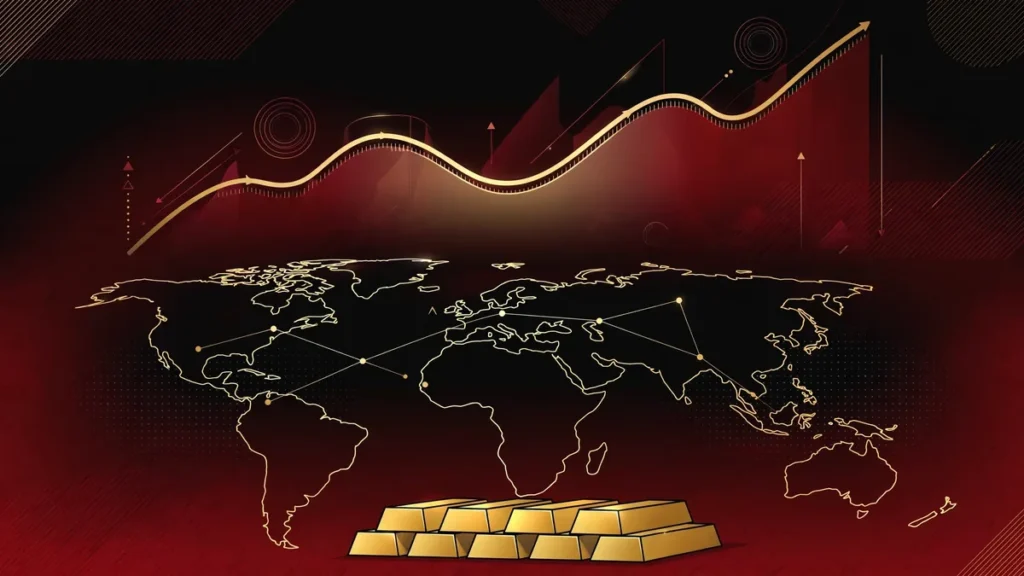
The dollar and real-yield channel
The third channel is the one investors most often miss, and it explains most of gold’s failures as a haven. Gold pays no interest and no dividend. Holding it means giving up the income a bond would pay, so gold competes directly with real yields — the return on a government bond after inflation. When real yields rise, gold becomes more expensive to hold and its price tends to fall; when they fall, gold becomes cheaper to hold and its price tends to rise. The Union of Arab Banks, analysing data from February 2006 to July 2026, found gold’s monthly returns had a correlation of −0.42 with changes in US ten-year real yields, the strongest single relationship in its study. The World Gold Council’s framework estimates that a 25-basis-point fall in the US ten-year yield corresponds to a 1.75% rise in the gold price, all else equal.
The dollar matters for the same reason. Gold is priced in dollars worldwide, so a stronger dollar makes it dearer for buyers in other currencies and tends to push the price down; the same study found a −0.32 correlation with the broad dollar. Crucially, the dollar can itself become the safe haven. If the United States is seen as the stable power in a chaotic world, capital may flow into dollars and Treasuries rather than gold, and gold can stall or fall even as a war worsens. That is exactly what happened in late 2026: market reports attributed gold’s slide below $4,000 to hot US inflation, a strong dollar at a 19-month high, a ten-year Treasury yield near 5.05%, and rising odds of a Federal Reserve rate rise in December. Fear was high, but money was expensive — and expensive money beats fear.
Why central banks keep buying gold
Behind the daily price moves sits a slower, structural force: central banks themselves have become gold’s biggest steady buyers. According to World Gold Council data, official-sector net purchases rose from 79 tonnes in 2010 to 1,080 tonnes in 2022, 1,051 tonnes in 2023 and 1,086 tonnes in 2024 — three consecutive years above 1,000 tonnes. The buying continued into 2026: central banks bought 321 tonnes in the third quarter, up 42% year on year and the fastest quarterly pace in nearly two years. China’s central bank extended its buying streak to 24 consecutive months in October 2026, adding 25.8 tonnes even as global bullion prices fell. And in the World Gold Council’s 2026 central-bank survey, 89% of central banks said they expected global official gold reserves to increase over the next 12 months.
The motive is diversification and insurance, not speculation. Reserves held in another country’s bonds can be frozen — as the sanctions era has repeatedly shown — while gold held in a central bank’s own vault cannot. For a full explanation of how those measures work, see WarBrief’s guide to how oil sanctions work, from price caps to shadow fleets. War, sanctions and the fracturing of the old financial order have turned gold from a crisis trade into a strategic reserve asset, and that structural demand is one reason the World Gold Council expects gold to remain supported even when short-term sentiment turns against it.

What history shows: gold in four wars
The record rewards careful reading, because gold’s wartime rallies are real but uneven. When Iraq invaded Kuwait in August 1990, gold gained about 9% — then surrendered those gains as the coalition’s swift victory removed the uncertainty. When Russia invaded Ukraine in February 2022, gold jumped roughly 5.5% in the following weeks, climbing from about $1,800 to more than $2,000 an ounce as European investors faced energy shocks, accelerating inflation and fear the conflict would spread. Yet the World Gold Council’s annual average gold price for 2022 was $1,800.10, virtually unchanged from $1,798.60 in 2021: aggressive Federal Reserve tightening pushed real yields up by 235 basis points during the year, and that headwind cancelled out the war premium.
The 2025 rally was different again. Amid Israel–Iran tensions in April 2025, gold touched roughly $3,500 an ounce, and the annual average price rose 44% to $3,431.50 from $2,386.20 in 2024. Then came 2026, the year that broke the simple rule. Gold set more than a dozen all-time highs in the first weeks of the year and reached a record near $5,600 an ounce in late January. When the US–Israel–Iran war erupted on February 28, gold was valued at roughly $5,278 an ounce and stayed mostly stable in the early phase — then fell by more than 20% to about $4,175 over the following months, even as the fighting continued. By the end of October it traded near $3,870. The war did not end — as WarBrief reported, President Trump later described the Iran war as “effectively over” while the status quo on the ground remained contested — but the market had moved on to interest rates, the dollar and profit-taking. WarBrief’s conflict zones hub tracks the fighting that drives these moves.
Gold in wartime: by the numbers
| Metric | Figure | Source |
|---|---|---|
| Spot gold, November 14, 2026 | ~$3,880 per ounce (CONFIRMED) | Live price feeds, GoldPrice.com |
| Record high, late January 2026 | ~$5,600 per ounce (CONFIRMED) | Market data; 52-week high $5,596.68 |
| Fall from January peak to October 30, 2026 | ~30%, to ~$3,870 (CONFIRMED) | Market reports, multiple outlets |
| Gold after Russia invaded Ukraine, February 2022 | +~5.5% in the following weeks (CONFIRMED) | CNBC |
| Gold after Iraq invaded Kuwait, August 1990 | +~9%, then gains surrendered (CONFIRMED) | Union of Arab Banks |
| Central-bank net gold buying, Q3 2026 | 321 tonnes, +42% year on year (CONFIRMED) | World Gold Council |
| Gold, July–November 2008 financial crisis | −24% (CONFIRMED) | Union of Arab Banks |
| World Gold Council model: 100-point geopolitical-risk rise | ~+2.5% gold price (MODEL ESTIMATE) | World Gold Council |
Figures marked CONFIRMED are supported by at least two sources. The World Gold Council model figure is a statistical sensitivity, not a prediction that any given conflict will lift gold by that amount.
Does gold always rise during war?
No — and the exceptions are as instructive as the rule. Gold fell 24% between July and November 2008, during the worst financial crisis in decades, because investors sold everything liquid to meet margin calls and the dollar strengthened. Its 2022 annual average was flat despite a major European war, because rising real yields offset the fear premium. And in 2026 it lost roughly 30% from its January record while a war involving the United States, Israel and Iran was under way, because hot inflation, a strong dollar and the prospect of higher interest rates mattered more to the price than the fighting did.
Four conditions tend to break the pattern. First, a strong dollar: when the greenback is the haven, gold stalls. Second, rising real yields: when bonds pay a high inflation-adjusted return, a zero-yield asset looks costly to hold. Third, forced selling: in a liquidity crunch, investors sell gold to raise cash, exactly as they did in 2008. Fourth, a war that is already priced in: if markets have spent months expecting a conflict, the outbreak itself may bring selling rather than buying, as profit-takers exit positions built in anticipation. The safe-haven mechanism is real, but it competes with these forces on every trading day — and in 2026, the other forces won.
What gold’s war premium means for US, UK and EU readers
For households, the most direct effect is the price of physical gold: jewellery, coins and bars track the spot price, so the 2026 slide from near $5,600 to around $3,880 cut the cost of a wedding ring or a sovereign coin by roughly a third — while anyone who bought near the January peak is sitting on a steep paper loss. For savers and pension holders, gold’s moves matter indirectly: it is held inside many pension funds and commodity funds, and its swings feed into the same inflation and interest-rate expectations that set mortgage rates and savings returns. Travellers feel it through the dollar: a strong greenback that pressures gold also makes holidays and imports dearer for Europeans, while a weaker dollar does the reverse.
For markets, gold is a barometer rather than a cause. When it rises with oil, as it did in early 2026, energy bills and inflation usually follow; when it falls while oil rises, as it did later in the year, the signal is that interest rates, not war, are driving prices — a distinction WarBrief explored when it examined why oil prices fell in November 2026 even as the Iran war premium lingered. For security, the central-bank buying story is the one to watch: when the world’s monetary authorities accumulate gold at the fastest pace in years, they are insuring against a financial order they no longer fully trust. That is a structural shift, not a headline, and it will outlast the current wars.
This article is educational only. It is not financial advice, and it does not recommend buying or selling gold or any other asset. Gold prices can fall sharply even during wartime, as 2026 has shown.
Frequently asked questions
Does gold always go up during war?
No. Gold often rises sharply at the start of a conflict, but it has also fallen during wars — it dropped 24% in the 2008 financial crisis, its 2022 annual average was flat despite Russia’s invasion of Ukraine, and it fell about 30% from its January 2026 record while the Iran war was under way. The outcome depends on the dollar, real interest rates and whether the war was already priced in.
Why is gold considered a safe haven?
Because it carries no counterparty risk: no government, company or bank has to honour a promise for gold to hold value. It cannot be printed, devalued by a central-bank decision or frozen in a foreign account, and it is recognised as valuable almost everywhere. The European Central Bank’s Financial Stability Review states that gold “generally offers a safe haven in times of stress, particularly during episodes of high geopolitical risk or policy uncertainty”.
How much did gold rise when Russia invaded Ukraine?
Gold jumped roughly 5.5% in the weeks after the February 2022 invasion, climbing from about $1,800 to more than $2,000 an ounce. But the rally did not last the year: aggressive US interest-rate rises pushed real yields up by 235 basis points, and the World Gold Council’s annual average price for 2022 was $1,800.10, virtually unchanged from 2021.
What makes gold fall during a war?
Four forces can overpower the safe-haven bid: a strong US dollar, rising real interest rates, forced selling when investors need cash, and a war that markets had already priced in. In late 2026, hot US inflation, a 19-month high for the dollar and a ten-year Treasury yield near 5.05% drove gold below $4,000 even as fighting continued in the Middle East.
Why are central banks buying so much gold?
Central banks bought 321 tonnes in the third quarter of 2026, up 42% year on year, and 89% of them expect global official reserves to keep rising. They are diversifying away from currencies that can be frozen by sanctions and insuring against a fracturing financial order — buying gold as a strategic reserve asset, not as a short-term trade.
Sources
- World Gold Council: Gold Demand Trends Outlook 2026
- Union of Arab Banks: Gold Beyond the Safe Haven — What Has Really Driven Its Price Since 1980?
- IndexBox: Gold Price Analysis 2026 — Safe-Haven Shift, Central Bank Buying, and Market Outlook
- Jainam: How Wars and Economic Crises Affect Gold Prices
- LiquidityFinder: Is War Good or Bad for Gold (XAUUSD)? The Trading Truth
- GoldPrice.com: Live Gold Spot Price, November 14, 2026


Discussion 0
Share analysis, corrections, or context. Be civil — comments are moderated.