WarBrief Live | October 21, 2026 | Intelligence Report
On October 21, 2026, the State Bank of India confirmed that 3,897 of its customer records containing personal data had been found on the dark web — nine days after hackers disabled refrigeration in more than 700 French supermarkets. The incidents are unrelated in attribution but share a signature analysts are watching: civilian systems, hit at scale, with no war label attached.
Executive Summary
- SBI’s review of roughly 375,000 records found 3,897 customer records with personal data; core operations are unaffected and an independent CERT-In-empanelled agency is investigating.
- Overnight October 11–12, hackers manipulated Danfoss refrigeration controllers in 700+ French supermarkets — raising defrost temperatures to 50°C and stretching defrost cycles to delay alarms — breaking the cold chain. A smaller second wave targeted Dixell equipment.
- The pattern — financial data in India, food cold-chain in France — points to a broadening target set: ordinary civilian operational technology, reached through third-party vendors. No actor has claimed the French attack; the “Siriusim” claim on the SBI leak is unverified.
What happened: a bank breach in India, melted cold rooms in France
On Wednesday, October 21, SBI disclosed in an exchange filing that on October 16 it had received alerts from its threat intelligence provider, India’s Defence Cyber Agency, and CERT-In about suspected customer-data exposure. Reviewing roughly 375,000 records, it identified 3,897 records with personal data: mobile numbers, dates of birth, names, email and residential addresses, branch and customer-file identifiers, and loan-record metadata.
The bank said it activated its cyber incident response protocols, engaged an independent CERT-In-empanelled cybersecurity agency, and stated the incident has had no material impact on core operations or business continuity.
Separately, on the night of October 11–12, hackers struck French supermarket refrigeration systems. First reported by BFM-TV and detailed by Le Monde, it hit around 300 Intermarché stores (including Netto), about 100 Coopérative U, roughly 80 Carrefour, several E.Leclerc outlets, and around 30 Monoprix — with a later Le Monde analysis putting the total above 700 stores. Attackers raised defrost temperatures to 50°C and stretched the defrost cycle from one hour to eight hours so alarms triggered later. Stores emptied freezers and discarded perishables; one Intermarché owner reported losses of €21,000 at purchase price.
How the French refrigeration attack worked
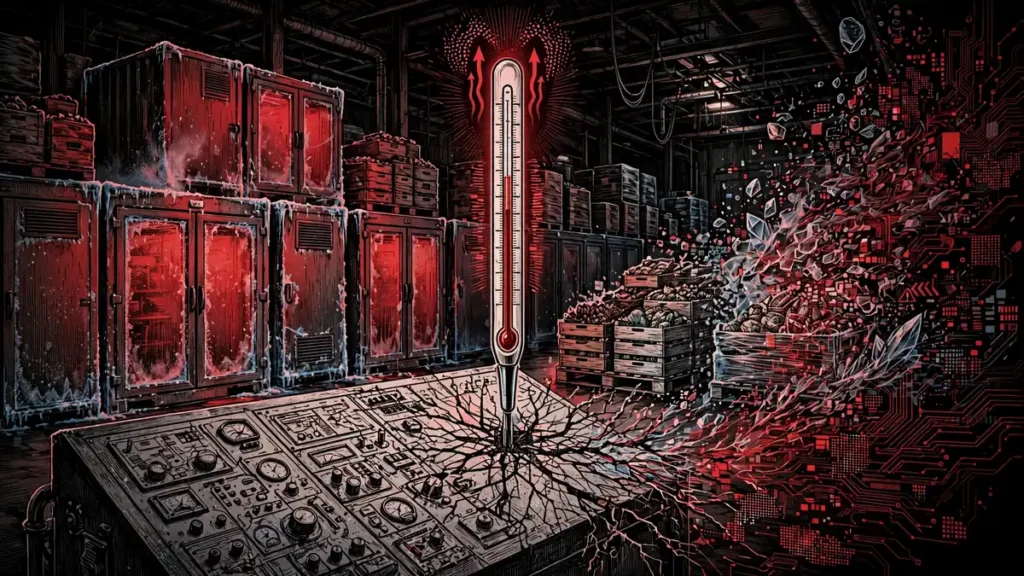
The details point to an operational-technology (OT) compromise. According to Le Monde, the first wave exploited refrigeration controllers made by Denmark’s Danfoss; ANSSI later flagged compromises affecting Dixell equipment, made by the US company Emerson, in a smaller second wave.
The method was deliberate: rather than shutting systems down — which would trigger immediate alarms — the attackers reprogrammed the defrost cycle, keeping temperatures climbing for hours. One manager discovered the breach at 4 a.m. when a delivery driver found the storeroom flooded, cold-room temperatures at 50°C, and the sprinkler system set off.
Critically, the supermarkets do not manage the IT controlling their refrigeration. Dominique Schelcher, president and director general of Système U, said on RTL that U stores are customers of refrigeration specialists who supply the Danfoss solution the hackers exploited; the specialist’s identity has not been made public. That structure — one vendor’s controllers deployed across hundreds of stores in competing chains — is what let a single compromise scale into a national incident.
What is confirmed — and what remains unverified
For SBI, confirmed: the bank’s filing establishes the timeline (alerts October 16, disclosure October 21), the figures (3,897 records with personal data among roughly 375,000 reviewed), the data categories, the independent CERT-In-empanelled investigator, and the bank’s statement that operations continue normally. Unverified: a threat actor calling itself “Siriusim,” flagged by the X account CyberPulse, claimed the dataset held 375,000 CSV rows and 2,722 PDFs including loan applications and account-opening forms. Authenticity, the full extent of exposure, and the actor’s identity are unconfirmed.
For the French attack, confirmed: the scale (700+ stores across multiple chains), the dates (overnight October 11–12), the method (defrost manipulation to 50°C, extended cycles), the vendor equipment (Danfoss, then Dixell), and ANSSI’s alert. Unverified: attribution and motive — no state or group has been named, and Le Monde’s October 17 follow-up notes the chain of responsibility is not fully clarified.
Related but distinct: the Economic Times reports that on October 15–17, the Central Bank of India shut down and isolated its RTGS outward system after a technical glitch and brought in external experts — with no customer financial loss and no attribution to a cyberattack. It should not be conflated with the SBI disclosure. CERT-In’s October 15 advisory about AI agents as attack vectors — noting observed cases where AI tooling compressed the window between compromise and impact from days to hours — is relevant threat context, not evidence linking these incidents.
Why civilian-infrastructure cyberattacks are accelerating
The French case is a warning because the target was unremarkable: refrigeration controllers, not power grids. ANSSI noted in a November 2024 report that 46 water-management organizations were hit by IT-related incidents between January 2021 and August 2024. What is new is the ability to reach hundreds of civilian sites at once through a shared vendor, causing disruption without touching anything classified as critical.
The two October incidents illustrate complementary attack economics. The SBI exposure monetizes personal and loan data — the raw material of identity theft and fraud. The French attack weaponized perishability: food cannot be restored once the cold chain breaks, so damage is irreversible even if systems recover quickly. Both share a common entry logic — compromise the third party, not the fortress — echoing the broader pattern of attackers exploiting trusted intermediaries.
State-linked cyber pressure on infrastructure has been building across 2026 — see WarBrief’s Iran cyber retaliation threat assessment — but these incidents carry no war label. That is the analytical point: civilian systems are now targeted in peacetime, by actors who may be criminal, state-directed, or both, and victims often learn of the breach from a threat-intelligence feed rather than their own monitoring.
Assessment and outlook
The October incidents likely reflect a structural shift, not coincidence: attackers increasingly prefer civilian operational technology and third-party data handlers — reliable payoff, hard attribution. One vendor compromise cascaded across competing companies; dark-web data markets create long-tail fraud risk even when core systems are untouched.
What to watch: (1) whether ANSSI or CERT-In name an actor or malware family — attribution would determine whether this is crime, espionage, or signaling; (2) whether French regulators mandate segmentation between refrigeration OT and store IT, long resisted on cost grounds; (3) whether the Dixell second wave grows, indicating retained access or shared tooling; (4) follow-on fraud in India using the exposed SBI records, which typically surfaces weeks after exposure. Track further reporting in the WarBrief Intelligence Reports hub and our analysis of ransomware monetization tactics.
Sources
- The Indian Express: State Bank of India reports cyberattack involving nearly 3,900 customer records
- The Economic Times: SBI probes suspected data breach after 3.75 lakh records surface on dark web
- Le Monde: A disastrous day for French supermarkets after massive cyberattack targets refrigeration systems
- Le Monde: French supermarket fridge cyberattack — a warning for the industry
- Le Monde: After Danfoss, hackers strike other refrigeration systems used in France