
WarBrief Live | October 15, 2026 | Breaking Analysis
The container ship GFS Pride sank in the Strait of Hormuz on October 14, 2026, after what Iran says was a strike by one of its naval mines — the first mine sinking Tehran has claimed in the Iran war. But Singapore’s maritime authority says the Singapore-flagged vessel was hit by an unidentified projectile, and it remains unresolved whether the two accounts even describe the same sinking. What is not in dispute is the tempo: attacks on commercial shipping near the strait are running at their highest pace since the war began.
Key Takeaways
- Iran’s Revolutionary Guard navy said on October 14 that a cargo ship carrying 2,500 containers sank after striking one of its naval mines on an “unauthorized” route through the Strait of Hormuz — the first mine sinking it has reported in the war.
- Shipping officials identify the ship that sank as the Singapore-flagged container vessel GFS Pride, struck by an unidentified projectile on October 13. All 21 crew were rescued; a second vessel, the GFS Giselle, was hit the same day but reached safety.
- It is not confirmed that the ship Iran says hit a mine is the same vessel that sank. The Associated Press and other outlets note the two accounts may describe the same sinking — or two different incidents.
- At least 10 vessels have been attacked near the strait since October 11, the highest pace since the war began, according to security data from Vanguard, the International Maritime Organization and UKMTO.
What happened to the GFS Pride?
According to British security firm Vanguard, the Singapore-flagged container ship GFS Pride was struck by a projectile on Tuesday, October 13, and sank on Wednesday, October 14, in waters near the Strait of Hormuz. The Maritime and Port Authority of Singapore said all 21 crew members were rescued and that a second Singapore-registered vessel, the GFS Giselle, was hit the same day but “left the area under its own power.” No injuries were reported in either incident.
Hours before the sinking was confirmed, Iran’s Islamic Revolutionary Guard Corps (IRGC) navy issued a very different account. State television quoted an IRGC statement saying a container ship had “struck a mine that exploded” while “attempting to cross the Strait of Hormuz using an unauthorized and dangerous shipping lane.” The IRGC said the ship was carrying 2,500 containers when it caught fire. Released images showed a vessel tilted in the water with a thick plume of black smoke and containers floating in the sea — though the Associated Press noted it could not independently verify those images. The sinking is part of a sharp escalation across the conflict zones monitored by WarBrief this week: Vanguard reported three other ships struck on Tuesday alone.
Did an Iranian sea mine sink the GFS Pride — or a missile?
This is the central open question, and the evidence so far supports neither account fully. The IRGC’s mine claim would mark a major tactical threshold: Iran has used drones, missiles and projectiles against merchant shipping since the war began, but it has never before announced a successful mine sinking. A mine strike is also harder to verify from afar than a missile hit, and Tehran’s released footage establishes only that a large container ship caught fire and sank — not what set it ablaze.
Singapore’s account points the other way. The Maritime and Port Authority of Singapore — the flag state of the vessel — said both ships were hit by “unknown projectiles,” and called the attacks “unprovoked, unjustifiable, and a breach of international law.” UKMTO, the British maritime monitoring agency, likewise described projectile strikes rather than a mine incident. Neither side has produced evidence that conclusively settles the matter, and the Associated Press has been careful to note that it is unclear whether the ship Iran says hit a mine and the GFS Pride are even the same vessel. Open-source maritime trackers add one more unverified detail — that the Pride was UAE-owned and had its tracking signal switched off for roughly 10 days — which WarBrief treats as unconfirmed.
Background: how Iran’s strait campaign escalated
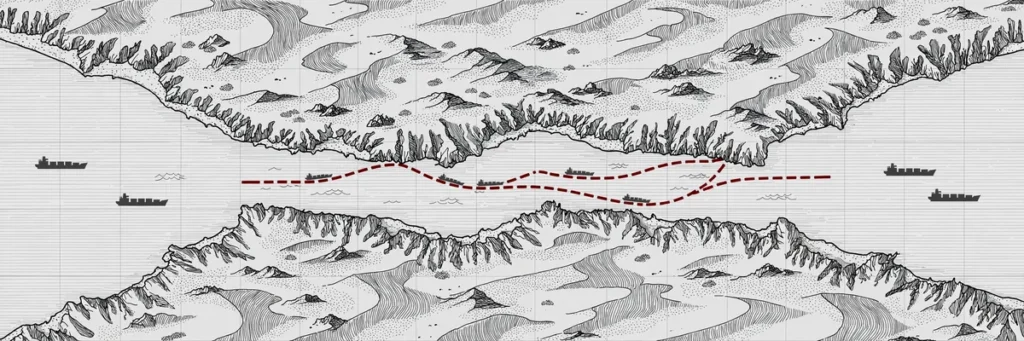
Merchant vessels transiting the Strait of Hormuz were first targeted by Iran in March 2026, in retaliation for the US-Israeli strikes on Iranian territory that triggered the war, according to security data reported by Agence France-Presse. Since then Tehran has steadily widened the campaign, warning ships against transiting without its approval, while the US military has imposed its own embargo on Iranian ports and guided commercial traffic along a route nearer to Oman’s coast.
The campaign has also taken on new forms. US Central Command said its forces destroyed an Iranian-affiliated dhow in the Gulf of Oman on October 6, accusing it of conducting surveillance and targeting US Navy ships. Reuters has reported that after American strikes degraded much of Iran’s radar capability, the IRGC began using unarmed spotters in small boats to identify targets — and that two senior Iranian officials described the new tactics as designed to keep oil prices high and influence the US midterm elections. Senior Tehran figure Mohsen Rezaei told state television that Iran targets five or six vessels every night: an Iranian claim, not an independently verified figure.
By the numbers: the October attack surge
Security data shows the shipping campaign has accelerated sharply this month. Four vessels were struck on Tuesday and six on Sunday — the highest single-day total since the conflict began.
| Metric | Figure | Source |
|---|---|---|
| Vessels attacked near Hormuz since Oct 11 | 10 — the highest pace since the war began | Vanguard / IMO / UKMTO, via AFP (CONFIRMED) |
| Attacks recorded in October (as of Oct 14) | 23 — nearly double the average monthly rate | Security data, via AFP (CONFIRMED) |
| Crew rescued from the GFS Pride | All 21, no injuries | Singapore MPA, via AP (CONFIRMED) |
| Hormuz oil flows at start of October | ~80% of pre-war levels, then fell back | Vanguard analyst, via AFP (CONFIRMED) |
| Sailors killed in attacks since the conflict began | 24 | UN maritime agency, via The Business Standard (REPORTED — single source) |
Caveat: figures marked CONFIRMED are corroborated by at least two independent sources; figures marked REPORTED come from a single source or an involved party and should be treated with caution.
Why the first mine sinking of the war changes the math
Whether or not a mine actually sank the GFS Pride, the claim itself matters — because sea mines change the economics of a shipping campaign in ways missiles cannot. A missile strike is a one-shot event; a minefield is a persistent threat that lingers for weeks, forcing navies into slow, expensive mine-clearance operations before insurers and shipowners accept the risk of transit. That is precisely the leverage Tehran has been seeking: the real bill for the Hormuz blockade is measured not only in damaged hulls but in war-risk premiums, rerouted voyages and crews who refuse to sail. A confirmed mine sinking would also invite a sharper response from the US-led naval presence than the attritional campaign has so far produced — and the pattern of strikes on tankers and container vessels, including the recent drone attack on the MT Petro Dolphin, suggests Tehran is now willing to contest shipping across vessel types and flags. Iran’s parliament speaker, Mohammad Bagher Qalibaf, said on October 14 that Iran must be prepared for war even as it negotiates with Washington, warning that a signed agreement is no guarantee because, in his words, the Americans “break their promises.”
What the GFS Pride sinking means for US/UK/EU readers
Fuel prices. The strait carried roughly one-fifth of the world’s hydrocarbons before the war, so every attack feeds into global energy prices. Flows had recovered to about 80 percent of pre-war levels at the start of October — and have since fallen back as attacks intensified. If a mine campaign is real, or even widely believed, insurers will price the strait as a mine-risk zone, and the cost will land on petrol, diesel and heating bills as winter approaches.
Goods and travel. A single container ship carries thousands of containers — 2,500 in the IRGC’s account of this sinking — and freight surcharges feed into the price of imported goods. October is already the worst month of the war for merchant shipping. The escalation is also spilling into the air: Houthi strikes on Saudi airports have disrupted hundreds of flights in the past ten days.
WarBrief’s coverage is educational and informational only — never financial advice.
What to watch next in the Strait of Hormuz
The first question is verification: whether any naval force conducts a wreck survey or mine-clearance sweep that confirms — or disproves — the IRGC’s mine claim. A confirmed minefield would likely trigger a formal naval response from the US and its partners. The second is tempo: ten vessels in four days is already the fastest rate of the war, and if it holds, insurers may effectively close the strait to traffic that cannot secure naval escort — a de facto blockade without anyone declaring one. The third is the political clock. Reuters’ reporting that Iranian officials see the campaign as a lever on oil prices ahead of the US midterm elections gives the escalation a deadline of sorts — though, as Qalibaf’s speech made clear, Tehran is preparing for the possibility that deterrence fails. Separately, CNN has reported, via the Jerusalem Post, that US strike plans against Iran include the GBU-43/B Massive Ordnance Air Blast bomb aimed at Iranian energy infrastructure and nuclear sites. That reporting remains unconfirmed by the Pentagon, but it signals how far planning for the next phase has already gone.
Frequently asked questions
Did an Iranian mine really sink the GFS Pride?
Iran’s Revolutionary Guard says so. Singapore’s maritime authority and shipping monitors say the vessel was hit by an unidentified projectile. It is not even confirmed that both accounts describe the same sinking, so the cause remains disputed.
What happened to the crew of the GFS Pride?
All 21 crew members were rescued with no injuries reported, according to Singapore’s Maritime and Port Authority. A second vessel hit the same day, the GFS Giselle, left the area under its own power.
How many ships have been attacked near the Strait of Hormuz?
At least 10 vessels since October 11, and 23 attacks in October overall — nearly double the average monthly number since the war began, per security data from Vanguard, the IMO and UKMTO reported by AFP.
Is the Strait of Hormuz closed to shipping?
No. Traffic continues, though oil flows have fallen back after recovering to about 80 percent of pre-war levels. The US military guides vessels along a route nearer to Oman’s coast, while Iran warns ships against transiting without its approval.
Will oil prices rise after the GFS Pride sinking?
A sustained disruption would put upward pressure on fuel prices, since the strait carried roughly one-fifth of the world’s hydrocarbons before the war. Vanguard analysts link the current attack surge to exports recovering toward pre-war levels — suggesting Tehran is targeting the recovery itself.
Sources
- Associated Press: Iran says a ship sank after striking a mine in Strait of Hormuz, and other Middle East developments
- The Times of Israel: Iran Guards say cargo ship sank in Hormuz after hitting mine
- Agence France-Presse (via GMA Network): Attacks in Strait of Hormuz reach highest level since start of war — security data
- The Hindu: Iran reports cargo ship sinks after hitting mine in Strait of Hormuz
- Gulf News: US-Iran war — ships sunk, flights cancelled, trade rerouted: your Oct. 15 briefing


Discussion 0
Share analysis, corrections, or context. Be civil — comments are moderated.