
WarBrief Live | October 13, 2026 | Travel & Airspace Safety
If you are booked on a flight to or from Saudi Arabia this week, assume it will not operate as scheduled. Riyadh’s King Khalid International Airport remains closed after repeated missile and drone strikes by Yemen’s Houthis, and a growing list of airlines — from IndiGo and Etihad to Qatar Airways, Lufthansa and Air France-KLM — has cancelled or suspended services to the kingdom. More than half of all outbound flights from Saudi airports failed to operate on Sunday, according to aviation data cited by Gulf News. Here is what we know, which routes are affected, and what to do if your trip is in the firing line.
Key Takeaways
- Riyadh’s King Khalid International Airport is closed until at least October 17 under a notice to airmen; Saudi authorities say safety checks come first.
- At least 12 airlines have cancelled or suspended flights to Saudi cities, including Riyadh, Jeddah and Dammam — some suspensions run to November and beyond.
- The US, UK, Canada, Germany and Spain have warned citizens to avoid Riyadh airport; the US Embassy says Americans should expect flight cancellations and airspace closures.
- If you are booked, contact your airline before heading to the airport — most carriers are handling rebooking or refunds for cancelled services directly.
Is Riyadh airport open right now?
No. King Khalid International Airport has been closed since October 10, when a Houthi missile and drone strike hit the airport, killing 12 people and injuring 309, according to Saudi Arabia’s General Authority of Civil Aviation (GACA), figures reported by Reuters and the Associated Press. A second strike on October 11 hit Terminal 4, killing a Pakistani resident and wounding 11 others, GACA said. On October 12, the Houthis claimed a third missile strike on the airport; the Saudi-led coalition said the missile was intercepted and destroyed.
The airport’s closure has been extended repeatedly. A notice to airmen (NOTAM) now keeps operations suspended through October 17, Reuters reported on October 12. GACA’s most recent public update said the suspension would remain “until further notice” while it verifies the safety and operational readiness of the airport’s facilities. Until the authority declares the airport secure, travelers should treat every booking through Riyadh as cancelled.
Dammam is not a clean substitute. GACA reported that King Fahd International Airport near Dammam was also targeted on the evening of October 11, with damage assessments and safety inspections underway, China Daily reported. Jeddah’s airport remains the most open of the three major Saudi airports, but several airlines have cancelled selected Jeddah services too. Our analysis of the Houthi air campaign covers how the escalation reached this point; this article sticks to what it means for your travel plans.
Which airlines have cancelled flights to Saudi Arabia?
The list is growing daily. The positions below are as reported on October 12–13, 2026 — several airlines have already extended their initial suspensions once, and more updates are expected. Always check your booking directly with the carrier before traveling.
Gulf and Middle East carriers. Etihad Airways cancelled all flights between Abu Dhabi and Riyadh until at least October 19, along with Abu Dhabi–Dammam flights on Tuesday and Wednesday and selected Abu Dhabi–Jeddah services through Thursday, regional outlets reported citing the airline’s notices. Qatar Airways has temporarily suspended flights to Riyadh and Dammam with no restart date announced. Gulf Air cancelled its Riyadh services from October 12 to October 17. Kuwait Airways cancelled Riyadh flights following the airport’s shutdown, and EgyptAir said it was suspending flights from Cairo and Alexandria to Riyadh until operations resume.
European carriers. The Lufthansa Group cancelled all flights to Riyadh until October 16, Reuters reported. Air France-KLM extended its suspension of services to and from the Saudi capital until the end of the month. KLM separately suspended its Riyadh and Dammam services through October 31, according to the airline’s notices.
Asian carriers. India’s IndiGo has cancelled flights to Riyadh, Jeddah, Dammam and Madinah through October 17, the airline announced on October 13. Akasa Air suspended its Jeddah and Riyadh services. Air India extended its suspension of flights to and from Riyadh until October 15. Philippine Airlines extended its suspension of flights to and from Riyadh all the way to November 29. Cathay Pacific postponed the resumption of its Hong Kong–Dubai and Hong Kong–Riyadh routes through January 31, 2027. Emirates and flydubai cancelled Dubai–Riyadh services for October 13–14, according to Gulf News.
US carriers. Delta Air Lines said it would delay its planned Atlanta–Riyadh service until March 2027.
The disruption is not limited to Riyadh-bound flights. Aviation analytics firm Cirium found that more than half of all flights leaving Saudi airports on Sunday did not operate, according to Gulf News, and The Business Standard reported cancellations across Saudi airports reached 46.4%.
By the numbers: the travel disruption
| Metric | Figure | Source |
|---|---|---|
| Killed, October 10 airport strike | 12 | Saudi GACA (via AP/Reuters) — CONFIRMED |
| Injured, October 10 strike | 309 | Saudi GACA — CONFIRMED |
| Killed, October 11 Terminal 4 strike | 1 (Pakistani resident) | Saudi GACA — CONFIRMED |
| Injured, October 11 strike | 11 | Saudi GACA — CONFIRMED |
| Riyadh airport closure extended to | October 17 (NOTAM) | Reuters — CONFIRMED |
| Cancellations across Saudi airports | 46.4% | The Business Standard — CONFIRMED |
| Outbound Saudi flights not operating (Sunday) | More than half | Cirium via Gulf News — CONFIRMED |
| KLM Riyadh/Dammam suspension through | October 31 | KLM notices — REPORTED |
| Etihad Abu Dhabi–Riyadh cancelled until | October 19 | Airline advisories via regional outlets — REPORTED |
| Cathay Pacific HK–Riyadh resumption | Postponed to Jan 31, 2027 | Reuters — REPORTED |
Figures marked CONFIRMED appear in two or more independent sources; REPORTED figures come from a single source. Airline positions are changing by the day — treat the dates as the carriers’ published positions, not permanent schedules.
Is it safe to fly over Saudi Arabia?
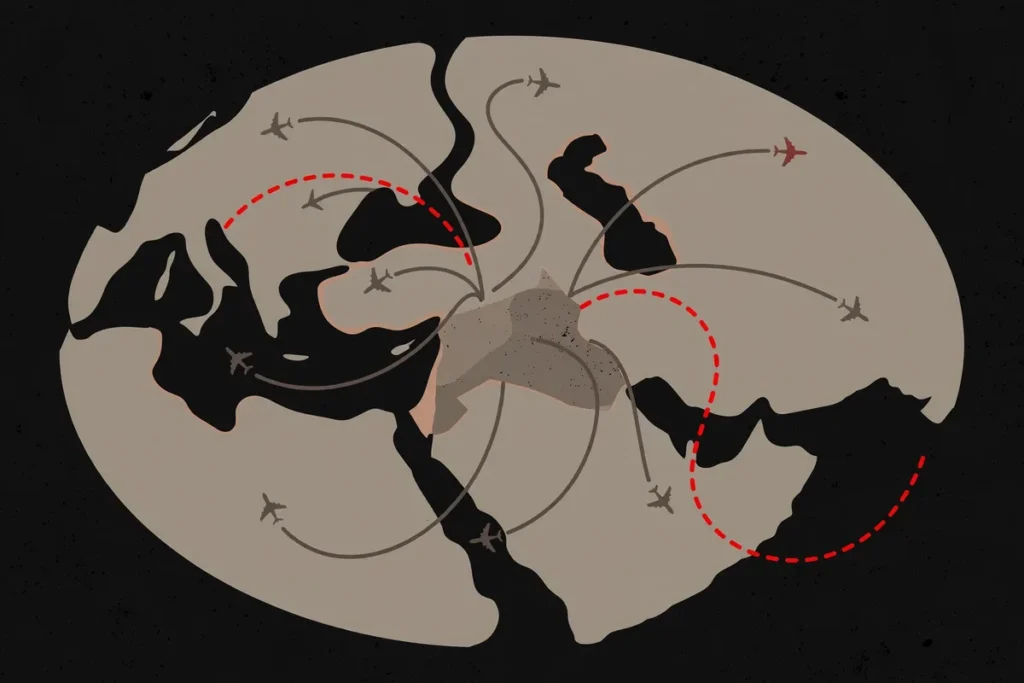
Regulators are treating Saudi airspace with unusual caution. The US Federal Aviation Administration warned American carriers on October 11 to exercise caution over Saudi airspace, following a similar warning from the European Union Aviation Safety Agency on October 9, The Business Standard reported. Aviation safety group OPSGROUP went further, recommending that airlines avoid the southern Middle East flight corridor entirely and reroute Europe-to-Asia flights over Central Asia — a longer path that limits access to Gulf hubs such as Dubai and Abu Dhabi.
The Houthis have declared Saudi airspace and airports to be military targets as part of their air campaign — our morning briefing on the campaign has the full military picture. Whether or not further strikes materialize, insurers and flight planners are pricing in the risk, which is why the cancellations keep spreading even to cities that have not been hit.
Embassies are not mincing words. The US Mission in Saudi Arabia “strongly recommends all US citizens avoid this airport and surrounding areas,” and said Americans should expect “potential flight cancellations, airspace closures, and travel disruptions,” Arab News reported. US government employees now need special authorization to use the airports in Riyadh, Jeddah and Dammam. Britain’s Foreign Office urged its citizens to avoid King Khalid International Airport until it is secure, while Canada, Germany and Spain issued similar warnings, AFP reported. The US State Department’s travel advisory for Saudi Arabia stands at Level 3 — reconsider travel.

What this means for US/UK/EU readers
For American, British and European travelers, the disruption lands in three ways. First, direct travel to Saudi Arabia — whether for business in Riyadh, pilgrimage, or connecting through the kingdom — is effectively off the table until at least October 17, and quite possibly longer if the closure is extended again. Second, even flights that merely overfly Saudi airspace may be rerouted, adding time and cost to Europe–Asia itineraries that pass over the region. Third, Gulf connecting hubs are feeling knock-on effects: Cathay Pacific has pushed its Hong Kong–Dubai resumption to January 2027, and KLM has adjusted Dubai suspensions as well.
Pilgrims deserve a special note. Jeddah is the usual gateway for Umrah and Hajj travel, and while it has seen fewer cancellations than Riyadh, some services are affected — IndiGo, for instance, has cancelled Jeddah flights through October 17. Anyone planning pilgrimage travel should confirm their routing with their airline and watch for updated guidance from Saudi authorities before committing to non-refundable bookings. Business travelers should note that organizers of major energy and investment conferences in Riyadh have said their events will go ahead as planned — but getting there is now the problem.
One more ripple worth watching: the region’s shipping lanes are being disrupted in parallel. Our look at October’s real shipping bill from the Hormuz disruption shows how air and sea logistics are tightening at the same time. For the broader conflict map, see our Conflict Zones hub.
What to do if you are booked on a cancelled flight
Do not go to the airport on the assumption your flight will operate. Check your booking status directly with the airline — flight trackers and third-party apps can lag behind fast-moving cancellations. If your flight is cancelled, contact the airline about rebooking or a refund; carriers typically handle these options directly with affected passengers, but the exact terms are set by each airline, so get them from the source.
Check your travel insurance. Many travel policies exclude losses linked to war, terrorism or civil unrest — read the fine print of your policy before assuming you are covered for cancellation or rebooking costs. If you bought “cancel for any reason” cover, this is the moment it earns its keep.
Consider alternative routings carefully. Dammam has also been targeted and some carriers have suspended services there, so it is not a reliable backup for Riyadh. Jeddah remains the most operational of the big three Saudi airports, but check your specific flight. Regional hubs like Dubai, Abu Dhabi, Doha and Bahrain still have services, though some are reduced — KLM and Cathay Pacific have trimmed Dubai operations too.
Watch the NOTAM and embassy advice, not rumors. Social media is full of unverified claims about further strikes. The reliable signals are the aviation authority’s notices, your airline’s advisories, and your government’s travel guidance. If your embassy is telling citizens to avoid an airport, believe it.
What to watch next
The first question is whether King Khalid International reopens on October 17 as the NOTAM currently indicates — or whether the closure is extended again. The second is whether the Houthis’ claimed October 12 strike marks a pause or the start of a sustained campaign; the Saudi-led coalition has vowed to respond, and retaliatory strikes were already reported on Houthi-held areas. The third is the airline list: each extension of a suspension (like Cathay Pacific’s push to January 2027) signals that carriers expect a long disruption. We will update this guide as the positions change — our coverage of the first major strike and the earlier October attacks track how the crisis built.
Frequently asked questions
Is Riyadh airport open right now?
No. King Khalid International Airport has been closed since October 10, 2026, after Houthi missile and drone strikes. A notice to airmen extends the closure through October 17, though Saudi authorities have also said operations are suspended “until further notice” pending safety inspections.
Which airlines have cancelled flights to Saudi Arabia?
At least 12 carriers, including IndiGo, Akasa Air, Air India, Etihad, Emirates, flydubai, Qatar Airways, Gulf Air, Kuwait Airways, EgyptAir, the Lufthansa Group, Air France-KLM and KLM. Delta has delayed its planned Atlanta–Riyadh launch to March 2027. Suspension end dates range from mid-October to January 2027.
Can I get a refund if my flight to Riyadh is cancelled?
Refund and rebooking terms are set by each airline, so contact your carrier directly — do not rely on third-party booking sites for policy details. Also check your travel insurance: many policies exclude war- and terrorism-related disruption.
Is Jeddah airport affected by the cancellations?
Less than Riyadh or Dammam, but it is not untouched. Etihad has cancelled selected Abu Dhabi–Jeddah services and IndiGo has cancelled Jeddah flights through October 17. US government employees need special authorization to use Jeddah airport. Confirm your specific flight with the airline.
Should I cancel my business trip or pilgrimage to Saudi Arabia?
The US State Department’s advisory is Level 3 (reconsider travel), and several governments advise avoiding Riyadh airport. If your trip is before October 17, it is very likely unworkable as planned. For later dates, watch whether the NOTAM is extended and check your airline’s advisories before booking anything non-refundable.
Sources
- Reuters: Factbox — Airlines cancel flights to Saudi Arabia after Riyadh airport attacks
- The Indian Express: Riyadh airport shut until October 17 as airlines cancel Saudi flights
- The Business Standard: Riyadh airport shutdown extended through October 17
- A News: Arab air carriers suspend service to Riyadh in wake of Houthi attacks
- NDTV: US, Canada, UK, Spain, Germany warn citizens in Saudi after attack on Riyadh airport
- Arab News: US embassy tells staff permission needed to use Saudi airports
- China Daily: Houthis hit Riyadh’s main airport again
- Travel and Tour World: Saudi flight cancellations — match your route and travel date


Discussion 0
Share analysis, corrections, or context. Be civil — comments are moderated.