
WarBrief Live | October 28, 2026 | Analysis
Last updated: October 28, 2026. We update this guide when major AI-military developments break.
Could artificial intelligence decide the outcome of a future war between the United States and China? The question sits at the heart of the most war-gamed — and least understood — conflict of the AI era: a hypothetical clash over ai taiwan war scenarios. No war between the two powers has happened, and nothing in this article predicts one will. But analysts, militaries, and lawmakers are already gaming out how AI would shape such a conflict, from AI-guided drone swarms over the Taiwan Strait to cyberattacks on the logistics networks that would move American forces across the Pacific.
Key Takeaways
- RAND’s “Camp(ai)gn” wargame simulated a hypothetical 2035 US-China conflict over Taiwan and found AI-enabled autonomous systems could create new forms of limited conflict — with escalation dynamics unlike classic great-power war models.
- CSIS war games of a Taiwan invasion scenario found a US-Taiwan-Japan coalition could repel an attack in most cases — but at staggering, World War II-scale losses on all sides.
- China’s PLA is formally pursuing “intelligentization”: Xi Jinping ordered the military to build an “intelligent military system” centered on AI and unmanned systems.
- Semiconductors are the war’s hidden front: Taiwan makes over 90% of the world’s most advanced chips, and a conflict could cost the global economy roughly $10 trillion.
- Every scenario below is hypothetical. No one can know how AI would actually perform under the fog of a real war.
What would AI change in a US-China war over Taiwan?
A US-China war over Taiwan is the canonical scenario in Western war colleges — the conflict both sides’ planners think about most. It is also entirely hypothetical: China has not invaded, the United States has not declared how it would respond, and nothing in this analysis suggests an invasion is inevitable or imminent. What analysts are asking is simpler: if such a war ever came, how would artificial intelligence change it compared with the wars of the past century?
The answer starts with speed. Modern war runs on a cycle analysts call the kill chain: find the enemy, decide, strike, and assess. AI compresses every link. Machine-learning systems can fuse satellite imagery, electronic signals, and drone feeds into a target picture far faster than human analyst teams. One possible scenario is a Taiwan Strait campaign where the opening hours are dominated not by visible fleets but by algorithms dueling over who sees the battlespace first — and who gets spoofed into seeing the wrong one.
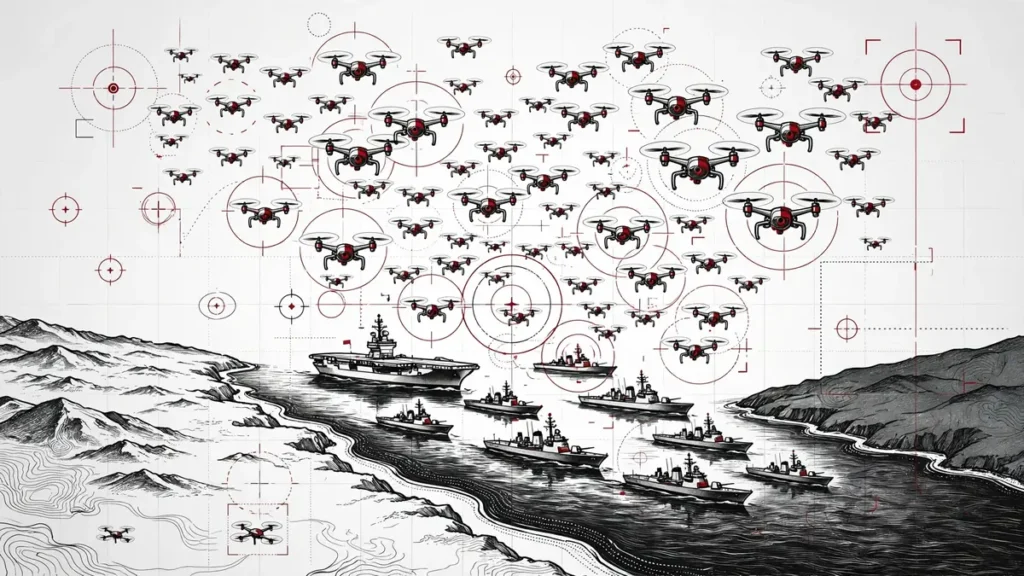
The second change is mass. Cheap, AI-guided drones could flood contested waters and airspace in numbers that make today’s missiles — designed for expensive, scarce targets — look absurdly mismatched (see our companion piece on AI drone warfare).
How are war games already testing AI in a Taiwan scenario?
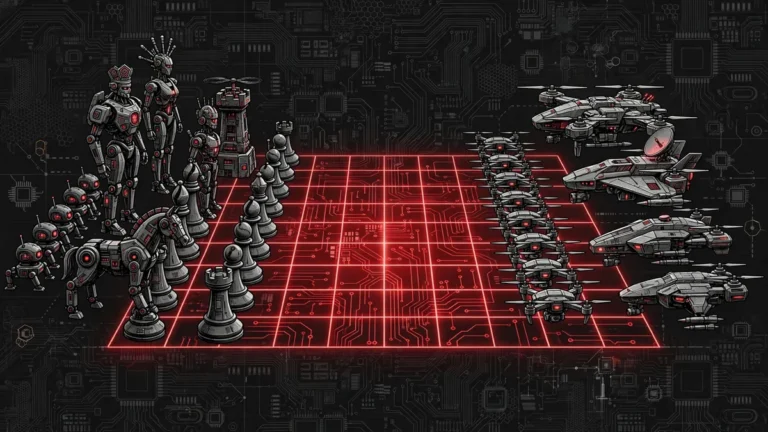
The most detailed public experiment so far is RAND’s “Camp(ai)gn” wargame, described in a 2026 RAND report. It builds on earlier conventional games — CSIS’s 2023 “First Battle of the Next War” played 24 scenarios of a hypothetical 2026 invasion and found a Taiwan/US/Japan coalition could repel it in most cases, but at staggering, World War II-scale cost. Camp(ai)gn ran ten iterations of a hypothetical 2035 conflict, played by more than 20 RAND analysts and affiliates, specifically to probe how AI-enabled autonomous systems would change campaign planning and execution.
Six observations emerged — and RAND stresses they are gameplay-generated hypotheses, not conclusions. First, autonomous systems could enable new forms of limited conflict fought mainly with robotic systems. Second, those robotic conflicts could produce escalation dynamics unlike classic great-power war models. Third, “autonomous mass” could matter most in a protracted war, possibly favoring China’s industrial base. Fourth, AI could expand a commander’s options while burying them under a heavier decisionmaking burden. Fifth, allies could gain new roles, from self-defense to coalition production. And sixth — counterintuitively — striking the adversary’s data centers is unlikely to prove an “Achilles’ heel” for AI-enabled forces.
In July 2026, CSIS put members of Congress through a newer variant focused on AI: the scenario opened with a 2027 Taiwan crisis of ambiguous intent — coercion, de facto blockade, or invasion prep — while AI-backed cyberattacks hit the transportation and logistics networks the US would need to deploy forces. As Representative Michael McCaul told participants, “Cyber is always going to be a leader in any kinetic war.”
Where would AI hit hardest: drones, cyber, space and logistics?
Break the scenario into domains and the AI fingerprints become clearer:
- Naval and air war. One possible scenario has AI coordinating unmanned surface vessels and collaborative combat aircraft that scout ahead of crewed jets, soaking up risk and extending sensor reach. Computer vision could help pick missile launches out of clutter — or be fooled by decoys, a vulnerability analysts warn about.
- Cyber. The CSIS lawmaker game treated AI-backed cyberattacks on ports, rail, and airports as a prelude to fighting, not a sideshow — designed both to disrupt deployment and to preserve access for later. AI could make such campaigns faster and more adaptive, though defenders get the same tools.
- Space. Both militaries depend on satellites for targeting and communications; AI-assisted analysis of satellite data, and AI-directed jamming or dazzling, would be central to blinding the other side’s kill chain.
- Electronic warfare. AI could retune jammers and radars in real time as the spectrum fills with hostile signals — a machine-speed duel humans cannot fight manually.
- Logistics. Moving fuel, munitions, and reinforcements across the Pacific is arguably the war’s hardest problem; AI-optimized routing and predictive maintenance could matter as much as any weapon, while AI-guided targeting of supply ships could strangle it. The broader competition driving all of this is covered in our global AI arms race explainer.
On the Chinese side, the direction of travel is explicit. In a Politburo study session in early August 2026, Xi Jinping told the PLA to intensify the military application of artificial intelligence and unmanned systems and build toward an “intelligent military system” — the “intelligentization” doctrine tied to the force’s 2027 centenary targets. A Reuters investigation in July 2026 found PLA-linked researchers using outputs from leading American AI models via “model distillation” to train domestic defense systems — leveraging US models as a shortcut despite export controls. The US response runs through the competition described in our US-China AI arms race coverage.
Could semiconductors and compute decide the war before it starts?
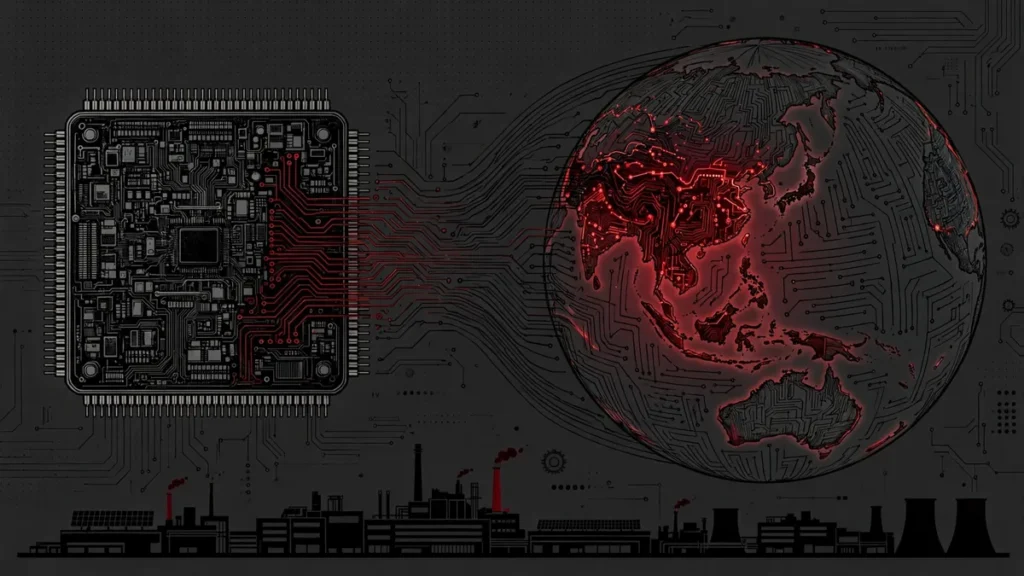
There is a front in this hypothetical war that requires no shooting at all: the chips. Taiwan’s TSMC manufactures more than 90% of the world’s most advanced logic semiconductors (below 7 nanometers) and holds roughly two-thirds of the global foundry market, according to TrendForce figures cited in a February 2026 risk briefing — supplying Apple, NVIDIA, AMD, and Qualcomm, and thereby powering the entire AI boom. Bloomberg Economics has estimated that a Chinese invasion of Taiwan would cost the global economy approximately $10 trillion, roughly 10% of world GDP.
That makes the chip supply chain both a deterrent and a target. In January 2026, the US and Taiwan struck a deal aimed at moving chip production to America, with Commerce Secretary Howard Lutnick stating a goal of relocating 40% of Taiwan’s semiconductor supply chain — a target analysts called unrealistic before 2030, given Taiwan’s “N-2 rule” keeping its most advanced nodes at home. TSMC’s CEO C.C. Wei told analysts in April 2026 that “AI-related demand continues to be extremely robust” — the same demand that makes the island’s fabs the most valuable real estate in any conflict scenario.
AI, Taiwan and a hypothetical war: by the numbers
| Metric | Figure | Source |
|---|---|---|
| RAND Camp(ai)gn wargame iterations (hypothetical 2035 Taiwan conflict) | 10, with 20+ players | RAND, 2026 (CONFIRMED) |
| CSIS 2023 Taiwan invasion scenarios played | 24; coalition repelled invasion in most | CSIS, Jan 2023 (CONFIRMED) |
| Estimated Chinese personnel losses in CSIS scenarios | ~22,000 | CSIS, Jan 2023 (REPORTED — scenario output, not fact) |
| TSMC share of world’s most advanced logic chips (sub-7nm) | Over 90% | TrendForce via Meridian Risk Intel, Feb 2026 (CONFIRMED) |
| Bloomberg Economics estimate: global cost of a Taiwan invasion | ~$10 trillion (~10% of world GDP) | Bloomberg Economics (REPORTED — model estimate) |
| US goal for relocating Taiwan’s chip supply chain | 40% | Commerce Secretary Lutnick, Jan 2026 (CONFIRMED statement; analysts call target unrealistic before 2030) |
| Chinese academic papers/patents reviewed showing US-model distillation by PLA-linked researchers | 80+ | Reuters/Jamestown Foundation, Jul 2026 (CONFIRMED) |
Caveat: war-game figures are scenario outputs, not predictions; economic figures are modeled estimates. Nothing here forecasts that a war will occur.
Why this matters beyond the battlefield
A US-China war over Taiwan would not stay in the Taiwan Strait. The semiconductor shock alone would cascade through everything from smartphones to cars to the AI data centers training the next generation of models — a $10 trillion hole in the world economy, per Bloomberg Economics’ modeling. Shipping lanes carrying a large share of global trade pass through waters that would become a war zone, and energy importers across Asia would face immediate disruption.
For readers in the US, Europe, and beyond, the nearer-term relevance is the competition already underway: export controls on advanced chips, the race to build domestic fabs, and the quiet militarization of AI research on both sides. Whether or not the nightmare scenario ever materializes, the preparations for it are reshaping technology policy, supply chains, and defense budgets today.
Frequently asked questions
Could AI decide who wins a US-China war over Taiwan?
No analyst claims certainty. AI could plausibly be decisive in specific domains — whoever sees first, decides fastest, and fields the most autonomous mass could gain real advantages — but RAND’s wargames found AI also creates new uncertainties, heavier decision burdens, and unfamiliar escalation paths. War games consistently show cost, not clean victory, as the likeliest product of such a war.
Is China ahead of the US in military AI?
It depends on the domain, and nobody outside the two militaries knows for sure. China has an explicit “intelligentization” doctrine and scale advantages in drones and robotics; the US retains advantages in high-end chips, frontier AI models, operational experience, and alliances. Claims that either side is definitively “winning” should be treated with skepticism.
Would a war over Taiwan stop AI development worldwide?
In one plausible scenario, yes — or at least severely disrupt it. With Taiwan producing over 90% of the most advanced chips, even a blockade (short of invasion) could halt the supply of cutting-edge AI hardware for a year or more. This is why both Washington and Beijing treat semiconductors as strategic assets.
Do war games predict that China will invade Taiwan?
No. War games explore what could happen under assumed conditions; they do not forecast intent or timing. Analysts war-game the Taiwan contingency because it is the most consequential hypothetical conflict, not because it is the most likely one.
Sources
- RAND: Exploring AI’s Operational Implications in a Future U.S.-China Conflict (Camp(ai)gn)
- Nextgov: Lawmakers get taste of AI-enabled cyberattacks in China-Taiwan war game
- Defense News (Reuters): Chinese military researchers tap US AI models to train defense systems
- Meridian Risk Intelligence: Taiwan Semiconductor Risk briefing (Feb 2026)
- ZeroHedge (via Bloomberg/Xinhua): Xi tells PLA to build ‘intelligent military system’
Discussion 0
Share analysis, corrections, or context. Be civil — comments are moderated.