WarBrief Live | October 2, 2026 | Explainer
A naval blockade is back in the headlines. In July 2026, the United States re-imposed a naval blockade on Iranian oil exports, and in late September US Central Command said its forces had turned back 125 commercial vessels near the Strait of Hormuz. On October 1, the US Treasury followed with new sanctions on Iran’s automotive and rail sectors — a signal that the economic pressure is now reaching the land routes Tehran uses to move oil and goods around the sea blockade. This explainer breaks down naval blockade mechanics: the international law behind them, how they are enforced ship by ship, and why they almost always leak.
Key Takeaways
- A naval blockade is a declared, enforced barrier to shipping — legally distinct from an embargo or a quarantine — and under the classic rules it must be effective, impartial, and notified to all states.
- Enforcement runs on visit and search: warships hail, board, and inspect merchant vessels, then order them to turn back, divert to a friendly port, or — in a full wartime blockade — capture them.
- The US blockade of Iranian oil is being enforced through interception and redirection of commercial vessels; US Central Command reported 125 vessels turned back as of September 30, 2026.
- Blockades leak. Iran is shifting oil and goods to overland routes through its rail and trucking networks — which is exactly why Washington sanctioned Iran’s automotive and rail sectors on October 1.
What a naval blockade actually is
A naval blockade is the use of warships to prevent vessels from entering or leaving specified ports or stretches of coastline. In legal terms, a blockade is an act of war — a measure involving the use of armed force, of the kind described in Article 42 of the United Nations Charter, rather than the non-forcible economic measures like embargoes covered by Article 41.
The classic rules were written down long before modern navies existed, and their modern statement is the 1994 San Remo Manual on International Law Applicable to Armed Conflicts at Sea. It sets five conditions for a lawful blockade: it must be declared and notified to all belligerents and neutral states, specifying when it begins, where it applies, and how long it lasts; it must be effective — maintained by a force actually capable of preventing access, not merely declared on paper; it must be applied impartially to the vessels of all states; it must not bar access to the ports and coasts of neutral states; and it must allow the passage of food and other essentials for the civilian population, subject to technical arrangements such as search.
These rules were designed for wars between states. Modern maritime pressure campaigns often sit in a gray zone: states may call an operation a “blockade” while opponents call it an unlawful use of force, and lawyers argue over whether the criteria of an international armed conflict are met at all. The US operation against Iranian oil is a case in point — Washington frames it as lawful pressure on a state it holds responsible for aggression, while Tehran calls it piracy. What is not in dispute is the mechanics: warships, declared operating areas, and merchant vessels being turned back at sea.
Blockade vs embargo vs quarantine: the terms explained
The three words are often used interchangeably, but they describe different instruments with different legal footings:
| Instrument | What it does | How it is enforced | Example |
|---|---|---|---|
| Blockade | Physically prevents ships from entering or leaving ports or coasts | Warships on station; visit, search, diversion or capture of vessels | US blockade of Iranian oil, 2026 |
| Embargo | Prohibits trade in specified goods, usually by domestic law and sanctions | Port-state controls, customs, financial sanctions, vessel blacklists | US sanctions on Iranian oil exports since 2018 |
| Quarantine | A blockade by another name — a political label chosen to avoid the legal consequences of the word “blockade” | Naval interception, as with a blockade | US “quarantine” of Cuba, 1962 |
| Maritime interdiction | UN-authorized stopping and inspection of vessels to enforce sanctions | Multinational naval forces acting under a Security Council resolution | Interdiction operations against Iraq, 1990–2003 |
The distinction matters because the legal consequences differ. A blockade is a belligerent act under the law of armed conflict and triggers the rights and obligations of neutrality law. An embargo is primarily a domestic and sanctions-law instrument enforced through ports, banks, and insurance markets rather than warships. A “quarantine” was the term President John F. Kennedy chose during the Cuban Missile Crisis precisely because “blockade” was understood as an act of war — the mechanics at sea were nearly identical, but the label was meant to manage the legal and escalatory implications.
The legal mechanics: what international law requires
Under the San Remo Manual’s framework, a blockading power must do more than park ships off a coast. First, the blockade must be declared: the government establishing it issues a formal declaration specifying the commencement date, the geographic limits, and a grace period for neutral vessels to leave. Second, it must be notified to all belligerent and neutral states and to the relevant local authorities — a blockade a neutral shipowner could not have known about cannot be enforced against that shipowner’s vessels.
Third, it must be effective. A “paper blockade” — declared but not maintained by sufficient force — is not legally binding, and neutral vessels are entitled to disregard it. Effectiveness is a question of fact: is there a force present that actually renders access dangerous? Fourth, it must be applied impartially. A blockade enforced against one neutral flag but not another is unlawful. Fifth, it must not cut off neutral ports and coasts — the barrier must be drawn around the blockaded party’s waters, not stretched across international shipping lanes in a way that strangles third countries.
Humanitarian law adds a further constraint: a blockade may not be used to starve a civilian population. If the civilian population of the blockaded territory is inadequately supplied, the blockading party must allow the passage of foodstuffs and other essential supplies, subject to technical arrangements including search. The blockading power may prescribe the routes and supervise distribution — but it may not simply seal the coast and walk away.
Enforcement at sea runs on the belligerent right of visit and search. A warship may hail a merchant vessel, send a boarding party to examine its papers and cargo, and determine whether it is carrying contraband or attempting to breach the blockade. A vessel that tries to run the blockade may be captured as prize; one that resists visit and search may be treated as hostile. In practice, modern operations more often end with diversion — the merchantman is ordered to proceed to a designated port for inspection — or with a simple turn-back order, which is what US forces have been issuing to vessels approaching Iranian ports.
How the Iran oil blockade is enforced in practice
The current operation is the second wave of a campaign that began in the spring. A first blockade ran from April 13 to June 18, 2026, after US-Iran ceasefire talks in Pakistan collapsed; President Trump announced its re-imposition on July 13, and US Central Command said enforcement began on July 14. CENTCOM has described the mechanism plainly: American forces intercept or turn back vessels traveling to or from Iran’s coast, regardless of nationality, and the operation is enforced, in the command’s words, impartially against vessels of all nations entering or departing Iranian ports.
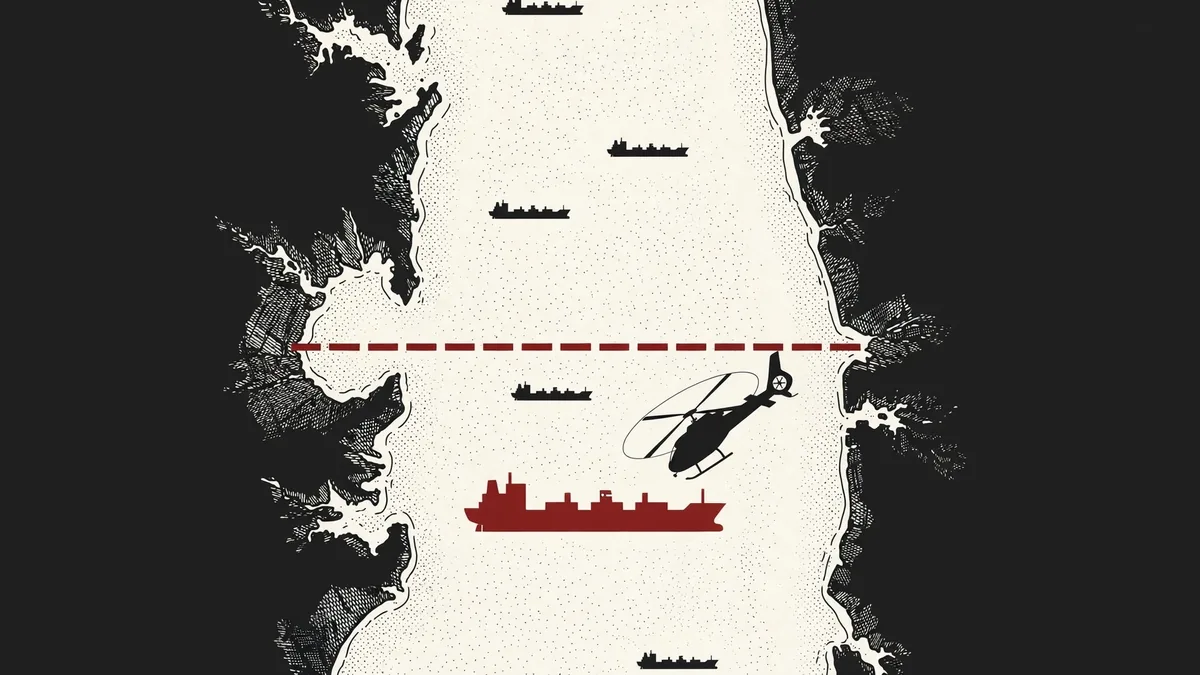
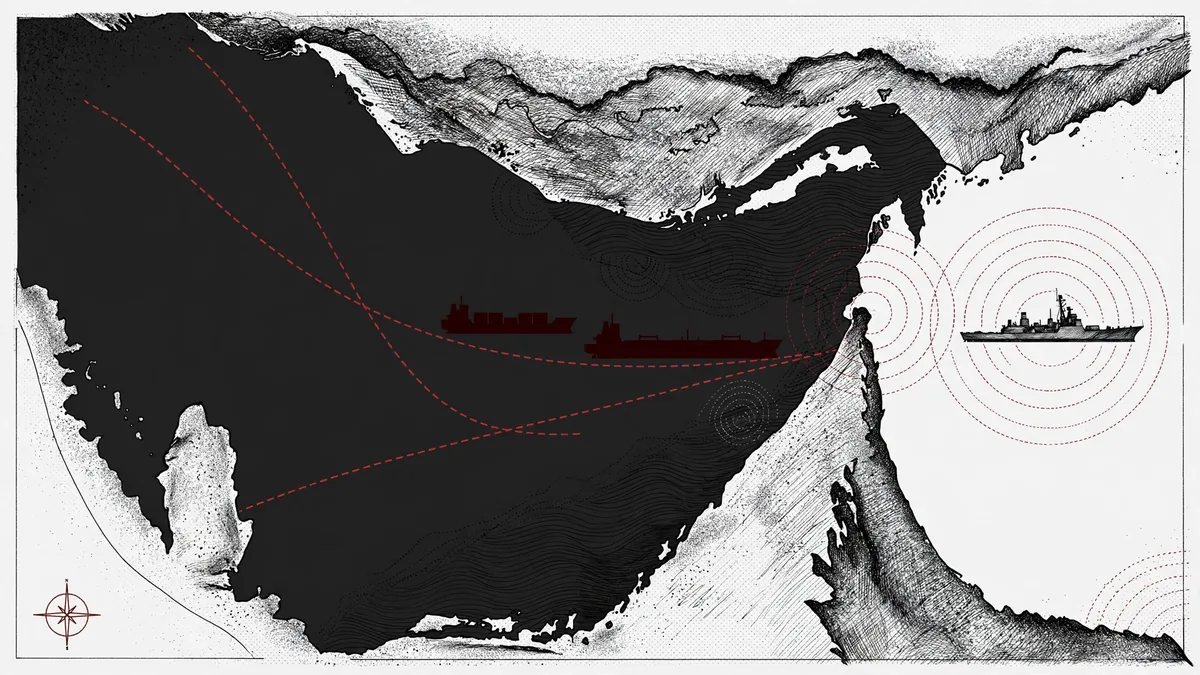
As of September 30, 2026, CENTCOM said US forces had redirected 125 commercial vessels to enforce compliance, with the USS George H. W. Bush carrier strike group operating in the Arabian Sea in support. The US military has published video of helicopters operating over tankers at sea — the visible end of the visit-and-search process. The Strait of Hormuz, the narrow waterway through which the redirected traffic funnels, remains the geographic center of the operation.
The economic effects have been swift. With seaborne oil exports — historically Iran’s main source of foreign revenue — choked off, the Iranian rial has fallen to record lows, trading at more than 2.5 million to the dollar in early October, according to the Associated Press. Iranian officials have said the Strait of Hormuz will remain closed until the blockade lifts — a retaliatory move over a waterway that carries roughly a fifth of the world’s oil, and one that has helped keep Brent crude above $103 a barrel and US diesel at record prices.
Washington is now extending the pressure beyond the sea. On October 1, the US Treasury Department sanctioned Iran’s automotive and rail sectors, designating Iran Khodro (IKCO) and SAIPA — which together account for more than 90 percent of Iran’s domestic auto market — alongside the state-owned Islamic Republic of Iran Railway Company, Raja Passenger Trains, and a major private freight line, plus foreign auto-industry suppliers in Indonesia, the UAE, and Turkey. The action, part of a campaign Treasury calls “Operation Economic Outcast,” targets the land routes Iran is using to move petroleum, fertilizer, and chemicals as the sea blockade bites. Read our sanctions hub for the full picture of how the sanctions architecture around Iran is built.
Treasury Secretary Scott Bessent said the October 1 action “directly targets Iran’s enablers and lays the groundwork for the United States and our partners to drain the regime’s revenue once and for all.” (Reuters, October 1, 2026)
Why blockades leak: the land-corridor workaround
No blockade in history has been airtight, and the reason is geography. Iran shares land borders with seven countries — including Iraq, Turkey, Armenia, Azerbaijan, Turkmenistan, Afghanistan, and Pakistan — and it has spent years building overland trade corridors precisely to reduce its dependence on sea routes. Oil and goods barred from the Strait of Hormuz can move by truck and rail: eastward toward Pakistan and Central Asia, northward through the Caucasus, and westward into Iraq and Turkey.
This is the classic blockader’s dilemma. A naval blockade controls the sea, but every coastline ends at a border. Blockaded states historically respond by rerouting through neutral neighbors — Iraq did it through Jordan and Turkey during the 1990s sanctions era; North Korea does it through its land border with China today. The workaround is slower and more expensive than sea transport, which is exactly the point: the blockade does not need to stop every barrel to succeed. It needs to raise the cost of every barrel until the economics break.
That is also why the October 1 Treasury sanctions matter operationally, not just symbolically. By designating Iran’s major automakers and its national railway, the United States is signaling that the land corridors are now part of the target set. Sanctioning IKCO and SAIPA constrains the truck and vehicle fleets that move goods overland; sanctioning the railway constrains bulk rail freight. The campaign is shifting from a sea blockade to a full-spectrum trade squeeze — and Iran’s response, from currency controls to barter arrangements with neighbors, will determine how long the pressure takes to bite. For the wider shipping picture, see our conflict zones hub.
Blockades in history: what past cases teach
The mechanics described above are not theoretical. The US “quarantine” of Cuba in October 1962 showed how a declared naval barrier, backed by visit and search, could force a superpower confrontation to a negotiated outcome without a shot fired between the fleets — though it brought the world closer to nuclear war than any event before or since.
The maritime interdiction operation against Iraq from 1990 to 2003, authorized by UN Security Council resolutions, demonstrated the long game: a multinational naval force stopped and inspected thousands of vessels over thirteen years, strangling Iraq’s oil exports and weapons imports while humanitarian exemptions for food and medicine became a political battlefield of their own.
More recently, the Saudi-led coalition’s restrictions on Yemen’s ports showed the humanitarian edge of the instrument: blockades that impede food and fuel can immiserate civilian populations quickly, which is why the San Remo rules on humanitarian passage exist — and why their enforcement remains one of the most contested questions in the law of naval warfare.
The lesson across all three cases is consistent: blockades work slowly, leak constantly, and impose costs on everyone — the blockaded state, neutral shipping, and the blockading power’s own diplomacy. They are instruments of attrition, not decision.
What to watch next
Three indicators will show whether the Iran blockade is tightening or fraying. First, the vessel count: if CENTCOM’s redirected-vessel figure keeps climbing, the sea barrier is holding; if commercial traffic to Iranian ports resumes, enforcement is slipping. Second, the rial: the currency is the real-time scoreboard of Iran’s economic pain, and further record lows would signal that the land corridors are not compensating fast enough.
Third, the diplomacy. US-Iran talks in Pakistan collapsed without a deal, and Washington is reportedly deploying additional forces — including a third aircraft carrier — to the region. Iran says the Strait of Hormuz stays closed until the blockade lifts. A blockade is leverage, and leverage only matters if it is spent at a negotiating table. Watch for whether the pressure produces talks — or produces the miscalculation that blockades, throughout history, have always risked.
Frequently asked questions
Is a naval blockade an act of war?
In legal terms, yes. A blockade is a use of armed force of the kind described in Article 42 of the UN Charter, lawful only in individual or collective self-defense or under UN Security Council authority. That is why President John F. Kennedy called the 1962 Cuba operation a “quarantine” rather than a blockade: the mechanics at sea were nearly identical, but the label was chosen to manage the legal and escalatory consequences.
What is the difference between a blockade and an embargo?
A blockade physically prevents ships from entering or leaving ports, enforced by warships at sea. An embargo prohibits trade in specified goods, enforced through domestic law, customs, financial sanctions, and vessel blacklists rather than warships. The two are often used together: the United States pairs its naval blockade of Iranian oil with sweeping Treasury sanctions on the sectors that could work around it.
What happens to ships that try to run a blockade?
A warship may hail the vessel, send a boarding party to examine its papers and cargo, and order it to turn back or divert to a designated port for inspection. In a full wartime blockade, a vessel that persists may be captured; one that resists visit and search may be treated as hostile. In the current Iran operation, US forces have opted for the milder end of the spectrum: CENTCOM reports vessels being redirected to ensure compliance.
Can a blockading power stop ships from any country?
Yes — and under the San Remo Manual it must do so impartially: a blockade has to be applied to the vessels of all states, not just the blockaded country’s flag. CENTCOM has said the Iran blockade is enforced against vessels of all nations entering or departing Iranian ports, which is why neutral-flagged tankers have been among the 125 vessels redirected.
Sources
- Reuters: US sanctions target Iran’s auto, rail sectors after blockade chokes shipping lanes (October 1, 2026)
- Washington Examiner: Treasury Department targets Iran automotive, railway sanctions (October 1, 2026)
- Dimsum Daily: US Navy redirects 125 commercial vessels amid Iran blockade (October 1, 2026)
- Associated Press (via Seoul Economic Daily): Iranian prices jump fivefold as war and sanctions squeeze (October 1, 2026)
- US Naval War College: San Remo Manual on International Law Applicable to Armed Conflicts at Sea
- The Maritime Executive: Defusing the Cuban Missile Crisis — naval quarantine for de-escalation
- GlobalSecurity.org: Maritime Interception Operations